Niu Lai Explained: Why China's "Worst Animated Film" Went Viral

- Niu Lai (《牛来》) took ¥7,705 — about $1,150 — in its first ten days, from 236 tickets sold in the whole of China. Six days later it had passed ¥32.7 million. Screenings went from 4 in the entire country on 14 August to 22,000 a day on 19 August.
- It was made by two people over five years with no outside investment. The director, Xin Yumeng, is a landscape design graduate who had never studied animation and built the film on second-hand home computers. His mother, Sun Lifang, wrote it, voiced it and — having never studied music — learned to compose and sing the closing song.
- The Douban average of 5.9 is misleading. 37.8% of ratings were one star and 35.8% were five. Chinese viewers nicknamed the shape 牛角, ox horns.
- The film was NOT pulled nationwide. That rumour circulated on 16 August and was checked and denied by cinemas in several provinces. Cinemas in Dalian, where the production company is based, did withdraw it — by their own choice, reportedly over concern for the city’s image.
- Allegations of money laundering and of milking a provincial arts subsidy have been raised and answered. Industry figures pointed out there is no external capital and no holding structure to launder through, and there is no public record of a subsidy application.
For its first ten days in Chinese cinemas, Niu Lai sold 236 tickets in the entire country and took ¥7,705 — about $1,150. By 14 August it was down to four screenings nationwide.
Six days later it had passed ¥32.7 million, and was playing on 22,000 screens a day.
Nothing about the film changed. What changed was that people found out how bad it was.
What is Niu Lai?
Niu Lai (《牛来》, roughly “the ox comes”) is an 86-minute Chinese 3D animated feature released in mainland cinemas on 5 August 2026. It follows a calf of that name growing up in harsh country — most of it framed as a dream — alongside a skylark, a snake the calf nicknames “little rope-end”, and a leopard called Bao La who protects the herd and is distrusted for it. The calf’s mother sacrifices herself to wolves so he can escape.
The story is a conventional one about courage, friendship and loss. The animation is not. It is low-polygon 3D of the kind associated with home computers rather than studios, and the single ink-wash poster released before the film opened looked nothing like the footage.
Who made Niu Lai?
Two people, over five years, with no outside investment: the director Xin Yumeng and his mother Sun Lifang, who between them handled the directing, animation, writing, music and voice acting.
Xin Yumeng (信雨萌) directed, produced and animated it. He is a landscape design graduate with no animation training who had previously worked in interior decoration and BIM — building information modelling. In a pre-release podcast interview with a Dalian children’s radio station, later surfaced by Ifeng, he described the transition in one line: he used to build with bricks, and now he builds with polygons. He assembled the film on second-hand home computers bought on Xianyu, China’s used-goods marketplace.
Sun Lifang (孙丽芳), his mother, wrote the screenplay. She had never studied screenwriting or music. She also composed and sang the closing song, having learned to do both from scratch, and both of them voiced the characters.
The title came from timing and superstition: preparation started in 2021, a Year of the Ox, and the director’s father was also born in an ox year.
There is one more detail that matters more than it first appears. According to the distributor, speaking to Jiangsu Television’s Litchi News, they watched the finished film and tried to talk Xin out of releasing it. He insisted, applied for the licence, and got it — the film’s public screening permit was issued in 2024, two years before it reached cinemas. It then opened what Chinese coverage calls 裸映, a “naked release”: one poster, no marketing, no press.
How did it go from ¥7,705 to ¥32 million?
By being seen, mocked, and then sought out. Audiences who went out of curiosity filmed clips off the cinema screen, the clips spread, and cinemas added showings to meet demand that no distributor had created — screenings rose from four nationwide on 14 August to 22,000 a day by 19 August.
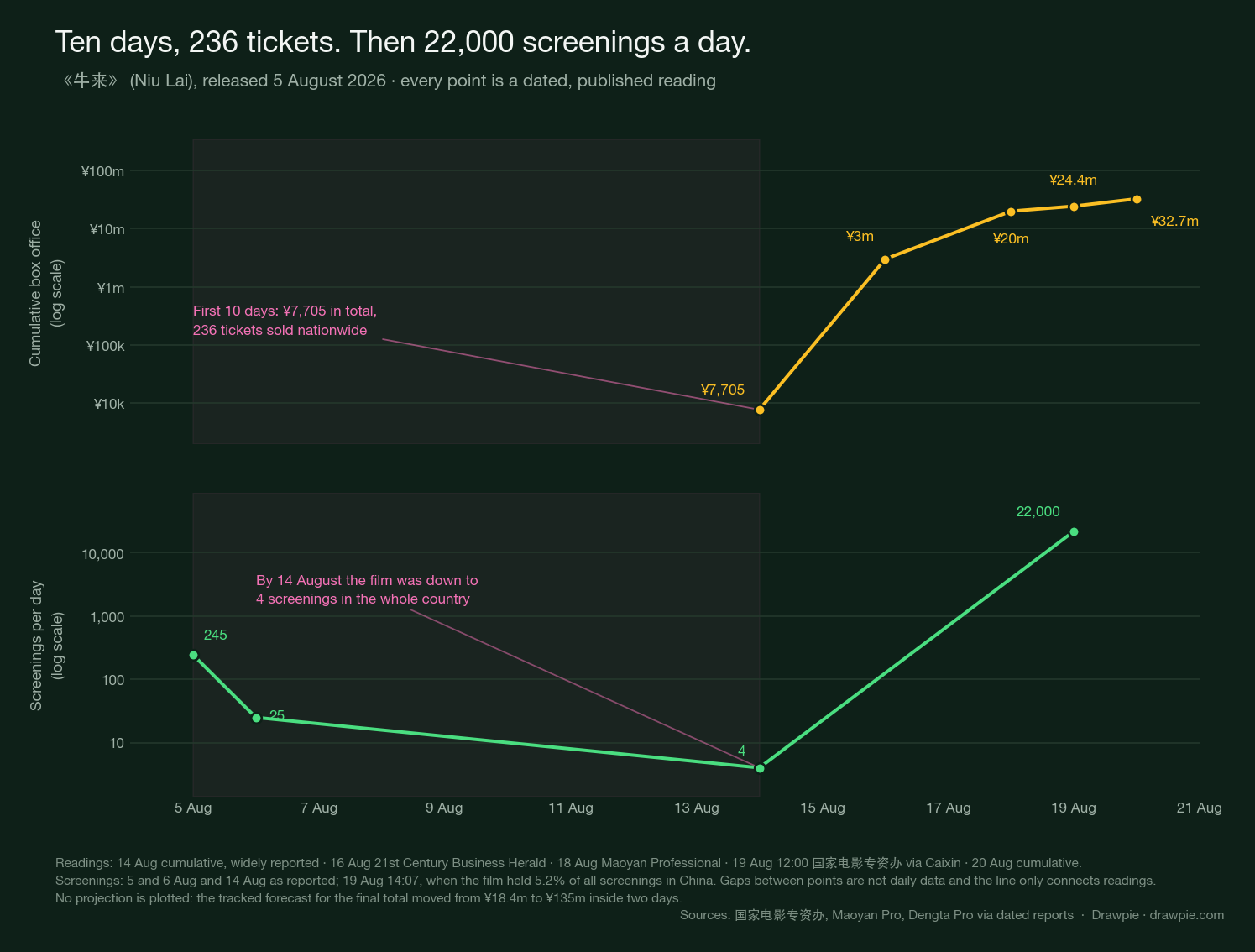
The collapse in the second panel is the part worth sitting with. The film opened on 245 screenings, fell to 25 the next day, and reached 14 August on four. At that point it had earned less than the price of a used car.
What followed was not a marketing campaign, because there was nobody to run one. Cinemas were responding to demand that had assembled itself: by 16 August screenings were up more than 1,900 times over, and by 19 August the film held 5.2% of every screening in China — a share normally occupied by a summer tentpole.
The takings followed:
| Date | Cumulative box office | Note |
|---|---|---|
| 5–14 Aug (first 10 days) | ¥7,705 | 236 tickets nationwide |
| 15 Aug | ¥46,000 in a single day | Cinemas begin adding showings |
| 16 Aug | ¥3 million | Screenings up more than 1,900× |
| 18 Aug | ¥20 million | |
| 19 Aug, 12:00 | ¥24.41 million | State film fund office figure |
| 20 Aug, 20:14 | Passed ¥30 million | |
| 20 Aug | ¥32.74 million | About $4.9 million |
On day 12 it entered the top ten highest-grossing domestic Chinese animated films of 2026. At some cinemas it was outselling The Odyssey .
What does the Douban score actually say?
That two completely different films were watched. The 5.9 average is the midpoint of a split, not a verdict: 37.8% of raters gave Niu Lai one star and 35.8% gave it five, so nearly three quarters of everyone who scored it sat at one extreme or the other.
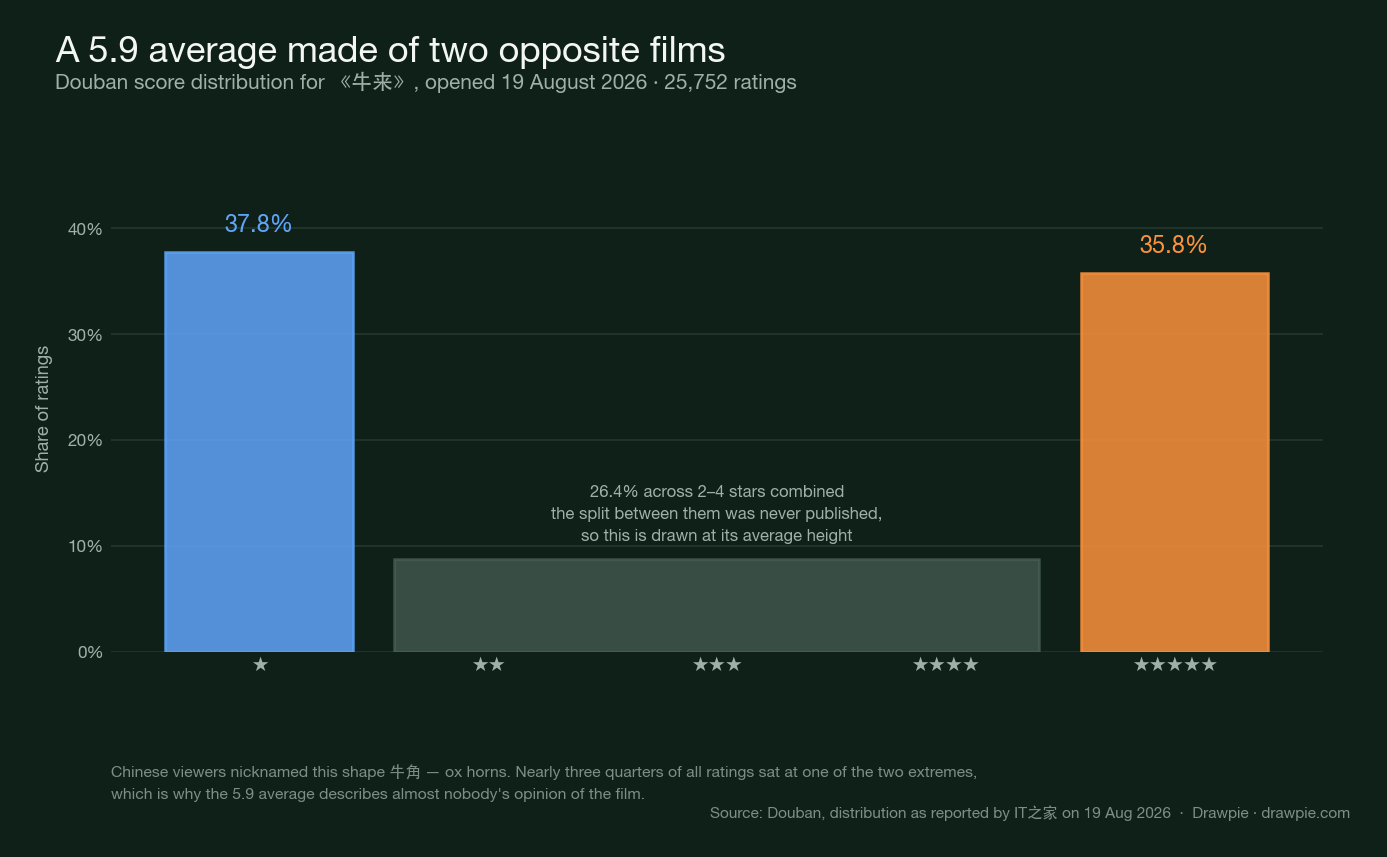
Douban opened scoring on 19 August, and the film settled at 5.9 from 25,752 ratings. Chinese viewers named the shape those ratings make 牛角 — ox horns — and the nickname is the clearest description anyone has offered of what the number hides.
Some of the five stars were sincere and some were a joke, and there is no way to separate them. Chinese reporting noted that ironic praise outnumbered straightforward negative reviews, which is its own kind of data point.
Why did the title make stock investors buy tickets?
Because 牛来 can be read as “the bull is coming”, and 牛市 is Chinese for a bull market.
The pun was not intended — the name came from the Year of the Ox — but it was seized on immediately. Some outlets called Niu Lai the film every A-share investor had to see this year, purely on the strength of the title being a good omen, and Chinese coverage credits that reading with pulling in a measurable number of ticket buyers.
It is worth being precise about what that is and is not. It is a fact about why some people bought cinema tickets. It is not information about any market, and nothing in a film title tells you anything about one.
Was Niu Lai pulled from cinemas?
Not nationally, and this is the most widely repeated wrong claim about the film.
On 16 August, screenshots circulated claiming all screenings would stop from 17 August and that authorities in Dalian had ordered a full withdrawal. Reporters checked. Cinema managers in Shandong, Jiangsu and Anhui said they had received no such notice. Tickets in Shanghai, Guangzhou and Chengdu were still on sale a week ahead. One manager pointed out the screenshot carried no official document.
What did happen is narrower and stranger. In Dalian — the city where the production company is registered — cinemas removed the film from 15 August. Their reasons varied: one said the film seemed controversial and they could not screen it, others gave no explanation, and one worker said plainly that it had been made by locals and they were worried about the city’s image.
The director then posted that his theatrical run was “officially concluded”, thanked the audience, said there was a great deal about the work worth improving, and added that simply completing the release process and getting onto a cinema screen had already fulfilled the ambition he set out with.
The box office roughly tripled after he said that.
Was it a money-laundering or subsidy scheme?
That was alleged, and it was answered. Accusations of money laundering and of extracting a Liaoning provincial arts subsidy spread as the takings climbed; industry figures rejected the mechanics, no regulator has announced an investigation, and there is no public record that any subsidy application was ever filed.
The mechanics are the part worth understanding. Laundering money through a film requires large cash flows, layers of related-party companies and inflated declared production costs — and Niu Lai is a single micro-enterprise with no external capital, no holding structure and nothing to inflate. On the subsidy point, Liaoning’s 2023 film support policy does allow qualifying films to apply for up to ¥1 million, but the money is not automatic: it is paid after review against verified production costs, and an unverifiable ¥1,680 budget is a poor foundation for a claim of that size.
The allegations are recorded here because they were a real part of the story. Nothing about them has been established.
Why do people keep calling this an anti-AI story?
Because of who made it, and how. Once it emerged that two untrained people had spent five years building the film by hand on second-hand computers, with a mother learning to compose and sing so it would have a closing song, much of the Chinese conversation turned from mockery to something closer to protectiveness.
The most common early complaint was that the film looked worse than something an AI would generate — which turned out to be the setup rather than the verdict. BBC Chinese reported the reversal and the nickname that came with it: “AI 时代的遗珠”, a pearl the AI era left behind. The phrase “the Niu Lai end credits song is good” trended on Weibo.
One viewer interviewed by the BBC put the appeal in a way that no amount of production value competes with: people are exhausted by grand narratives and polished technique that they cannot participate in, and this was something they could join with their own hands and minds. Another was blunter — it is good because it is genuinely bad enough to be a delight.
An academic paper in a Chinese cultural studies journal reached for a term netizens had already coined: 活人感, roughly “the sense of a living person”. The argument is that audiences stopped evaluating the object and started perceiving the people behind it — their limits, their five years, their obvious lack of anything to hide behind. That is not something a polished film reliably offers, and it is not something a generated one can.
What are Chinese critics actually saying?
Sharply divided, and along more interesting lines than good-versus-bad. Some critics defended the film’s unguarded amateurism as something Chinese cinema rarely offers; others called it a non-product that professionals could not fail to make this badly; state media told cinemas to act as gatekeepers; and several commentators argued the whole phenomenon says more about audiences than about the film.
In favour. The intellectual historian Xu Jilin wrote that he had assumed the appeal was simple enjoyment of ugliness, then watched clips and the closing song and was disarmed by what he called a primitive, coarse innocence — something he said has become very rare on Chinese cinema screens. The animation director Zhou Shengwei drew a distinction he thought mattered: most notorious bad films fail because of their makers’ self-regard, while this one radiates a plain exhaustion and powerlessness that young working audiences recognised. He expects it to become “a cult classic for Gen Z”, and compared it directly to The Room and The Rocky Horror Picture Show.
Against. The animation director Wang Yunfei was dismissive on professional grounds: it never became a product at all, and a trained team could not fail this badly by accident. He treated the phenomenon as spectacle-seeking. The state-run Beijing News criticised the film as shoddy and called on cinemas to act as gatekeepers. An essay in Hong Kong’s HK01 argued the success is an attention-economy failure mode, and that celebrating it amounts to a populist mockery of an entire industry’s professionalism. Others worried about bad money driving out good — that studios would learn to chase notoriety rather than quality.
Deflating it. Hu Xijin, formerly editor-in-chief of the Global Times, said the internet had simply amplified a coincidence and that it would neither start a trend nor displace mainstream taste. The Paper landed in a similar place: audiences have seen too many polished works, this is a rebellion against that, and it is one unusual sample rather than a manufactured industry problem.
There was also a casualty. Cui Jingxuan, who directed a film released in the same window, said publicly that he could not make sense of it and would stop making films for cinemas.
What happens to Niu Lai now?
Three things are already visible: it has become raw material for everyone else, it has created a copyright problem that nobody is enforcing, and its director has a second feature in production.
It has become raw material. Derivative works — Ma Lai, Gou Lai, Ao Niu — spread across Chinese platforms, and the style was picked up by accounts including CCTV.com, China Eastern Airlines and People’s Daily’s Douyin account, which used the ox for a road-safety video. Cinemas began hand-drawing their own posters. Plush toys appeared on e-commerce platforms.
There is a copyright problem nobody is enforcing. Much of the footage that made the film famous was filmed off cinema screens, which Chinese lawyers quoted by Modern Express describe as infringing reproduction rights, with uploading it a further infringement of network dissemination rights — potentially actionable even where no money is made. Lawyers have raised similar concerns about the derivative works. The producers have said nothing about any of it.
And there is a second film. In the same pre-release interview, Xin Yumeng said his next feature, Yang Gao (《羊高》), is already in production.
What this article cannot tell you
How much the film really cost. ¥1,680, ¥94,000 and ¥160,000 are all in circulation and they measure different things. Nobody has published accounts.
How many of the five-star reviews were sincere. The Douban distribution records what people clicked, not what they meant.
Where the box office ends. The tracked forecast for the final total moved from ¥18.4 million to ¥135 million inside two days, which is a good indication of how much anyone knows. This page reports what has been taken, not what will be.
Sources
| Source | Used for |
|---|---|
| Chinese Wikipedia — 牛来 | Plot, credits, production company history, screening licence number, release chronology, screenings counts, and the collected critical response |
| Caixin, 19 August 2026 | The ¥24.41 million figure from 国家电影专资办 at 12:00 on 19 August, and the estimated producer share of ¥7.71 million |
| IT之家, 19 August 2026 | The Douban distribution: 37.8% one star, 35.8% five stars, citing Maoyan Professional for box office |
| Sina Finance, 19 August 2026 | The 5.9 score from 25,752 ratings, and the 牛角 nickname for the distribution shape |
| 21st Century Business Herald, 16 August 2026 | ¥3 million cumulative and the 1,900× increase in screenings |
| Kuai Technology, 16 August 2026 | The nationwide-withdrawal rumour, the cinema responses that contradicted it, and the Dalian situation |
| Sohu, August 2026 | The money-laundering and Liaoning subsidy allegations, the industry response, and the ¥1 million policy ceiling |
| Frankfurter FX reference rates, 20 August 2026 | The ¥6.72 conversion rate, cross-checked at ¥6.75 against a second source |
How we verified this
Every box office figure here carries the date and hour it was read, because during the spike this film was earning millions of yuan a day. Reports published on 16 August variously give ¥3 million, ¥4 million and ¥5 million as the cumulative total — all of them plausibly correct at different hours of the same day. Figures without a timestamp were not used.
🔴 The two sources every Chinese outlet cites cannot be read directly, and nothing here pretends otherwise. Maoyan Professional (猫眼专业版) and Dengta/Lighthouse Professional (灯塔专业版) are the industry-standard trackers; both are JavaScript applications behind a login, and the data endpoints tried returned 404 or an empty shell. So every tracker figure below is attributed to a dated report that credits them, never to a reading taken here. The exception is the ¥24.41 million figure, which comes from 国家电影专资办, the state film fund office, via Caixin — that is the state’s own box office accounting rather than a commercial tracker, and it is the most authoritative single number on this page.
⚠️ The opening ten-day total is reported four different ways and this page says so rather than picking one silently. ¥7,169 (nine days, 236 tickets), ¥7,352, ¥7,705 and ¥7,711 all appear in Chinese coverage, depending on the cut-off and whether pre-sales are counted. ¥7,705 for the first ten days is the most widely carried and is what is used, with the spread noted here.
🔴 The production budget is contested and no single figure is presented as fact. A widely circulated Chinese figure of ¥1,680 covers materials and censorship submission fees only. Chinese estimates including imputed labour run to about ¥160,000. English-language coverage has settled on “$14,000”, which converts to roughly ¥94,000 — a number that sits inside that contested range rather than resolving it. All three are given, none is endorsed.
⚠️ A headline claiming People’s Daily had “named” the film turned out to mean the opposite of what it sounds like. The article beneath it says People’s Daily’s Douyin account used the film’s ox to make a road-safety video — state media joining the meme, as CCTV.com and China Eastern Airlines also did, not a rebuke. The rebuke that did happen came from Beijing News, separately, and is reported as such.
⚠️ The “pulled from cinemas nationwide” claim is a rumour that was checked and failed. Screenshots on 16 August claimed all screenings would stop from 17 August. Cinemas in Shandong, Jiangsu and Anhui said they had received no notice; tickets remained on sale a week ahead in Shanghai, Guangzhou and Chengdu. Dalian is the real and separate story and is reported on its own terms.
The money-laundering and subsidy allegations are reported as allegations, with the response, and with what is not known. No regulator has announced an investigation, no finding has been published, and there is no public record of a subsidy application having been filed. Nothing here asserts wrongdoing.
🔴 This article takes no view on the Chinese stock market. The film’s title is a pun that investors read as “the bull is coming”, and that pun demonstrably sold tickets, which is why it appears here. That is a fact about ticket sales. It is not a market signal, and this site does not publish market forecasts of any kind.
Currency conversions use ¥6.72 to the US dollar, the rate on 20 August 2026, cross-checked against a second independent source at ¥6.75. Yuan is the real figure throughout; dollars are approximate.