Nigel Farage and Reform UK: Polls, Policies, Immigration, Tax & the Route to Number 10

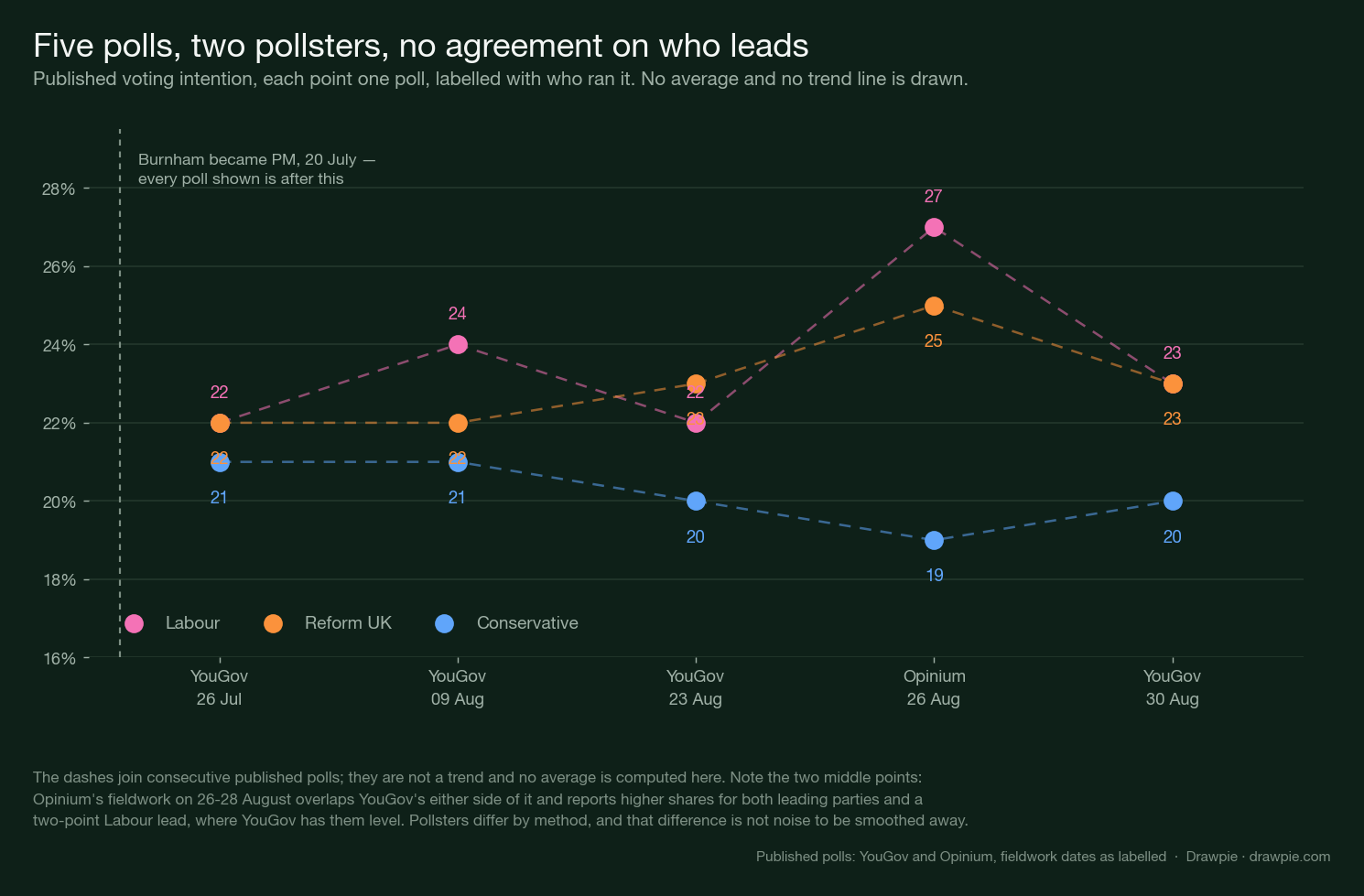
- Across five published polls from 26 July to 31 August 2026, Reform UK ranged from 22% to 25% and Labour from 22% to 27%. The two were level in two of the five.
- The pollsters disagree with each other. Opinium’s fieldwork on 26–28 August overlapped YouGov’s on either side and produced higher shares for both leading parties and a two-point Labour lead, where YouGov had them level.
- Andy Burnham has been prime minister since 20 July 2026, and every poll on this page was taken after that. This is not a before-and-after.
- On leader ratings Opinium recorded Burnham at net +14, the highest of those tested, and Farage at net −23, the lowest — though Farage improved five points on the previous wave. On best prime minister the split was 43% to 24%.
- Farage held Clacton on 13 August with 63.34%, but the arithmetic matters: Labour, the Conservatives, the Liberal Democrats and the Greens all declined to stand. His own vote rose by 1,014 while turnout fell by 10,847.
- The next general election is not required until 2029. The last was in July 2024 and the maximum parliamentary term is five years.
- This page publishes no forecast, no probability and no betting or prediction-market price for any outcome.
Reform UK has polled between 22% and 25% over the last six weeks, and in two of five published polls it was level with Labour. What that means for the question in the headline is more complicated than either the party’s supporters or its opponents usually allow, and a lot of it comes down to a calendar.
This page reports what has been published and what the rules require. It contains no forecast, no probability and no betting price.
Where the polling actually stands
| Pollster | Fieldwork | Lab | Ref | Con | Grn | LD |
|---|---|---|---|---|---|---|
| YouGov | 26–27 Jul | 22 | 22 | 21 | 13 | 11 |
| YouGov | 9–10 Aug | 24 | 22 | 21 | 12 | 11 |
| YouGov | 23–24 Aug | 22 | 23 | 20 | 13 | 13 |
| Opinium | 26–28 Aug | 27 | 25 | 19 | 12 | 10 |
| YouGov | 30–31 Aug | 23 | 23 | 20 | 13 | 12 |
No average is computed here, and that is on purpose. Look at the two middle rows. Opinium’s fieldwork on 26–28 August sits between two YouGov polls and reports higher shares for both leading parties and a two-point Labour lead, where YouGov has them level three days later.
That is a house effect — pollsters differ in how they weight, prompt and turnout-filter — and it is not noise to be smoothed away. It is the reason a single poll headline should never be read as the state of the nation.
One thing this chart cannot show you. Andy Burnham became prime minister on 20 July 2026, and every poll here was taken after that. This is a picture of the position under the new prime minister, not a before-and-after of the change.
The leader ratings, which are a different question
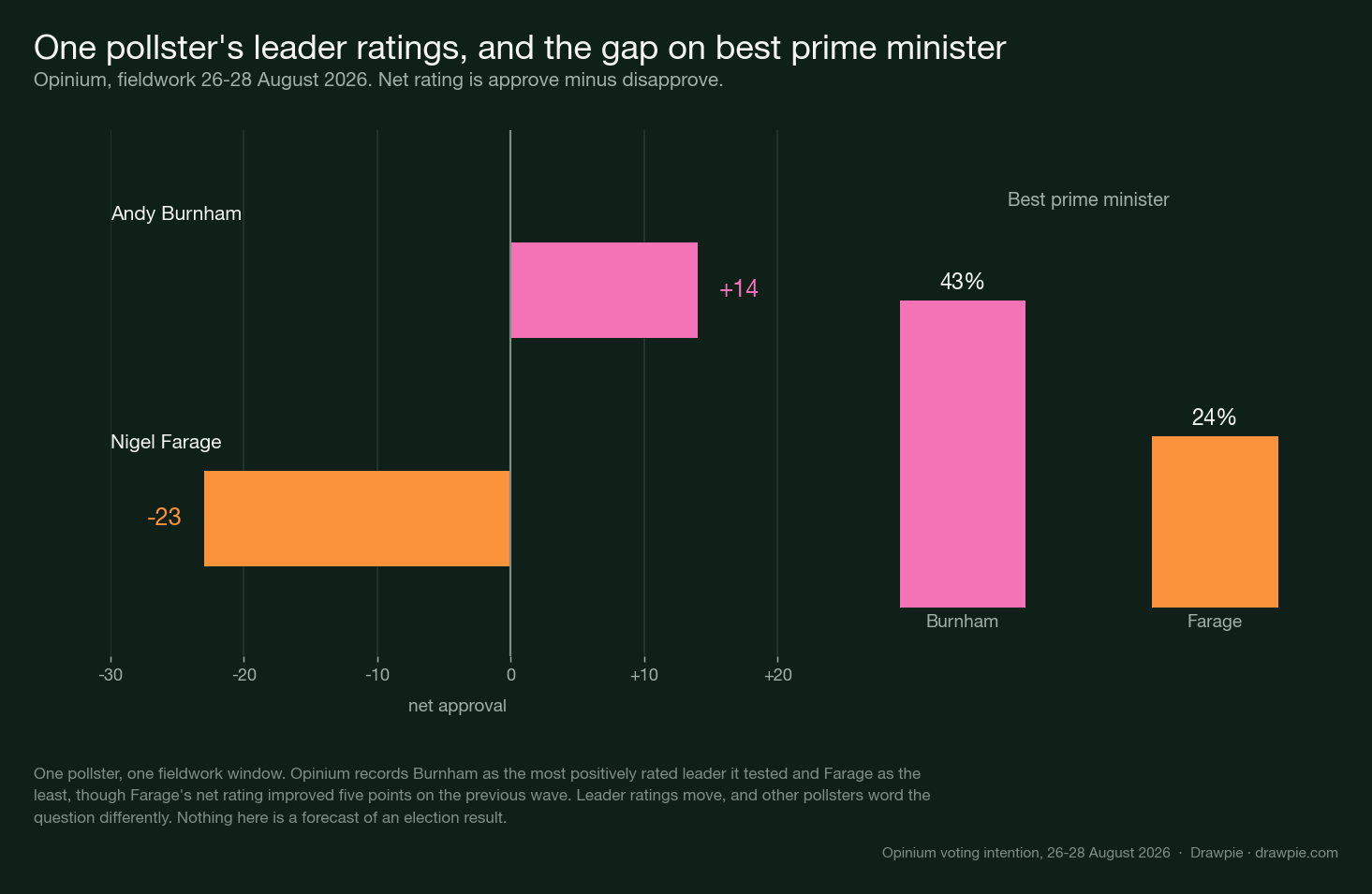
Voting intention and personal ratings often diverge, and here they do.
| Opinium, 26–28 August 2026 | |
|---|---|
| Burnham, net approval | +14 (up 3) |
| Farage, net approval | −23 (up 5) |
| Best prime minister: Burnham | 43% |
| Best prime minister: Farage | 24% |
Opinium recorded Burnham as the most positively rated of the leaders it tested and Farage as the least — while Reform sat within two points of Labour on voting intention in the same poll.
Both numbers moved in Farage’s favour. His net rating improved five points on the previous wave. A −23 that is improving is a different fact from a −23 that is not, and this page does not claim to know which continues.
This is one pollster and one fieldwork window. Others ask the question differently.
What Clacton actually showed
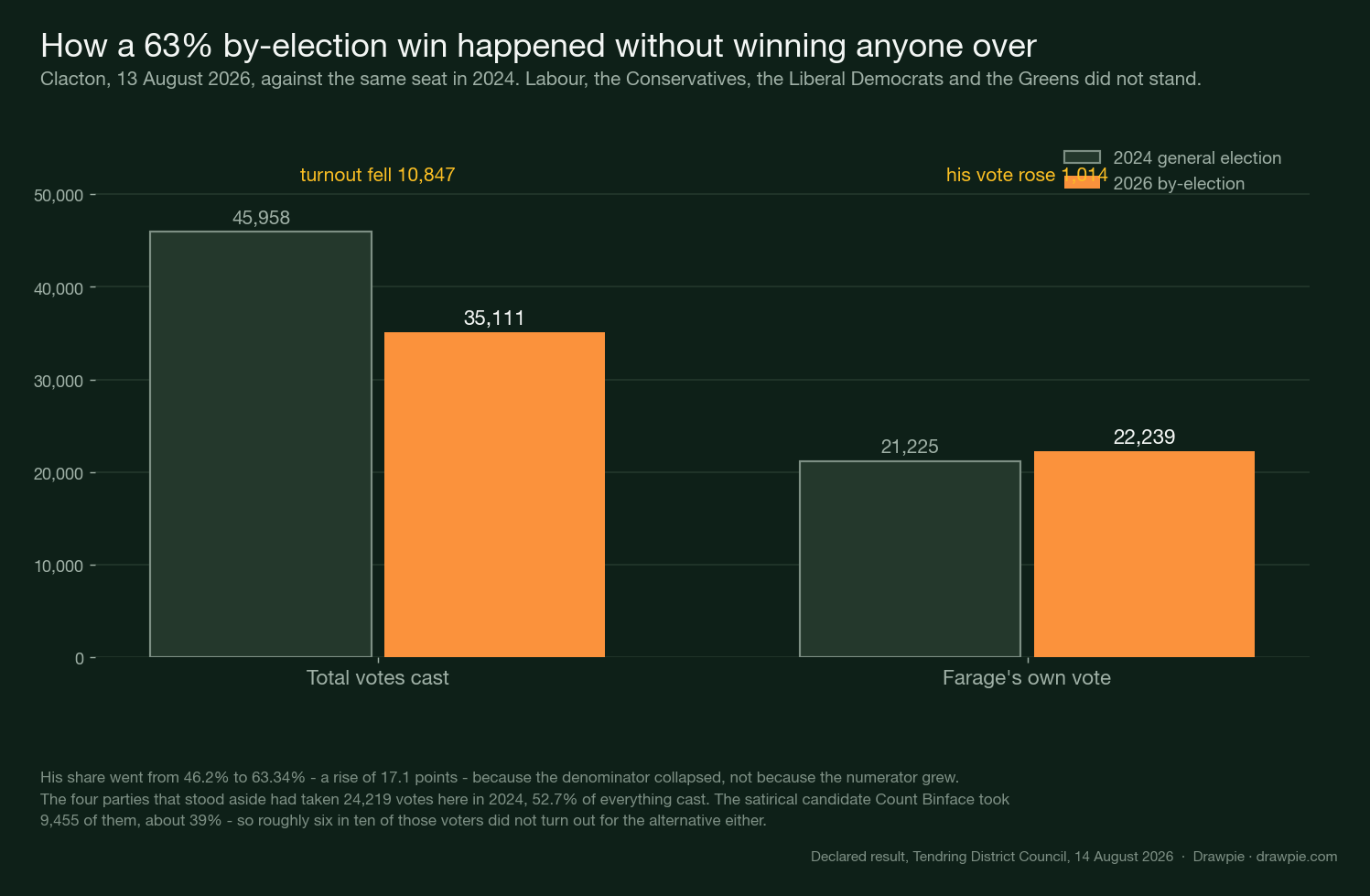
Farage held Clacton on 13 August 2026 with 22,239 votes, 63.34% — a figure that reads as overwhelming and mostly is not.
Labour, the Conservatives, the Liberal Democrats and the Greens all declined to stand. Those four had taken 24,219 votes in the seat in 2024, 52.7% of everything cast.
| 2024 | 2026 by-election | Change | |
|---|---|---|---|
| Total votes cast | 45,958 | 35,111 | −10,847 |
| Farage’s own vote | 21,225 | 22,239 | +1,014 |
| Farage’s share | 46.2% | 63.34% | +17.1 points |
His share rose 17 points because the denominator collapsed, not because the numerator grew. He added a thousand votes in a seat where nearly eleven thousand fewer people voted.
The satirical candidate Count Binface finished second on 9,455 votes, 26.93% — about 39% of the four absent parties’ 2024 vote, meaning roughly six in ten of those voters did not turn out for the alternative either. It was still the best parliamentary result of his career by a wide margin; his party’s previous best on Parliament’s records was 308 votes.
Why there was a by-election at all. The sitting MP resigned the seat and then stood for it again. The resignation came while the Parliamentary Commissioner for Standards was examining an allegation that he failed to declare a £5 million gift. Reporting notes the inquiry resumed once he was returned to the Commons, because that process can only proceed while its subject is a sitting MP.
That is a description of the mechanism and of an allegation under examination. It is not a finding, and no motive for the resignation is asserted here.
Can Nigel Farage become prime minister?
Nobody can answer that, and this page will not pretend to. What can be set out is what would have to be true.
First, there has to be an election. The last general election was in July 2024 and the maximum parliamentary term is five years, so one is not required until 2029 unless called earlier. Everything else is downstream of that.
Second, the arithmetic of first past the post cuts both ways. With five parties polling in double figures, a party on the low-to-mid twenties can win a great many seats or very few, depending entirely on where its vote sits. A national share does not translate into seats proportionally, and the same 23% produces wildly different outcomes depending on distribution. Seat projections exist; they are models with stated assumptions, and none is produced by this site.
Third, becoming prime minister means commanding the confidence of the Commons — in practice, leading the largest party after an election, or heading an arrangement able to command a majority.
And a fourth thing, which is where the polls above matter most. Reform is polling close to Labour on voting intention while its leader is the least positively rated of those tested by one pollster. Those two facts pull in different directions and this page does not know which dominates.
Is Reform UK leading the polls?
Not consistently, across the five polls on this page.
Reform led one of them outright — YouGov’s 23–24 August, on 23% to Labour’s 22%. It was level in two, and behind in two, including Opinium’s 26–28 August poll where Labour led by two points on higher shares for both.
The honest summary is that Reform and Labour are polling within a couple of points of each other and the answer changes depending on which pollster you read and which week.
When is the next UK general election?
It is not required until 2029.
The last was held in July 2024, and the maximum term of a Parliament is five years. An earlier election is possible — governments can seek one — but none is scheduled, and any question about who becomes prime minister has to be read against a timetable that may be three years long.
What are Reform UK’s policies on immigration and tax?
This page does not summarise them, because doing it properly needs the party’s own current published material rather than a paraphrase, and that was not read for this build.
That is a gap and it is better stated than filled badly. What this page covers is the published polling, the Clacton result and the procedural position. For policy, the party’s own platform is the primary source, and manifesto commitments from 2024 may not reflect current positions.
The bottom line
Five polls, two pollsters, six weeks: Reform between 22% and 25%, Labour between 22% and 27%, level in two of the five, and the two pollsters disagreeing with each other over the same fieldwork window.
A 63% by-election win that was mostly the other parties not turning up.
A leader whose party is within two points of the governing party and who is the least positively rated leader one pollster tested, improving.
And no election required for three years. Anyone offering you a number for the chances of any of this is offering you something this page cannot verify — which is why there isn’t one here.
Polls as published by YouGov and Opinium, fieldwork dates as given, 26 July to 31 August 2026. Clacton result as declared by Tendring District Council on 14 August 2026. This page contains no forecast, no probability and no betting or prediction-market price.