Could Israel End Iran's Enrichment Capability Without the US?

- The question is partly out of date. The June 2025 attacks are assessed to have destroyed or disabled all of Iran’s installed centrifuges — almost 22,000 — across its three safeguarded sites, leaving it with no identifiable route to weapon-grade uranium in its enrichment plants for the first time in two decades.
- The material is a different story. 440.9 kg of uranium enriched to 60% was last verified on 13 June 2025. The IAEA says it cannot state the current size, composition or whereabouts of the stockpile.
- The hardest single target was struck by the United States, not Israel. Fordow sits under 260 to 300 feet of rock; the only non-nuclear weapon that reaches it is the 30,000 lb GBU-57, which only the US owns and only the B-2 carries.
- No further bombing resolves the part that remains. Unaccounted uranium is an inspection problem, and inspectors have been locked out since Iran suspended cooperation in July 2025.
The honest answer begins by correcting the question. Destroying Iran’s enrichment capability is not a task waiting to be attempted. Most of it has already been done. The centrifuges went in June 2025, in an operation whose hardest target was struck by American aircraft carrying an American weapon that no other country owns.
What that campaign did not do is account for 440.9 kilograms of enriched uranium. That is the part still outstanding, and it is not a bombing problem.
What is actually left of Iran’s enrichment capability?
Very little that anyone can find.
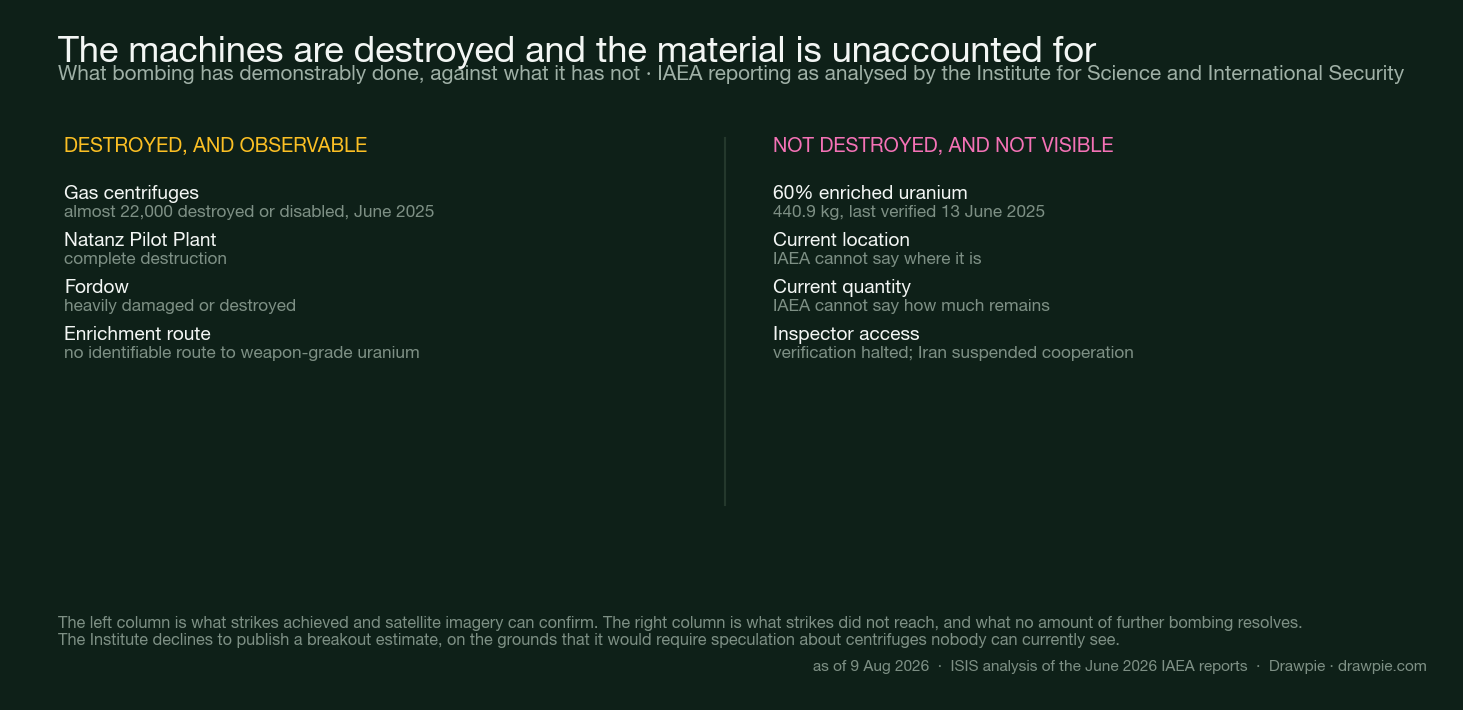
Analysis of the June 2026 IAEA reports records that the June 2025 attacks likely destroyed or rendered inoperable all of Iran’s installed centrifuges — almost 22,000 — across its three safeguarded enrichment sites: Natanz, the Natanz pilot plant and Fordow.
The conclusion drawn from that is the strongest statement available: for the first time in two decades, Iran has no identifiable route to produce weapon-grade uranium in its centrifuge enrichment plants. Satellite imagery shows no operational activity at the damaged facilities, and no resumption of enrichment has been verified.
One contemporaneous note is worth keeping for balance. Immediately after the June 2025 strike, the Israeli military’s own initial assessment was that Fordow had sustained serious damage but had not been completely destroyed — alongside reports that Iran may have moved equipment beforehand.
That is a real result. It is also only half the machine.
Where is the uranium, and who has seen it?
Nobody outside Iran has seen it since 13 June 2025.
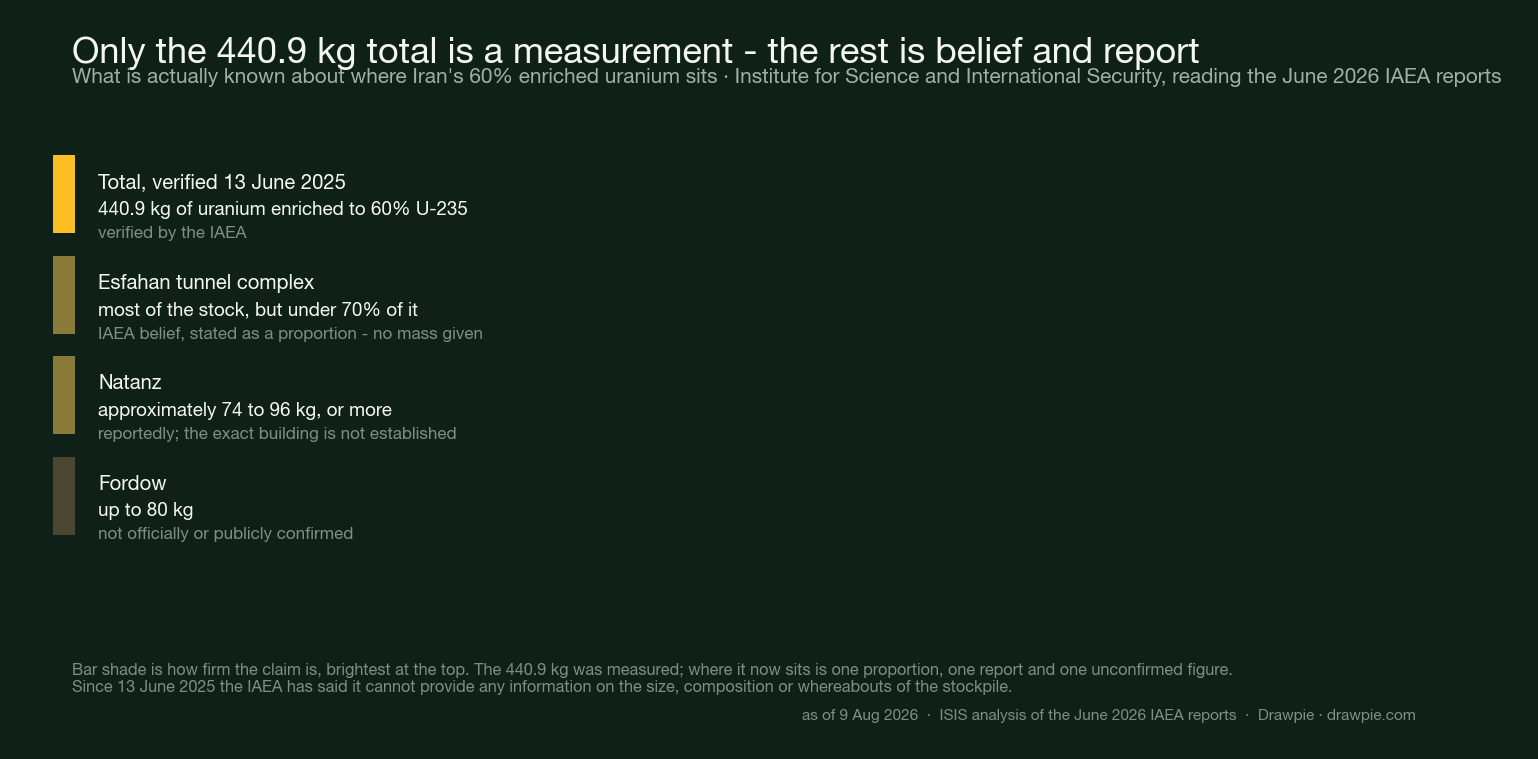
| Where | What is claimed | How firm |
|---|---|---|
| Total | 440.9 kg, 13 June 2025 | verified by the IAEA |
| Esfahan tunnel complex | most of the stock, under 70% of it | IAEA belief, given as a proportion — no mass |
| Natanz | approximately 74–96 kg, or more | reported; the building is not established |
| Fordow | up to 80 kg | not officially or publicly confirmed |
Only the total is a measurement. The location breakdown is one proportion, one report and one figure the Institute explicitly flags as unconfirmed. Esfahan — the tunnel complex holding most of it — is the site inspectors have not been allowed into, and in February 2026 the IAEA recorded regular vehicle movement at its entrance.
The IAEA’s own position is unambiguous: it cannot provide any information on the current size, composition or whereabouts of Iran’s enriched uranium stockpile. Iran formally suspended cooperation in July 2025, and after 28 February 2026 the agency stopped conducting verification activities under the safeguards agreement altogether. Iran has denied the agency access to 20 declared nuclear sites and one location outside facilities, and the IAEA has called nearly a year without access a matter of proliferation concern.
There is a further wrinkle from the first round. A preliminary, low-confidence US Defense Intelligence Agency assessment concluded that Iran had moved much of the stockpile before the June 2025 strikes, and that those strikes did not collapse the underground facilities. Treat the confidence level as part of the finding.
Which part of the job was American?
The part that reached the bottom of a mountain.
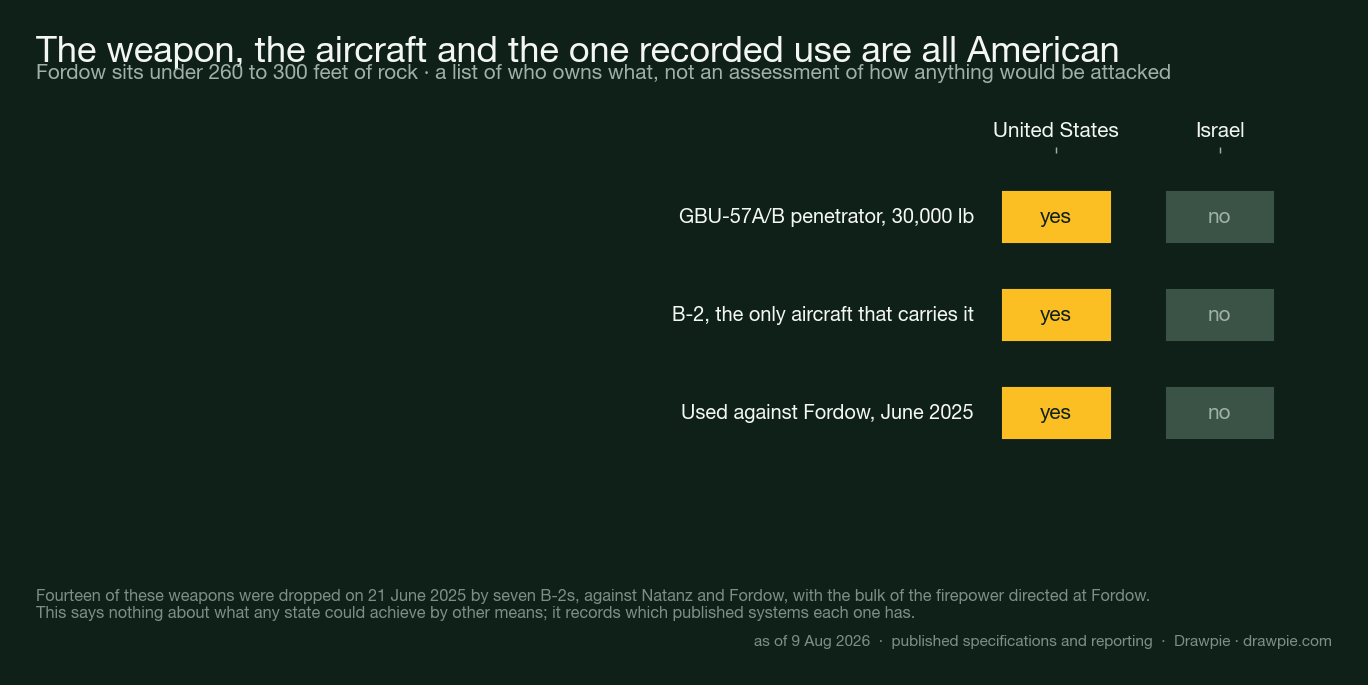
Fordow is built under 260 to 300 feet of rock, reinforced with concrete, about 18 miles from Qom. The only non-nuclear weapon that reaches that depth is the GBU-57A/B, a 30,000-pound penetrator and the heaviest non-nuclear weapon in the US inventory. The United States is the only state that has it, and the B-2 is the only aircraft that carries it.
The Congressional Research Service records what was used on 21 June 2025: over 125 US aircraft, including seven B-2 Spirit bombers, firing approximately 75 precision-guided weapons of which 14 were GBU-57 MOPs, over 25 minutes. The MOPs went against Natanz and Fordow, with the bulk of the firepower directed at Fordow, while a US submarine launched over two dozen Tomahawks at Isfahan.
The CRS document also contains the single most direct statement on the question this article is asking. Writing at the time, it records that Israeli officials sought direct US involvement in striking certain Iranian nuclear facilities “via capabilities Israel apparently does not have.”
That is the answer in the words of Congress’s own research service, written while it was happening. It is not a judgement about Israeli capability in general; it is a record of what was asked for and who owned it.
What did the strikes not solve?
Verification. And it is the thing that decides whether any of this holds.
Consider what is now true simultaneously:
- The centrifuges are destroyed, which can be seen from orbit.
- The uranium is unaccounted for, which cannot.
- No inspector has entered the site holding most of it in over a year.
A stockpile you cannot see is not a stockpile you have eliminated. Further strikes could damage more buildings; they cannot produce a verified inventory. Only inspectors can do that, and inspectors are a diplomatic outcome, not a military one.
That is why the analysts closest to the documents refuse to publish a breakout timeline. The Institute heads that section “Not Enough Information for Breakout Calculations”, on the basis that producing one would require unsubstantiated speculation about whether centrifuges exist and function. Anyone offering you a number of weeks is doing something the people with the best information decline to do.
What the Institute will say is narrower and worth quoting for its shape rather than its precision: before the strikes Iran could have built a first, non-missile-deliverable device within months; today it assesses that would take more than a year, with significant new uncertainty about whether such a device would even work. That is a judgement about weapon development, not a breakout clock.
Is the United States still in this?
It is trying to get out. That is the context any question about acting alone now sits in.
The 2026 war opened on 28 February with US and Israeli strikes. Since then:
| Date | What happened |
|---|---|
| 17 Jun | Islamabad Memorandum suspends hostilities for 60 days — and defers the nuclear question |
| 8 Jul | The president declares the memorandum over |
| 31 Jul | The US pauses its July air campaign |
| 7 Aug | The chairman of the Joint Chiefs is reported to be seeking an off-ramp |
The constraints reported alongside that are material rather than rhetorical: senior commanders describing the munitions stockpile as dangerously low, about $37.5bn spent by late July with roughly $67bn more requested, and a planned escalation stood down after Middle Eastern allies said they feared retaliation against their energy infrastructure. We covered that in detail in the off-ramp piece .
Note what the June memorandum did with the nuclear file: it postponed it. The question in this article was never settled by either the fighting or the deal.
So could it be done without American support?
Three answers, because the question has three parts.
The destruction of enrichment plants: largely already done, and not by Israel alone. The centrifuge halls are wrecked. On the hardest target, the weapon, the aircraft and the sortie were American. Whether Israel could have achieved the same result by other means is not something the public record can answer — and the public record is what this article is limited to.
The elimination of the material: not done, and not achievable by bombing at all. 440.9 kg is unaccounted for, held wherever Iran has put it, most likely in tunnels that survived. No air campaign converts that into a verified zero.
The guarantee that it stays destroyed: not a military question. Centrifuges can be rebuilt; the analysis notes a programme burrowing deeper. What prevents reconstitution is inspection and agreement, and Iran has tied inspector access to a final deal.
So the useful version of the answer is this. The part that bombs can do has mostly been done, and the United States did the hardest of it. The part that remains is the part bombs were never able to do. Framing it as a question about whether one country can finish the job alone assumes the job is the kind of thing that can be finished from the air, and the evidence on the table says it is not.
Sources
Checked on 9 August 2026.
| Source | What it supports here |
|---|---|
| Institute for Science and International Security — analysis of the June 2026 IAEA reports | The 440.9 kg figure and its 13 June 2025 verification date, the site-by-site distribution, the roughly 22,000 destroyed centrifuges, the damage at Natanz and Fordow, the “no identifiable route” conclusion, the IAEA’s inability to describe the stockpile, the suspension of verification after 28 February 2026, and the refusal to publish a breakout estimate |
| Scientific American — the bunker-buster designed for Fordow | The depth of Fordow, the GBU-57’s weight and role, and that the US is the only country that has it |
| GlobalSecurity — Operation Midnight Hammer | The June 2025 operation, the 14 weapons dropped and the split between Fordow and Natanz |
| Congressional Research Service — US strikes on nuclear sites in Iran | The scope of the June 2025 strikes on Fordow, Natanz and Isfahan |
| Britannica — 2026 Iran war | The 28 February 2026 opening strikes and the shape of the 2026 conflict |
| Drawpie — Dan Caine’s off-ramp from the 2026 Iran war | The war timeline, the Islamabad Memorandum and its deferral of the nuclear question, the munitions and cost constraints, and the stood-down escalation |
The hero image is a generic arid landscape, not any facility named in this article.
How we verified this
Terminology is kept precise throughout, because the loose version is wrong. Iran states its programme is peaceful, and the IAEA has not declared a weapons programme. What is documented is enrichment capacity and a stockpile of highly enriched uranium. This article says “enrichment” and “HEU” and does not describe Iran as having a weapons programme.
The technical figures come from the Institute for Science and International Security’s analysis of the June 2026 IAEA verification and NPT safeguards reports, which is the most detailed public reading of documents the IAEA does not publish in full. Where the IAEA’s own words are quoted, they are quoted from that analysis.
The war timeline comes from our own reporting, which used CNN and contemporaneous coverage; see the piece on Dan Caine’s off-ramp for that sourcing.
One assessment is deliberately given with its confidence level attached. The US Defense Intelligence Agency’s early judgement that the June 2025 strikes set Iran back “a matter of months” was a preliminary, low-confidence report. It is included because it was influential, and labelled because it was provisional.
We do not publish a breakout estimate, and neither does our source. The Institute states plainly that producing one would require unsubstantiated speculation about whether centrifuges exist and work. Any figure of the form “Iran is X weeks away” that you see elsewhere is doing something the people with the best access decline to do.
This article contains no operational content. It describes what has already been struck, what inspectors last verified, and which state owns which published system. It does not assess how any target could be attacked, and the possession chart is a record of who has what.
A correction made after re-reading the source directly. An earlier version of this article and its chart gave 265–287 kg at the Esfahan tunnel complex and “about 80 kg” at Fordow. Neither is what the Institute says. It gives no mass at all for Esfahan — only the IAEA’s belief that most of the stock, but under 70% of it, is there. Fordow is “up to 80 kilograms”, explicitly flagged as not officially or publicly confirmed, and Natanz is “74 to 96 kilograms or more”. The chart was rebuilt to show how firm each claim is instead of implying three measurements. The same pass corrected the centrifuge destruction, which the Institute attributes to the June 2025 attacks rather than to those and the 2026 rounds together.
A second correction, from checking the non-IAEA facts the same way. An earlier version said the 14 MOPs were split “12 on Fordow, two on Natanz”. That split appears in coverage but is in neither the Congressional Research Service account nor GlobalSecurity’s, so it has been removed; both say only that the weapons went against Natanz and Fordow, with the bulk directed at Fordow. Checking the same section against the sources themselves confirmed the figures that were right: Fordow “under 260 to 300 feet of rock”, the 30,000 lb weight, the US as “the only country possessing the bomb” and the B-2 as “the only aircraft designed to drop” it are all Scientific American’s own words.
The question as asked assumes a task still to be done. Much of it has already happened. Rather than answer a hypothetical, this sets out what was destroyed, what was not, which part required American equipment, and what no bombing campaign can reach.