Nationwide Savings Rates: The 4.55% Fixed Bonds & Cash ISAs Explained
Savings rates change without notice and variable rates can move at any time. Every figure here is a reading of Nationwide’s own compare page on 28 August 2026. From late September the numbers need re-reading against that page before this can be relied on.
Everything else on the page is unaffected; the figures below still say when they were read.

- 4.55% is the two-year rate, and it applies to two different products: the 2 Year Fixed Rate Cash ISA at 4.55% AER tax-free, and the 2 Year Fixed Rate Online Bond at 4.55% AER gross.
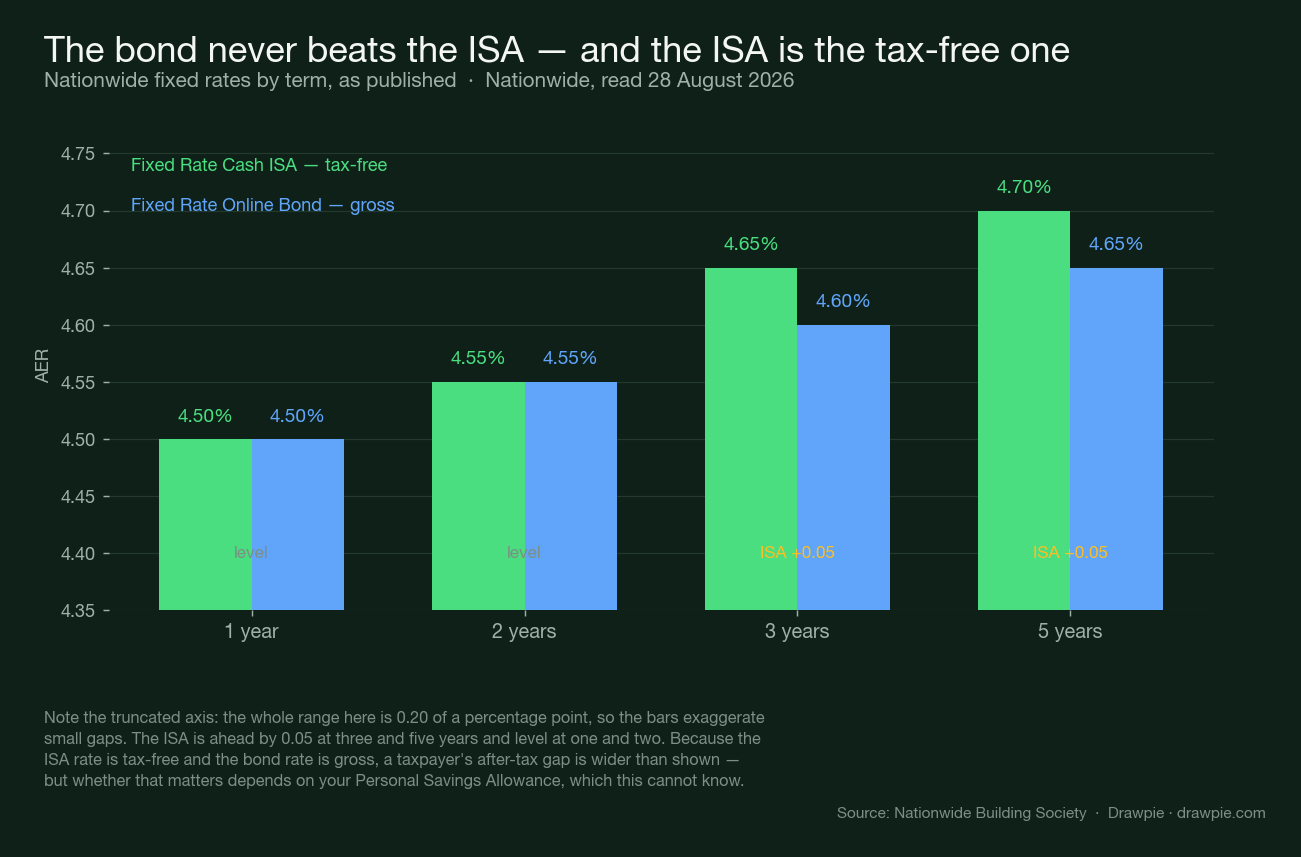
- The bond never beats the ISA at any term. They are level at one and two years, and the ISA is 0.05 points ahead at three and five — before you account for the ISA being tax-free and the bond being gross.
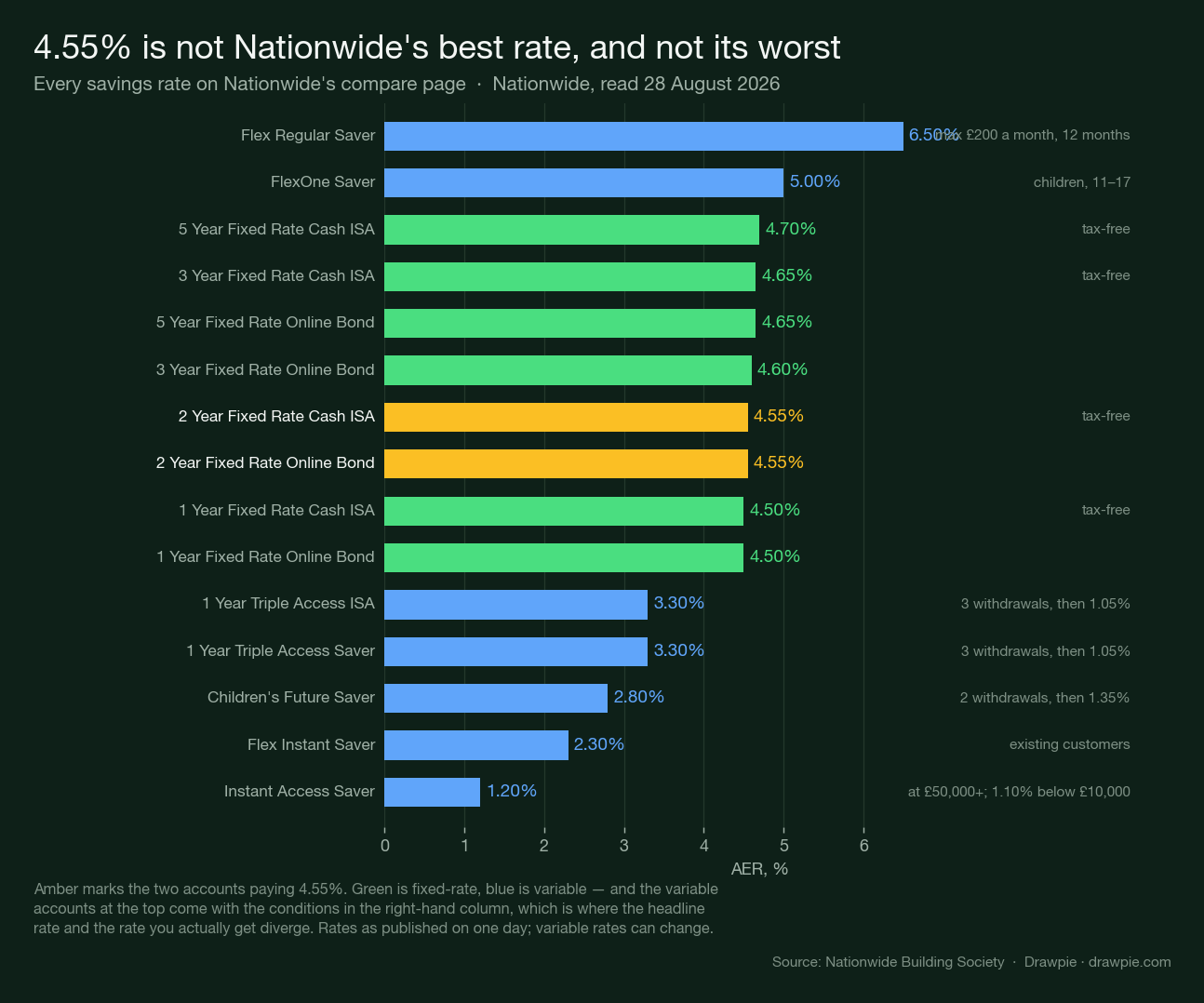
- 4.55% is not Nationwide’s best rate. The Flex Regular Saver pays 6.50% and the 5 Year Fixed Rate Cash ISA pays 4.70% — but the regular saver caps deposits at £200 a month.
- Neither fixed product is accessible. The bond allows no withdrawals until the term ends; taking money out of the ISA closes it and triggers an early access charge.
- Nationwide publishes a maturity rate guarantee: if its rate changes between the point it contacts you and your maturity date, you get the better of the two, provided you respond by that date.
4.55% is Nationwide’s two-year fixed rate — and it is not one product but two. The 2 Year Fixed Rate Cash ISA pays 4.55% AER tax-free, and the 2 Year Fixed Rate Online Bond pays 4.55% AER gross. Same headline, different tax treatment.
That distinction turns out to run through the whole range. Here is what each account pays, what it costs you in access, and which of the two families is actually ahead.
What is Nationwide’s 4.55% rate, exactly?
The two-year rate, on both the ISA and the bond. Here is the full fixed-rate ladder as published:
| Term | Cash ISA | Online Bond |
|---|---|---|
| 1 year | 4.50% | 4.50% |
| 2 years | 4.55% | 4.55% |
| 3 years | 4.65% | 4.60% |
| 5 years | 4.70% | 4.65% |
Full product names: Fixed Rate Cash ISA and Fixed Rate Online Bond. ISA rates are quoted AER/tax-free; bond rates are AER/gross. Both are fixed for the term.
Two years is the point where the two products converge. Below it and at it they are identical; above it the ISA pulls ahead.
Is the Cash ISA or the Fixed Bond better?
The bond never beats the ISA at any term — that is the strongest thing the numbers alone support.
| Term | Gap |
|---|---|
| 1 year | level |
| 2 years | level |
| 3 years | ISA +0.05 |
| 5 years | ISA +0.05 |
And that understates it, because the two rates are quoted in different units. The ISA’s 4.55% is tax-free. The bond’s 4.55% is gross — interest that may be taxable depending on your circumstances. For anyone whose savings interest exceeds their Personal Savings Allowance, the after-tax gap is wider than the table shows. For anyone comfortably inside their allowance, it may be nothing.
What that does not mean is that the ISA is automatically right for you. ISA subscriptions use up an annual allowance that a bond does not, and there are eligibility differences below. The honest summary is narrow: on rate alone, there is no term at which the bond wins.
What is Nationwide’s highest savings rate?
Not 4.55% — it is 6.50%, and the condition attached to it is the reason that number is not the answer to most people’s question.
| Account | Rate | The condition |
|---|---|---|
| Flex Regular Saver | 6.50% | Max £200 a month; drops to 1.05% after 4 withdrawals |
| FlexOne Saver | 5.00% | Children aged 11–17 |
| 5 Year Fixed Rate Cash ISA | 4.70% | Locked for five years |
| 3 Year Fixed Rate Cash ISA | 4.65% | Locked for three years |
| 5 Year Fixed Rate Online Bond | 4.65% | Locked for five years |
| 3 Year Fixed Rate Online Bond | 4.60% | Locked for three years |
| 2 Year Cash ISA / Online Bond | 4.55% | Locked for two years |
| 1 Year Cash ISA / Online Bond | 4.50% | Locked for one year |
| 1 Year Triple Access ISA / Saver | 3.30% | 3 withdrawals, then 1.05% |
| Children’s Future Saver | 2.80% | 2 withdrawals, then 1.35% |
| Flex Instant Saver | 2.30% | Existing current account customers |
| Instant Access Saver | 1.10–1.20% | Rate depends on balance |
The 6.50% has a hard ceiling built in. At £200 a month for twelve months, the most that can be in the account by the end is £2,400 — and the average balance across the year is far lower than that, because the money arrives gradually. A high rate on a small, growing balance is a different proposition from 4.55% on a lump sum.
The Instant Access Saver is the other end of the range, and it is tiered: 1.10% below £10,000, 1.15% from £10,000 to £49,999.99, and 1.20% at £50,000 and above. The rate applies to the whole balance, not in slices.
What happens if you need the money early?
On the fixed products, you either cannot get it or it costs you. This is the trade for the rate and it is worth reading before, not after.
| Product | Early access |
|---|---|
| Fixed Rate Online Bond | No withdrawals until the term ends. Not reduced — not permitted |
| Fixed Rate Cash ISA | A withdrawal closes the ISA and you pay an early access charge |
The bond is the stricter of the two in one sense and the ISA in another. The bond simply will not let you; the ISA will, but the account does not survive it.
The variable accounts substitute a cliff for a lock. The Flex Regular Saver and both Triple Access accounts let you withdraw — but the fourth withdrawal drops the rate to 1.05% for the rest of the term. The Children’s Future Saver drops to 1.35% after the second. In each case the account keeps running; the headline rate does not.
If genuine access matters more than rate, the Instant Access Saver and Flex Instant Saver both allow unlimited withdrawals — at 1.10–1.20% and 2.30% respectively.
Who can open each account?
The eligibility rules differ more than people expect, and one of them is an age gap:
| Account | Who |
|---|---|
| Fixed Rate Online Bond | UK residents aged 16 or over · online only |
| Fixed Rate Cash ISA | UK residents aged 18 or over, sole account only · online and branch |
| Flex Regular Saver | Nationwide current account holders 16+, applying online |
| Flex Instant Saver | Existing current account customers |
| FlexOne Saver | FlexOne account holders aged 11–17 |
| Children’s Future Saver | Parents or guardians with parental responsibility for a child under 18 |
| Triple Access ISA | UK residents 18+, sole account only |
| Triple Access Saver / Instant Access Saver | UK residents 16 or over |
Two things to notice. A 16 or 17-year-old can open the bond but not the ISA — ISAs are 18+. And an ISA cannot be held jointly: Nationwide’s page states they can only be opened by one person as a sole account, which is an ISA rule rather than a Nationwide one.
The bond is also online only, where the ISA can be opened online or in branch.
What happens when a fixed account matures?
Nationwide publishes a rate guarantee for that moment, and it is worth knowing because maturity is when savers most often lose out by doing nothing.
In its own words: when your fixed rate bond or ISA is due to mature, if its rate changes between the point it contacts you and your maturity date, you get the better rate — provided you get back to it by that maturity date.
The condition is the active part. The guarantee protects you against a rate move in the window; it does not protect you against letting the maturity date pass without instructions. Nationwide has separate maturity-options pages for bonds and ISAs, and a SavingsWatch service that notifies members of rate changes.
Sources
| Source | Used for |
|---|---|
| Nationwide — Compare savings accounts and ISAs | Every rate, term, withdrawal condition and eligibility rule on this page, including the 4.55% two-year figures for both products and the maturity rate guarantee |
| Nationwide — Savings and ISAs | The product structure, and the maturity-options and SavingsWatch pages referenced above |
How we verified this
✅ Every rate here was read from Nationwide’s own “Compare savings accounts and ISAs” page on 28 August 2026 — not from a best-buy table, a comparison site or a news report. For a money page the provider’s own page is the only source that is both authoritative and current, and it is the one a reader can check in a click.
🔴 We could not verify that rates have risen, so this page does not say they have. The brief that produced it described a rate rise. Nationwide’s page carries no rate-change language anywhere: the words “increase”, “risen”, “new rate”, “effective from”, “improved” and “last updated” return nothing on it. What we have is a snapshot of the rates on one day, and that is all this page claims. Whether these are higher than last month is not something a single reading can establish, and inventing a direction of travel on a savings page would be a real disservice.
✅ The 4.55% in the brief checks out, and it is two products rather than one. The 2 Year Fixed Rate Cash ISA is 4.55% AER/tax-free (fixed) and the 2 Year Fixed Rate Online Bond is 4.55% AER/gross (fixed). Both figures are on the same page.
⚠️ The ISA-versus-bond comparison is stated in the weaker, safer direction on purpose. The claim made is that the bond never beats the ISA — not that the ISA is better for you. Those are different. The ISA rate is quoted tax-free and the bond rate gross, which are not the same unit for a taxpayer, and whether the difference matters depends on your Personal Savings Allowance and how much ISA allowance you have left. No page can know that about you.
⚠️ The chart comparing them uses a truncated axis and says so on its face. The entire range is 0.20 of a percentage point, so bar heights exaggerate small gaps. The numbers are printed on every bar for that reason.
⚠️ Headline variable rates are not the rates most savers end up with. The 6.50% Flex Regular Saver drops to 1.05% after four withdrawals and takes a maximum of £200 a month. The Triple Access accounts drop from 3.30% to 1.05% after four withdrawals. Those conditions are reported alongside every variable rate rather than in a footnote.
🔴 This is not financial advice and contains no forecast. Nothing here recommends a product or predicts where rates go. Nationwide Building Society is authorised by the Prudential Regulation Authority and regulated by the FCA and the PRA under registration number 106078, per its own site.