Mistfall Hunter Solo Guide: Best Class & Extraction Tips

- Solo is a separate game from trio, by design. Bellring Games has said it makes “distinct adjustments based on separate data collected from Solo and Trio modes, rather than applying blanket changes” — so any tier list that gives one grade per class is answering a question you did not ask. It is also why Blackarrow’s pre-launch nerf was aimed at solo specifically, where the developer called its performance “slightly overturned”.
- The ranked ladder pays you to run away. Path of Glory deducts points for exactly one thing — failing to extract. Losing a fight and escaping costs nothing; winning a fight and dying to the next player costs you the match. Avoiding combat is not the cowardly line, it is the scoring-optimal one.
- Extraction is something you build, not somewhere you walk. You summon an extraction point at a Soul Tree, and it consumes a Soul of Return you carried in. Right now a live bug the developer lists under Known Issues takes an extra one if you wander in and out of the tree’s area while summoning — decide before you approach.
- Mistfall Hunter is on PC via Steam, PlayStation 5 and Xbox Series X/S, all from launch on 30 July 2026, at $24.99 standard or $39.99 deluxe. There is no duo mode and Bellring Games says there will not be one soon, so your options are alone or in a three.
Mistfall Hunter’s solo mode is not trio with fewer people in it — the developer balances the two from separate data. In its community AMA, Bellring Games said it makes “distinct adjustments based on separate data collected from Solo and Trio modes, rather than applying blanket changes to class balance.”
That is the single most useful thing anyone can tell you about playing alone right now, three days after the 30 July 2026 launch. It means a class being strong in trios is not evidence about solo, and it means the tier lists handing out one grade per class are averaging two things the studio deliberately keeps apart.
The game is on PC via Steam, PlayStation 5 and Xbox Series X/S, all from launch day, at $24.99 for the Standard edition and $39.99 for the Deluxe.
What has the developer actually said about solo?
More than you would expect, and it is worth reading before any tier list.
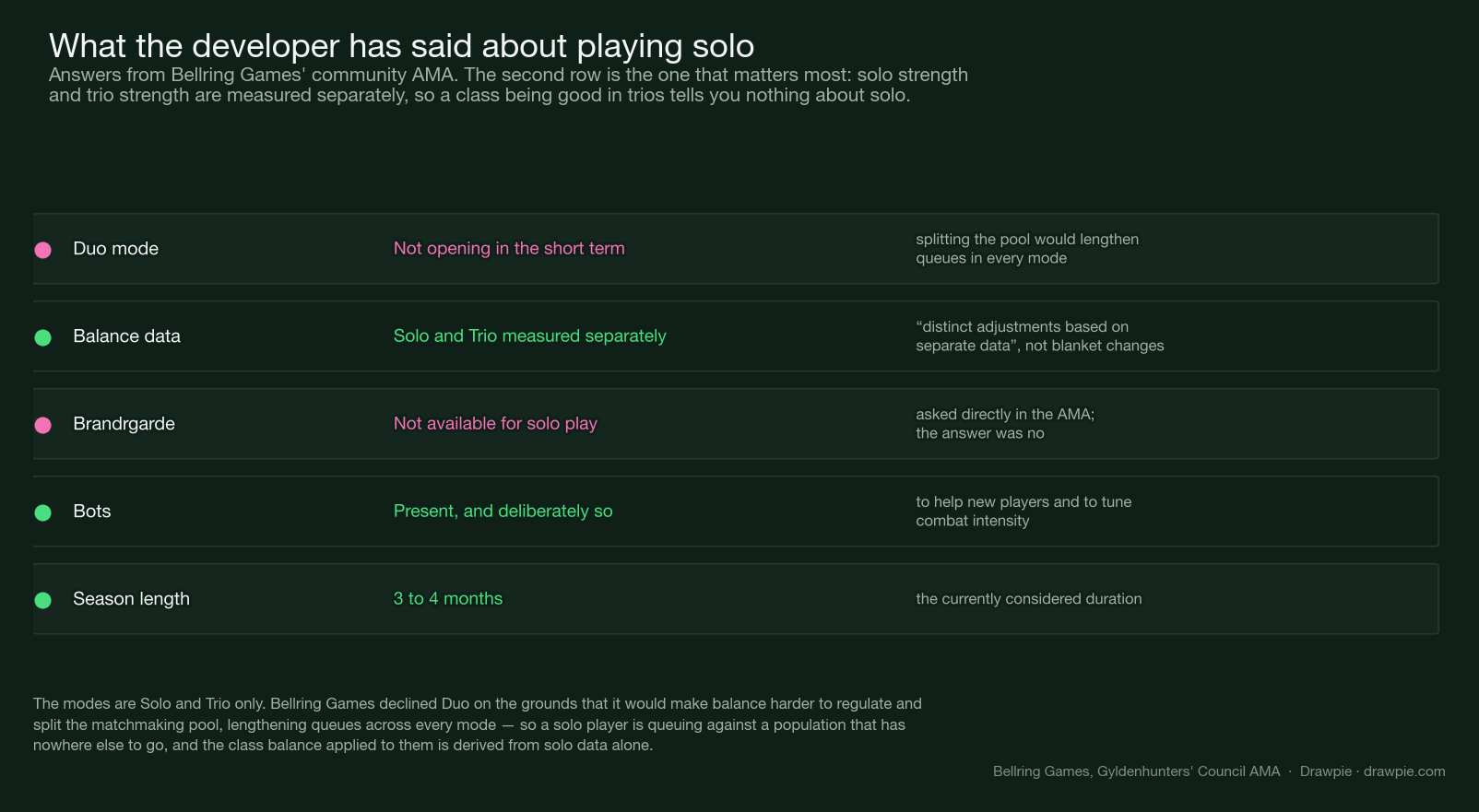
There is no duo mode, and there will not be one soon. Asked directly, the studio said opening duo matchmaking would make balance harder to regulate and would split the existing matchmaking pool, lengthening queues across every mode. Your choices are one or three.
Bots are in matches on purpose — the developer describes them as playing a valuable role for new players and in tuning combat intensity, with AI improvements framed as a long-term project. Not everything moving out there is a player.
Brandrgarde is not available for solo play. That was asked in the same AMA and the answer was no.
A season runs three to four months on current thinking, which sets the horizon for anything you are grinding toward.
Which class is best for solo?
The honest answer is that the developer has told us which one it thought was too strong in solo, and that is the closest thing to evidence available.
Before launch, Blackarrow’s solo performance was described as “slightly overturned”, with skills and talents becoming “overbearing in high-tier gear matches”. Its special arrows were toned down in response — the Sepsis talent now requires a fully charged bow.
That is a nerf, and it still tells you where the power was. A class the studio singled out for being too good specifically in solo was, by the only measurement that exists, the strongest solo pick. Whether the nerf was enough is exactly what the coming weeks will show.
Two other classes were reined in for reasons that read as solo-relevant even though the wording was not solo-specific: Shadowstrix for mobility and “overwhelming crowd-control chains” that let it “overperform”, and Seer — Mace for disengage, kiting and chasing that were “overly dominant”. Escape tools and chase tools matter more alone than in a group, because there is nobody to trade the fight with. For how the same six classes rank once trios are back in the picture, see the tier list .
For a first solo class, Mercenary is still the sane pick: the developer called its data “relatively balanced” and changed almost nothing. And as the next section explains, the ladder is built so that a class which survives is worth more than a class which wins.
Why is running away the correct solo play?
Because of one scoring rule, and it is unusually generous.
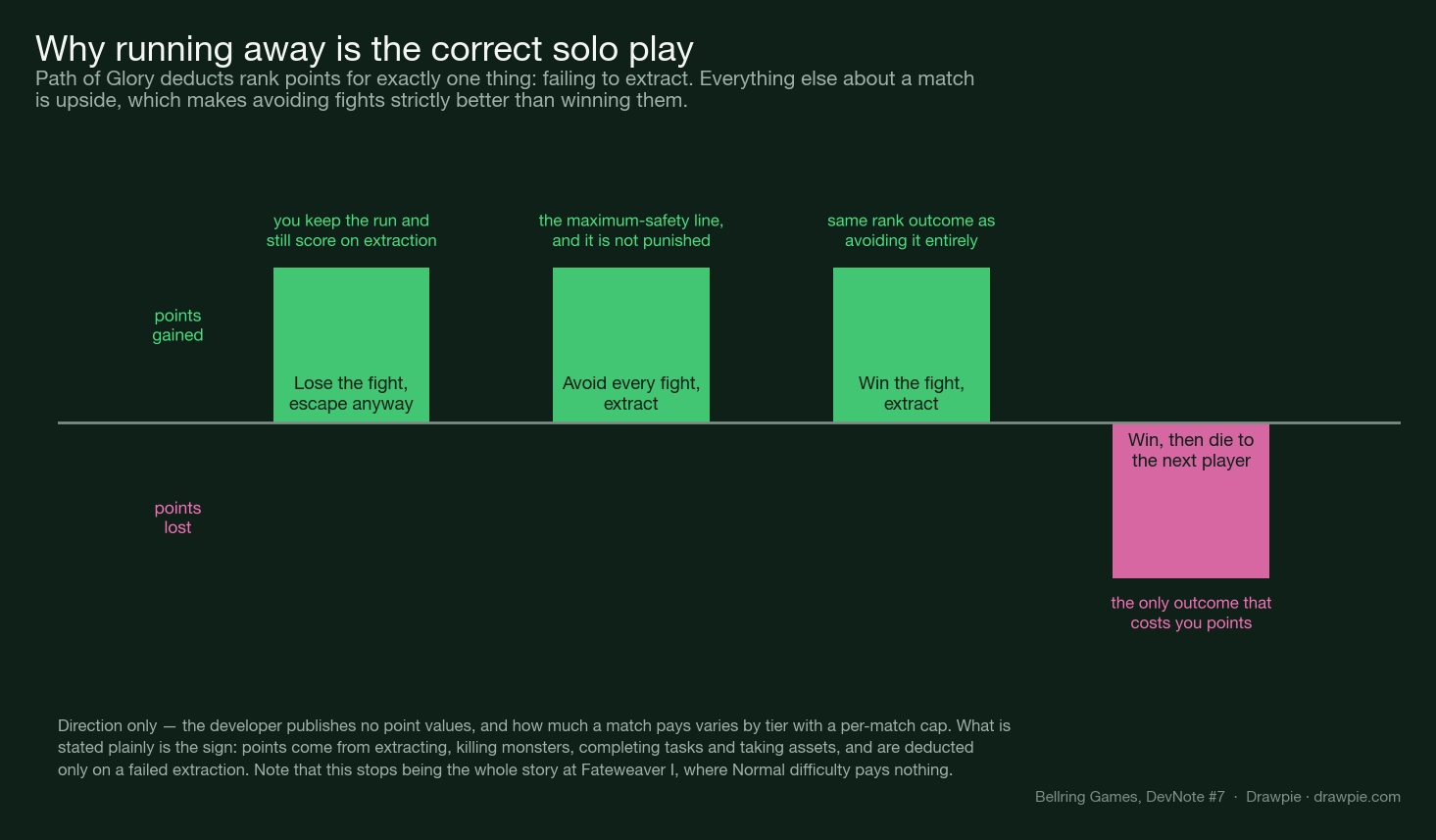
Path of Glory deducts rank points for exactly one thing: failing to extract. Points come from extracting successfully, killing monsters, completing tasks and acquiring assets. A lost duel that you walk away from costs you nothing.
Read that as an incentive and the solo strategy falls out of it. Winning a fight and then dying to the third party it attracted is the single worst outcome available to you — worse than never taking the fight at all, which costs you nothing and banks whatever you were already carrying. Avoiding combat is not timidity here; it is the line the scoring rewards.
Two caveats. There is a cap on points per match, so a monster run cannot be farmed indefinitely. And which actions pay out varies by your current tier — the ladder changes what it wants from you as you climb.
What is the one extraction mistake to avoid?
Wandering while you decide.
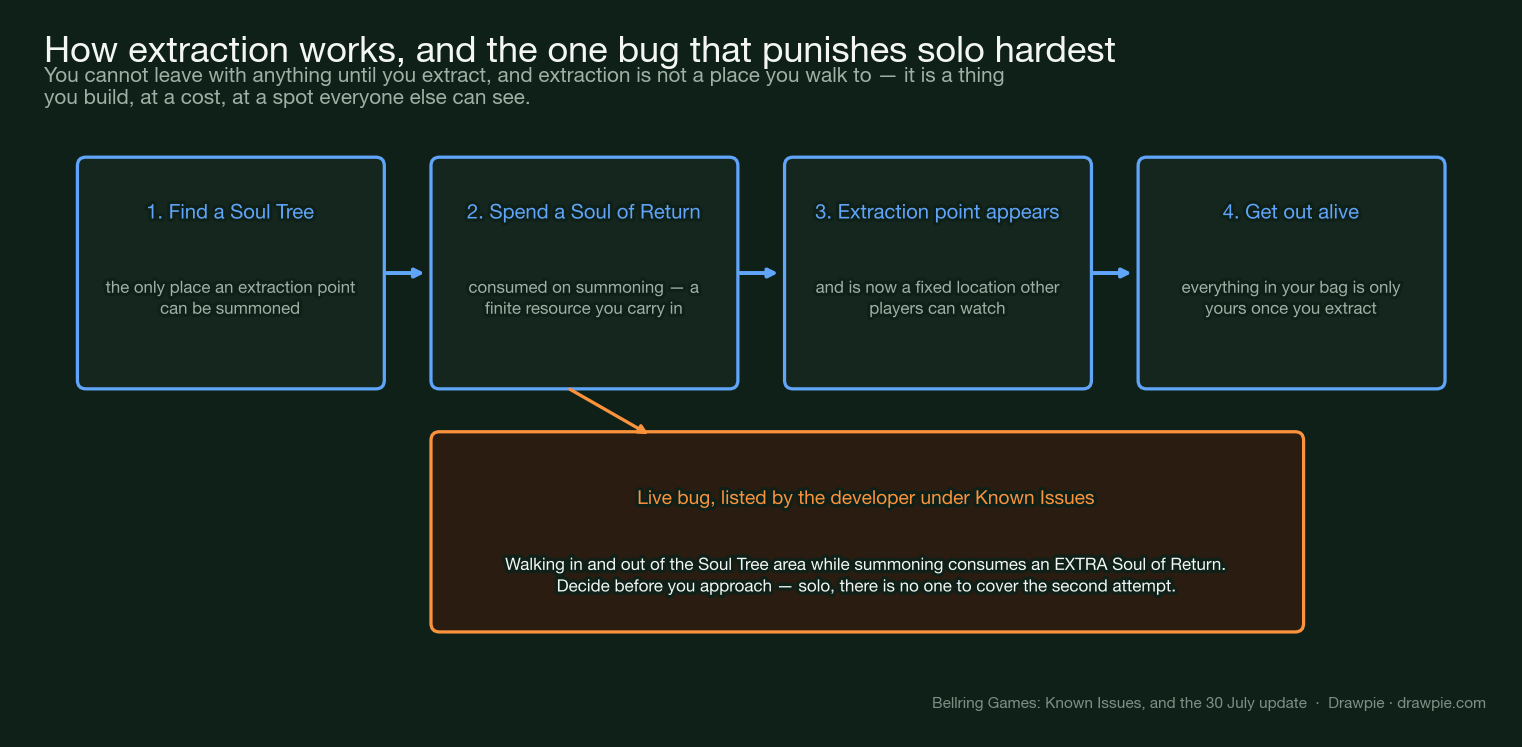
Extraction is not a door you find. You summon an extraction point at a Soul Tree, and summoning consumes a Soul of Return — a finite thing you brought in with you. Once summoned, the point is a fixed location, and anyone else on the map can watch it.
The mistake is mechanical, and the developer lists it under Known Issues: repeatedly entering and exiting the area around a Soul Tree while summoning an extraction point incorrectly consumes an extra Soul of Return. In a trio someone can cover a second attempt. Alone, a wasted Soul of Return can be the run.
So decide before you approach the tree. Commit to the summon or stay out of its radius entirely.
How does the ladder change how you play?
There is one wall on it, and it arrives sooner than most players expect.
From Fateweaver I — the fourth of the seven tiers — Normal difficulty stops awarding rank points entirely. Below that line you can climb at whatever difficulty you are comfortable with. Above it, you have to go somewhere harder.
That matters for a solo player more than a trio, because harder content alone means longer fights against monsters while other players are on the same map. It is worth knowing which difficulty you can clear reliably before you hit the tier that forces the question.
The full ladder runs Duskborn, Mistwalker, Dawnseeker, Fateweaver, Oracle, Exalted, Zenith. Ranked is opt-in per match and unlocks at character level 6, so there is no penalty for playing unranked while you learn a class.
Solo tips that follow from the rules
Treat every fight as optional. The scoring says so. The only fight you have to take is the one between you and the extraction point.
Count your Souls of Return like ammunition. They are what turns loot into loot you own. The number you have left is the real limit on how long you can stay.
Assume the extraction point is watched. It is a fixed, visible location that you created. The period between summoning and leaving is the most dangerous stretch of any run.
Do not read trio advice as solo advice. The developer separates them; so should you. This applies to class picks, builds and engagement rules alike.
Remember not everything is a player. Bots are in the mode deliberately, and reading a bot as a player — or the reverse — is a costly mistake in both directions.
What to watch
Whether Blackarrow stays the solo pick. It was nerfed for being too strong in solo specifically. The first post-launch balance pass will show whether that landed.
Whether melee gets help. Players raised melee being “easily suppressed” in the AMA, and the studio’s answer was about combat philosophy — attacks commit you to recovery frames — rather than a promise to change it. Solo melee carries that cost with no one to peel for you.
Duo, eventually. The refusal was explicitly “in the short term”. If it arrives, the solo pool changes shape overnight.
Season 1’s Soul Harvest. The ritual and its Soulgnawer elite roll out progressively, and a new elite monster changes what a lone player can safely engage.
How we verified this
Everything here comes from Bellring Games, read from the Mistfall Hunter Steam news feed (app 3282300) via Steam’s own events API: the Gyldenhunters’ Council AMA for the solo and trio answers, DevNote #7 for the Path of Glory scoring rules and the class verdicts, and the Known Issues and 30 July update posts for the extraction bug and the platform and pricing details.
The reason this article can exist three days after launch is one sentence from that AMA: the developer balances solo and trio from separately collected data. That makes “which class is best solo” a question with a real answer structure, rather than a guess dressed as a ranking — and it is why the pre-launch note that Blackarrow was “slightly overturned” in solo is usable here, because the developer attached it to solo specifically.
What is deliberately absent: encounter rates, loot values, rank-point thresholds, time-to-kill, or any figure describing how often anything happens. None has been published. Every chart in this article is structural — what the systems are and what the developer said about them — and the scoring chart shows direction only, because the point values genuinely are not public.
The tips below are reasoning from published rules, not from a claim of high-level play. Where something follows from a stated rule it is presented as following from it; where it is a judgement about how the rules interact, it is written as one.