Minnesota Elections 2026: Results, Candidates, Polls & Key Races
Update log (1)
- — Results here are the Minnesota Secretary of State's own figures with 100% of precincts reporting, read the day after the 11 August primary. The state's own pages still label them unofficial pending certification, so totals may move slightly.

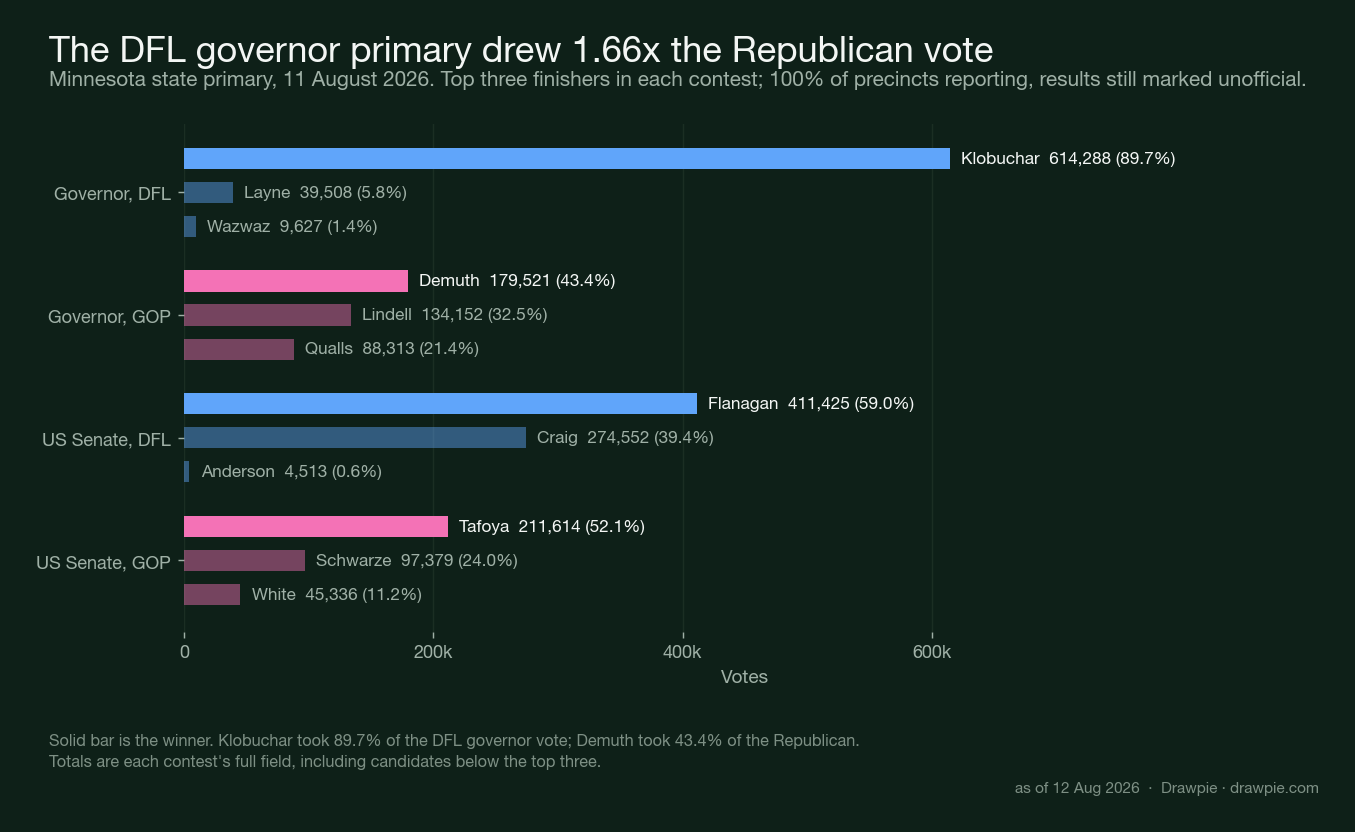
- Amy Klobuchar is leaving the US Senate to run for governor, and she took the DFL nomination with 89.68% of the vote. She faces Republican Lisa Demuth, the state House speaker, who won a three-way race with 43.45% — ahead of MyPillow founder Mike Lindell on 32.47%.
- Peggy Flanagan won the Senate nomination by nearly 20 points over Angie Craig, 59.02% to 39.38%. The last public poll before the vote had it the other way round: SurveyUSA on 6 August had Craig 42, Flanagan 40. She meets Republican Michele Tafoya, the former NBC sideline reporter, in November.
- Only one poll has ever tested the November Senate match-up, and it was taken in February. Emerson College had Flanagan 47, Tafoya 41 among 1,000 likely voters — six months and two primaries before the field was settled.
- The ratings split on the governor’s race and agree on the Senate. Cook calls the governor’s race Solid Democratic, Sabato says Safe, Inside Elections says only Likely. All four services rate the Senate seat Likely Democratic.
Minnesota voted on 11 August 2026, and both marquee races now have their November match-ups. Amy Klobuchar is leaving the Senate to run for governor against Republican Lisa Demuth. Peggy Flanagan won the Senate nomination and faces Michele Tafoya.
Both results were emphatic. One of them was the opposite of what the last poll showed.
Who won the Minnesota primary on 11 August?
Klobuchar and Demuth took the governor nominations; Flanagan and Tafoya took the Senate ones. All four won with full precinct reporting, though the state still labels the numbers unofficial.
| Contest | Winner | Share |
|---|---|---|
| Governor, DFL | Klobuchar | 89.68% |
| Governor, GOP | Demuth | 43.45% |
| Senate, DFL | Flanagan | 59.02% |
| Senate, GOP | Tafoya | 52.07% |
The turnout gap between the parties is the first thing that stands out. The DFL governor primary drew 684,956 votes against 413,205 on the Republican side — 1.66 times as many.
What is the Minnesota governor race in 2026?
An open seat, with a sitting US senator on the ballot. Amy Klobuchar gave up a Senate seat to run for governor, and she took the DFL nomination with 89.68% — 614,288 votes against a field of six.
The Republican primary was the more interesting contest:
| Candidate | Votes | Share |
|---|---|---|
| Lisa Demuth | 179,521 | 43.45% |
| Mike Lindell | 134,152 | 32.47% |
| Kendall Qualls | 88,313 | 21.37% |
Lisa Demuth, the state House speaker, won it. Mike Lindell, the MyPillow founder, finished second with just under a third of the vote — a serious share for a candidate with no elected office, and the number most likely to be argued about for the rest of the cycle.
There are no incumbents in the race. Klobuchar and Demuth meet on 3 November.
Who is running for US Senate in Minnesota?
Lieutenant Governor Peggy Flanagan against Michele Tafoya, in a seat with no incumbent because Klobuchar is running for governor instead.
Flanagan beat US Representative Angie Craig by nearly 20 points:
| Candidate | Votes | Share |
|---|---|---|
| Peggy Flanagan | 411,425 | 59.02% |
| Angie Craig | 274,552 | 39.38% |
On the Republican side, Michele Tafoya — best known as a former NBC sideline reporter — took 52.07% with 211,614 votes, ahead of Adam Schwarze on 23.96% and Royce White on 11.15%.
The November ballot has four candidates, not two: Flanagan (DFL), Tafoya (R), Rebecca Whiting (Libertarian) and Marisa Simonetti (unaffiliated).
What do the polls say about Minnesota?
Almost nothing current — and the last primary poll got the Senate race backwards.
Start with what happened. SurveyUSA polled the DFL Senate primary three times, and its final read was five days before the vote:
| Poll | Craig | Flanagan | Other |
|---|---|---|---|
| 6 Aug | 42% | 40% | 18% |
| 21 Jul | 40% | 40% | 20% |
| 17 Jun | 41% | 36% | 23% |
The result was Flanagan 59.02, Craig 39.38. So the last poll had Craig two points ahead; she lost by nearly twenty.
That is worth reading carefully rather than as a simple failure. The 6 August poll was 513 likely voters at ±5.3 points, and 18% were undecided — a two-point gap inside a five-point margin was never a call. What the sequence does show is that the late-deciding fifth of the electorate broke heavily one way, and no poll caught it.
The Republican side moved too: SurveyUSA had Adam Schwarze at 5% on 6 August; he finished with 23.96%.
For November, there is exactly one poll, and it is from February. Emerson College, fielded 11 February 2026 with 1,000 likely voters at ±3 points, had Flanagan 47, Tafoya 41. That was taken six months and two primaries before the field was settled. It is the only public test of this match-up that exists, and it should be read with its date attached.
What do the race ratings say?
Four services rate the Senate seat identically and three disagree about the governor’s race. That contrast is the useful part.
| Race | Cook | Inside El. | Sabato |
|---|---|---|---|
| Governor | Solid D | Likely D | Safe D |
| Senate | Likely D | Likely D | Likely D |
For the Senate, DDHQ/The Hill also says Likely Democratic, making it four-for-four.
On the governor’s race the three houses reach for three different words. Cook’s “Solid” and Sabato’s “Safe” are each firm’s most confident category; Inside Elections’ “Likely” is a step down from that. These are separate in-house scales rather than one shared ladder, so the gap is a real difference of opinion about how competitive the seat is, not a wording quirk.
For the wider picture of what Minnesota means for control of the chamber, our 2026 Senate control breakdown covers the seats that decide it.
Are the Minnesota results official yet?
No. The state calls them unofficial. Both results pages show 87 of 87 counties complete and 4,105 of 4,105 precincts reporting, and still carry an unofficial header, because certification has not taken place.
In practice that means the winners are not in doubt — none of these margins is close — but the exact totals can still shift slightly. Every figure in this article is the state’s own, read on 12 August 2026.
Minnesota had 3,886,543 voters registered at 7am on primary day, and polls ran 7 a.m. to 8 p.m.
What else was on the Minnesota ballot?
Statewide primaries for secretary of state, state auditor and attorney general, all eight US House districts, and state legislative seats. The Secretary of State’s results site publishes each separately, including judicial contests.
One knock-on worth flagging: Angie Craig gave up her US House seat to run for the Senate, so her district is open in November — a seat that would otherwise not have been in play.
Minnesota was one of six states voting that day. Wisconsin’s governor primary the same evening produced an upset of its own , where the eventual winner had polled at 7% three weeks earlier.
Bottom line
Klobuchar against Demuth for governor, Flanagan against Tafoya for the Senate, both on 3 November.
The ratings favour the DFL in both, more strongly for governor than for the Senate. But the most instructive number from Tuesday is not a margin — it is that the final poll of the Senate primary had the loser two points ahead, and the winner won by nearly twenty. For November, the only poll that exists was taken in February.
Sources
Read on 12 August 2026.
| Source | What it supports here |
|---|---|
| Minnesota Secretary of State: governor primary results | Every governor vote total and percentage, the 87-county and 4,105-precinct reporting figures, the registered-voter count, and the unofficial label |
| Minnesota Secretary of State: US Senate primary results | Every Senate vote total and percentage for both parties |
| 270toWin: 2026 Minnesota Senate polls | The three SurveyUSA DFL primary polls with dates, samples and margins, the Republican primary polling, and the single February Emerson College general-election poll |
| Ballotpedia: Minnesota gubernatorial election, 2026 | The governor race ratings from Cook, Inside Elections and Sabato, the November general-election line-up, the no-incumbent status and poll times |
| Ballotpedia: US Senate election in Minnesota, 2026 | The Senate ratings from four services and the four-candidate November ballot including the Libertarian and unaffiliated candidates |
How we verified this
Every vote total on this page comes from the Minnesota Secretary of State’s results site, not from a network call. Both contests show 87 of 87 counties complete and 4,105 of 4,105 precincts reporting, timestamped 12 August 2026. Each winner’s percentage in the chart is recalculated from the raw vote counts rather than copied, and the script asserts the recomputed figures match the state’s published percentages — 89.68%, 43.45%, 59.02% and 52.07%.
🔴 The state still calls these unofficial, and so do we. The results pages carry an “Unofficial Results” header despite full precinct reporting, because certification has not happened. That is why this article gives no margin-of-victory claim to more decimal places than the state does, and why the update note flags that totals can still move.
The polling section separates primary polls from general-election polls, because mixing them is the standard error in this race. 270toWin’s Minnesota Senate page lists three SurveyUSA primary polls, four Republican primary polls and exactly one general-election poll. The general-election poll is Emerson College, fielded 11 February 2026 — before either primary field was settled. Any article treating it as a current read on Flanagan against Tafoya is using a six-month-old number.
The polling miss is reported with its own caveats rather than as a gotcha. SurveyUSA’s final DFL primary poll, 6 August, had Craig 42 and Flanagan 40 with 18% other or undecided on a 513-voter likely-voter sample at ±5.3 points. The result was Flanagan 59.02 to Craig 39.38. The undecided share was large, the sample small, and a two-point lead inside a ±5.3-point margin was never a prediction of a winner. What it does show is that the late-deciding vote did not split evenly.
Race ratings are quoted per service because the services do not use the same scale. For governor, Cook Political Report says Solid Democratic, Sabato’s Crystal Ball says Safe Democratic and Inside Elections says Likely Democratic — three labels from three houses, and Inside Elections’ is the least certain of the three. For the Senate, Cook, DDHQ/The Hill, Inside Elections and Sabato all say Likely Democratic. Aligning those words onto one scale would be our editorial choice, not theirs, so they are listed as written.
🚫 No betting odds or prediction-market prices appear anywhere in this article. Nothing from a bookmaker or prediction market is used, quoted or linked.
Third-party candidates are included where the state lists them. The Senate general election has four certified candidates, including a Libertarian and an unaffiliated candidate; the governor’s race, as listed, has two.