Micron Stock Jumps on Record Earnings as Chip Shortage Is Set to Last Beyond 2027

Micron Technology (MU) stock jumped more than 13% after the chipmaker reported the best quarter in its history, blowing past Wall Street’s expectations on every line. Fiscal third-quarter revenue hit $41.46 billion — up about 346% from a year earlier — with adjusted earnings near $25 per share and a record gross margin of 84.9%. But the line that grabbed the most attention wasn’t a number at all: Micron’s CEO said the AI-driven memory shortage is likely to last beyond 2027. Here’s what the company reported and why it matters. (This is news and context, not investment advice — see the note at the end.)
What did Micron report?
Simply put, every figure beat both analyst estimates and Micron’s own guidance.
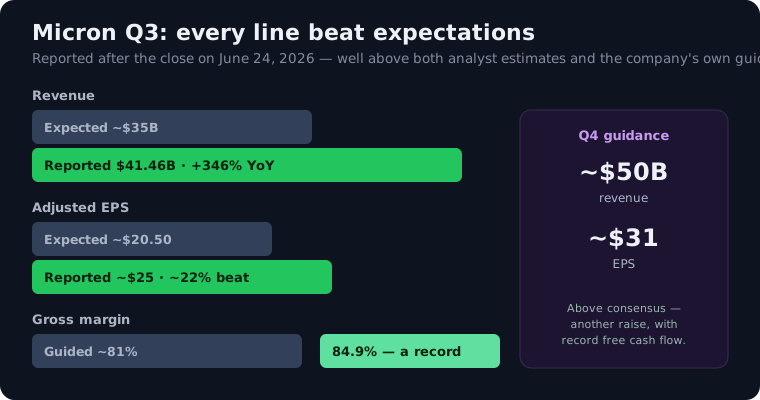
| Metric | Expected | Reported |
|---|---|---|
| Revenue | ~$35B | $41.46B (+346% YoY) |
| Adjusted EPS | ~$20.50 | ~$25 (~22% beat) |
| Gross margin | ~81% guided | 84.9% (record) |
Revenue came in roughly 16% above the consensus estimate, and the 84.9% gross margin is the highest Micron has recorded since at least 1990 — meaning it’s keeping more of every sales dollar than at any point in its history. Both major product lines hit records, with DRAM revenue reaching $31.3 billion (76% of sales) and NAND $9.9 billion (24%). Data-center revenue alone was around $25 billion. After the report, the stock jumped sharply in after-hours trading, climbing more than 13%.
Why did Micron stock jump?
Beyond the headline beat, two things drove the enthusiasm. First, the forward guidance: Micron expects fiscal fourth-quarter revenue of about $50 billion and earnings of roughly $31 per share — well above what analysts had penciled in, alongside record free cash flow. A company guiding meaningfully higher signals confidence that demand isn’t slowing. Second, and most importantly, the outlook on supply. Rather than hinting that the boom might cool, management indicated the opposite: that demand for memory continues to outstrip what the industry can produce, and will keep doing so for years.
Why is the chip shortage expected to last beyond 2027?
This was the standout message. Micron’s CEO said the company expects tight conditions to persist beyond calendar 2027 — notable because it’s the firm benefiting most from the shortage admitting it can’t yet see when supply will catch up.
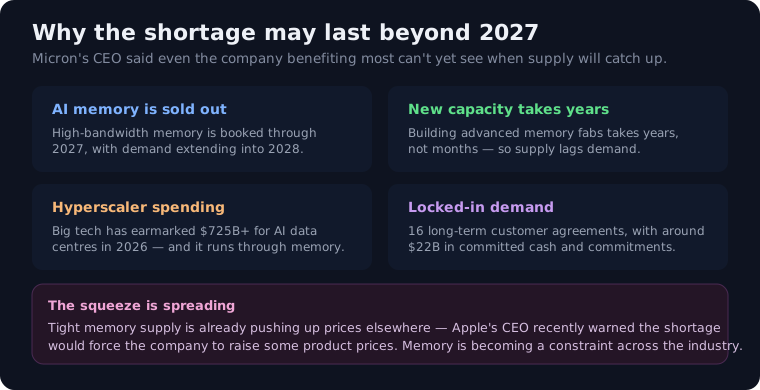
Several forces are behind that view. Micron’s high-bandwidth memory, the specialized chips that feed AI accelerators, is fully booked through 2027, with demand extending into 2028. Building new advanced memory factories takes years rather than months, so supply simply can’t ramp fast enough. Meanwhile, the largest cloud companies have collectively earmarked more than $725 billion for AI data centers in 2026, and that spending ultimately flows through memory chips. Micron has also locked in demand through 16 long-term customer agreements, representing around $22 billion in committed cash and commitments. The combination points to a structural, not temporary, imbalance.
What does this mean for AI and prices?
Micron’s results are widely treated as a barometer for the entire AI hardware trade, and this report validated the bullish case: AI infrastructure spending is holding up, and memory has real pricing power. The flip side is that the same shortage is starting to push up costs elsewhere. Apple’s CEO recently warned that the memory squeeze would force the company to raise some product prices, and Micron’s results suggest that pressure isn’t easing soon. In other words, the AI memory boom that’s lifting chipmakers may gradually show up in the price of everyday electronics.
Is the memory boom different this time?
This is the real debate, and it’s worth hearing both sides rather than taking a victory lap. The bull case is that memory has fundamentally changed: long-term, take-or-pay customer contracts, record margins, and a shortage stretching beyond 2027 suggest a shift from the industry’s notorious boom-and-bust cycles to sustained, high-margin growth. The cautious case is just as real. Micron’s valuation has climbed enormously, which leaves little room for disappointment; the company also signaled it will raise capital spending again, a reminder that staying ahead in memory is expensive. Memory has always been cyclical, and if AI demand moderates or new capacity eventually catches up, pricing could swing the other way. There’s even a near-term risk that a stock can fall on great results if the good news was already priced in. A single blockbuster quarter doesn’t settle whether this cycle is truly different — it just raises the stakes of the question.
The bottom line
Micron delivered a record quarter — $41.46 billion in revenue, a record 84.9% margin, and guidance for roughly $50 billion next quarter — and its CEO signaled the AI memory shortage will likely run beyond 2027. That’s a powerful confirmation of the AI hardware story and Micron’s pricing power. Whether it marks a permanent break from memory’s cyclical past, or simply a very good moment in an old cycle, is the question investors will keep debating — and one no single quarter can answer.
For more market context, see our explainers on why Sandisk stock crashed and the great rotation into AI hardware .
This article is news and general context, not investment advice, and does not recommend buying or selling any security. Figures are as reported by the company for fiscal Q3 2026; stock movements are intraday and change continuously. Analysts disagree about the outlook, and past performance does not predict future results.