Micron (MU) Earnings Preview: What Investors Need to Watch Tonight

Micron Technology (MU) reports its fiscal third-quarter results after the market close on Wednesday, June 24, 2026 — and it’s one of the most closely watched chip earnings of the year. Analysts expect revenue of roughly $34.5 to $35.5 billion and non-GAAP earnings of about $20 per share, but the real focus is on AI-memory demand, record-level margins, and the outlook for next year. It also lands just a day after Micron’s stock plunged in a broad memory-chip selloff, raising the stakes. Here’s what to know going in. (This is news and context, not investment advice — see the note at the end.)
When does Micron report earnings?
Micron releases its fiscal Q3 2026 results after the close on Wednesday, June 24, 2026, followed by a conference call where management discusses the numbers and, crucially, its outlook. Because the report comes after hours, the stock’s big move typically happens in after-market and the next day’s trading rather than during the regular session.
What are analysts expecting from Micron’s Q3?
Wall Street is looking for very strong growth. Consensus estimates cluster around $34.5 to $35.5 billion in revenue and roughly $20 in non-GAAP EPS — figures that sit notably above Micron’s own guidance.
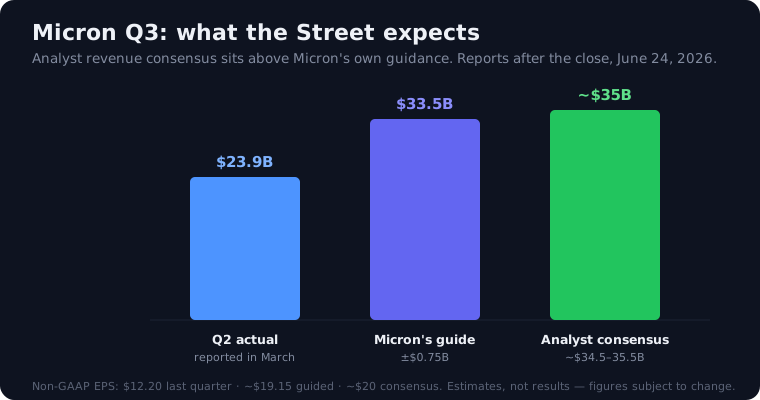
| Metric | Last quarter (actual) | Micron’s Q3 guide | Analyst consensus |
|---|---|---|---|
| Revenue | $23.86B | ~$33.5B (±$0.75B) | ~$34.5–35.5B |
| Non-GAAP EPS | $12.20 | ~$19.15 (±$0.40) | ~$20 |
The fact that analysts are modeling above the company’s own guidance tells you the Street expects a beat. For context, last quarter Micron posted record revenue of $23.86 billion — up 196% year over year — and EPS of $12.20 that beat estimates by roughly 42%, while saying its high-bandwidth memory capacity for 2026 was already fully allocated. Expectations this time are even higher.
What should investors watch in Micron’s earnings?
The headline revenue and EPS will grab attention, but several underlying details matter more for the story.
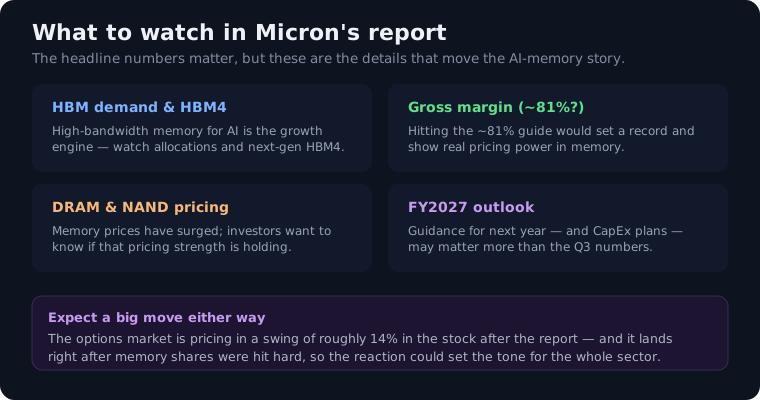
The big ones: high-bandwidth memory (HBM) — the specialized memory that goes into AI accelerators is Micron’s growth engine, so commentary on HBM demand, next-generation HBM4, and allocations tied to AI chip platforms will be scrutinized. Gross margin — Micron guided to around 81%, which would be a record, so hitting or beating that is a key test of its pricing power. DRAM and NAND pricing — memory prices have surged, and investors want confirmation that strength is holding. And above all, the outlook for fiscal 2027, including capital-spending plans, which may move the stock more than the Q3 numbers themselves.
Why does this Micron report matter so much right now?
Timing makes this one unusually loaded. Micron’s stock fell about 13% on Tuesday as a sharp selloff in memory peers Samsung and SK Hynix on South Korea’s market triggered panic that spread to US chip names. Even after that drop, MU is up well over 200% year to date, which captures how central the AI-memory trade has become — and how far expectations have run.
That’s why this report is widely seen as a bellwether for the entire AI-memory sector. A strong result and confident outlook could steady nerves after the selloff; a cautious one could deepen worries that the trade got ahead of itself. The options market is pricing in a swing of roughly 14% in the stock after the report, so a large move in either direction is expected.
Is Micron stock a buy before earnings?
This is the question everyone asks, and the honest answer is that it’s genuinely contested — so here’s both sides rather than a recommendation. On the bullish side, analyst sentiment is overwhelmingly positive: ratings are heavily skewed to “buy,” and several firms have raised their price targets aggressively into the report, some above $1,200 and one as high as $1,500, citing sold-out HBM capacity, record margins and a memory cycle they argue has become structural rather than boom-and-bust.
On the cautious side, Micron’s roughly $1 trillion valuation already prices in a lot of that optimism. The main risks: if hyperscalers buy less memory or train AI models more efficiently than expected, HBM demand could soften before Micron’s new capacity comes online; capital spending is rising sharply; and competition from Samsung and SK Hynix is intense. This week’s selloff is a reminder that sentiment can turn fast. A single earnings report won’t settle the bull-versus-bear debate — and with a ~14% move priced in, the risk cuts both ways.
The bottom line
Micron’s Q3 report, out after the close on June 24, is a major test for the AI-memory trade. Analysts expect roughly $35 billion in revenue and about $20 EPS — above the company’s own guidance — but HBM demand, the ~81% margin target, and the fiscal 2027 outlook are what really matter. Coming right after a steep selloff in memory stocks, the reaction could set the tone for the sector. Whatever happens, expect volatility, and remember that one quarter is a data point, not the whole story.
For more market context, see our explainers on why Sandisk stock crashed and the great rotation into AI hardware.
This article is news and general context, not investment advice, and does not recommend buying or selling any security. Analyst estimates are projections, not results; all figures are as of the preview window before the June 24, 2026 report and are subject to change.