Meaco Cirro Review: The Ultra-Quiet Portable Air Conditioner for a Good Night's Sleep

- The Meaco Cirro 12000 is a 12,000 BTU portable air conditioner rated 45 dB in Super Quiet mode (up to 51 dB at full power), priced at £519.99 — built and marketed for bedrooms, with a mode that also dims the display for sleep.
- It is genuinely quiet, but not the quietest on paper: on a like-for-like sound-pressure basis the electriQ EcoSilent (38 dB) and De’Longhi GentleJet (43 dB) rate a lower minimum. And 45 dB is still above the WHO’s <30 dB guideline for undisturbed sleep — quiet, not silent.
- Watch the yardstick: many budget units’ scary-looking 63–65 dB figures are EU-label sound power (about 10–13 dB higher than a near-field reading), so a raw number-vs-number table overstates the gap.
- Placement is a free lever — moving the unit a few metres from the pillow shaves a few real decibels off what you hear, though room reflections stop it dropping to zero.
If summer heat is wrecking your sleep, the noise of the fix can be as bad as the problem: most portable air conditioners drone somewhere around a running dishwasher. The Meaco Cirro is Meaco’s answer to that — a “Super Quiet” portable AC rated 45 dB in its quietest mode and pitched squarely at bedrooms, right down to a sleep setting that dims the display so there’s no glow at 2am. The headline is real, and for a light sleeper it can genuinely be a lifesaver for a good night’s kip. But “45 dB” needs a bit of unpacking before you spend £519.99 — so here’s how quiet that actually is, why where you put it matters, and how it stacks up honestly against other popular UK portable ACs.
This is a product explainer based on manufacturer specifications and public reporting, not a paid or affiliate review. Drawpie doesn’t earn a commission on anything here.
What is the Meaco Cirro?
The Cirro is a range of smart portable air conditioners from Meaco, the British climate-appliance brand best known for its dehumidifiers. There are three core cooling-only models (each also sold in a cooling-and-heating variant):
| Model | Price | Cooling | Room size | Noise (quiet → max) | Inverter |
|---|---|---|---|---|---|
| Meaco Cirro 12000 | £519.99 | 12,000 BTU | 20–30 m² | 45 – 51 dB | No |
| Meaco Cirro+ 14000 | £599.99 | 14,000 BTU | 25–35 m² | 42 – 51 dB | Yes |
| Meaco Cirro+ 16000 | £629.99 | 16,000 BTU | 35–40 m² | 42 – 51 dB | Yes |
This review focuses on the Cirro 12000, the entry model and the one most people cooling a bedroom will look at. Its key specs:
- Cooling: 12,000 BTU/h, suited to rooms of roughly 20–30 m²
- Noise: 45 dB in Super Quiet mode, up to 51 dB at full power
- Energy rating: A, with a natural R290 refrigerant
- Power draw: around 1,350 W on full cooling
- Smart control: WiFi, the Meaco app, plus Amazon Alexa and Google Assistant voice control, a timer and a child lock
- Sleep features: a Super Quiet mode that also dims the display so the room stays dark
- Build: 722 × 430 × 358 mm, 28.45 kg, with window kit and castors included; 2-year warranty (extendable to 5)
One nuance worth flagging up front: the base Cirro 12000 is not a DC inverter unit — Meaco’s own spec sheet says so. Its quietness comes from a “Dual-Wrapped Compressor” (layers of cotton wool and silicone insulation that damp the vibration). The pricier Cirro+ 14000 and 16000 are inverter models, which is how they trim the minimum figure to 42 dB. If steady, variable-speed running is a priority for you, that’s the practical difference between the base model and the “+” ones.
How quiet is 45 dB, really?
Decibels aren’t intuitive, so here’s a plain-English yardstick — and the number that matters most for sleep.
| Level | Sounds like | For sleep |
|---|---|---|
| ~30 dB | A soft whisper; a quiet library | WHO guideline — keep continuous bedroom noise below this for good sleep |
| ~40 dB | A fridge humming; a quiet office | Audible but usually tolerable |
| ~45 dB | Light rainfall | Around the level where intermittent noise starts to disturb some sleepers |
| ~50 dB | Moderate rain; a quiet dishwasher | Can delay sleep onset and wake light sleepers |
| ~60 dB | Normal conversation | Clearly disruptive |
Two rules of thumb make sense of this. Every +10 dB is perceived as roughly twice as loud, and the World Health Organization recommends keeping continuous bedroom noise below 30 dB for good-quality sleep.
So be clear-eyed: the Cirro’s 45 dB is quiet, not silent. It sits well below the ~63 dB drone of an older portable AC, and for most people it fades into the background like light rain. But it is still above the WHO’s ideal, so if you’re the kind of sleeper who wakes at a dripping tap, expect to notice it — just far less than almost anything else that actually refrigerates the air. (Two caveats on the number itself: Meaco doesn’t publish the measurement distance behind its 45 dB figure, and we’re not aware of an independent lab test — the press coverage repeats Meaco’s own rating.)
Placement: where you put it changes how loud it feels
Here’s a free lever most people miss. Sound spreads out as it travels, so an AC that measures 45 dB up close is quieter by the time it reaches your pillow across the room. In the open, sound pressure drops about 6 dB for every doubling of distance (the inverse-square law). A real bedroom isn’t open air, though — walls, ceiling and furniture bounce sound back, so the level falls off more gently and settles onto a reflected-sound “floor” rather than fading to nothing.
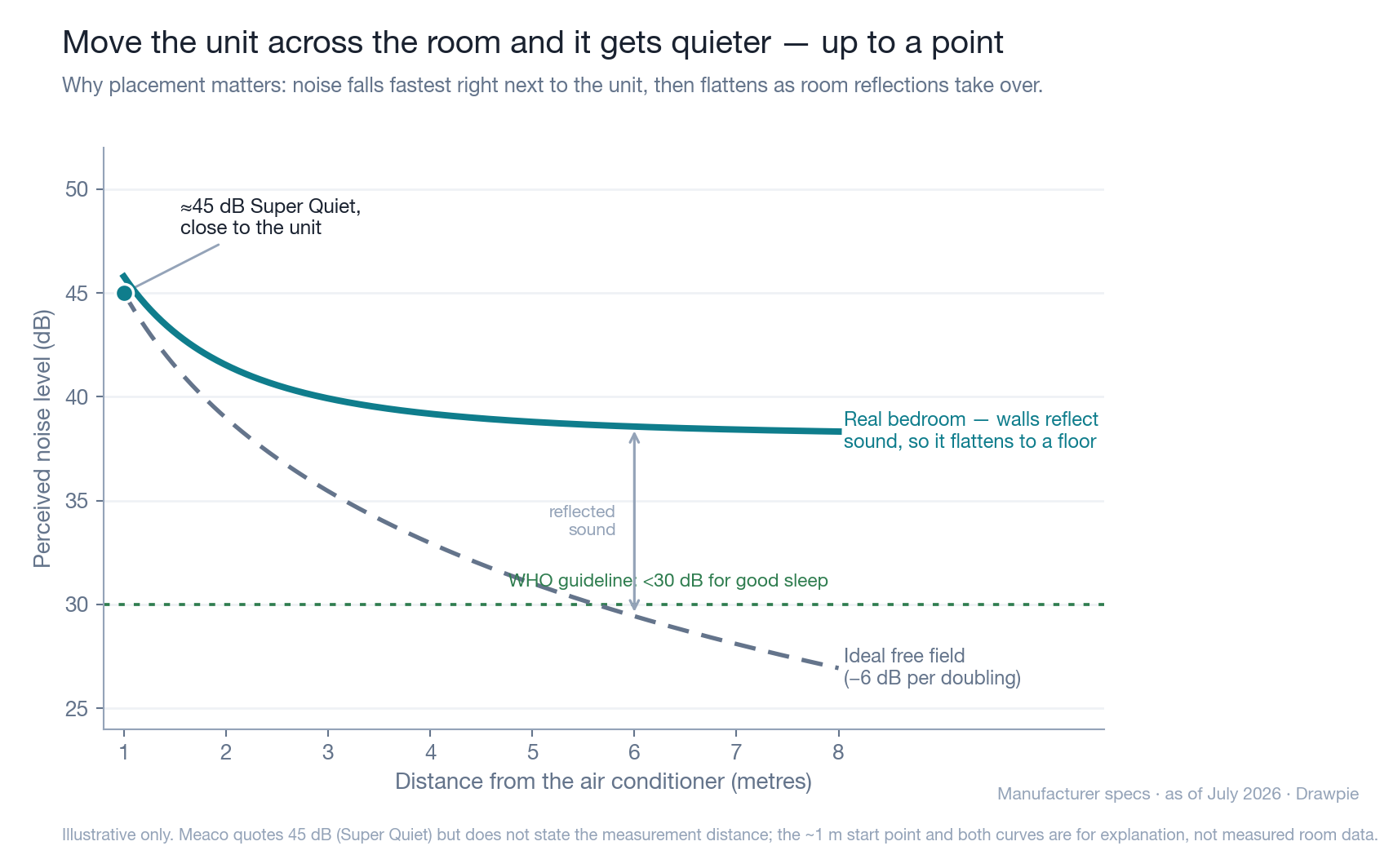
The practical takeaway: siting the unit across the room instead of right beside the bed buys you a few real decibels for free, on top of choosing sleep mode. A quick placement cheat-sheet:
| Do this | Why |
|---|---|
| Put the unit on the opposite or a side wall | Distance cuts the level you hear, and cool air crosses the room instead of blowing on you |
| Keep it ~1 m or more from your head, off the headboard wall | You’re out of the loudest near-field of the compressor |
| Use Super Quiet / sleep mode | It’s the low end of the noise range — and dims the display |
| Sit it near a wall or corner, not mid-room | Nearby surfaces absorb a little and it’s out of the direct line to the bed |
(The chart is illustrative: it starts from Meaco’s 45 dB figure and the standard physics, not a measured room, since the test distance isn’t published.)
How the Cirro compares with other popular UK portable ACs
This is where you have to be careful — because the manufacturer noise numbers you’ll see quoted are not all measured the same way, and comparing them blindly makes some units look far better or worse than they are.
There are two different figures in circulation:
- Sound pressure — what a microphone (or your ear) hears at a set distance. This is what the “quiet” specialists quote: Meaco, De’Longhi’s GentleJet, electriQ.
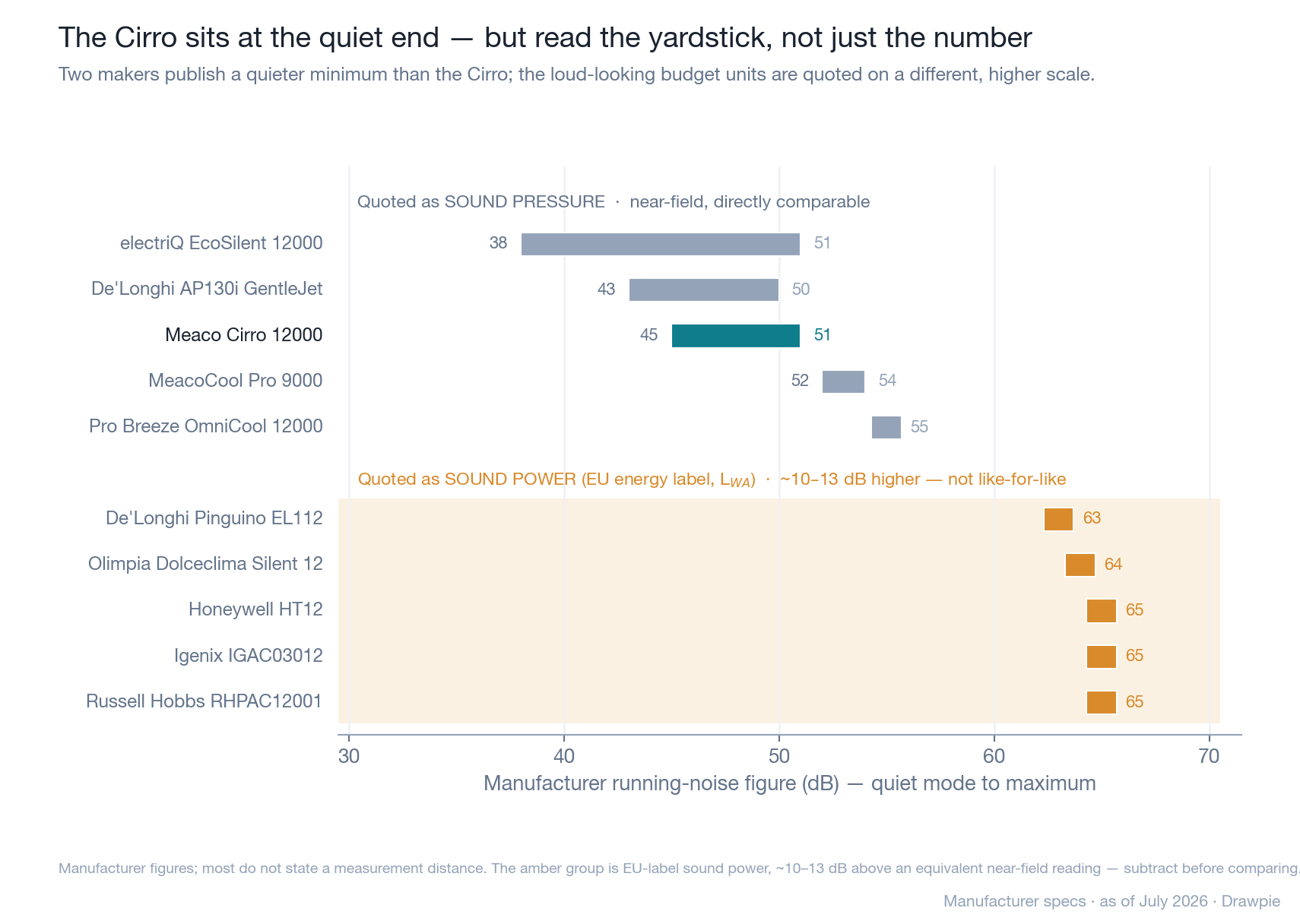
- Sound power (LwA) — a lab figure on the EU energy label, describing the total acoustic energy the machine emits. It runs roughly 10–13 dB higher than an equivalent near-field pressure reading. Many budget units’ “63–65 dB” specs are this number.
Put a 45 dB pressure rating next to a 65 dB power rating and it looks like a chasm. Convert the 65 dB power figure to a comparable pressure reading (~52–55 dB) and the real gap is much smaller — though the quiet units are still genuinely quieter. So here are the manufacturer figures kept in their two separate camps:
| Model | Noise (mfr) | Basis | Notes |
|---|---|---|---|
| electriQ EcoSilent 12000 | 38 – 51 dB | Sound pressure | Lowest quiet-mode figure here |
| De’Longhi AP130i GentleJet | 43 – 50 dB | Sound pressure | Also rated 64 dB sound power |
| Meaco Cirro 12000 | 45 – 51 dB | Sound pressure | Bedroom-focused; dims display |
| MeacoCool Pro 9000 | 52 – 54 dB | Sound pressure | Independent tests measured ~59 dB |
| Pro Breeze OmniCool 12000 | ~55 dB | Unstated | “Comparable to gentle rainfall” |
| De’Longhi Pinguino EL112 | 63 dB | Sound power | ≈ low-50s dB as a pressure reading |
| Olimpia Dolceclima Silent 12 | ~64 dB | Sound power | “Silent” marketing; ~64 dB(A) EU-label class |
| Honeywell HT12 / Igenix / Russell Hobbs | ~65 dB | Unstated (likely power) | Typical budget-unit rating |
Two honest conclusions come out of this. First, the Cirro is firmly at the quiet end, but it is not the quietest on paper: the electriQ EcoSilent (38 dB) and the De’Longhi GentleJet (43 dB) list a lower minimum. Second, most of the “loud” budget units aren’t as far behind as their raw numbers suggest — they’re just quoted on the higher sound-power scale. Where the Cirro earns its place is the whole package: a low pressure figure plus the sleep-focused touches (display dimming, app, timer) that the cheaper units skip.
So — is it a lifesaver for sleep?
For the right person, yes. If summer nights are unbearable and the noise of a normal portable AC is a deal-breaker, the Cirro does the thing that matters: it refrigerates a bedroom while staying quiet enough to sleep through. The dimming display, app scheduling and child lock make it genuinely bedroom-friendly in a way a £250 budget unit isn’t, and Meaco reckons it’s around half the noise of its older portables.
Just buy it for the right reasons. At £519.99 it’s a premium price — roughly double a basic 12,000 BTU unit — and you’re paying for quietness and the smart/sleep features, not extra cooling power. If the machine will mostly cool an empty room during the day, or you cool a living space where a bit of noise doesn’t matter, a cheaper unit does the cooling for far less. And remember 45 dB is quiet, not silent: the very lightest sleepers may still want to run it to cool the room, then switch it off at bedtime.
The bottom line
The Meaco Cirro delivers on its core promise — real cooling at a noise level most people can sleep through — and the bedroom-first features are the best part of the package. Read the spec with clear eyes: it’s at the quiet end rather than the outright quietest, “45 dB” is quieter than budget rivals but not below the WHO’s 30 dB sleep ideal, and much of that on-paper gap to cheaper units is a measurement-scale quirk, not pure performance. If a cool and quiet bedroom is worth £519.99 to you, it’s an easy recommendation. If you just need to drop the temperature and can live with some hum, your money goes further elsewhere.
How quiet is the Meaco Cirro?
The Cirro 12000 is rated 45 dB in its Super Quiet mode, rising to 51 dB at full power (the Cirro+ 14000 and 16000 dip to 42 dB). For context, 45 dB is about the level of light rainfall — quiet enough for most people to sleep through, though still above the WHO’s guideline of under 30 dB for undisturbed sleep.
Is the Meaco Cirro an inverter air conditioner?
The base Cirro 12000 is not a DC inverter — its low noise comes from a “Dual-Wrapped Compressor” with cotton-wool and silicone insulation. The larger Cirro+ 14000 and 16000 models are inverter units, which is how they reach the quieter 42 dB minimum.
Is the Meaco Cirro the quietest portable air conditioner?
It’s among the quietest, but not the outright quietest on paper. On a like-for-like sound-pressure basis, the electriQ EcoSilent 12000 (38 dB) and De’Longhi AP130i GentleJet (43 dB) list a lower minimum. Many budget units quote 63–65 dB, but that’s usually EU-label sound power, which runs about 10–13 dB higher than a comparable near-field reading.
How much does the Meaco Cirro cost?
The cooling-only Cirro 12000 is £519.99. The larger inverter models are £599.99 (Cirro+ 14000) and £629.99 (Cirro+ 16000); cooling-and-heating variants cost more.
Where should I place a portable AC in a bedroom for the least noise?
Put it on the opposite or a side wall, at least a metre from your head and off the headboard wall, and use sleep mode. Distance and room surfaces shave a few real decibels off what you hear at the pillow, on top of the quieter fan setting.
If you’re weighing up the running costs of cooling a bedroom all night, see our guide to portable air conditioner running costs in the UK , our best portable air conditioner picks for 2026 , and the portable air conditioner finder to match a unit to your room.