Masters of the Universe (2026): Cast, Plot, Ending Explained and Review

- It is streaming on Prime Video, included with a Prime membership, from 22 July 2026 — 47 days after it opened in cinemas on 5 June.
- There are three credits scenes, not one. The first is a gag, the second introduces She-Ra, and the third sets up Skeletor’s return.
- The ending’s point is that the Sword of Power was never the source of the power. Adam transforms without it, and it reassembles afterwards.
- It took about $114m worldwide against a budget reported between $170m and $200m — a clear financial loss despite mostly positive reviews.
Amazon MGM’s live-action Masters of the Universe started streaming on Prime Video today, Wednesday 22 July 2026, included with a Prime membership at no extra cost. That is 47 days after it opened in cinemas on 5 June — an unusually short gap, and one that says something about how the theatrical run went.
Travis Knight directs. Nicholas Galitzine plays Prince Adam, Jared Leto plays Skeletor, and the film’s central idea is one the 1980s cartoon never entertained: that the most powerful man in the universe spent fifteen years as an ordinary bloke in Oklahoma.
Everything below was checked on 22 July 2026.
Where can I watch Masters of the Universe (2026)?
| Detail | |
|---|---|
| Streaming | Prime Video, from 22 July 2026 — included with Prime, no extra rental fee |
| Digital purchase / rental | Available from 21 July 2026 |
| Cinemas | Still on limited release in some markets as of 22 July |
| Physical media | 4K UHD / Blu-ray announced, date not yet confirmed |
| Cinema release | 5 June 2026 |
| Runtime | 140 minutes (2h 20m) |
| Rating | PG-13 |
| Director | Travis Knight |
| Studio | Amazon MGM Studios (domestic) · Sony Pictures Releasing International |
A note on region. Streaming rights differ by country, and “it’s on Prime Video” is not the same statement everywhere. The 22 July date is the Amazon MGM release for its own platform; if you are outside the US or UK, check your local Prime Video listing before assuming it is there. We have not verified availability country by country, so we are not going to claim it.
The 47-day window matters. Amazon MGM’s usual pattern for its own theatrical titles is a fast handoff to Prime Video rather than a long premium-rental period — but 47 days is short even by that standard, and studios do not shorten windows on films that are still selling tickets.
Masters of the Universe (2026) cast: who plays whom
| Actor | Character | Who they are in the story | |
|---|---|---|---|
| Nicholas Galitzine | @nicholasgalitzine | Prince Adam / He-Man | Eternia’s heir, smuggled to Earth as a baby and raised in Oklahoma with no memory of it. Talks his way through problems because he has never had the option of fighting his way through them — which is the entire point of the character here. |
| Jared Leto | @jaredleto | Skeletor | The usurper who has held Eternia for fifteen years. Played knowingly and theatrically rather than menacingly, and by common account he is the most entertaining thing on screen. |
| Camila Mendes | @camimendes | Teela | Adam’s childhood friend and a front-line resistance fighter. She is the one who finds him on Earth and drags him home, and she is further along as a warrior than he is for most of the film. |
| Idris Elba | @idriselba | Duncan / Man-At-Arms | Royal armourer, Teela’s adoptive father and the resistance’s commander. He carries the film’s weight and its mentor role, and he is openly sceptical of Adam at first. |
| Alison Brie | @alisonbrie | Evil-Lyn | Skeletor’s sorceress and second-in-command. Keep her in mind — the last shot of the film belongs to her. |
| Morena Baccarin | @morenabaccarin | The Sorceress | Guardian of Castle Grayskull. She is the one who gets the infant Adam off Eternia in the opening, and the one who explains where the power actually comes from at the climax. |
| James Purefoy | — | King Randor | Adam’s father, imprisoned for fifteen years. His last exchange with his son states the film’s theme outright. |
| Charlotte Riley | — | Queen Marlena | Adam’s mother, an astronaut from Earth. She takes on the rule of Eternia afterwards, and she has the line that sets up the sequel. |
| Kristen Wiig | — | Roboto (voice) | Robot ally, and the film’s main source of comic timing. Damaged in the fighting and rebuilt by Duncan by the end. |
| Jóhannes Haukur Jóhannesson | @johanneshaukur | Fisto | Resistance fighter. |
| Jon Xue Zhang | @jonxuezhang | Ram-Man | Resistance fighter. |
| Dolph Lundgren | @dolphlundgren | Cameo | He-Man in the 1987 film, appearing here in a small role — the film’s biggest wink at its own history. |
Three of the cast — James Purefoy, Charlotte Riley and Kristen Wiig — have no personal Instagram account we could confirm, so no handle is listed for them. We would rather leave a gap than link you to somebody else.
Masters of the Universe (2026) plot
⚠️ Spoilers from here. This is the full story, including how it ends.
Eternia falls on the night Skeletor takes the palace. The Sorceress gets the infant Prince Adam off the planet along with the Sword of Power, and he lands on Earth — where he loses the sword and grows up in Oklahoma with no idea what he is, sharing a flat and an ordinary life.
Fifteen years later the sword resurfaces and Teela, who knew him before, comes to bring him home. What he finds is a conquered planet: his parents imprisoned, Skeletor ruling, and a resistance led by Duncan that is distinctly unimpressed by the soft-handed man from Earth they have been told is their prince. He has no muscles, no combat training and no conviction — he talks his way through things, because talking is all he has ever had.
That is the film’s actual engine, and it is a smarter structural choice than it first appears. He-Man has always had a storytelling problem: a hero who is invincible by definition has nowhere to develop. Starting him as a nobody manufactures an arc the character never had.
The resistance moves on Snake Mountain to free Adam’s parents, and the raid fails. King Randor dies there — Adam gets his father back for a matter of minutes before losing him. Adam is captured, and the Sword of Power ends up in Skeletor’s hands.
It does not work for him. The sword simply refuses, which is the first clear signal of what the film is actually arguing. Skeletor takes it to Castle Grayskull regardless, and the final confrontation happens there.
Skeletor shatters the sword and runs Adam through with the broken hilt. It makes no difference. The Sorceress reaches Adam with the answer the whole film has been building to — the power was never in the blade — and he transforms into He-Man without it. The sword reassembles afterwards, on his terms.
He-Man wins the fight that follows. Skeletor’s body disintegrates and leaves nothing but the skull on the floor.
Six months later Eternos has been rebuilt, Duncan has repaired Roboto, Queen Marlena has taken up the rule, and Adam has publicly taken the name He-Man. Cringer becomes Battle Cat, and the two of them ride out to answer a distress call as the credits begin. Adam has also brought his friend from Earth to see Eternia — the film’s last quiet joke about where its hero actually grew up.
Masters of the Universe ending explained
The plot above covers what happens. This is what it means — and the one detail the published accounts genuinely disagree on.
The whole film is one argument, made three times. Randor’s dying line at Snake Mountain (“he never had to be the strongest”), the Sorceress’s revelation at Grayskull (the power was never in the blade), and the sword reassembling only after Adam has already transformed are three separate beats beating the same drum. A property built in 1983 on the premise that strength solves things has been turned into one about why it does not — and it gets there without sneering at the source material, which is the harder half of that job.
The sword is the clearest piece of writing in it. It refuses to work for Skeletor. It shatters at the exact moment it should matter most. Adam transforms with it in pieces on the floor. Only then does it come back together. An object that the 1980s toy line treated as the source of the power is systematically demoted to a symbol of it, and the film never has to say so out loud.
One detail is genuinely disputed, so we are not going to pretend otherwise. Some published accounts describe Randor’s death as an accident caused by Adam himself — a sword strike during the fight that brings the ceiling down on his father. Others state plainly that Adam is not responsible and that Skeletor is. Every account agrees Randor dies at Snake Mountain as a result of that confrontation, but not on who caused it. If the accidental-patricide reading is correct, this is a considerably darker film than the marketing suggested — which may be exactly why the accounts diverge.
Skeletor is destroyed, not killed. His body disintegrates and leaves the skull behind, intact and on screen. That is a deliberate choice, and the third credits scene confirms it.
Is there a post-credits scene in Masters of the Universe?
Yes — there are three, and they are spread across the whole credit roll. The first arrives almost immediately, the second lands mid-credits, and the third is at the very end. Stay to the end; the last one is the one that matters.
⚠️ Spoilers for all three scenes below.
- Orko recaps the film. A direct lift of the moral-of-the-story tag that closed episodes of the 1983 cartoon, played for laughs — his takeaway being that people with skulls for heads cannot be trusted.
- She-Ra is introduced. Queen Marlena and Duncan watch He-Man ride out, and Marlena worries about both her children. The scene closes on Princess Adora — played by Lauren Saliu , which is why she is not in the cast table above — seen from behind, looking towards what appears to be Hordak’s fortress.
- Evil-Lyn takes the skull. She retrieves what is left of Skeletor from Castle Grayskull and leaves with it, plainly intending to bring him back. His laugh is the last thing you hear.
So: one joke, and two separate sequel hooks pointing in different directions — the Horde and Etheria on one side, a resurrected Skeletor on the other.
Where was Masters of the Universe (2026) filmed?
Mostly in England, with the alien exteriors shot in Iceland — and unusually for a film this size, several of the locations are real places you can visit rather than sets.
| Location | What it stands in for | Can you visit? |
|---|---|---|
| Wells Cathedral, Somerset | A major battle sequence — reportedly 200+ crew built sets inside the cathedral | Yes, a working cathedral open to visitors |
| Wookey Hole Caves, Somerset | Several sequences in and around the caves | Yes, a paid tourist attraction |
| Beer Quarry Caves, Devon | Underground sequences | Yes, guided tours only |
| Canary Wharf, London | Earth-side scenes, including a tube station | Yes, free public access |
| Iceland | Eternia’s volcanic exteriors | Yes, though specific sites are not confirmed |
| Italy | Additional photography | Site not confirmed |
| Sky Studios Elstree · Bray Film Studios | Interiors and stage work | No — working studios |
Worth separating those last two rows from the rest: Elstree and Bray are sound stages, not locations. Fan round-ups routinely fold studios and real places into one “filming locations” list, which is how you end up with people turning up somewhere expecting to recognise it.
Principal photography ran from around February to June 2025.
What did critics and audiences actually make of it?
Two things are true at once here, and the gap between them is the interesting part.
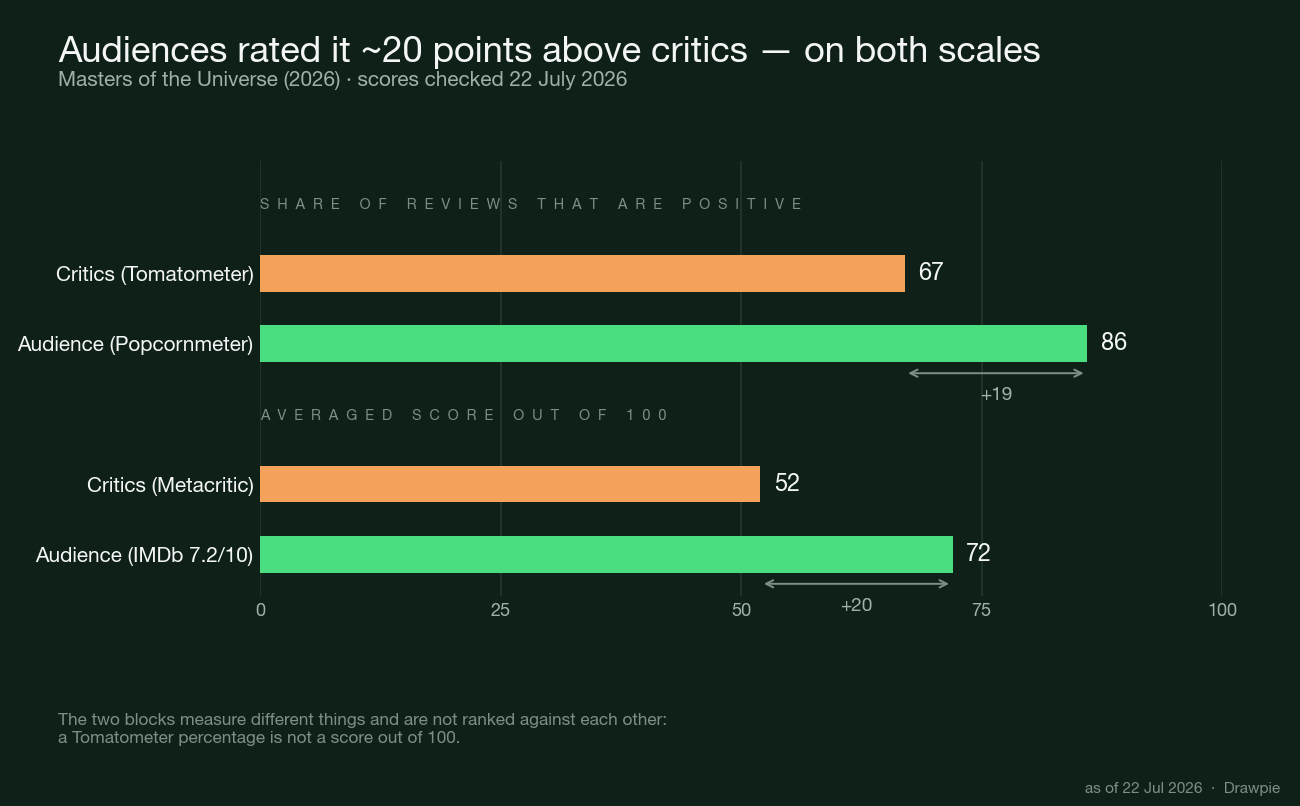
| Measure | Critics | Audience | Gap |
|---|---|---|---|
| Share of reviews that are positive | 67% (Tomatometer, 251 reviews) | 86% (Popcornmeter, 5,000+ ratings) | +19 |
| Averaged score out of 100 | 52 (Metacritic) | 72 (IMDb, 7.2/10) | +20 |
| Exit polling | — | B (CinemaScore) | — |
All figures checked 22 July 2026. Review counts grow and scores move; the Tomatometer had already shifted from 68% / 248 reviews to 67% / 251 between Wikipedia’s snapshot and ours.
A ~20-point spread in the same direction on two different measurement systems is not noise. It is the same pattern that showed up in Disney’s live-action Moana remake earlier this month , where critics were far harsher than the people who bought tickets. It is the signature of a film that is not especially polished but is doing something audiences respond to — and in this case it is not hard to identify what.
The Oklahoma opening is the whole trade. Making Adam a nobody for the first act is what gives the character an arc, and it locks precisely into the theme the ending pays off. It also means the first stretch of a He-Man film is a fish-out-of-water comedy, which is not what the audience for a He-Man film turned up to see. That is a structural cost, not an execution failure — the film chose the version that is better as a story and worse as a Friday-night blockbuster, and critics reviewing pace felt it more sharply than audiences watching at home ever will.
A camp Skeletor is the right call and it has a price. Getting a 2026 audience to accept a purple-robed skull as a threat essentially requires playing him knowingly, and by every account that is the most enjoyable thing in the film. But a villain who is fun is a villain who is not frightening. The ending kills a king and impales the hero, and the menace still sits lighter than those events should feel. That is the bill for the tone, not a flaw in the performance.
The theme lands, which is rarer than it sounds. Randor’s line at Snake Mountain, the Sorceress’s revelation at Grayskull, and the sword reassembling only after Adam has already transformed are three separate beats making the same argument. A 1983 property built on the premise that strength is the answer has been turned into one about why it is not, without the film sneering at the source. That is a real piece of adaptation.
Our rating: 6.5 / 10 — more sincere than accomplished, better in its ideas than its execution, and best watched at home where the slow first act costs you nothing.
Why did it lose money if the reviews were fine?
Roughly $114m worldwide — about $65m domestic and $49m international — against a production budget reported between $170m and $200m depending on the outlet, before marketing. The opening weekend was $29.3m and it finished second.
That is a clear loss, and 67% with a B CinemaScore is not the profile of a film that failed on quality. Some observations:
- He-Man is not a household property the way it is often assumed to be. Recognition among people who were children in the mid-1980s is not the same as broad cultural currency, and that demographic is not the one filling cinemas in 2026.
- A streaming company running a theatrical release is doing something it is structurally not built for. Amazon MGM’s marketing reach into audiences who were not already interested is limited compared with studios that do this every month.
- Losing the opening weekend removes the one week a film like this had. Without a number-one debut, there is no news cycle, and nothing to convert casual awareness into ticket sales.
- The 47-day streaming window is the tell. Nobody moves a film to streaming that quickly while it is still performing.
Will there be a sequel?
Two of the three credits scenes exist to set one up, which tells you what the plan was. The box office tells you what is likely to happen instead.
A theatrical sequel is hard to justify on these numbers. But Amazon owns the property, owns the platform, and has already spent the money — and a Prime Video series is the far more natural home for what those scenes set up. The She-Ra thread in particular suits episodic television better than a second film: contained budget, a new lead, and a story that can run without needing another $170m opening weekend.
Treat the credits scenes as intent, not as a schedule — the same caution applies to every 2026 blockbuster building a franchise out of post-credits teases .
The bottom line
Worth your time if you have Prime and any affection for the property — it is genuinely well-meaning, the theme is properly built, and Leto is having a better time than anyone else on screen. Skip it if you are impatient: the first forty minutes are a different film from the one you are waiting for, and knowing that in advance does not entirely fix it.
It was always going to play better on a sofa than in a cinema, and as of today that is exactly where it lives.
Is Masters of the Universe on Prime Video?
Yes. It has been streaming since 22 July 2026 and is included with a Prime membership at no additional charge. It was also available to buy or rent digitally from 21 July.
How many end credits scenes does Masters of the Universe have?
Three — one shortly after the credits begin, one mid-credits, and one right at the end.
Does Skeletor die in Masters of the Universe?
His body is destroyed, leaving only his skull. The final credits scene shows Evil-Lyn collecting it, so the film is explicit that this is not permanent.
Is Masters of the Universe (2026) a sequel to the 1987 film?
No. It is a new adaptation with no story connection to the Dolph Lundgren film, though Lundgren himself makes a cameo appearance.
How long is Masters of the Universe (2026)?
140 minutes, or 2 hours 20 minutes.