Why Mamdani Pushed New York's Second-Home Tax (2026)

- The short answer is a $12 billion hole. Mamdani inherited it, promised on Tax Day that he would tax the rich rather than cut services or raise ordinary property taxes, and the second-home surcharge is the piece of that promise Albany agreed to pass.
- It is already law. The state legislature enacted it on 26 May 2026 as part of the state budget; it took effect on 1 July and sunsets on 30 June 2031. The first bills are due on 1 January 2027.
- Three homeowners sued on 7 August — but over the rollout, not the tax. The city published a roll naming over 900,000 owners and then sent letters to 17,000, and the response deadline has already been pushed from 21 August to 18 September.
On 15 April 2026 — Tax Day — Mayor Zohran Mamdani and Governor Kathy Hochul stood together and announced a pied-à-terre tax: an annual surcharge on expensive New York City homes whose owners live somewhere else. Six weeks later the state legislature passed it. It took effect on 1 July, the first letters went out in late July, and on 7 August three homeowners took the city to court.
The question of why he pushed it has a short answer and a longer one. The short answer is that he inherited a $12 billion budget gap and had promised not to close it by cutting services or raising ordinary property taxes, which leaves a narrow menu. The longer answer is about what this particular tax lets a mayor say, and about the one structural fact that had killed every previous attempt.
What is Mamdani’s second-home tax?
It is a state law that lets New York City charge an annual surcharge on residential property that is not somebody’s primary residence — officially, the “City Surcharge on Property That Does Not Serve as a Primary Residence”.
The legislature added it as sections 1350 to 1356 of the state tax law, inside Part HH of the 2026–2027 state budget bill, and enacted it on 26 May 2026. It took effect on 1 July 2026 and is written to sunset on 30 June 2031 unless extended. The Department of Finance administers it, adds it to the property’s statement of account, and enforces it the same way it enforces property tax — with one difference that matters: the abatements, credits and exemptions that reduce a normal property tax bill do not apply to the surcharge.
For the year that began on 1 July 2026, the surcharge is due and payable on 1 January 2027. After that it follows the same twice-yearly schedule as the rest of the property tax bill.
Why did Mamdani push it?
Because of the size of the gap, the promises attached to it, and the fact that this is the one tax on the wealthy that Albany was willing to pass.
The hole. The administration’s own framing, from the May budget release, is that it inherited a historic $12 billion budget gap. The FY2027 Executive Budget it published on 12 May 2026 came to $124.7 billion, and the political claim attached to it was specific: balanced without slashing services, without raising property taxes, and without draining long-term reserves. Take those three things off the table and what remains is new revenue from a narrow group.
The promise. Mamdani has been explicit about the framing. Announcing the notification process in July, he said that when he came into office he made clear the city would need long-term solutions to long-term fiscal challenges, and that on Tax Day he promised to tax the rich — “and with our new pied-à-terre tax, that is exactly what we have done.” The April release describes the target as people who use New York City real estate “as a vehicle for wealth storage rather than as homes”, and names examples, including a $238 million Midtown penthouse.
The one structural fact. New York City cannot invent taxes. A pied-à-terre tax needs Albany’s authorisation, which is exactly why leaders across multiple administrations proposed versions of this for more than a decade without one ever being enacted. The version that passed traces back through state Senate bill S44B and earlier drafts to a 2014 proposal. What changed in 2026 was not the idea; it was that a governor put her name on it and folded it into the state budget, where it passed as part of a package rather than as a standalone vote.
That is also the honest answer to the political question. This tax has a property that few others do: on the city’s account of it, the people who pay are by definition people who live somewhere else and do not pay New York City income tax — which makes it unusually cheap to support. The administration says the tax is backed by 93% of New Yorkers. That figure comes from the Mayor’s Office release, which does not name a pollster, a sample size or when the survey was run, and we could not find the underlying poll. Treat it as a claim rather than a measurement.
How much does the surcharge actually charge?
Between 0.8% and 6.5% a year, depending on what kind of home it is — and the two property classes are taxed on completely different values, which is where most of the confusion starts.
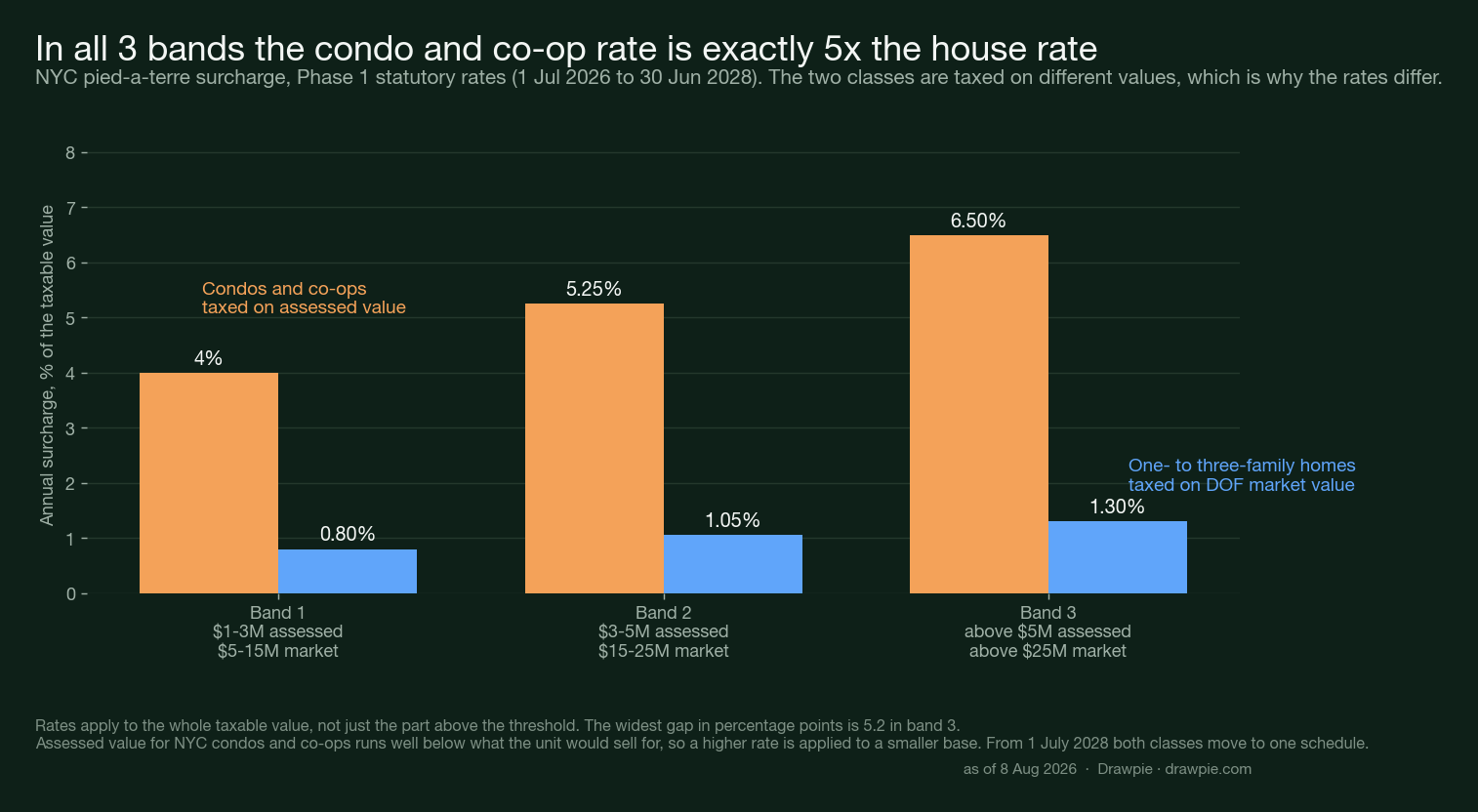
| Property | Taxable value | Rate |
|---|---|---|
| Condo or co-op | Assessed value $1M–$3M | 4% |
| Condo or co-op | Assessed value $3M–$5M | 5.25% |
| Condo or co-op | Assessed value above $5M | 6.5% |
| One- to three-family home | Market value $5M–$15M | 0.8% |
| One- to three-family home | Market value $15M–$25M | 1.05% |
| One- to three-family home | Market value above $25M | 1.3% |
Two things about that table do a lot of work.
First, the rate applies to the whole taxable value, not only the slice above the threshold. Crossing a band boundary re-rates the entire property.
Second, the two columns are not comparable. Houses are charged on the Department of Finance’s estimate of market value, derived from comparable sales. Condos and co-ops are charged on assessed value, because the department cannot by statute value them at market — and assessed value for New York co-ops and condos runs far below what the unit would actually sell for. That is why the condo threshold is $1 million while the house threshold is $5 million, and why the condo rates are set at exactly five times the house rate in every band. It is the same schedule applied to a much smaller base.
That arrangement is temporary. From 1 July 2028 the tax enters a second phase in which condos, co-ops and houses all use a $5 million threshold, based on a new valuation model the Department of Finance has to build to approximate market value from comparable sales. At that point condo and co-op valuations rise and their rates drop to match the house schedule.
Who has to pay, and who is exempt?
Anyone whose covered property was not somebody’s primary residence — but “somebody” is broader than the owner, and the test is a specific date.
A property counts as a primary residence if, as of 5 January of the preceding fiscal year, it was lived in for more than half the year by either of the following:
- one or more covered owners, or an immediate family member of one — defined as a spouse, child, sibling, parent, grandparent or grandchild
- one or more tenants or permitted sub-tenants under an arm’s-length lease running at least a year
So a unit rented out long-term is not caught, and neither is one your parent or child lives in. The tax is aimed at units that sit empty.
Ownership structures are where it gets awkward. For property in a trust, the beneficial owners are treated as the covered owners, provided they are the sole beneficiaries. For property in an LLC, partnership or corporation, the majority interest holders are. The legal owner — the trustee or the entity — is the one that actually pays.
There is a gap in that design worth knowing about. If several people each hold only a minority stake in an LLC, so that nobody is a majority holder, then nobody is a covered owner — and the property is subject to the surcharge no matter who lives in it, unless a genuine arm’s-length tenant has it as their primary residence. The statute is also silent on what happens when a trust holds a majority interest in an LLC that holds the property.
And one consequence catches people who would never describe themselves as pied-à-terre owners: if you live in New York City and own more than one home here, only one of them can be your primary residence. The other is a covered property, and you owe the surcharge on it even though you pay city and state income tax.
Why did people who live in New York get letters?
Because the city published its property tax roll — over 900,000 names and addresses — and a great many people found themselves on a list that was widely read as a list of people who owe the tax. It was not.
The roll is released annually and, on the mayor’s account, its publication is required under state law. What was new was the surcharge, which turned a routine document into a story. The Department of Finance later amended its own website to say, in capitals, that the vast majority of properties and units in the roll will not be subject to the surcharge. Of those 900,000-plus entries, letters went to 17,000 owners telling them they had been identified as potentially liable and would have to prove the home is their primary residence.
Tax lawyers reported being swamped with calls. On the Monday after the letters landed, Mamdani extended the response deadline by four weeks, from 21 August to 18 September, saying the administration had not wanted to levy the charge without giving New Yorkers a period to engage with the city, and that this was that period. Separately, the statute requires the Department of Finance to notify owners of properties subject to the tax no later than 30 August 2026.
Why is the city being sued?
Three homeowners went to court on 7 August 2026 over how the tax was rolled out. Notably, the suit does not challenge the tax itself.
The petitioners are Simon Hedley, Rachel O’Brien and Carmine Morano. They say the city wrongly identified their homes as potentially subject to the surcharge when those homes are their primary residences, and that the city “arbitrarily and capriciously foisted onto New York City residents the burden of proving they are not subject” to it. They are asking a court to declare the notices and the published roll unlawful, to take the list down, to pause any obligation to respond while the case runs, and to stop enforcement until it is decided.
Two details are worth having. O’Brien is married to a Republican city council member from Staten Island, and Carmine Morano is his father, so this is not a politically neutral set of plaintiffs. Their lawyer is Randy Mastro, who was first deputy mayor under the previous mayor and is a prominent critic of this one; his line on the case is that the mayor wanted a headline and got one, at the cost of thousands of people who owe nothing being confused and put to expense. The third petitioner, Hedley, describes himself as a Mamdani supporter who nonetheless received a letter and found it unsettling.
The city’s response, through a spokesperson for the mayor, is that the Department of Finance has been working around the clock to answer questions and help people who are subject to the charge, that the surcharge will pay for cleaner parks and safer streets, and that the Law Department is prepared to defend the city vigorously.
Whatever the merits, the timing matters more than it looks. The surcharge is supposed to start producing money in the fiscal year that has already begun, and the first bills are due on 1 January 2027.
Will it actually raise $500 million?
The $500 million figure is the administration’s and the Governor’s. The city’s own comptroller, looking at an earlier version of the bill, thought the arithmetic worked on paper and then got smaller once you allowed for the real world.
| Estimate | What it assumes |
|---|---|
| $500 million a year, from the Governor’s office | About 13,000 second homes with a market value of at least $5 million |
| Almost exactly $500 million, City Comptroller, gross | A little over 11,200 properties, before exclusions and behavioural change |
| Roughly $340–380 million, City Comptroller, adjusted | After allowing for units rented out, and for owners changing behaviour |
The comptroller’s fiscal note is the most useful document in this whole story, because it lists what nobody knows: how many of the targeted properties are actually lived in by owners or their relatives, how many are rented to primary residents, how many co-op and condo units would be appraised below the threshold, and how the tax applies to two- and three-family houses. It also flagged, before any of this happened, that implementation could be affected by legal challenges, and that it was unclear when collections would start.
That analysis was written against an earlier draft with different rates, so the numbers are not a direct forecast of the enacted tax. What carries over is the shape of the uncertainty: the revenue depends almost entirely on how many of these homes turn out to be rented or occupied, and on what owners do once the bill is real.
What happens next?
Four dates, and one of them is the one to watch.
| Date | What happens |
|---|---|
| 30 Aug 2026 | Statutory deadline for the Department of Finance to notify owners of properties subject to the surcharge |
| 18 Sep 2026 | Extended deadline for owners who received letters to respond and prove primary residence |
| 1 Jan 2027 | First surcharge payment falls due for the year that began 1 July 2026 |
| 1 Jul 2028 | Phase 2 begins: one $5 million threshold and one rate schedule for all property types |
| 30 Jun 2031 | The surcharge sunsets unless the legislature extends it |
The date that actually decides things is 18 September, because the number of successful primary-residence claims is what turns an estimate into a revenue line. If a large share of the 17,000 letter recipients demonstrate they live in their homes, the money lands closer to the comptroller’s lower range than to the headline. The litigation sits on top of that: the relief the plaintiffs are asking for would pause the obligation to respond at all, which would push the whole thing past the point where it can be counted in this fiscal year.
This article makes no prediction about what any of this does to New York property values, and quotes nobody else’s. If you want a sense of how housing costs are moving in a different market, our piece on UK mortgage rates hitting a one-month high covers what that does to buyers and remortgagers there.
Sources
Checked on 8 August 2026.
| Source | What it supports here |
|---|---|
| NYC Mayor’s Office, 15 Apr 2026 — Mamdani and Hochul announce the state’s first pied-à-terre tax | The announcement date and framing, the $5M headline threshold, the $500M projection, the “wealth storage” language, the 93% claim, the named example properties |
| Governor’s Office, 15 Apr 2026 — Pied-à-terre tax proposal for luxury second homes | That the state is authorising the city to levy; “at least $500 million a year”; the definition excluding rented and family-occupied homes; the extra $1.5bn of state support for the city |
| Dechert, 5 Jun 2026 — New York City imposes pied-à-terre tax | Phase 1 and Phase 2 rate schedules and thresholds, the assessed-versus-market distinction, the primary residence test and its 5 January date, trust and LLC treatment, payment dates, no abatements |
| Holland & Knight, 4 Jun 2026 — New York State enacts pied-à-terre tax | Enactment on 26 May 2026, Part HH and tax law sections 1350–1356, the 1 July 2026 effective date and 30 June 2031 sunset, and that NYC residents owning more than one home are caught |
| NYC Comptroller — The pied-à-terre tax and its potential revenues | The 13,000-property basis for the $500M figure, the comptroller’s own $500M gross and $340–380M adjusted estimates, the list of unknowns, the S44B lineage |
| NYC Mayor’s Office, 12 May 2026 — $124.7 billion FY2027 Executive Budget | The $12 billion inherited gap, the budget total, and the no-cuts/no-property-tax-rise framing |
| CNN, 7 Aug 2026 — Homeowners file lawsuit challenging the rollout | The petitioners, that the suit does not challenge the tax’s legality, the 900,000-entry roll and 17,000 letters, the relief sought, and the city’s response |
| Gothamist, 7 Aug 2026 — New lawsuit slams the tax for creating “mass confusion” | The plaintiffs’ relationship to a city council member, Mastro’s quote, the deadline extension from 21 August to 18 September, and Mamdani’s “period of engagement” remark |
| CPA Practice Advisor, 24 Jul 2026 — Mamdani starts the notification process | The start of the notice mailing, the Finance Commissioner’s involvement, and Mamdani’s “tax the rich” quote |
Rate figures in the chart and the table above are the statutory Phase 1 rates as read by the two law-firm alerts; the five-times relationship between the two schedules is our own arithmetic on those rates.
How we verified this
Primary documents first. The design, rates and mechanics here come from the enacted statute as read by two independent law-firm alerts (Dechert, 5 June; Holland & Knight, 4 June), cross-checked against the City and State press releases and the City Comptroller’s fiscal note. Where the press coverage simplified the design — several outlets described the condo and co-op threshold as a market value — we followed the statutory reading, which uses assessed value in Phase 1.
The 93% claim is not treated as a poll. The Mayor’s Office release says the tax is “supported by 93% of New Yorkers”. It names no pollster, sample size, field dates or margin of error, and we could not locate the underlying survey. It appears in this article as something the administration says, not as a measurement.
A source we checked and did not use. A February 2026 congressional press release attacking a “Mamdani property tax hike” turns up in searches for this story. It predates the pied-à-terre announcement and is about a proposed increase in the general property tax rate, which is a different measure. It is not opposition to this tax and is not cited as such.
Revenue figures are labelled by whose they are. The $500 million is the administration’s and the Governor’s estimate. The $340–380 million range is the City Comptroller’s own modelling, published before enactment and based on an earlier version of the bill with different rates, so it is an indication of how the estimate moves once exclusions and behaviour are counted, not a competing forecast of the enacted tax.
No forecast. This article does not predict what the surcharge will do to New York property values, rents or sales volumes, and carries no third-party projection of that.