Did Lindsay Clancy Admit She Did It? What Her Defense Actually Argued

- Lindsay Clancy pleaded not guilty to first-degree murder in the deaths of her three children.
- Her defense told the jury she killed them, but argued she should not be held criminally responsible because she was suffering from postpartum psychosis and was overmedicated.
- Those two things are not a contradiction. A lack-of-criminal-responsibility defense generally does not dispute what happened — it disputes responsibility for it.
- Clancy did not testify. Everything the jury heard from the defense was said by her lawyer.
- The trial ended in a mistrial on 4 September 2026. There is no verdict and no conviction.
- The jury split 11 to 1. Which way the eleven leaned has not been officially disclosed — that the eleven favoured acquittal is her lawyer’s claim.
- A not guilty verdict by reason of mental disease or defect would not have meant release. PBS reports it could have meant continued confinement in a psychiatric hospital.
- At a 29 September 2026 status hearing, Judge Sullivan heard arguments on a required-finding-of-not-guilty motion, a double-jeopardy motion to dismiss, a motion to investigate the holdout juror, and a prosecution gag-order request — and ruled on none of them. All four return on 2 November 2026.
- No retrial date has been set. The district attorney’s office still had not decided whether to retry Clancy.
Lindsay Clancy pleaded not guilty. Her defense also told the jury she killed her three children. Both of those are true, and neither contradicts the other.
That is the whole answer to the question, and it is the thing most coverage runs together. On 4 September 2026 her trial ended in a mistrial — so no court has ruled on any of it.
The short answer
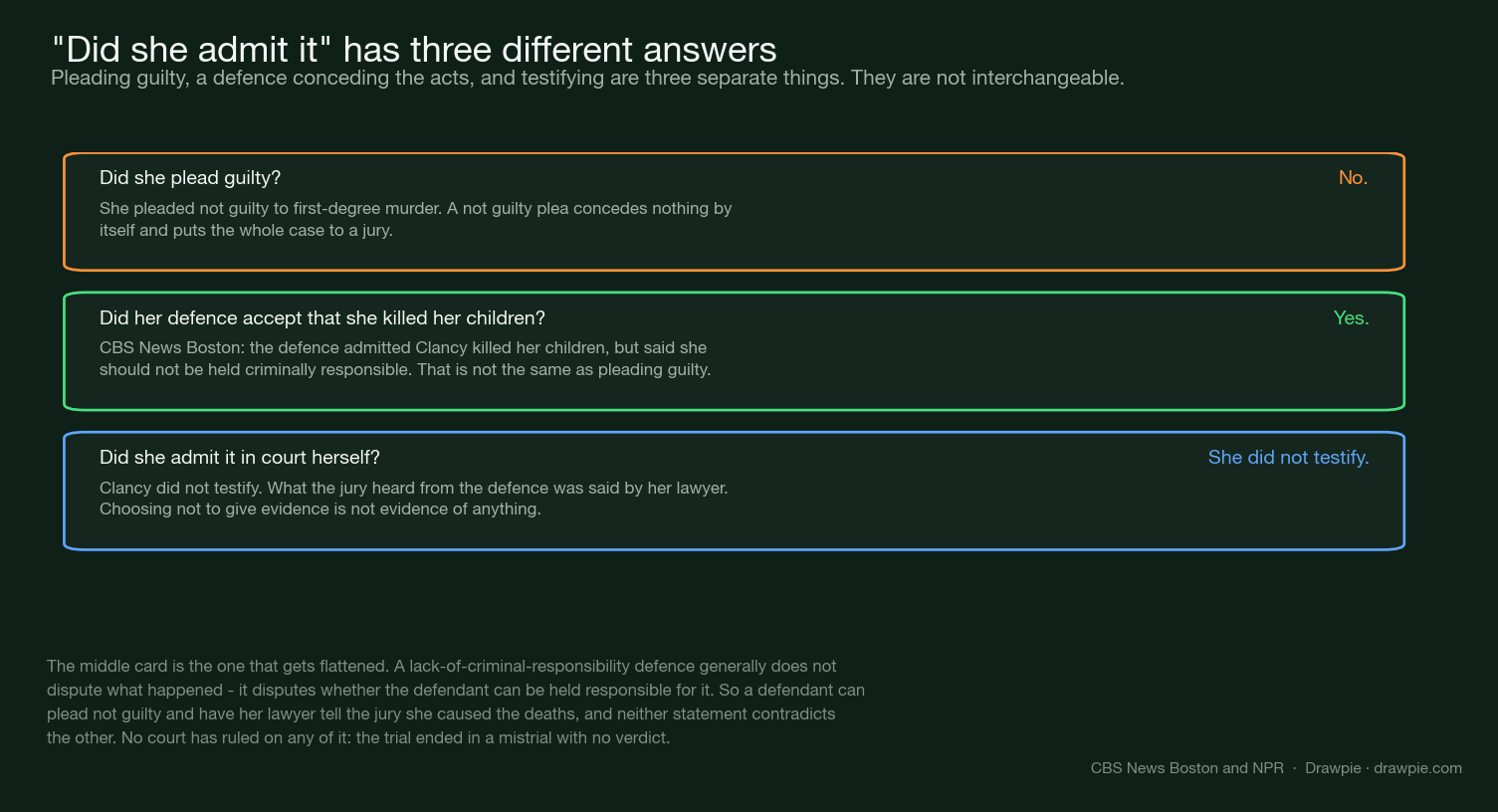
| The question | The answer |
|---|---|
| Did she plead guilty? | No. Not guilty to first-degree murder. |
| Did her defense accept she killed her children? | Yes. But argued she was not criminally responsible. |
| Did she admit it herself, in court? | She did not testify. |
The middle row is where the confusion lives. A lack-of-criminal-responsibility defense — often called the insanity defense — generally does not dispute what happened. It disputes whether the defendant can be held responsible for it. So her lawyer could tell a jury she caused the deaths while she maintained a not guilty plea, and both statements stand.
What she pleaded
Not guilty to first-degree murder, in the deaths of Cora, 5, Dawson, 3, and Callan, 8 months, at the family’s home in Duxbury, Massachusetts, on 24 January 2023.
A not guilty plea concedes nothing by itself. It puts the entire case to a jury and requires the prosecution to prove it.
What the defense admitted
In CBS News Boston’s words: “The defense admitted Clancy killed her kids, but said she shouldn’t be held criminally responsible because she was overmedicated and suffering from postpartum psychosis.”
Her attorney was Kevin Reddington. The defense called forensic psychologist Paul Zeizel, who testified that Clancy was experiencing postpartum psychosis, and that she said she heard a male voice ordering her to kill her children and herself.
Clancy did not testify. Everything the jury heard from her side came from her lawyer and her experts. A defendant is not obliged to give evidence, and declining to is not evidence of anything.
What the prosecution argued
That she knew what she was doing.
Prosecutors said Clancy planned the killings and knew right from wrong. NPR summarises the prosecution case as arguing she was well enough to plan and act with intention.
Plymouth County District Attorney Tim Cruz, defending the decision to charge first-degree murder:
“This case, however, was about Lindsay Clancy and what she did on January 24, 2023, and the cruel and calculated killing of three innocents. I understand that postpartum depression has impacted the lives of countless women and their families and I sympathize with their struggles. The investigation into these heinous killings however, did not establish that they were caused by such depression.”
Both sides agreed she was struggling. The dispute was about what that meant in law.
What the jury was actually deciding
The test, as reported: whether her mental state made her unable to tell right from wrong, or to conform her conduct to the law.
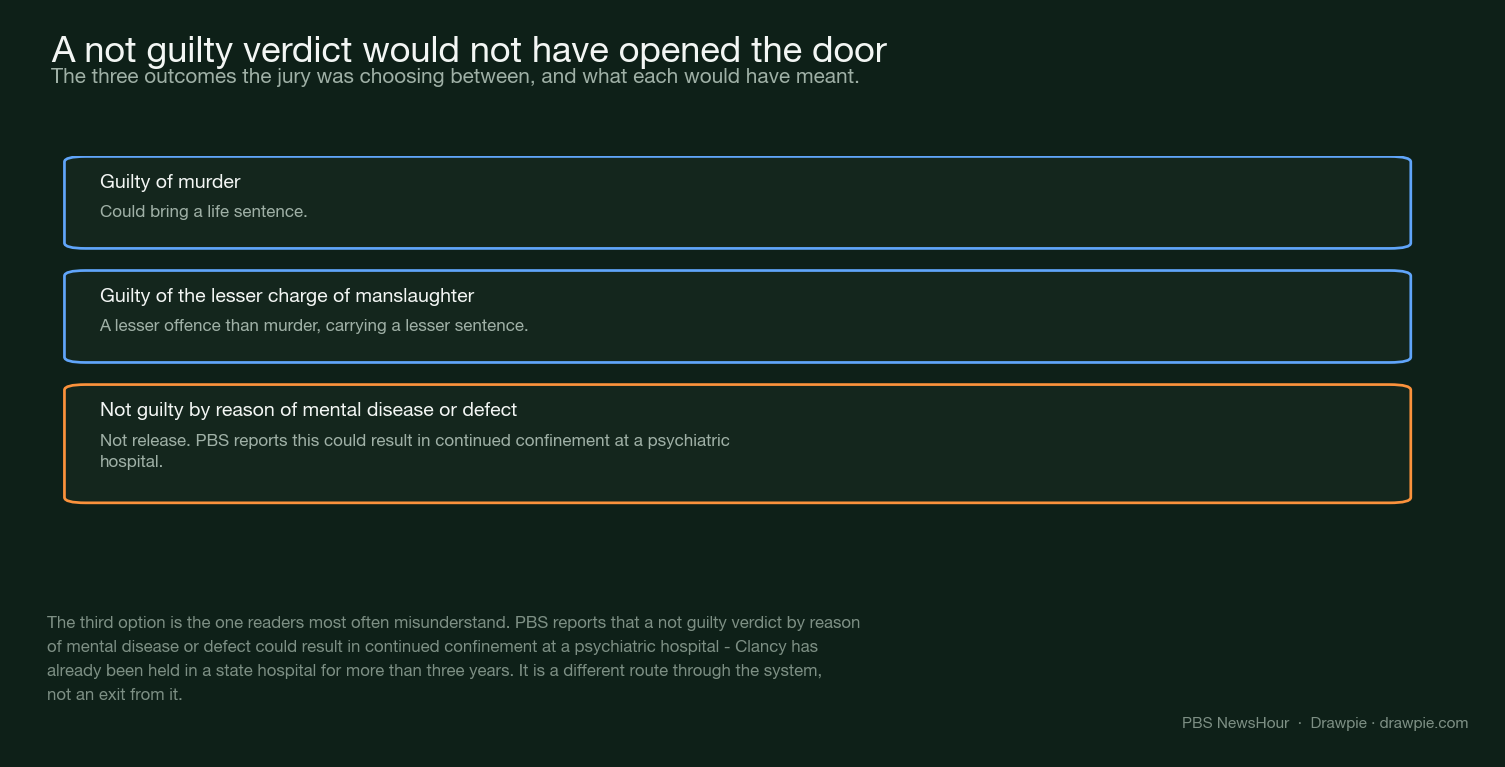
And three possible outcomes, per PBS:
- Guilty of murder — could bring a life sentence.
- Guilty of the lesser charge of manslaughter — a lesser offence, a lesser sentence.
- Not guilty by reason of mental disease or defect.
The third one is not release, and this is the most widely misunderstood part of the case. PBS reports that a not guilty verdict could result in Clancy’s continued confinement at a psychiatric hospital. She has already been held in a state hospital for more than three years. It is a different route through the system, not an exit from it.
Why the trial ended without a verdict
The jury could not agree, and on 4 September 2026 Judge William Sullivan declared a mistrial.
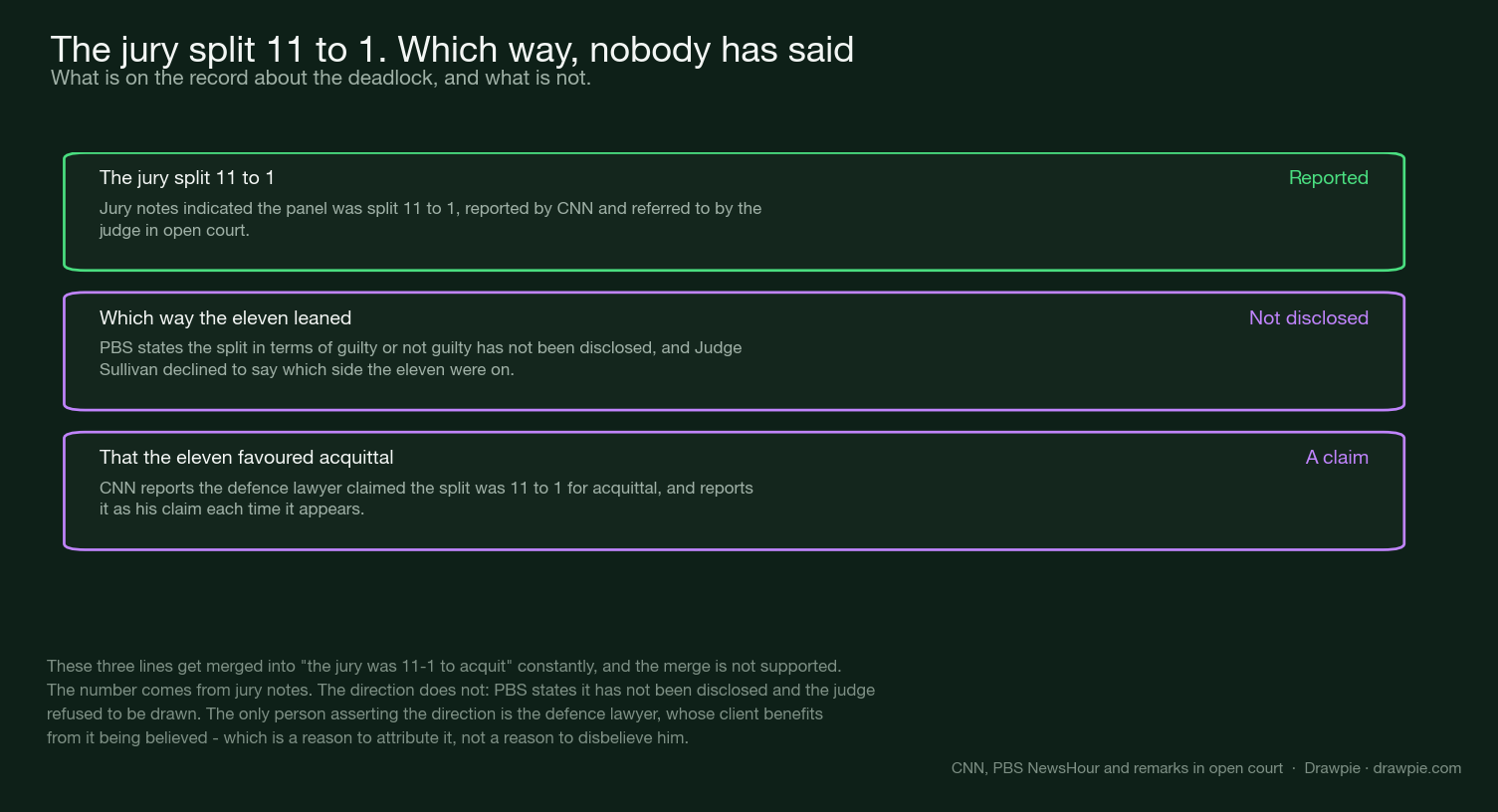
Deliberations ran about 38 hours across seven days, per CNN. The panel of twelve — nine women and three men — sent notes indicating it was split 11 to 1.
Which way the eleven leaned has not been officially disclosed. PBS states that plainly. Judge Sullivan declined to say: “I don’t think it’s appropriate for me to say I agree with one juror or 11.” Reddington claimed afterwards that the split was 11 to 1 for acquittal — CNN reports that as his claim, both times it appears.
Three defense applications failed before the mistrial:
- To dismiss the holdout juror. The judge refused, but gave the jury fresh instructions on the meaning of reasonable doubt.
- To survey the jury on a lesser charge before declaring a mistrial, which would have prevented a retrial for first-degree murder. Refused.
- An emergency appeal to the Massachusetts Supreme Judicial Court, arguing the holdout juror’s reasoning reflected bias against people with debilitating mental illness. Rejected.
What happens next
The 29 September 2026 hearing produced arguments, not rulings. Clancy appeared in person at Plymouth Superior Court for the first time since the mistrial. Judge Sullivan heard several motions that day and decided none of them, setting 2 November 2026 for the next round.
Two of those motions aim to end the case outright:
- A motion for a required finding of not guilty, argued by Reddington on the basis that the prosecution’s evidence was insufficient to convict. Prosecutor Shanan Buckingham — arguing for the prosecution in court that day — called the argument “laughable” and described the evidence against Clancy as voluminous.
- A motion to dismiss on double-jeopardy grounds, filed 22 September by attorney Martin Weinberg (who represented Karen Read on the same theory in her case). It argues Judge Sullivan should have investigated the holdout juror further before declaring a mistrial, and that retrying Clancy on the same charges would violate her Fifth Amendment protection against double jeopardy.
Neither was decided on 29 September. Both go back before Judge Sullivan on 2 November.
A separate, related motion asks the court to investigate the holdout juror — reported by ABC News, Fox News and Boston.com as Michael Desronvil — over reports he was on his phone during deliberations. The same motion raises his personal legal history: a restraining order, an eviction proceeding, and a 2021 domestic violence charge that was dismissed. None of that has been tested in court or ruled on. It is a defense allegation inside a motion, not a judicial finding, and Desronvil’s own attorney, Edward Paltzik, has called it a “Looney Tunes motion.” This, too, goes back before Sullivan on 2 November.
The prosecution, in turn, asked for a gag order against Reddington, over his public comments naming and describing the holdout juror — media organizations including WBZ-TV and Boston Globe Media opposed the request. It was also deferred to 2 November.
No retrial date was set, and the district attorney’s office still had not decided whether to retry Clancy. Reddington said the defense could not be ready before June 2027; Judge Sullivan pushed back, saying his goal was “to get this thing tried as soon as possible.”
Separately, and outside the courtroom, Reddington has publicly asked President Trump for a pardon — something Reddington himself acknowledges is legally impossible, since Clancy faces state rather than federal charges. Trump called it a “state situation” and said there was nothing he could do.
In the meantime she remains in custody at a state hospital.
The bottom line
She pleaded not guilty. Her lawyer told the jury she killed her children. Neither of those is the same as a conviction, and there isn’t one.
If you take one distinction from this page, make it that one — a defense can concede what happened and still contest whether the person who did it can be held responsible. Twelve jurors spent 38 hours on that question and could not agree.
If you or someone you know is struggling after having a baby, the Postpartum Support International HelpLine is 1-800-944-4773, in English and Spanish, 8am–11pm ET. PSI states on its own site that the HelpLine does not handle emergencies. In the US, 988 is the Suicide and Crisis Lifeline; in an emergency, call 911.
Court proceedings as reported by NPR, CBS News Boston, PBS NewsHour, CNN, The Boston Globe, Boston.com, ABC News and the Associated Press. There is no verdict in this case.