Kimi K3 vs Claude Fable 5 vs GPT-5.6 Sol: Price, Benchmarks & Cost

- Kimi K3 (Moonshot AI, out 16 July 2026) is the cheapest of the three at $3 in / $15 out per 1M tokens; GPT-5.6 Sol is $5 / $30; Claude Fable 5 is $10 / $50. Fable costs 3.3× Kimi on the same workload.
- On the one benchmark that measures all three the same way — the Artificial Analysis Intelligence Index — they sit inside a 3-point band (Fable 59.9, Sol 58.9, Kimi 57.1). The real gap is price, not capability.
- Kimi K3’s cache-hit input rate is $0.30 per 1M — a 90% discount, the steepest of the three — so workloads with heavy prompt reuse tilt further toward it.
- We deliberately don’t publish a ‘cost per successful task’ figure: no benchmark measures a success rate for all three on one methodology, so any such number would be invented. Use the cost side, judge capability separately.
Three frontier models are now within reach of the same use case, and the headline is not that one is smartest — it’s that they cost wildly different amounts to do nearly the same thing. Moonshot AI’s Kimi K3 just landed (16 July 2026), Claude Fable 5 is back online after its June suspension, and GPT-5.6 Sol has been generally available since 9 July. Here’s the verified pricing, the one benchmark that compares them fairly, and — as always — the numbers we won’t pretend to have. Google’s entry sits outside this three-way because it still has no published model card; we take Gemini 3.5 Pro and GPT-5.6 on their own for that reason.
The three models, briefly
- Kimi K3 — Moonshot AI’s flagship, an open-weight Mixture-of-Experts model (2.8 trillion total parameters, 1M-token context). API live 16 July; full open weights promised by 27 July. It’s the newcomer and the cheap one.
- Claude Fable 5 — Anthropic’s most capable widely-released model, GA on 9 June, suspended on 12 June under a US export-control directive, and restored from around 1 July. The premium option.
- GPT-5.6 Sol — OpenAI’s, generally available since 9 July. The one in the middle on price.
What they cost
Start with the thing that’s actually knowable to the cent — the list prices, straight from each lab’s own page:
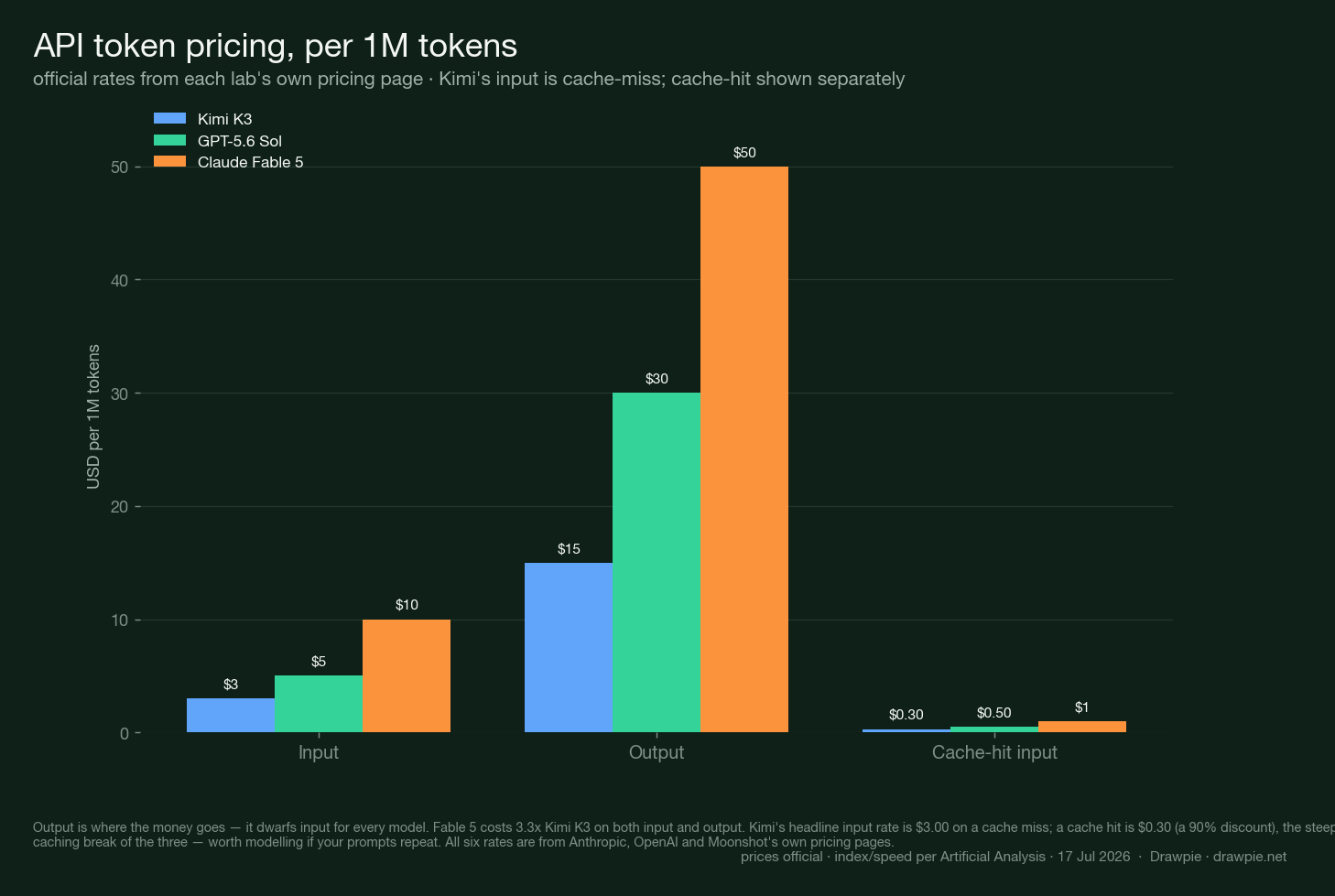
Two things to take from this. First, output is where the money goes — every model charges 5× more for what it writes than for what it reads, so a chatty, long-answer workload costs far more than a read-heavy one. Second, the three sit on a clean 3.3× ladder: Fable 5 costs 3.3 times Kimi K3 on both input and output, with Sol almost exactly in between. Kimi’s one extra trick is caching: a cache hit bills input at $0.30 per 1M, a 90% discount and the steepest of the three.
Because the ladder is constant, the cost gap is a fixed ratio at any scale — the lines never cross:
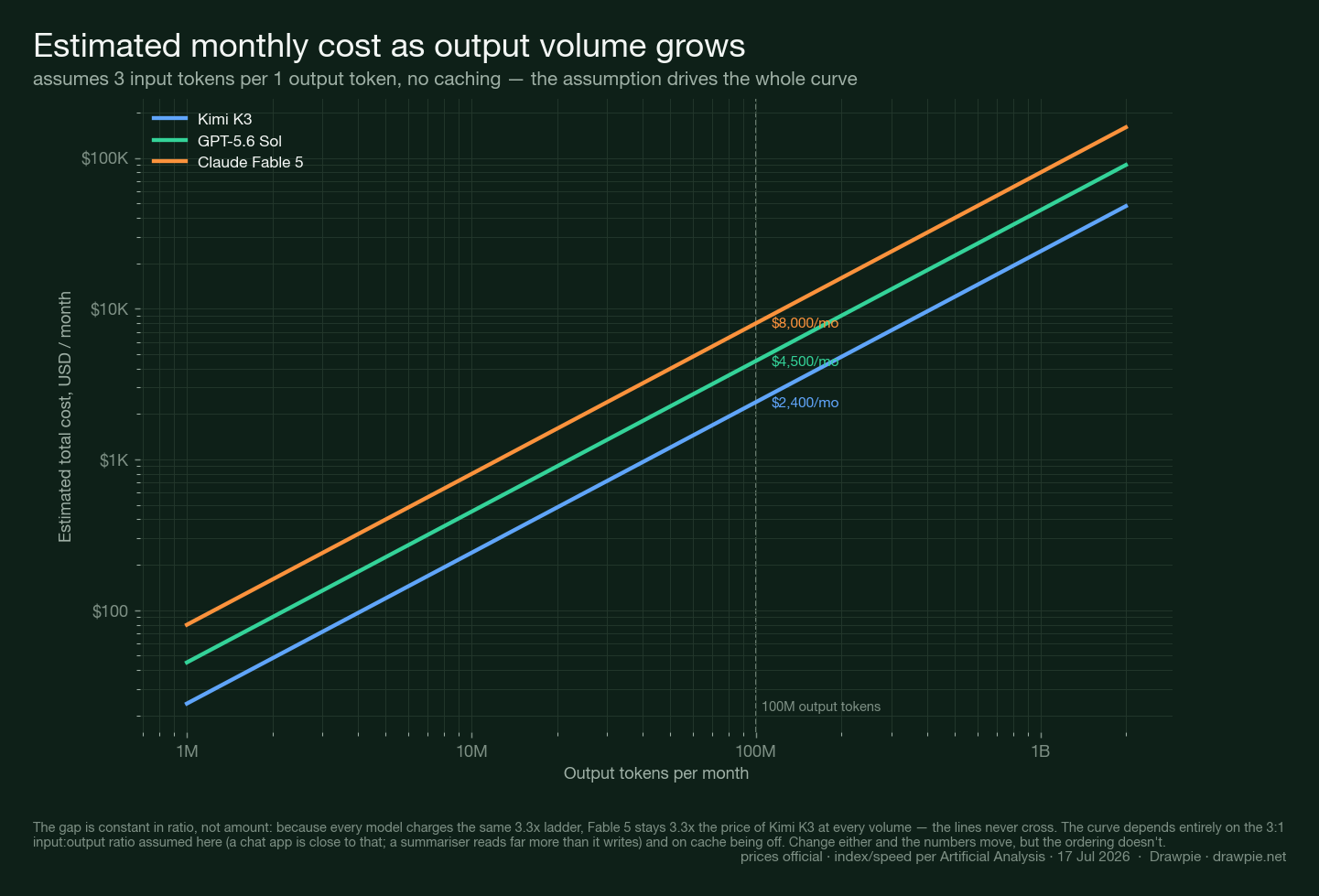
At a middling 100M output tokens a month, that’s roughly $2,400 (Kimi) / $4,500 (Sol) / $8,000 (Fable) — on the stated 3:1 input:output assumption. Your real mix moves the absolute numbers, but not the order.
Are you paying 3× for a smarter model?
This is where most comparisons go wrong, so we’re going to be careful. There is exactly one benchmark that measures all three on the same methodology — the Artificial Analysis Intelligence Index, which Artificial Analysis runs itself rather than stitching together each lab’s self-reported numbers.
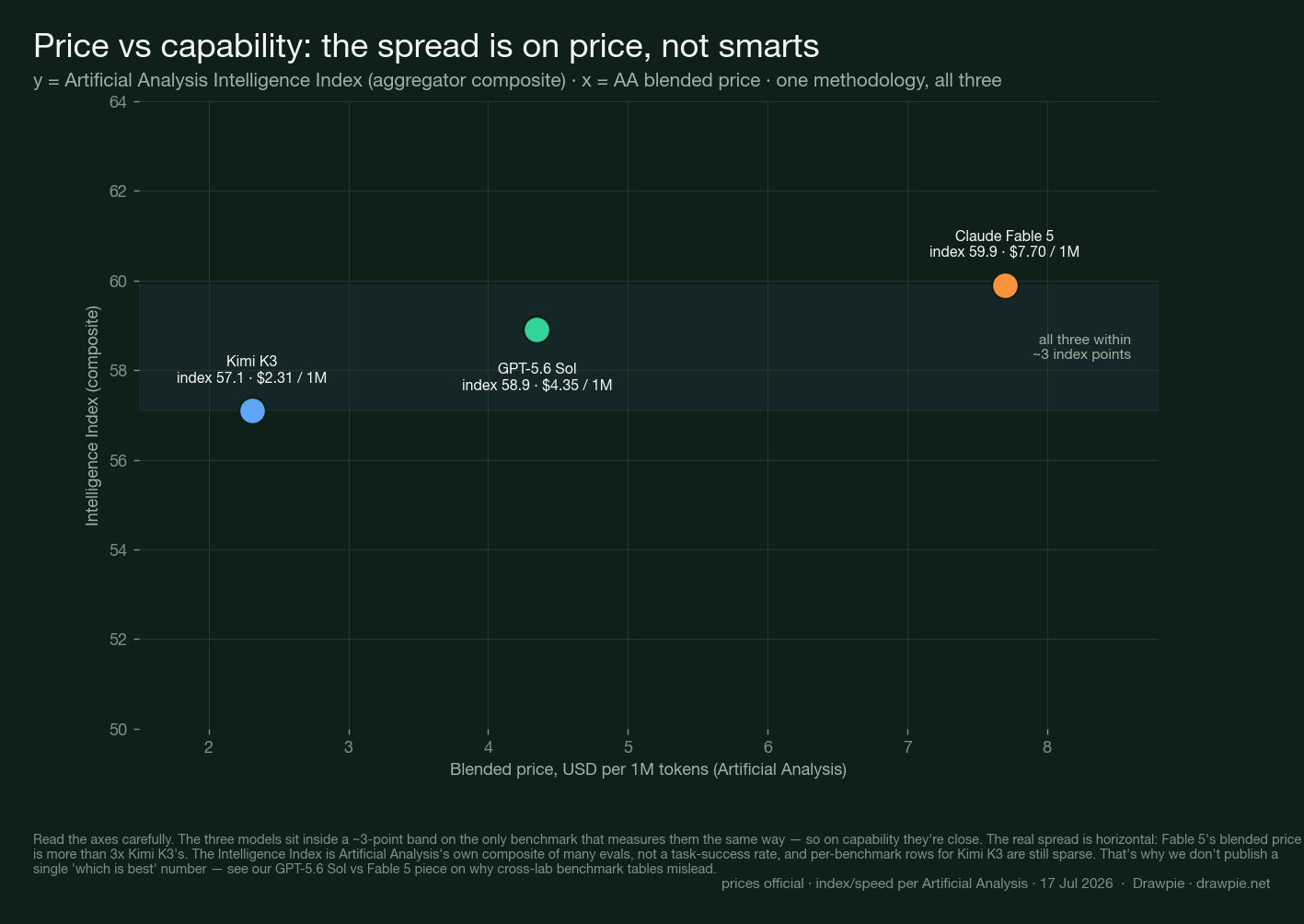
Read the axes. On capability, the three sit inside a ~3-point band (Fable 59.9, Sol 58.9, Kimi 57.1). The spread that actually matters is the horizontal one: Fable 5’s blended price is more than 3× Kimi K3’s for a benchmark difference you’d struggle to feel on most tasks. So no — you’re mostly paying 3× for the brand and the ceiling, not for a categorically smarter everyday model.
Two honesty notes. The Intelligence Index is a composite of many evals, not a task-success rate, and Kimi K3’s individual per-benchmark rows are still sparse (Moonshot uses its own harnesses and hasn’t published standard SWE-bench Verified numbers). And this tiny spread is exactly why our GPT-5.6 Sol vs Fable 5 piece argues an honest cross-lab benchmark comparison is nearly impossible — this chart illustrates that, it doesn’t refute it.
Speed, price and capability together
Fold in output speed and the picture gets a little sharper:
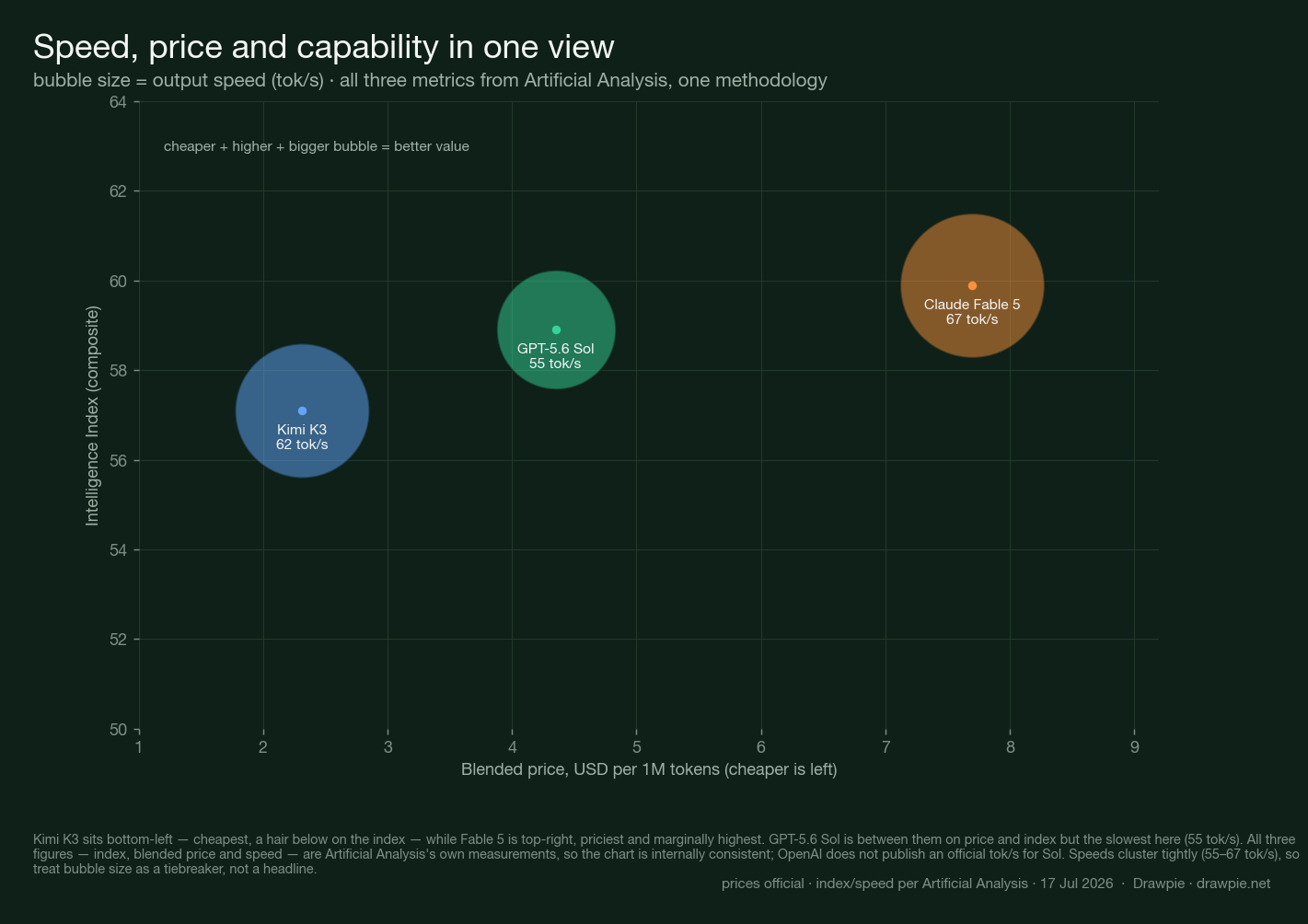
Kimi K3 sits in the value corner — cheapest, and only a hair below on the index. Fable 5 is the top-right premium pick. GPT-5.6 Sol lands between them on both price and capability but is, per Artificial Analysis, the slowest of the three (55 tok/s). All three figures here — index, price and speed — are Artificial Analysis’s own, so the chart is internally consistent; note OpenAI doesn’t publish an official speed for Sol. And the speeds cluster tightly (55–67 tok/s), so treat the bubble sizes as a tiebreaker, not a headline.
Why there’s no “cost per successful task” here
You’ll see other write-ups divide price by a benchmark score and call it “cost per successful task” or “value.” We’re not doing that, and it’s worth saying why.
A cost-per-successful-task number needs a success rate — the share of real tasks a model completes — measured the same way for every model. That figure does not exist across these three. The completion numbers that do exist (Terminal-Bench, the various SWE benchmarks) are self-reported by each lab on different agent scaffolds, so they aren’t comparable; stitching them into one axis would be inventing the result. And the one genuinely comparable number, the Intelligence Index, is a composite capability score, not a success rate — relabeling it “tasks completed” would be dressing up a different measurement.
So the honest split is: use the cost side, which is exact, and judge capability separately, knowing it’s close. That’s also how our calculator is built.
Work out your own bill
Our LLM API Cost Calculator takes your monthly input and output token volumes (and your cache-hit rate), applies the official prices, and shows what each model would cost — cheapest first. It shows the Intelligence Index beside each cost as a reference, but never folds it into the price.
Which should you pick?
Not a rankings question — a workload question.
- Default to Kimi K3 for cost-sensitive, high-volume work. It’s the cheapest by a wide margin, within 3 index points of the leaders, open-weight, and its caching discount is the steepest — so anything with reused prompts leans further its way.
- Reach for Claude Fable 5 when you’re paying for the ceiling: the hardest reasoning, agentic and coding work where the top of the index earns its 3× premium, and where Anthropic’s reliability and tooling matter.
- GPT-5.6 Sol sits in the middle — a sensible pick if you’re already in the OpenAI ecosystem, though it’s the slowest of the three by Artificial Analysis’s measure.
Frequently asked questions
Which is cheapest, Kimi K3, GPT-5.6 Sol or Claude Fable 5?
Kimi K3, clearly — $3 input / $15 output per 1M tokens, versus $5/$30 for GPT-5.6 Sol and $10/$50 for Claude Fable 5. Fable costs about 3.3× Kimi on the same workload.
Is Claude Fable 5 worth 3× the price of Kimi K3?
On the only comparable benchmark they’re within ~3 points, so for everyday work the extra spend buys a small capability edge, not a categorical one. It’s most defensible for the hardest reasoning and agentic tasks.
Can you compare their benchmark scores directly?
Only one — Artificial Analysis’s Intelligence Index — measures all three the same way. The SWE-bench / Terminal-Bench / GPQA numbers each lab publishes use different setups and aren’t comparable.
Is Kimi K3 open source?
It’s open-weight: Moonshot released the model weights (full release promised by 27 July 2026), which is why it can be run and priced far more cheaply than the closed frontier models.
The bottom line
Three models, one comparable capability score that puts them within a whisker of each other, and a 3.3× price ladder separating them. If capability were the story, this would be a close call; because it isn’t, it’s mostly a budgeting decision — so run your own numbers and be sceptical of any single “best model” or “value per task” figure, including ones that look authoritative.