Katie Price: Nothing to Hide — the Documentary, Self-Commodification and Review

- Katie Price: Nothing to Hide is a four-part documentary series from Louis Theroux’s Mindhouse, released on Sky Documentaries and NOW on 8 July 2026. It’s an archive-led retrospective of her roughly 30-year public life, told with candid interviews with her family, children, friends and former partners.
- The through-line is self-commodification — the way Price turned her persona, her relationships and, latterly, her trauma into sellable content. Which means a documentary made with her participation cannot escape being another instance of it, and the only real question is whether the film ever gets a vantage she did not grant.
- There are two fair readings, and this piece keeps them both: the shrewd working-class businesswoman who took ownership of her own image and built a multi-million-pound brand, and the critique — made by writers like Sarah Ditum and academics like Stéphanie Genz — that a whole life turned into content came at a real human cost.
- The critic sample is far too small to lean on: Rotten Tomatoes sat at about 60% from five reviews on 11 July 2026 and 67% from six on 24 July. At that size the number moves double digits on one opinion.
There is a line critics keep reaching for about Katie Price, and Sky’s new documentary has made it unavoidable: that her real product was never the modelling, the fragrances or the reality shows — it was herself. Katie Price: Nothing to Hide puts thirty years of that self-selling back on screen, and reopens an old argument about where candour ends and commodification begins. Here’s what the series is, how her self-commodification actually works, why it pulls the rest of us in, and the one question worth asking of the film itself. Everything was checked on 11 July 2026, and we’ve kept fact and opinion clearly apart.
What is “Katie Price: Nothing to Hide”?
| Detail | |
|---|---|
| Format | Four-part documentary series (hour-long episodes) |
| Where | Sky Documentaries and NOW (UK) |
| Released | 8 July 2026 |
| Made by | Mindhouse — Louis Theroux’s production company; directed by Paddy Wivell |
It’s an archive-led retrospective of Price’s public life “beyond the headlines” — from her emergence as the Page 3 model “Jordan” in 1996, through reality TV, marriages, motherhood, business, cosmetic surgery, bankruptcy and mental health. It leans on previously unseen footage and first-time candid interviews with family, her children, friends, associates and former partners. The title, Nothing to Hide, sells transparency — which is precisely the claim the reviews then argue about.
Katie Price, the self-brand
To see why “self-commodification” fits, it helps to trace the brand. She began modelling in 1996 as “Jordan” — itself a constructed alter ego, the first act of brand-building. The real pivot was I’m a Celebrity… (2004), which turned her into a reality-TV fixture and launched a long fly-on-the-wall franchise, from Katie & Peter to a string of solo shows.
Around that persona she built an unusually wide business. There were the books — roughly eight autobiographies and eleven novels (the early ones ghost-written, a documented fact rather than a dig); Being Jordan alone reportedly passed a million copies. There were fragrances (Stunning, Besotted and more), fashion and equestrian ranges (KP Equestrian), lingerie lines and other merchandise. At her mid-2000s peak she was routinely described as one of Britain’s wealthiest models, with a widely-quoted — but unaudited — fortune around £40 million. More recently she joined OnlyFans in January 2022, and has said the account earns her £50,000–£80,000 a month (her own figure, not independently verified).
That’s the case for the generous reading, and it’s a real one: a working-class woman who took ownership of her own objectification and monetised it herself, on her terms, across three decades and half a dozen industries.
The turn to selling “the real me”
The harder question comes with her later work, which foregrounds vulnerability: documentaries about trauma, mental health, addiction and caregiving. Katie Price: Trauma and Me (Channel 4, 2022) followed a stay at The Priory and a PTSD diagnosis; the earlier BBC films Harvey and Me (2021) and What Harvey Did Next (2022) followed her eldest son’s move to adult care.
This is where commentators divide, and it’s worth keeping their words as their interpretation, not fact. Sarah Ditum argues Price effectively pioneered an everything-is-content model that anticipated the exploitative logic of social media, monetising even her marriages and her children — and that the apparent control was partly an illusion, leaving her paying a heavy personal price for a life built on being wanted. Academics have studied her directly, too: Stéphanie Genz’s 2015 paper My Job is Me reads the Katie Price brand as a case study in how authenticity itself becomes a commodity — realness harnessed to self-branding. The counter-view, equally present in the coverage, is that openly discussing abuse, PTSD and disability caregiving is genuine, destigmatising candour. The most honest verdict is that it can be both at once.
Why self-commodification pulls the rest of us in
Whatever you make of Price, the deeper question is why audiences reward this — why turning a life into a product works. There’s no clean survey that ranks the reasons (so treat anything claiming exact percentages with suspicion), but media and cultural studies offer a well-established set of overlapping mechanisms. They tend to reinforce one another in a loop: the more a star reveals, the closer we feel, the more attention they capture, the more revealing pays.
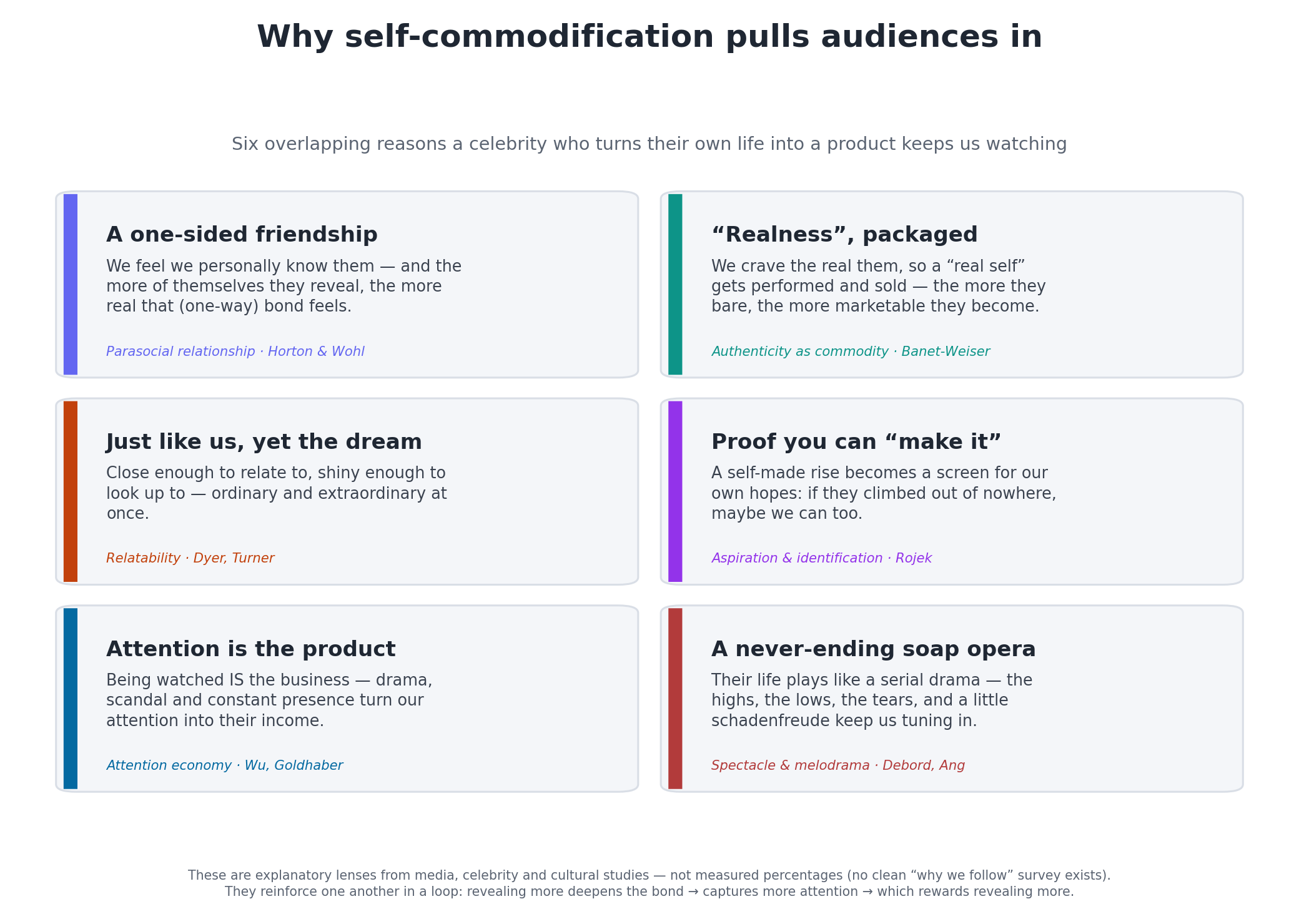
In short: a one-sided friendship (the “parasocial” bond, where self-revealing content makes us feel we truly know them); “realness” as a product (we crave authenticity, so a “real self” gets performed and sold); the ordinary-and-extraordinary pull of someone relatable yet living the dream; aspiration (a self-made rise as a screen for our own hopes); the attention economy, where being watched is the business and drama converts our attention into income; and the never-ending soap opera of a public life, complete with the small guilty pull of schadenfreude. Price hits all six — which is a large part of why, love her or not, so many people keep watching.
Is it worth watching?
The score is too small to lean on. Rotten Tomatoes showed about 60% from five critic reviews on 11 July 2026; by 24 July it was 67% from six. That is not a trend — it is one additional review. At this sample size the percentage moves double digits on a single opinion, so it tells you almost nothing.
The more useful observation is that this documentary cannot escape its own subject.
A film about a woman whose product is herself has a problem no filmmaker can solve: her participation is simultaneously what makes it viable and what makes it suspect. Without her it is a clip show. With her it is, by definition, another authorised release in a thirty-year sequence of authorised releases about her candour. The title makes the trap explicit — Nothing to Hide promises disclosure, and disclosure is precisely the thing she has been selling since the beginning.
So the question worth asking of it is narrow and answerable: does the camera ever get a vantage she did not grant?
That is what separates a documentary about self-commodification from a further instance of it. It is not a test specific to her, either: Prime Video’s Guardiola series A Beautiful Obsession meets the same problem from another direction, because Manchester City’s own production arm co-produced it — startling access, granted by the people being filmed. Concretely, it means looking for three things — an on-record voice that contradicts her rather than contextualising her; archive used against the narration rather than to illustrate it; and any sequence where the film declines to accept her framing of an event. If those are present, the film has independent standing. If the structure is her account, illustrated, then it is doing the thing it is ostensibly examining.
The pattern around the film is itself evidence. This is not her first documentary, and the recurring commercial proposition across all of them has been access — the promise that this time you get the real version. A career-length series of works premised on finally being unguarded is a strong argument for the thesis in this article, whatever any individual entry turns out to be like.
Our read: the subject is genuinely rich, and the honest way to watch it is to keep score of who is in control of each sequence. The interesting failure here would not be a dull film — it would be a film that is completely absorbing and still leaves you with exactly the impression its subject intended.
A note on Harvey
Any fair piece has to handle Harvey Price — Price’s eldest son, who has septo-optic dysplasia, autism and Prader-Willi syndrome and needs full-time care — with care rather than as spectacle. The most substantive part of that story isn’t the documentaries but the advocacy: after Harvey was targeted by online abuse, Price campaigned for “Harvey’s Law,” gathering around 220,000 signatures and giving evidence to a House of Commons committee inquiry into online abuse and disabled people — a genuine contribution to the online-harms debate. Critics have debated where advocacy ends and brand-management begins in the films that feature him; that debate is fair game, the person at its centre is not.
The bottom line
Katie Price: Nothing to Hide is really a documentary about a question it can’t quite answer about itself: is showing everything the same as revealing anything? The generous reading — a self-made woman who monetised her own image with rare shrewdness — is true. So is the critique that a life turned entirely into content extracts a price of its own. Both can hold at once, which is exactly why she remains one of Britain’s most-watched and most-argued-over public figures, and why a series promising nothing to hide has left critics arguing about what, if anything, it actually showed.
Frequently asked questions
Where can I watch Katie Price: Nothing to Hide?
It’s on Sky Documentaries and NOW in the UK, released as a four-part series on 8 July 2026. It was made by Louis Theroux’s production company, Mindhouse, and directed by Paddy Wivell.
Is the documentary any good?
The critic sample is too small to answer that — Rotten Tomatoes was around 60% from five reviews on 11 July 2026 and 67% from six on 24 July, a range that moves double digits on a single opinion. The more useful test is the one in the section above: watch for whether the film ever gets a vantage on Price that she did not grant it.
What does “self-commodification” mean in Katie Price’s case?
It’s the idea that her main product has been herself — her persona, relationships and personal story turned into marketable content across modelling, reality TV, books, merchandise and, later, documentaries about her own trauma. Supporters read it as savvy self-made business; critics read it as a life sold at a personal cost.
Is Katie Price bankrupt?
She was declared bankrupt in November 2019 over debts reported at more than £3.5 million, and was made bankrupt a second time in 2024. Her financial difficulties are part of what the new documentary revisits.
More documentaries, explained: our look at Netflix’s Shipwrecked: Nightmare at Sea , and the Five-Star Weekend cast, plot and reviews .