JD Vance 2028 Predictions: Could Lower Gas Prices Win Him the White House?
Update log (1)
- — Prices in this article were read on 14 August 2026: AAA's national average that morning was $4.0776 a gallon, up from $3.1601 a year earlier. Vance had not announced a presidential campaign as of that date.

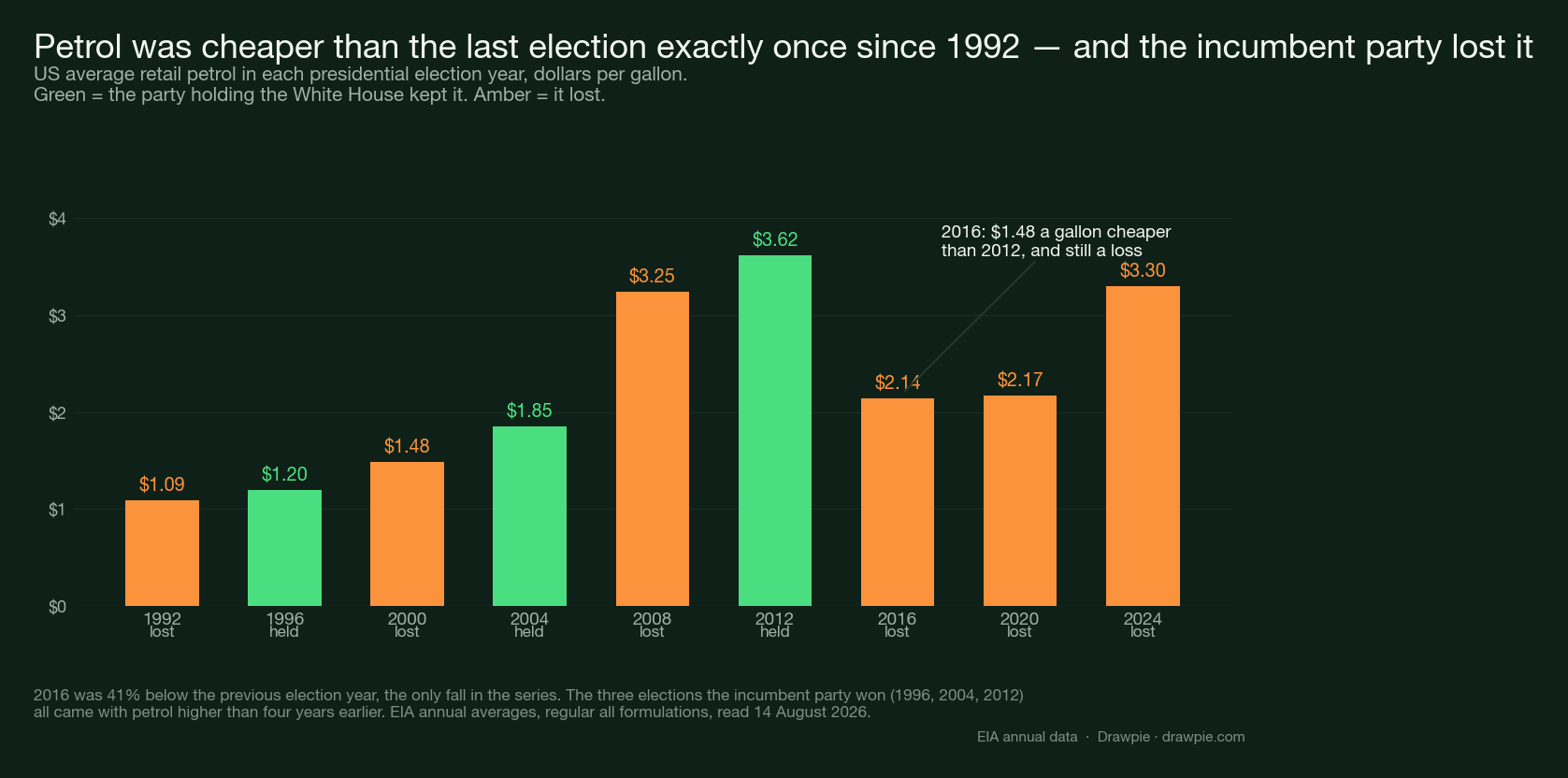
- The premise is weaker than it sounds. Using EIA’s annual average petrol price, only one presidential election since 1992 was fought with petrol cheaper than the previous election — 2016, when it was $1.48 a gallon lower than 2012 — and the party holding the White House lost that election.
- The three elections the incumbent party did win in that period, 1996, 2004 and 2012, all came with petrol higher than four years earlier. On this measure the folk rule points the wrong way.
- Vance has not announced a 2028 campaign. In May 2026 he said he is not running, and there is no presidential campaign filing tied to him. Polling puts him at or near the top of the Republican field, with some softening this year.
- Right now petrol is going the other way. AAA’s national average was $4.0776 on 14 August 2026, against $3.1601 a year earlier — about 29% higher.
Cheap petrol is supposed to be the incumbent party’s friend, and the record since 1992 does not show it. In that period exactly one presidential election was fought with petrol cheaper than the previous election year — 2016 — and the party holding the White House lost.
That is the awkward fact underneath the question in the headline. Below is where JD Vance actually stands, what pump prices have actually done, and what the research says about how much any of it is within a president’s control.
Is JD Vance running for president in 2028?
He has not announced, and in May 2026 he said he is not running. No presidential campaign filing tied to the vice president has been reported.
What exists instead is position: published polling has put him at or near the top of the prospective Republican field, though surveys this year have shown some softening in his support among Republican voters. He has also declined to rule a run out permanently, which is the normal condition of a sitting vice president two years from a convention.
The party fight around him is a separate story, and a live one — we covered the Iran-driven Never Vance argument and Rubio’s position in July.
Do cheaper gas prices actually save the party in power?
Once since 1992 the question has actually been tested, and the answer that year was no.
| Election | Price | Incumbent party |
|---|---|---|
| 1992 | $1.087 | Lost |
| 1996 | $1.199 | Held |
| 2000 | $1.484 | Lost |
| 2004 | $1.852 | Held |
| 2008 | $3.246 | Lost |
| 2012 | $3.618 | Held |
| 2016 | $2.143 | Lost |
| 2020 | $2.168 | Lost |
| 2024 | $3.304 | Lost |
Those are EIA annual averages for regular petrol, all formulations. Read down the column and the pattern that is supposed to exist is not there. 2016 was $1.48 a gallon cheaper than 2012, a fall of 41%, and the incumbent party lost anyway. The three elections the party in power did win — 1996, 2004 and 2012 — every one of them came with petrol higher than four years earlier.
You will see a stronger version of this claim in circulation: that since 1976, whenever petrol was cheaper than the last presidential election year, the White House stayed with the same party. We could not read 1976 to 1988 from the same EIA series, so we have not tested those. What we can say is that on the series that does run continuously, the rule has one test case and fails it.
Where are US gas prices right now?
Higher than a year ago, by about 29%. This is the part of the headline question that is already answered: the trend into the midterms is not cheaper petrol.
| Reading | Regular, per gallon |
|---|---|
| 14 August 2026 | $4.0776 |
| A week earlier | $4.0422 |
| A month earlier | $3.8587 |
| A year earlier | $3.1601 |
Those are AAA’s national averages, read on 14 August 2026. Whether they are higher or lower in 2028 is not something this article will guess at, and anyone who tells you confidently is guessing too.
Can a president lower gas prices anyway?
Much less than campaign rhetoric implies, in both directions. The research consensus is that pump prices are set mostly by crude markets, refining capacity and taxes, and that presidential levers are slow, small or both.
That cuts against the premise of the headline in a specific way: if a vice president cannot reliably move the variable, then “could lower gas prices win him the White House” is really a question about luck. Prices in 2028 will be a fact he runs on or against, not a policy he can order up.
What does the research say about gas prices and approval?
The link that is well documented is to approval, not to victory. Analysis of the period from 1976 to 2007 found that a 10-cent rise in petrol corresponded to roughly a 0.60% fall in presidential approval, and more recent work using fifty years of data ranks petrol among the stronger predictors of approval, with the first stage of a price spike doing the most political damage.
Two things follow. Approval is not the same as an election result, as 2016 demonstrates. And the asymmetry matters: a rise hurts faster than an equivalent fall helps, which is a poor trade for whoever is defending the White House.
So could cheaper gas win Vance the White House?
On the evidence available, cheaper petrol is neither necessary nor sufficient. Not necessary, because the incumbent party has won three times since 1992 with petrol higher than the previous election. Not sufficient, because the one time it was dramatically cheaper, the incumbent party lost.
The honest version of the question is narrower: petrol is one input into presidential approval, approval is one input into an election, and the candidate has limited control over the first link in that chain. If Vance runs and wins, cheap petrol will be listed among the reasons; the table above suggests that would be a story told afterwards rather than a mechanism you could rely on in advance. Where he actually stands with primary voters, and how far the pollsters disagree about it, is in the Vance vs Rubio polling .
What this article does not do
It does not predict petrol prices, and it does not price the race. No forecast of pump prices for 2027 or 2028 appears here, ours or anyone else’s, and no betting or prediction-market odds appear either.
It does not tell you Vance will run — he has said he is not running, and no filing exists. It does not test the pre-1992 years, which the circulating version of the claim relies on. And it does not attempt to say how much of any past election result petrol explains, because the honest answer is that nobody has isolated that, and the elections where it should have mattered most are the ones that fit worst.
How we verified this
We do not forecast petrol prices, and this article contains none. Petrol is a traded commodity, and this site does not publish predictions of future prices or trends for anything with a market price — our own or anyone else’s, including agency and bank outlooks. Every price here is a completed observation with a date on it. The question in the headline is answered with what has already happened, which is the only honest way to answer it.
No betting or prediction-market odds appear here either. That applies to the 2028 nomination and to the election, and it is a site-wide rule rather than a judgement about this race.
The election-year table is our own arithmetic on EIA’s published series. We used “U.S. Regular All Formulations Retail Gasoline Prices”, annual averages in dollars per gallon, read from eia.gov on 14 August 2026, and compared each presidential election year with the previous one. That series begins in 1992, which is why the article says “since 1992” rather than repeating the widely circulated claim that runs “since 1976” — we could not read the earlier years from the same series, and mixing two EIA series with different grade coverage would change the numbers.
That distinction matters, because the circulating claim does not survive the check. The version you will see repeated is that whenever petrol was cheaper than the previous presidential election year, the party in the White House kept it. On this series 2016 is the only such year, and the incumbent party lost. We are not asserting the claim is false for 1976 to 1988, which we did not test; we are reporting that it fails on the years we could verify.
Vance’s status is reported, not inferred. He has made no formal announcement and no presidential campaign filing has been reported; in May 2026 he said he is not running. Statements about his standing in the Republican field come from published polling, which is a snapshot of opinion at a date and not a measure of what will happen in 2028.
The research findings are attributed rather than adopted. The approval-rating relationship and the point about limited presidential control over pump prices come from published academic and press analysis; we cite what they found rather than presenting it as our own model, and we have not attempted to quantify how much of any election outcome petrol explains.