The Japanese Manicure: What P-Shine Actually Is, What It Costs and How Long It Lasts

- A Japanese manicure is a buffing treatment, not a polish. A vitamin-rich paste goes on with a leather buffer, then a beeswax powder is buffed over it.
- The shine is the nail itself. Nothing is painted on and nothing sits on top.
- There is no UV or LED lamp, because nothing has to cure.
- It is reported to last up to about a month, and it wears off gradually rather than needing removal.
- Home kits run roughly €14.50 to €44 depending on the set.
- Booking one in the US is the hard part. The official US channel is a retail shop with no salon locator and no service prices.
- It is often suggested for nails recovering from acrylics or gels.
No polish. No lamp. No removal appointment. The shine is your own nail, buffed — and it holds for about a month.
The Japanese manicure has been circulating as a low-maintenance alternative to gel. Here is what it actually involves, what it costs, and the honest answer about getting one in the United States.
What a Japanese manicure actually is
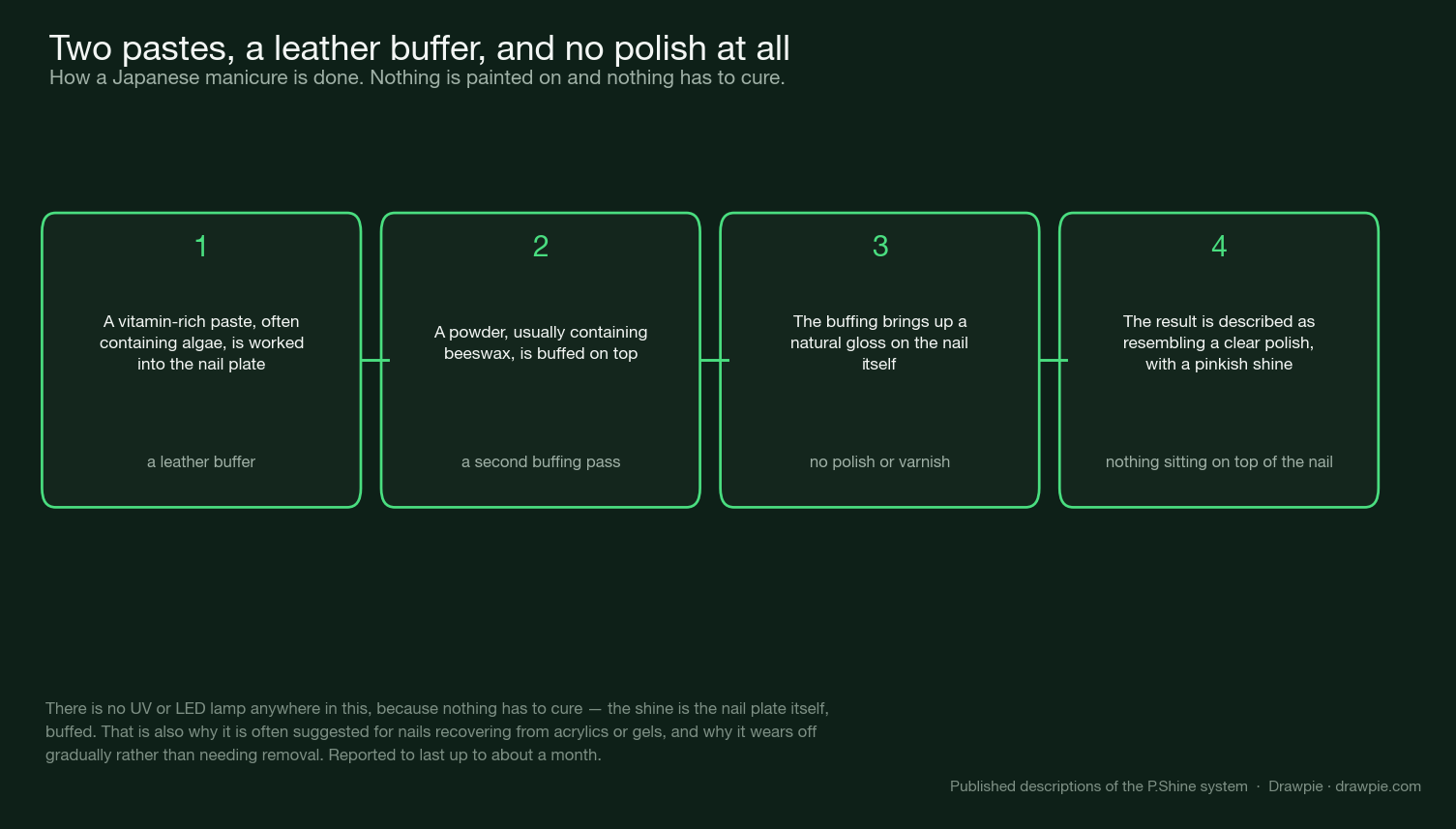
It is a two-stage buffing treatment, popularised internationally by the Japanese company P.Shine.
- A vitamin-rich paste, often containing algae, is worked into the nail plate with a leather buffer.
- A powder containing beeswax is buffed over the top.
- The buffing brings up a gloss on the nail itself.
- The finish is often described as looking like a clear polish — a soft pinkish shine — except that nothing is sitting on the nail.
The key structural point: this is a dry technique that treats the nail plate. It is not a coating. That single difference is what drives everything else about it.
Why there is no lamp
Nothing has to cure, so there is nothing to cure it with.
Gel needs a UV or LED lamp because it contains a photoinitiator — the chemical that makes it harden under the light. We went through that chemistry in detail in our explainer on the TPO rules .
A Japanese manicure has no such step. There is no lamp, and there is no soak-off afterwards either, because there is no layer to remove.
How long it lasts
Reported to last up to about a month.
But “lasts” means something different here, and it is worth being precise. A gel manicure ends: it grows out, it chips, you book a removal. A buffed shine fades. There is no point at which it looks broken, only a gradual return to how your nails were.
That is the actual appeal for most people who switch. Not that it lasts longer — that it never needs an appointment to end.
Japanese manicure vs gel vs polish
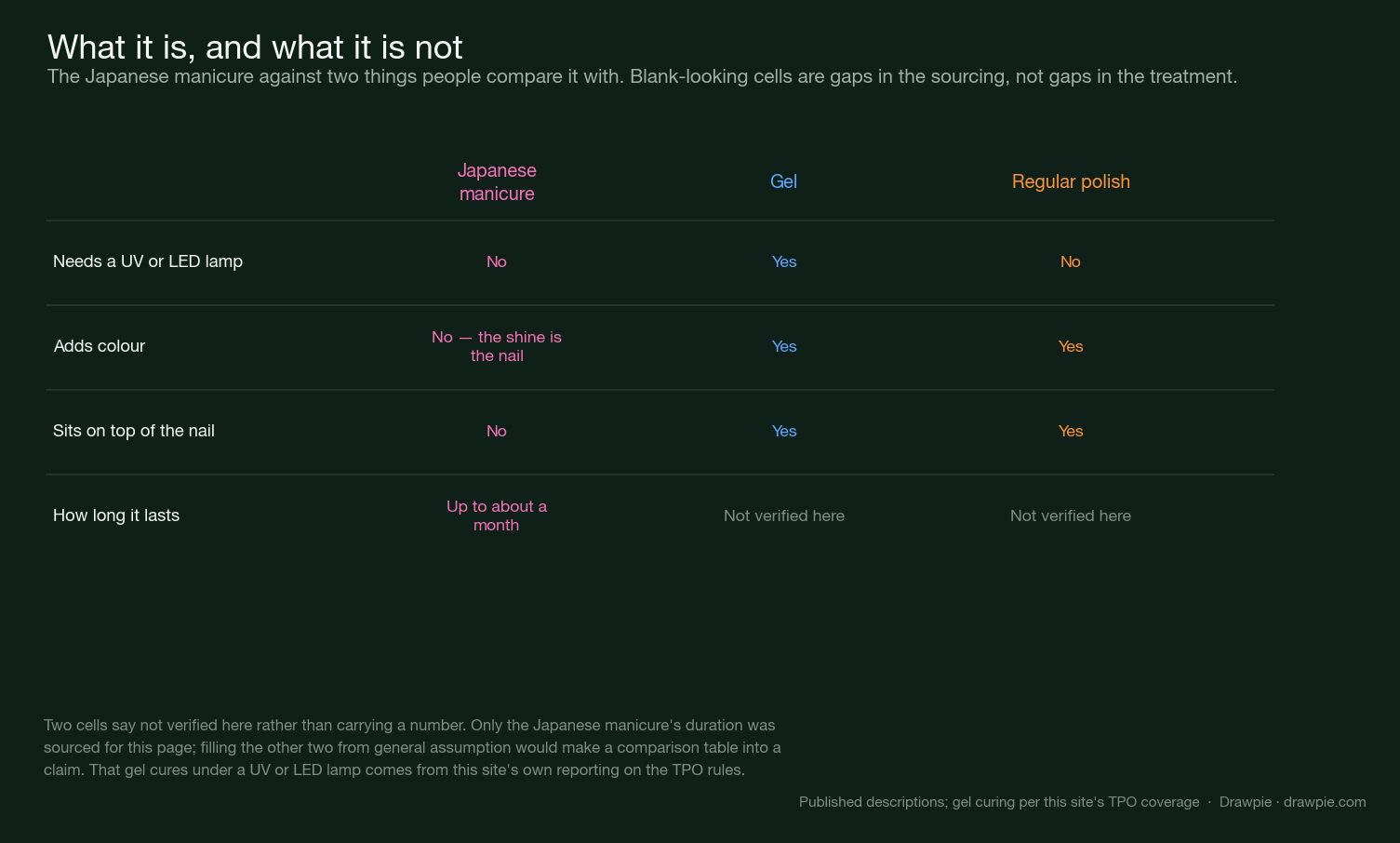
| Japanese manicure | Gel | Regular polish | |
|---|---|---|---|
| Needs a UV or LED lamp | No | Yes | No |
| Adds colour | No — the shine is the nail | Yes | Yes |
| Sits on top of the nail | No | Yes | Yes |
| How long it lasts | Up to about a month | Not verified here | Not verified here |
Two cells in that table are deliberately empty. Only the Japanese manicure’s duration was sourced for this page. Filling in gel and polish from general assumption would turn a comparison into a claim, and a comparison table is precisely where an unsourced number reads as authoritative.
And note the second row. If you want colour, this is not the treatment. It does one thing: it makes bare nails shine.
What it costs
Home kits: roughly €14.50 to €44, spanning small refills up to professional sets.
Salon pricing is where this gets thin, and this page is not going to fill the gap with a guess.
The one salon price located was 70 CAD in Toronto — Canadian, and stated as such rather than converted into a dollar figure that would look like a US price.
No US salon service price could be found at all.
Where to get it in the US
Mostly, you don’t book it — you buy the kit.
The official US channel for P.Shine is a retail shop. It sells kits, buffing pads, files and refills, and it states plainly that it is for retail customers. What it does not have:
- a salon locator
- a list of participating salons
- any published service price
- an advertised salon training or certification programme
So the practical answer is: individual US salons may well offer this, and some certainly do, but there is no central way to find them. If your salon does not already list it, the realistic route is the at-home kit.
That is a less satisfying answer than a booking link. It is the accurate one.
Who it actually suits
On what the sources support rather than on a recommendation from here:
- Nails recovering from acrylics or gels. This is the use case the treatment is most often positioned for.
- Anyone who wants their nails to look finished without colour. The whole effect is bare-nail gloss.
- Anyone tired of the maintenance cycle. No lamp, no removal, no rebooking — it fades out.
Who it does not suit: anyone who wants colour, length, or a look that holds a specific shade for a specific event. It cannot do any of those.
The bottom line
A paste, a powder, a leather buffer, and about a month of shine that belongs to the nail rather than sitting on it.
Kits are cheap. Booking it in the US is the genuinely hard part, and no amount of searching turned up a service price or a way to find a salon offering it.
Technique from published descriptions of the P.Shine system, cross-checked. Prices as listed by retailers. The gel curing fact is from this site’s own TPO coverage. Not health or safety advice.