Jamieson Greer on Canada Tariffs: What the New 50% Duties Mean for Canadians
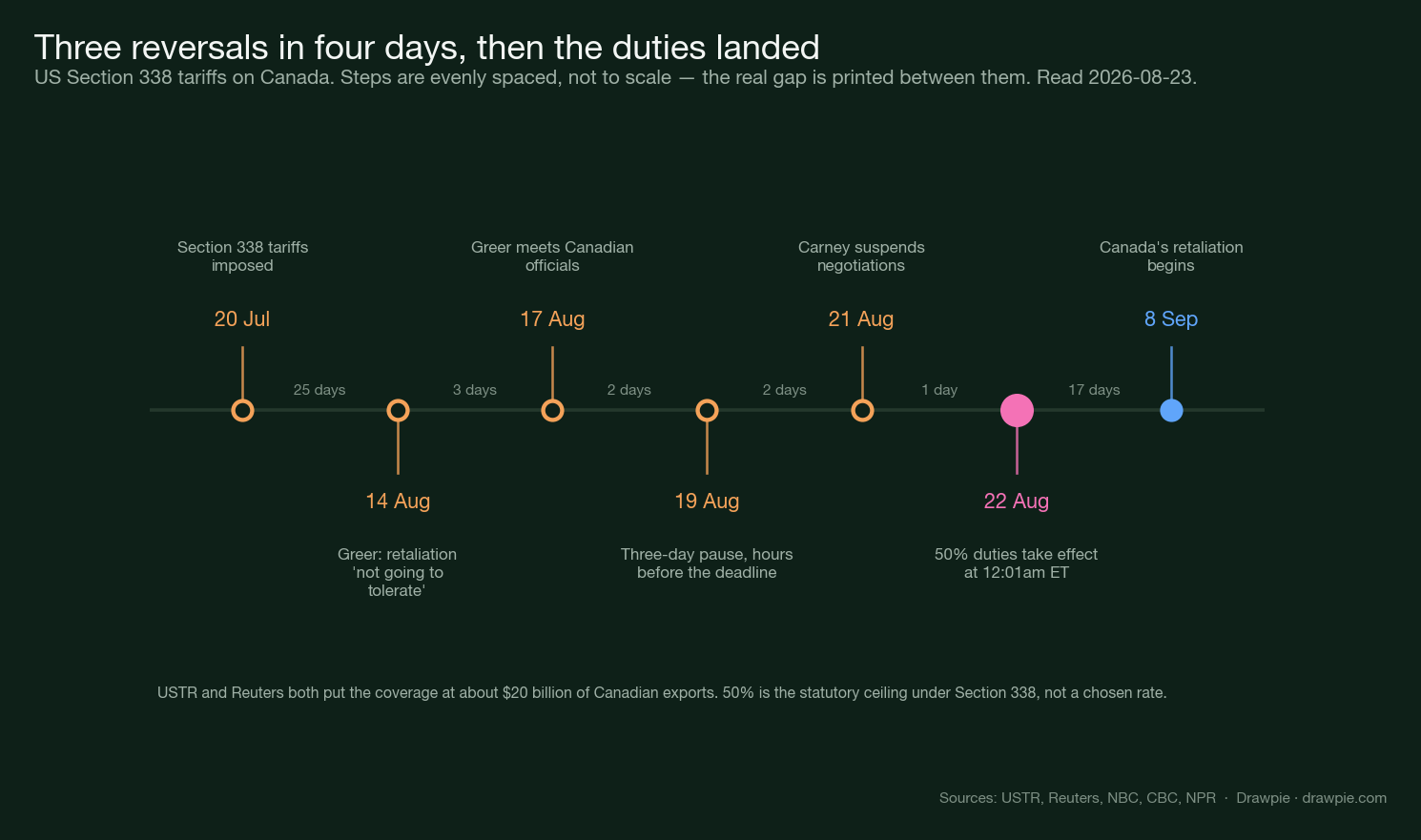
Canada’s counter-tariffs begin on 8 September, which changes what this page needs to say in both directions — the retaliation list becomes live rather than announced, and any US response to it will postdate everything here. The negotiation status is more volatile still: this file was written roughly 26 hours after the duties took effect, and the previous week saw three reversals in four days.
Everything else on the page is unaffected; the figures below still say when they were read.

- The 50% duties are in force. They took effect at 12:01am Eastern on Saturday 22 August, after Prime Minister Mark Carney suspended negotiations on the Friday evening and recalled Canada’s negotiators to Ottawa.
- USMCA compliance does not exempt your goods. This is the single most important difference from the tariff rounds of the past 18 months, and it is a deliberate feature of the legal authority being used rather than an oversight.
- They cover roughly $20 billion of Canadian exports: wine, furniture, dairy, cement, clothing, fishing rods and hockey equipment among them. Both USTR and Reuters put the figure at about $20 billion.
- Greer’s stated grievances are three and they are specific: US alcohol pulled from Canadian shelves, better dairy market access given to the EU than to the US, and a cap on US vehicle exports from companies reshoring to America.
- Canada retaliates on 8 September with tariffs on US steel, electronics and other products. Carney’s phrase is ‘dollar for dollar’, and he has been blunter: ‘You’re at war when you get attacked. We got attacked.’
At one minute past midnight Eastern on Saturday, a 50% American tariff landed on roughly $20 billion of Canadian exports. Two days earlier the two countries had a deal, or said they did.
The part that matters most for Canadian exporters is not the rate. It is that being USMCA-compliant does not get you out of it — which is not how any of the tariff rounds of the past year and a half have worked.
What exactly is being tariffed?
Around $20 billion of Canadian exports, at 50%. Reuters lists the sectors as wine, furniture, dairy products, cement, clothing, fishing rods and hockey equipment. NBC News adds building materials and liquors.
The measure began as three separate actions announced on 20 July, aimed at motor vehicles, alcoholic beverages and dairy — the three areas where Washington says Canada discriminates against American exporters. What has landed is broader than those three headings suggest.
Does USMCA protect my goods?
No, and this is the change.
Holland & Knight, in a legal alert published nine days after the announcement, puts it in a heading of its own: No USMCA Exemption. Their reading is that “USMCA origination does not exempt covered goods from the Section 338 duty, a significant departure from other Canada tariff regimes”, and that “the additional 50 percent applies in full regardless of USMCA origination status”.
For eighteen months, USMCA compliance has been the thing that shielded most Canadian exports from American tariffs. Exporters who built their paperwork around proving origin have been doing the right thing, and for this measure it buys nothing.
If you take one operational point from this page, that is it: do not assume your existing USMCA documentation changes your exposure here.
Why can the US do this? What is Section 338?
Section 338 of the Tariff Act of 1930 — 19 U.S.C. 1338 — lets the President impose duties of up to 50 percent on imports from a country that discriminates against US commerce.
Two things follow from that sentence. First, 50% is not an opening bid in the usual sense: it is the maximum the statute allows, so there is no higher number to escalate to under this authority. Second, it is a very old and very rarely used provision, which is why it sits outside the USMCA framework that governs the newer tariff rounds.
It also arrives during the ongoing USMCA review, which is the context Washington has chosen for it.
What does Greer say this is about?
Three specific grievances, in his own words from USTR’s 20 July statement. He says Canada has:
- “taken U.S. alcohol products off Canadian shelves”
- “given better market access to dairy products from the European Union”
- “put a cap on U.S. vehicle exports to Canada from companies reshoring to the United States”
His framing is that Canada is an outlier: “Canada, unlike other partners and allies, continues to retaliate against the United States for its efforts to rebalance trade and protect U.S. industry in national-security sensitive sectors.”
Speaking to reporters in Des Moines on 14 August, Greer rejected the trade-war label. “For us, this is not a trade war. We have domestic supply chains we’re trying to protect,” he said. “It’s not Canada-specific, we’re doing this globally. If a country retaliates against us, we’re not going to tolerate that. We’ll take action.”
He also said Canada’s measures were “the kind of things that China would do” — a comparison that landed badly in Ottawa — and, on the prospect of agreement: “At the end of the day, we’re going to do what’s best for America. If there’s a way to bring Canada along with that, we’re happy to do that.”
Worth noting what a law firm rather than a government says about those three grievances. Holland & Knight assesses two of them — the auto surtax and the provincial alcohol bans — as things Canada could reverse, and the dairy complaint as a narrow quota-eligibility issue that the USMCA review could address, though one that is politically difficult for any Canadian government.
What has Carney said and done?
He pulled out, then promised to match.
On the Friday evening, minutes before the deadline, Carney said in a statement that progress “has not been enough to meet our objectives for Canadians” and that “this evening, I have decided to suspend trade negotiations with the U.S. and have directed Canada’s negotiators to return to Ottawa.”
On the Saturday he called the tariffs “a miscalculation” and explained the breakdown this way: “In recent days, the United States proposed new terms that were uneconomic, unfair, and undermined the net benefits for Canada, and called into question the reliability of any deal. In short, they asked too much, and they offered too little.”
Asked whether Canada was in a trade war, he did not hedge: “You’re at war when you get attacked. We got attacked.”
What happens on 8 September?
Canada’s counter-tariffs begin, on US steel, electronics and other products. Carney’s commitment is to “match Washington’s new tariffs dollar for dollar in order to protect Canadian workers, farmers, families and businesses”.
Dollar for dollar means the value of the trade covered, not the rate applied to any particular item, and Ottawa has not published the full line-by-line list at the time of writing. Anyone quoting you a specific rate on a specific US product from 8 September is ahead of the published detail.
What does this actually mean for Canadians?
Three honest answers, and one thing nobody can tell you.
If you export to the US in the covered sectors, your goods are subject to the duty now, and your USMCA paperwork does not change that. That is the immediate, concrete effect.
If you buy American goods in Canada, the relevant date is 8 September, not 22 August. Canada’s tariffs are what raise prices on US products in Canadian shops, and those are two and a half weeks away.
If you work in steel, autos, aluminium or agriculture, note that the sectoral tariffs already in place are separate from this and were not resolved. Carney had been pushing to get those addressed in the same deal; that is one of the things the collapse leaves unfinished.
What nobody can tell you is what any of this costs a specific household or how long it lasts. There are estimates in circulation. They are projections, this page does not carry them, and the past four days are a reasonable argument for treating any confident forecast with suspicion.
Is Canada in a trade war with the US?
The two governments disagree on the word. Greer: “For us, this is not a trade war. We have domestic supply chains we’re trying to protect.” Carney: “You’re at war when you get attacked. We got attacked.” What is not in dispute is that 50% American duties are in force on about $20 billion of Canadian exports and that Canada has announced counter-tariffs for 8 September.
When did the 50% tariffs take effect?
12:01am Eastern on Saturday 22 August 2026. They had originally been due on 19 August, 30 days after the 20 July announcement, but were paused for three days fewer than two hours before that deadline when Trump said the two countries had reached a deal.
How much Canadian trade is affected?
About $20 billion of exports, on both USTR’s and Reuters’ accounting. For scale, Canada and the United States traded $880 billion in goods and services last year, and Canada sends close to 70% of its exports to the US.
Are these on top of existing tariffs?
Yes. CBC reported before they landed that the 50% duties would sit on top of the sectoral levies already in place, on industries such as autos and steel. Those earlier measures are unaffected by this action and were not part of what collapsed.
Sources
| Source | Used for |
|---|---|
| USTR: Ambassador Greer statement on Section 338 tariffs, 20 July 2026 | Greer’s three grievances and his framing, all quoted verbatim; the three sector actions; the “nearly $20 billion” figure; the 30-day effective date; and the up-to-50-percent statutory wording |
| Holland & Knight, 29 July 2026 | That USMCA origination does not exempt covered goods, and the assessment of which grievances are reversible |
| CBC News, 14 August 2026 | Greer’s Des Moines remarks, the China comparison, and that the duties sit on top of existing sectoral tariffs |
| NPR, 19 August 2026 | The three-day pause announced under two hours before the deadline, and the $880 billion trade figure |
| NBC News, 22 August 2026 | Carney’s suspension statement, “a miscalculation”, the “they asked too much, and they offered too little” quote, and the midnight effective time |
| Reuters via The Spokesman-Review, 22 August 2026 | The affected sectors, the 8 September retaliation date and its scope, “dollar for dollar”, “you’re at war when you get attacked”, and the 70% export dependence |
How we verified this
🔴 Greer’s own words come from USTR’s own press release, not from coverage of it. The 20 July 2026 statement is quoted directly for the three grievances and for the framing around retaliation. His 14 August remarks in Des Moines are quoted from CBC News, which had a reporter there. Where a quotation appears on this page it is verbatim from one of those two, and nothing has been compressed into a paraphrase presented as a quote.
🔴 The USMCA point is the one most likely to be got wrong, and it was checked against a legal analysis rather than a news summary. One aggregated summary read to us said the duties “cover goods that do not receive preferential treatment under” USMCA, which is the opposite of the truth. Holland & Knight’s 29 July alert states it plainly: “USMCA origination does not exempt covered goods from the Section 338 duty, a significant departure from other Canada tariff regimes,” and separately that “the additional 50 percent applies in full regardless of USMCA origination status.” Reuters reports the same. The summary was wrong and is not used.
⚠️ Two different totals are circulating and this page uses the one two independent sources agree on. USTR’s release says “nearly $20 billion in imports from Canada”; Reuters says “some $20 billion of Canadian exports to the U.S.” A $28 billion figure appears in some aggregated coverage and could not be traced to either the agency or a wire report, so it is not used.
⚠️ 50 percent is a ceiling, not a chosen number. Section 338 of the Tariff Act of 1930 empowers the President to impose duties “of up to 50 percent”. Coverage that treats 50 as a negotiating figure is missing that the statute does not permit more.
⚠️ The situation moved three times in four days and this page is a snapshot of one moment. A three-day pause was announced fewer than two hours before the original deadline, negotiations were suspended two days later, and the duties landed the day after that. This was written about 26 hours after they took effect.
This page makes no forecast about prices, exchange rates, markets or the outcome of negotiations, and carries no analyst estimate of what any of this costs a household. Those numbers exist and they are all projections.
Dates and times are given in Eastern time, which is how both governments and all the sources used state them.