Insidious: Out of the Further: Ending Explained, the Mid-Credits Scene and Full Cast (2026)
Update log (1)
- — Added a section on where to buy tickets while the film is still in US theatres, linking to its Fandango page. Note that no page can give you showtimes without a location — screenings differ by city and by day.

- There is one credits scene, and it is not at the end of the crawl. It arrives straight after the stylised main-on-end title sequence: Cyrus Lam strapped into the Dead Dentist’s chair while Keyface locks the red door on him. Sit through the titles, not the whole roll.
- The suicide you watch in the first five minutes is not a suicide. Gemma’s mother was a Courier too, and what her daughter saw was her trapping Cyrus inside a memory of her own rather than letting him use her. The film withholds that until the last act.
- Gemma wins by repeating her mother’s move at scale — carrying the entire house, demons still inside it, into the Further. Shut in with the dead he had lied to about resurrection, Cyrus is torn apart by his own followers.
- It is a hit by a distance. Made for $18m, it opened at $25.1m and stands at $71.0m worldwide — while critics sit at 57% and the CinemaScore is a C+.
The most useful thing to know before the lights come up is where to sit and for how long. The second most useful thing is that the scene you watched in the first five minutes did not mean what the film let you think it meant.
Is there a post-credits scene in Insidious: Out of the Further?
There is one credits scene, and it comes sooner than “post-credits” suggests — right after the stylised main-on-end title sequence, not at the end of the full crawl. So you do not have to sit through the grip list. You do have to sit through the part with the design flourishes.
Coverage disagrees on the label. SlashFilm places it after the main-on-end titles and calls it mid-credits; ScreenRant and dmtalkies both call it post-credits. None of them puts it at the very end, which is the only part of the disagreement that changes what you do.
Who is in the Insidious: Out of the Further cast?
Amelia Eve leads as Gemma Hall, a dental hygienist and single mother, with Lin Shaye returning as Elise Rainier for the sixth time. This is the first film in the series not built around the Lambert family, so most of these names are new to it.
| Actor | Role | Notes |
|---|---|---|
| Amelia Eve | Gemma Hall | Dental hygienist raising her daughter in her own childhood home |
| Island Austin | Maya Hall | Gemma’s daughter, and a Courier as well |
| Sam Spruell | Cyrus Lam | The dead cult leader trying to get out |
| Lin Shaye | Elise Rainier | The franchise constant, guiding Gemma from inside the Further |
| Brandon Perea | Nick Mendoza | Police officer, and the one telling Gemma to leave the house |
| Maisie Richardson-Sellers | Clare | Tattoo shop owner, and an astral projector herself |
| Laura Gordon | Ingrid Hall | Gemma’s mother, seen in the opening and in memory |
| Joshua Lopez | Lester | Supporting |
| Jonathan Oldham | The Dead Dentist | The demon in the chair, and the mid-credits scene |
Behind the camera it is a new voice with familiar backing: Jacob Chase writes and directs, from a story he shares with David Leslie Johnson-McGoldrick, with James Wan, Jason Blum, Leigh Whannell and Oren Peli producing and Joseph Bishara returning to score. It was shot in Melbourne between 29 September and 13 November 2025.
Insidious: Out of the Further ending explained: what actually happens?
Gemma defeats Cyrus by doing what her mother did, only bigger: she carries the entire house — demons still inside it — into the Further, and leaves him shut in there with the dead he lied to. From here this covers the whole film, including the mid-credits scene.
⚠️ Full spoilers from this point.
The ending is not really a twist. It is a delayed explanation, and the thing being explained happens before the title card:
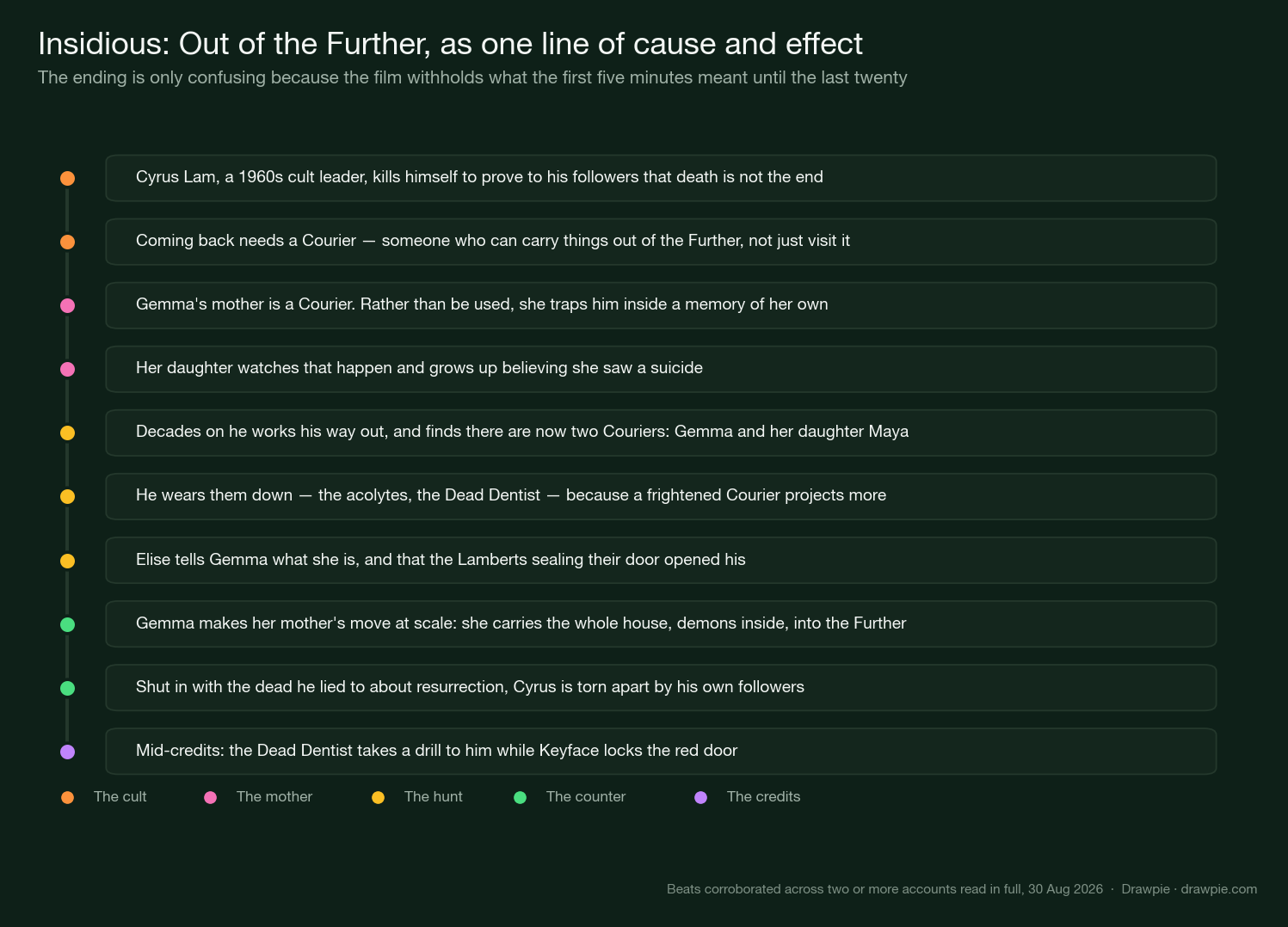
Cyrus Lam ran a cult in the 1960s built on a promise that death is not the end and that he could put his followers back in touch with the dead. He killed himself to prove it. Getting back out, though, needs someone the films call a Courier — not an astral projector who can visit the Further, but someone who can carry things out of it.
What did Gemma’s mother actually do?
She was a Courier, and the death her daughter witnessed was her trapping Cyrus inside a memory of her own rather than letting him use her. Gemma grows up believing she watched her mother take her own life, and the film lets the audience believe it too for most of its running time. It also lets Gemma believe her mother was mentally ill, which is the wound the whole character is built on.
This is the single beat on this page that only one of the accounts read for it spells out — it comes from dmtalkies’ piece of 23 August. It is here because everything else in the ending is downstream of it: it is why Cyrus is weakened, why he comes back for Gemma specifically, and why Gemma’s own solution is a variation on a move that has already worked once.
He was strong enough to get out eventually. What he found on the other side was better than what he lost: Gemma is a Courier, and so is her daughter Maya. Two doors instead of one.
Who is Cyrus Lam, and what did he want?
A dead cult leader who wants a living carrier, and who is willing to terrorise two generations of one family to get one. The ring Maya finds in a box in the garage, marked “C.L.”, is the thread that ties the present-day haunting to a man who died sixty years ago; Gemma fills in the rest from an old VHS tape of his sermons.
His method is not subtle and does not need to be. He wears Gemma and Maya down — the elderly acolytes he inducted decades ago, the Dead Dentist in his chair — because a frightened Courier projects more often, and every projection is another chance to make her carry something back.
The irony the film ends on is that he never actually had the power he sold. He promised his followers resurrection and could not deliver it; when Gemma shuts the house on all of them, the dead he lied to are in there with him.
How does this connect to the other Insidious films?
Through a single line of Elise’s dialogue: the Lamberts sealing their door in The Red Door is what opened Cyrus’s. That is the whole bridge, and it is deliberately light — this is the first entry designed to work without knowing the previous five.
Three other threads are worth naming for anyone who has seen them:
- Elise Rainier has been in the series since the 2010 original and died in it. She has spent most of the franchise since operating from inside the Further, which is where Gemma reaches her — by astral communication first, face to face during the final confrontation.
- Keyface, the demon who locks the red door on Cyrus in the mid-credits scene, comes from Insidious: The Last Key.
- The red door itself is the image the previous film was named for.
That mid-credits shot puts two franchise callbacks and the film’s cruellest joke in the same frame: the Dead Dentist takes a dull drill to a dead man’s teeth while Keyface shuts the door, and the woman he spent the film trying to break cleans teeth for a living.
The house-into-the-Further finale is also a straight nod to the ending of the original Poltergeist, which SlashFilm points out has been an influence on this series from the start.
Where can you buy Insidious: Out of the Further tickets?
It is still in US theatres, and the film’s Fandango page lists every screen near you once you set a location. From there you can buy directly or jump to the chain’s own app, which is usually where loyalty pricing and discount days apply.
One thing no article can give you is a time. Fandango shows no showtimes at all until you pick a location, because screenings differ by city and by day — the link is a starting point, not a schedule. What is fixed is the rest: it opened on 21 August, runs 1h 46m, and is rated PG-13 for strong violent content, bloody images, terror and some strong language.
Is Insidious: Out of the Further a hit?
Comfortably. It cost $18m and has taken $71.0m worldwide in its first ten days. It opened at No. 1 with $25,106,020 across 3,303 screens and stands at $36.5m domestic and $34.5m international.
| Day | Domestic gross |
|---|---|
| Fri 21 Aug | $10,675,888 |
| Sat 22 Aug | $8,674,923 |
| Sun 23 Aug | $5,755,209 |
| Mon 24 Aug | $2,101,444 |
| Tue 25 Aug | $2,949,766 |
| Wed 26 Aug | $1,821,571 |
| Thu 27 Aug | $1,551,306 |
Tuesday is the only day in that week that rose, up 40% on the Monday before it on the same number of screens — the discount-Tuesday programmes at the major chains, which is the one reliable way to pay less for a ticket to anything.
For contrast, look at what opened against it. Jason Statham’s Mutiny arrived the same Friday on a $40m budget and took $7.7m. Insidious cost less than half as much and made more than three times as much in the opening weekend alone.
Is Insidious: Out of the Further worth seeing?
Critics are lukewarm, audiences are warmer, and the split is narrower than the franchise usually produces. As of 30 August it holds 57% on the Tomatometer from 114 reviews and 69% with audiences from more than a thousand verified ratings. Metacritic has it at 47. CinemaScore audiences graded it C+.
The critics’ consensus is unusually specific about the trade-off: the film’s attempts at a fresh spin mostly underline how formulaic the series has become, but some of the set pieces are among the most effective in it. Rotten Tomatoes’ audience summary is blunter and funnier — it warns that the film is especially hard going for anyone with a phobia about teeth or fingernails, which tells you exactly which set pieces those are.
If you want the Lamberts, they are not here. If you have never seen an Insidious film, this is the easiest one to start with in fifteen years — and if you have seen all five, the reward is one line of Elise’s dialogue and a demon locking a door.
How we verified this
✅ The ending is built from beats that two or more accounts carry, all read in full on 30 August 2026: SlashFilm (Bill Bria, 20 August, 8:30 PM EST), ScreenRant (Josh Bate, 20 August, 1:45 PM EDT), dmtalkies (Ruchika Bhat, 23 August) and Wikipedia’s plot section. The two 20 August pieces post-date the 18 August Los Angeles premiere, so they are written from a screening rather than from supplied material.
🔴 One load-bearing beat rests on a single source and is attributed in the text. That Gemma’s mother was trapping Cyrus in a memory rather than taking her own life is spelled out only by dmtalkies. It is on this page, and on the chart, because it is the revelation the whole film turns on — but the article names where it comes from instead of letting four sources appear to agree.
⚠️ The villain is Cyrus Lam, not Cyrus Lee. ScreenRant uses “Lee” throughout its ending explainer. Wikipedia, dmtalkies and SlashFilm all use Lam, and SlashFilm is the one that pairs the name with the credited actor — “Cyrus Lam (Sam Spruell)”. Three to one, and the outlier never ties the name to the cast list.
⚠️ “Mid-credits” versus “post-credits” is a real disagreement, and the practical answer is the same either way. SlashFilm places the scene after the film’s main-on-end titles and calls it mid-credits; ScreenRant and dmtalkies both call it a post-credits scene. Nobody describes it as arriving at the very end of the crawl, so this page tells you to stay through the stylised title sequence rather than through everything.
⚠️ One lore claim was left out for being single-sourced. dmtalkies states that the franchise’s previous villains were all followers of Cyrus, which would make him the series’ top-level antagonist. No other account read here says so, and it is a large enough claim about six films that one source is not enough.
✅ Box office and scores were read off the source pages rather than from coverage. The daily domestic table, the $18m budget and the $71.0m worldwide total come from The Numbers; the Tomatometer, audience score and review counts were read live on Rotten Tomatoes on 30 August.