India's Telegram Ban Triggers a VPN Surge: What Happened — and the Hidden Risks (June 2026)

India temporarily blocked Telegram in mid-June 2026 ahead of a major medical-entrance re-exam, and instead of simply moving on, users rushed to download VPNs — pushing downloads of major VPN apps up 49% in a single day. The block, the biggest day for VPN downloads in India since at least the start of 2025 , has reignited debates about censorship, proportionality and digital security. Here’s what happened, why, and the risks experts are warning about.
Why is Telegram banned in India?
India’s IT ministry temporarily restricted Telegram to stop the spread of fake exam papers ahead of the NEET-UG re-test, the country’s largest entrance exam by applicant volume. The restriction, set to last until 22 June 2026 , was implemented by the Ministry of Electronics and Information Technology (MeitY) after the National Testing Agency said bad actors were using the app’s message-editing feature to spread fabricated exam papers and fake leak evidence.
It’s a temporary, event-linked measure — not a permanent ban — affecting a platform with more than 150 million users in India .
How big was the VPN surge?
VPN downloads jumped 49% the day the restriction was announced, from a recent daily average of 139,000 to 208,000. According to app-intelligence firm Appfigures, individual providers saw even sharper spikes — Proton VPN downloads on Apple’s App Store jumped 113% and Turbo VPN rose 85% . Proton VPN climbed from 18th to 5th in Apple’s Utilities rankings in two days, and Proton said daily registrations from India rose 120% above baseline.
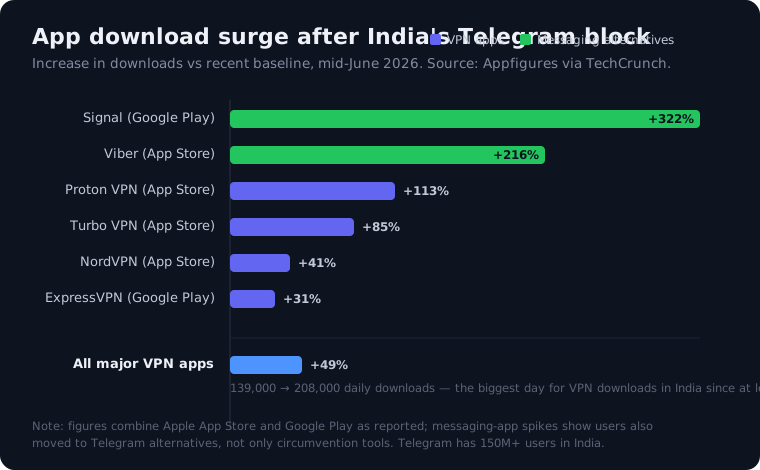
The download spikes weren’t limited to VPNs — users also moved to alternative messaging apps. The figures reported:
| App | Type | Download increase |
|---|---|---|
| Signal | Messaging | +322% (Google Play) |
| Viber | Messaging | +216% (App Store) |
| Proton VPN | VPN | +113% (App Store) |
| Turbo VPN | VPN | +85% (App Store) |
| NordVPN | VPN | +41% (App Store) |
| ExpressVPN | VPN | +31% (Google Play) |
| All major VPN apps | VPN | +49% overall |
As one NordVPN privacy advocate put it, spikes in demand for VPNs tend to follow any kind of platform restriction, regardless of the reason — when access to a tool people rely on is suddenly removed, they look for alternatives fast.
What did the court decide?
The Delhi High Court upheld the restriction on Friday, rejecting Telegram’s challenge. Telegram had argued that authorities should target specific content rather than block the entire platform , and said it had already removed channels flagged by law enforcement. Government lawyers defended the measure as a temporary, event-linked response; Solicitor General Tushar Mehta told the court that while a permanent ban could raise proportionality concerns, the current measure had a “logical nexus” to its objective .
The enforcement method also drew scrutiny: an internet-analysis director reported that an Indian telecom hijacked BGP routes belonging to Telegram to enforce the block, and Telegram’s founder publicly accused rivals of lobbying for the ban.
Are free VPNs safe? The risk experts are warning about
This is the part most users overlook: security experts warn that a free VPN can be far riskier than whatever you are trying to avoid. According to specialists quoted by Outlook Business, many free services may log user activity, sell data or expose users to credential theft , and a VPN does not automatically guarantee anonymity or security.
The key risks flagged:
- A VPN is not automatic anonymity. If the provider itself lacks strong security practices, your data can still be intercepted or misused.
- Free VPNs monetize you. Logging and selling browsing data is a common business model for “free” services.
- Credential theft. Untrusted apps can harvest logins and personal data.
- Wider exposure. Experts note unverified VPNs can even expose connected devices and industrial systems to outside actors.
It’s worth noting that several of these warnings come from the same news coverage as VPN-provider commentary, so readers should weigh sources. But the underlying point is widely held in security circles: installing an unknown app to regain access can trade one risk for a larger one.
Is this part of a bigger pattern?
Yes — VPN surges now follow platform blocks almost everywhere, and India restricts the internet more than most countries. By one tracker, Telegram is currently blocked in 13 countries and has faced disruptions in at least 40 others over the years. The same playbook repeats globally: VPN downloads in the US rose more than 40% week-over-week when TikTok was briefly pulled from app stores in 2025, and similar spikes followed restrictions in Iran and Russia.
India itself has enforced at least 170 internet restrictions since 2015 , far outpacing other nations, including localized shutdowns during contentious events.
The bottom line
India’s temporary Telegram block, tied to exam-fraud concerns, produced a textbook reaction: a 49% jump in VPN downloads and a rush to apps like Signal and Viber. The Delhi High Court upheld the measure, which was set to run until 22 June. The most important takeaway for ordinary users isn’t how to get around a block — it’s that grabbing an unknown free VPN can be riskier than the restriction itself, so any privacy tool deserves the same scrutiny you’d give your bank app.
This article reports on events and is not a guide to circumventing lawful restrictions. It reflects reporting as of 21 June 2026 and may be superseded as the situation develops. Nothing here is legal advice.