Greenland's Oil and Gas: How Much Is There, and Can Anyone Get It?

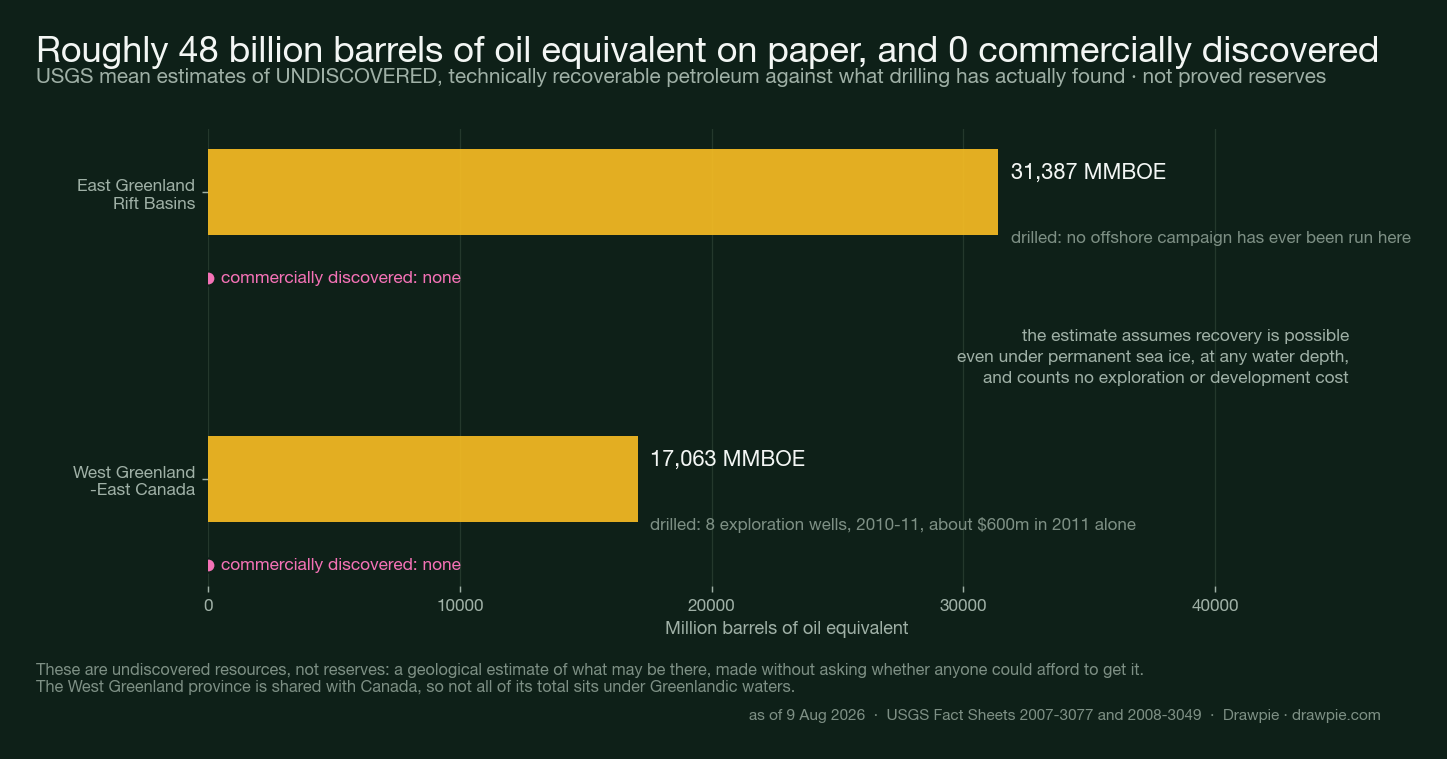
- The headline number is about 48 billion barrels of oil equivalent across Greenland’s two petroleum provinces — but none of it is a reserve. The USGS assessed undiscovered, technically recoverable resources, which is a geological estimate of what might be there.
- The estimate explicitly assumes the oil could be recovered even under permanent sea ice at any water depth, and includes no economic considerations at all. The USGS says so in the fact sheet: results are presented without reference to the costs of exploration and development.
- The one serious drilling campaign found nothing. Cairn Energy drilled eight wells offshore west Greenland in 2010 and 2011, spending about $600 million in 2011 alone, and made no commercial discovery.
- Since July 2021 Greenland has issued no new oil or gas exploration licences. The moratorium did not cancel older permits, and the one live project — Jameson Land in the east — is currently in a dispute with the regulator over equipment moved without approval.
Greenland sits on one of the largest untapped petroleum estimates in the Arctic, and not a single barrel of it has ever been produced commercially. Both halves of that sentence are true, and the gap between them is the entire subject.
The question “how much oil does Greenland have, and how easy is it to get” has a precise answer, and it is not the one the big number suggests.
How much oil and gas does Greenland actually have?
About 48 billion barrels of oil equivalent, spread across two geological provinces. The figures come from the US Geological Survey’s Circum-Arctic Resource Appraisal, which assessed 33 Arctic provinces.
| Province | USGS mean estimate |
|---|---|
| East Greenland Rift Basins | 8.9bn bbl oil, 86 tcf gas, 8.1bn bbl NGL — 31,387 MMBOE |
| West Greenland–East Canada | 7.3bn bbl oil, 52 tcf gas, 1.2bn bbl NGL — 17,063 MMBOE |
The west Greenland province is shared with Canada, so not all of its total sits under Greenlandic waters. The USGS does not split it, and neither do we.
That is a genuinely large number. Of all the Arctic’s undiscovered oil, the USGS says more than 70% sits in just five provinces — and two of them are Greenland’s, alongside Arctic Alaska, the Amerasia Basin and the East Barents Basins. Most of the east Greenland total is concentrated in the North and South Danmarkshavn basins, offshore.
Is that a reserve, or a guess?
Neither, exactly — and this is where most coverage goes wrong.
These are undiscovered, technically recoverable resources. That means a probabilistic estimate, built from geology, of petroleum that might exist and that could be produced with existing technology if it exists. It is not a reserve. A reserve is oil someone has found, measured and determined they can profitably produce. Greenland has essentially none of that.
The USGS is unusually direct about what its numbers do not include. From the fact sheet itself, on the offshore estimates:
the resources would be recoverable even in the presence of permanent sea ice and oceanic water depth
And on economics:
No economic considerations are included in these initial estimates
That is the answer to “is it easy to extract” hiding inside the answer to “how much is there”. The 48 billion barrels is calculated on the assumption that the ice and the water depth are not obstacles, and without costing a single well. Roughly 84% of the Arctic total is offshore.
The assessment also excludes unconventional resources entirely — coal bed methane, gas hydrate, oil shale and tar sand are all outside it.
Has anyone actually found any?
One company tried seriously, and found nothing worth producing.
Cairn Energy drilled offshore west Greenland across two summers:
| Season | Wells | Result |
|---|---|---|
| 2010 | 3 | no oil or gas |
| 2011 | 5 | no commercial discovery, about $600m spent |
The individual results are instructive. The Gamma-1 well in the Eqqua block reached total depth without encountering hydrocarbons. Delta-1 in the Napariaq block returned nothing promising. In the Atammik block, 202 km offshore Nuuk, Cairn did hit what it called reservoir-quality sands — then plugged and abandoned the well anyway, unable to evaluate the samples properly because of mud losses and poor hole conditions.
Eight wells. No commercial discovery. East Greenland — the province holding the bigger estimate — has never had an offshore campaign at all.
Why is it so hard to drill there?
Four constraints, and only one of them is geology.
- The season. Cairn’s 2010 campaign ran inside a three-month window, which is what the weather allows. A well that runs into trouble does not simply get another month.
- The ice. The USGS assumed it away for the purpose of estimating. An operator cannot.
- The water. Most of the estimated resource is offshore, and in the deep basins.
- The absence of everything else. There is no pipeline network, no processing infrastructure and no nearby service base. Every item arrives by ship in the ice-free window — which is exactly why the current dispute is about the logistics of moving equipment, not about drilling.
Greenland’s own government put it in economic terms when it stopped issuing licences: the minister for natural resources said the price of extraction was, on the government’s calculations, too high.
Is it even legal to look?
Not for anyone new. Greenland stopped issuing oil and gas exploration licences in July 2021.
The stated reasons were climate and the environment, and the cost calculation above. The important detail for anyone reading a headline about Greenlandic oil: the moratorium did not cancel licences already in force. Older permits survive on their original terms.
That is why there is still a live oil project in a country that has banned oil exploration.
What is happening at Jameson Land right now?
A drilling plan and an enforcement dispute, both in the last few weeks.
The Jameson Land licences in east Greenland predate the 2021 ban and were extended by four years in 2024. They are held by London-listed 80 Mile PLC through its subsidiary White Flame Energy. In May 2026 Greenland Energy Company, listed on NASDAQ, took a 70% working interest as drilling contractor, raising $70 million to fund two exploration wells, with equipment due in the third quarter and drilling in the fourth — subject to government approval.
Approval is the sticking point. The equipment travelled from Dundas in north-west Greenland to Tasiilaq in September 2025, then in July 2026 was moved on to a staging area near Nerlerit Inaat airport. The company had held approval to land equipment in Jameson Land, but that approval had expired, and a renewal application is still being considered.
Greenland’s Mineral Licensing and Safety Authority issued a formal warning. Its director, Jørgen Hammeken-Holm, was quoted as saying that any landing of drilling equipment “would be unacceptable without government approval”, and warned of firm sanctions — including police involvement or support from the Arctic Command — if the authorities were ignored.
At the time of writing that is where it stands: a funded plan to drill, and a regulator saying not without permission.
So — how much, and how easy?
Plenty on paper. Nothing proved. Currently closed to new entrants.
To take the question in its parts:
- How much? About 48 billion barrels of oil equivalent estimated across two provinces, of which the east Greenland share — 31.4 billion — is the larger and the less explored. Two of the Arctic’s five biggest undiscovered-oil provinces are Greenland’s.
- Is it real? Unknown. It is an estimate of the undiscovered. The only serious test drilled eight holes and found nothing commercial.
- How easy? The estimate itself answers this by omission: it counts oil that would need to be produced under permanent sea ice, in deep water, with no cost accounted for and no infrastructure existing.
- Is it available? No new licences since 2021. The one project that survives does so because it predates the ban, and it is currently arguing with the regulator about where it may put its equipment.
The honest summary is that Greenland’s oil is large, unproven, expensive and — for now — mostly illegal to go looking for. Any story that leads with the 48 billion and stops there has told you about a fifth of it.
Sources
Checked on 9 August 2026.
| Source | What it supports here |
|---|---|
| USGS — Circum-Arctic Resource Appraisal (Fact Sheet 2008-3049) | The province-by-province means for both Greenland provinces, the Arctic totals, the 84% offshore figure, the five-province concentration of undiscovered oil, and the quoted assumptions on sea ice, water depth and economics |
| USGS — East Greenland Rift Basins assessment (Fact Sheet 2007-3077) | The 31,387 MMBOE mean, the concentration in the North and South Danmarkshavn basins, and that the work was done with GEUS |
| The Arctic Institute — Cairn Energy abandons well off Greenland | The 2010 and 2011 campaigns, the three-month weather window, and the abandoned wells |
| S&P Global — Greenland ends decades-long hunt for oil with ban on new licensing | The July 2021 moratorium and the government’s stated reasoning |
| ArcticToday — US company raises $70 million for oil exploration in east Greenland | The Jameson Land licence holders, the 70% working interest, the $70m raise, the drilling timetable and the 2024 four-year extension |
| ArcticToday — British firm eyes major Greenlandic oil project despite government opposition | The equipment movements, the expired approval and the regulator’s warning |
Unit note: MMBO is million barrels of oil, BCFG is billion cubic feet of gas, MMBNGL is million barrels of natural gas liquids, and MMBOE converts all three to a common oil-equivalent basis.
How we verified this
The distinction this article is built on is reserves versus resources. Greenland has essentially no proved oil reserves. What it has is a USGS assessment of undiscovered, technically recoverable petroleum: a probabilistic estimate of what the geology might contain. Coverage that calls these figures “reserves” is wrong, and the difference is the whole story.
The caveats are quoted from the USGS rather than paraphrased, because they are the answer to the second half of the question. The Circum-Arctic fact sheet states the offshore estimates assume resources “would be recoverable even in the presence of permanent sea ice and oceanic water depth”, and that “No economic considerations are included in these initial estimates; results are presented without reference to costs of exploration and development”. It also excludes unconventional resources — coal bed methane, gas hydrate, oil shale and tar sand — explicitly.
A like-for-like error was caught before publication. An earlier draft of the chart set the 31,387 MMBOE East Greenland estimate against Cairn Energy’s dry wells. Cairn drilled offshore west Greenland. The two provinces are in entirely different states of exploration, so the chart now shows each against its own drilling record.
One published figure is not Greenland’s alone. The West Greenland–East Canada province is shared, so its 17,063 MMBOE does not all sit under Greenlandic waters. We have not tried to split it, because the USGS does not.
Two listed companies appear in the Jameson Land section and this article makes no assessment of either. 80 Mile PLC is London-listed and Greenland Energy Company is on NASDAQ. Their corporate arrangements are reported as facts because they explain who is drilling and under what licence. Nothing here is a view on any security, and there is no forecast of oil or gas prices anywhere in this article.
The Jameson Land dispute is live and one-sided in the record. The regulator’s position and its director’s words are on the record; the licence holder’s response is not, at the time of writing. This is reported as an enforcement warning, not as a finding against anyone.