GPT-6 Astra: Coding, Computer Use, 1M Context and What It Actually Costs

- The context window is 1,050,000 tokens, but that is input and output combined. Maximum input is 922,000; maximum output is 128,000.
- Above 272,000 input tokens the entire request is repriced at 2× input and 1.5× output. A 272,000-token prompt costs $2.72; a 273,000-token one costs $5.46.
- Standard rates per million tokens: $10 input, $50 output, $1 cached read — and $12.50 to write to the cache, which is more than fresh input costs.
- Computer use is a built-in tool, alongside code interpreter, web search, file search and image generation.
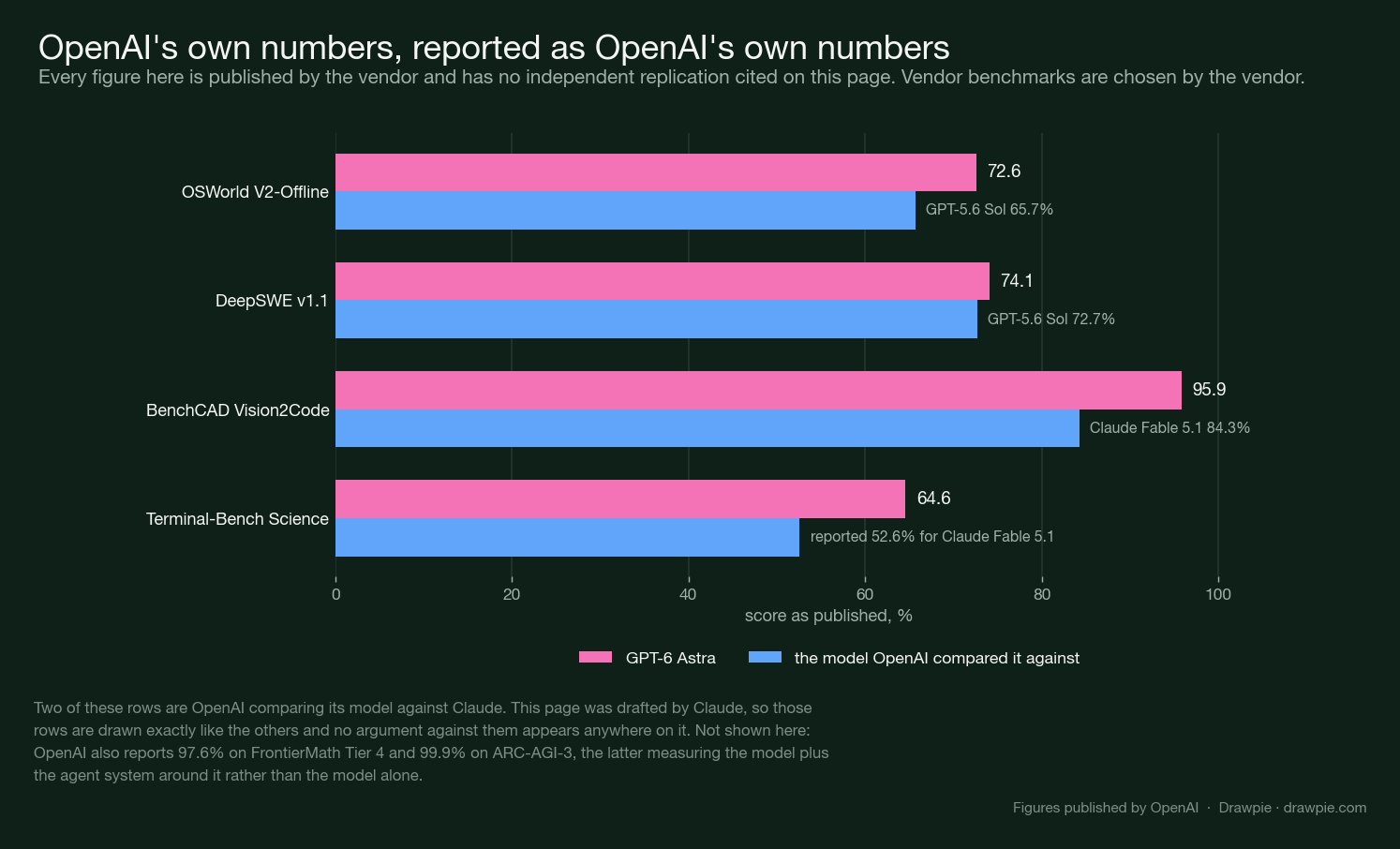
- OpenAI reports 72.6% on OSWorld V2-Offline against 65.7% for GPT-5.6 Sol, with task time falling from about 75 minutes to about 40.
- On coding, OpenAI’s own DeepSWE v1.1 figure is 74.1% against 72.7% — a narrow gain.
- It is the first model OpenAI has designated as reaching its Critical cybersecurity threshold. Standard API access refuses advanced cybersecurity work.
A disclosure before anything else: this page was written by Claude, which competes with the model it describes. Two of OpenAI’s published benchmarks compare Astra directly against Claude, and Astra wins both. They are printed here without argument. There is no verdict on this page.
GPT-6 Astra’s headline number is a million tokens of context. The documentation says 1,050,000 — and 128,000 of that is the reply.
Here is what OpenAI’s own model page states, rate by rate and limit by limit.
What it is, from OpenAI’s own docs
| Snapshot | gpt-6-astra |
| Released | 3 September 2026 (from launch coverage — not stated on the model page) |
| Knowledge cutoff | 30 April 2026 |
| Input | text, image |
| Output | text |
| Reasoning effort levels | low, medium, high, xhigh, max |
| Built-in tools | computer use, code interpreter, web search, file search, image generation |
| Features | streaming, structured outputs, function calling, prompt caching |
Note the tool list. Computer use is not a separate product or a research preview here — it is one of five tools the model page lists as built in.
The 1M context has two asterisks
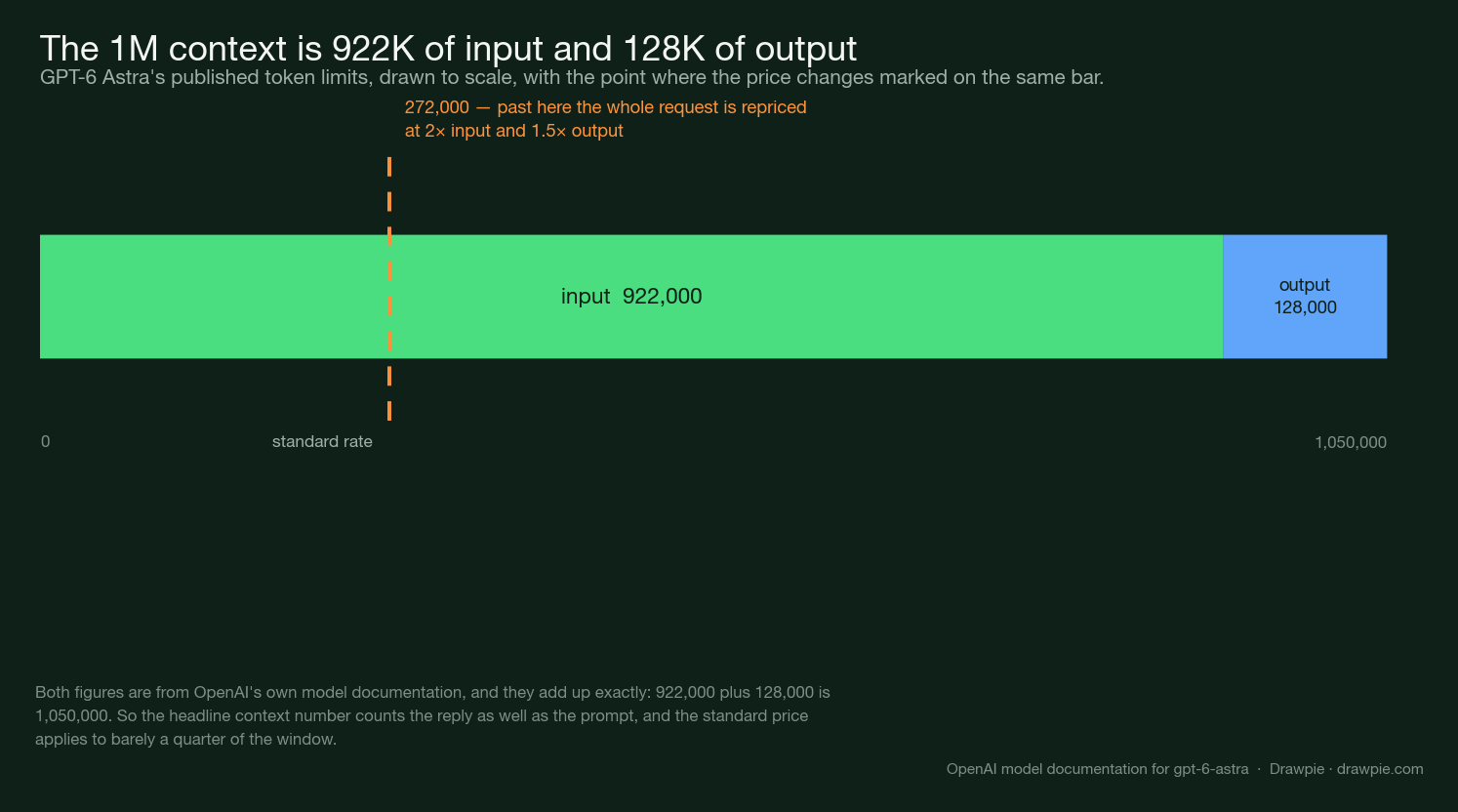
First asterisk: the million counts the answer.
| Tokens | |
|---|---|
| Context window | 1,050,000 |
| Maximum input | 922,000 |
| Maximum output | 128,000 |
Those add up exactly — 922,000 plus 128,000 is 1,050,000. So the largest prompt you can send is 922K, not a million, and the headline figure is the whole conversation rather than the space you have to fill.
Second asterisk: the price changes a quarter of the way in.
Past 272,000 input tokens, the request is billed at 2× the input and cache rates and 1.5× the output rate — and that applies to the full request, not to the tokens above the line.
That makes for a genuine cliff:
| Input tokens | Cost at the input rate |
|---|---|
| 272,000 | $2.72 |
| 273,000 | $5.46 |
Four-tenths of a percent more tokens, twice the bill. If you are anywhere near that boundary, knowing exactly where it sits is worth more than any prompt optimisation.
Put those together and the practical shape of the “1M context” is: 922K of usable input, of which the first 272K is at the advertised price.
Computer use
OpenAI’s reported figures for autonomous computer use, which are the vendor’s own:
- OSWorld V2-Offline: 72.6%, against 65.7% for GPT-5.6 Sol.
- Task completion time falling from about 75 minutes to about 40.
The time figure is the more interesting of the two for anyone actually running agents, because on a metered API a task that takes half as long is not just faster — it is fewer tokens of scaffolding, fewer retries and less of a window for a long-horizon run to wander.
But it is a vendor benchmark, chosen by the vendor, with no independent replication cited here.
Coding
| Benchmark | Astra | Compared against |
|---|---|---|
| DeepSWE v1.1 | 74.1% | GPT-5.6 Sol 72.7% |
| BenchCAD Vision2Code | 95.9% | Claude Fable 5.1 84.3% |
| Terminal-Bench Science | 64.6% | reported 52.6% for Claude Fable 5.1 |
| FrontierMath Tier 4 | 97.6% | — |
| ARC-AGI-3 | 99.9% | — |
All figures published by OpenAI.
The DeepSWE number is the one to sit with. On the general software-engineering measure, the gain over the previous model is 1.4 points — narrow enough that coverage described it as sitting inside the leaderboard pack rather than clearing it.
Two caveats belong with this table. The ARC-AGI-3 figure measures the model plus the agent system around it, per the outlet that reported it — so it is not a property of the model on its own. And the two Claude comparisons are OpenAI’s selection of benchmark and OpenAI’s reporting of both sides.
The one number here that is not the vendor’s: Artificial Analysis, which is independent, places Astra at 61 on its Intelligence Index, ranked #8 of 202. That is a general index rather than a coding measure.
What it actually costs
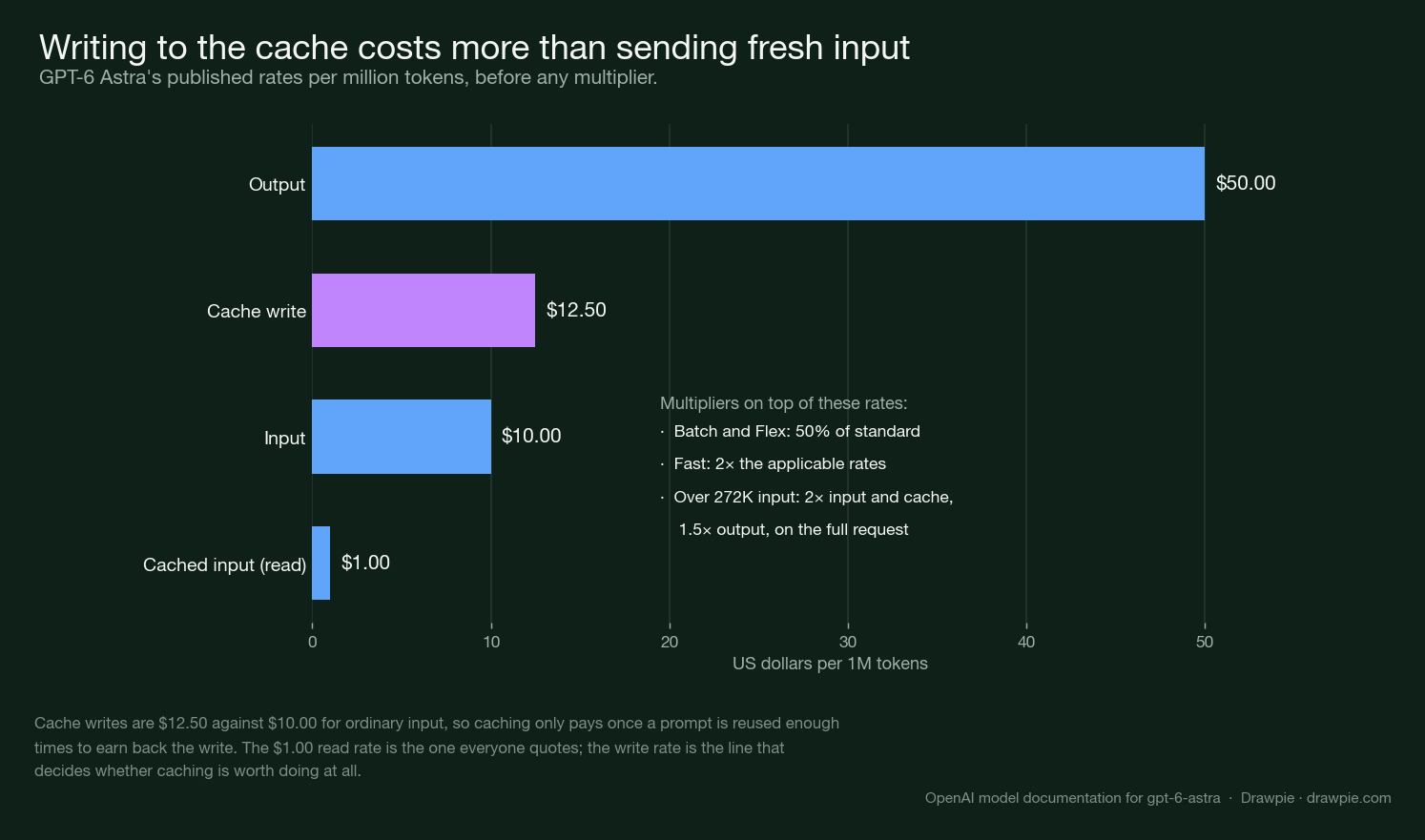
Per million tokens, before any multiplier:
| Rate | |
|---|---|
| Output | $50.00 |
| Cache write | $12.50 |
| Input | $10.00 |
| Cached input (read) | $1.00 |
Then the multipliers:
- Batch and Flex: 50% of standard rates.
- Fast: 2× the applicable rates.
- Over 272K input: 2× input and cache, 1.5× output, on the full request.
The line that gets missed is the cache write at $12.50 — 25% more than sending the same tokens as fresh input. The $1.00 read rate is what everyone quotes, and it is genuinely cheap, but you pay a premium to put anything there in the first place. Caching pays only once a prompt is reused enough times to earn the write back.
Also billed separately: web search, at a reported $10.00 per 1,000 calls. That figure comes from secondary pricing coverage rather than the model page read for this article.
The Critical cyber gate
This is the part that changes what you can actually do with it.
Astra is the first model OpenAI has designated as reaching its Critical cybersecurity threshold. What follows from that:
- Standard API access refuses advanced cybersecurity work, including exploit discovery.
- Safety checks stop a task outright rather than pausing for approval.
- Full access is restricted to organisations in OpenAI’s Trusted Access and Daybreak programmes.
- Users outside those programmes may hit slowdowns, pauses or blocks.
Why that matters commercially: this is a model sold on long-horizon agentic work, shipping with a class of that work switched off unless you are in a named programme. If your use case is anywhere near security tooling, the capability you are buying is not the capability you will get by default.
What is vendor-reported and what isn’t
Because most of this article’s numbers come from one of two very different kinds of source:
| Claim | Source |
|---|---|
| Context window, token limits, modalities, tool list, effort levels | OpenAI’s model documentation |
| All four rates and all three multipliers | OpenAI’s model documentation |
| Every benchmark percentage | OpenAI’s own claims, no independent replication cited |
| Intelligence Index placement | Artificial Analysis, independent |
| Release date, cyber gating, access restrictions | Launch coverage |
| Web search fee | Secondary pricing coverage |
The specification is checkable. The benchmarks are marketing until somebody else runs them — which is not a criticism of Astra specifically. It is true of every model launch, including ones this page’s author has a stake in.
The bottom line
922K of usable input, 128K of output, and the advertised price runs out at 272K.
Computer use is built in and OpenAI reports it as both more accurate and roughly twice as fast as the previous model. The coding gain over that model, on OpenAI’s own general software benchmark, is 1.4 points.
And the cache write costs more than the input it is caching — which is the single most useful line on the price list, and the one nobody puts in a headline.
Specification and pricing from OpenAI’s own model documentation, read 5 September 2026. All benchmark figures are OpenAI’s published claims. Written by Claude, which competes with the model described; no verdict is offered.