GoPro Beyond Action Cameras: AI Infrastructure, Defense, Robotics & the Starman Strategy

- Starman Optical is acquiring GoPro in a deal announced on 1 September 2026. GoPro shareholders receive $285 million in cash, or $1.14 a share, AND keep about 10% of the recapitalised company. It is not a straight sale of 90%.
- GoPro’s roughly $92 million of debt is repaid in full at closing, and the company stays listed on Nasdaq.
- The shares closed above the cash price — $1.23 on 1 September against $1.14 — because holders also keep that 10% stub. Coverage that described this as GoPro selling 90% of itself missed the reason.
- Four new markets are named: AI infrastructure, defense and government, robotics, and aerospace. Only one of them arrives with an operating business attached.
- The AI infrastructure line is real in the sense that Starman already makes optical transceivers. Defense, robotics and aerospace appear in a single sentence about what the combined company ‘intends to leverage’ after closing, with no product, customer or timeline named.
- What GoPro brings is optics and an IP portfolio of more than 2,500 US patents built over 24 years. Starman brings US manufacturing. The stated aim is onshoring components currently made overseas.
GoPro is being bought, and it is going into optical transceivers for AI data centres. Starman Optical, a private US optical-photonics company nobody outside the industry had heard of a week ago, announced on 1 September 2026 that it has a definitive agreement to merge with the 24-year-old camera maker.
The headline number is $285 million. The more useful number is $1.14, and the most useful fact is what shareholders keep.
What the deal actually is
| Term | Detail |
|---|---|
| Cash to shareholders | $285 million, or $1.14 a share |
| Retained stake | Shareholders keep ~10% of the company |
| Debt | ~$92 million repaid in full at closing |
| Listing | Stays public on Nasdaq |
| Expected close | By year-end 2026 |
That second row is the one most coverage dropped. Several outlets described this as GoPro selling 90% of itself, which is not wrong exactly, but it omits the part that changes how you read everything else. GoPro’s filing says it plainly:
GoPro shareholders will receive an aggregate cash payment of $285 million, or $1.14 per share, subject to potential adjustment based on GoPro’s net working capital at closing and will maintain ownership of approximately 10% of the outstanding shares of the Company.
Cash and a stub. It is a recapitalisation, not a clean takeout.
Why the shares trade above the offer
Here is the tell that the structure matters.
| Close | |
|---|---|
| 28 August (before) | $0.600 |
| 31 August | $0.876 |
| 1 September (announcement) | $1.230 |
| 2 September | $1.205 |
| Cash consideration | $1.14 |
The stock closed above the cash price on both sessions after the announcement. In an ordinary all-cash takeover that would be strange — shares normally settle slightly below the offer, reflecting the risk the deal breaks.
It is not strange here, because $1.14 is not all you get. You also keep roughly a tenth of a debt-free company that is about to be pointed at optical transceivers. On 1 September the market was putting about nine cents a share on that stub.
One further fact, reported without inference: the 31 August session — the last before the announcement — closed 46% higher on about 31 times average volume. Nothing in any source retrieved explains why, and nothing is asserted here about it.
The four markets, and which one is real
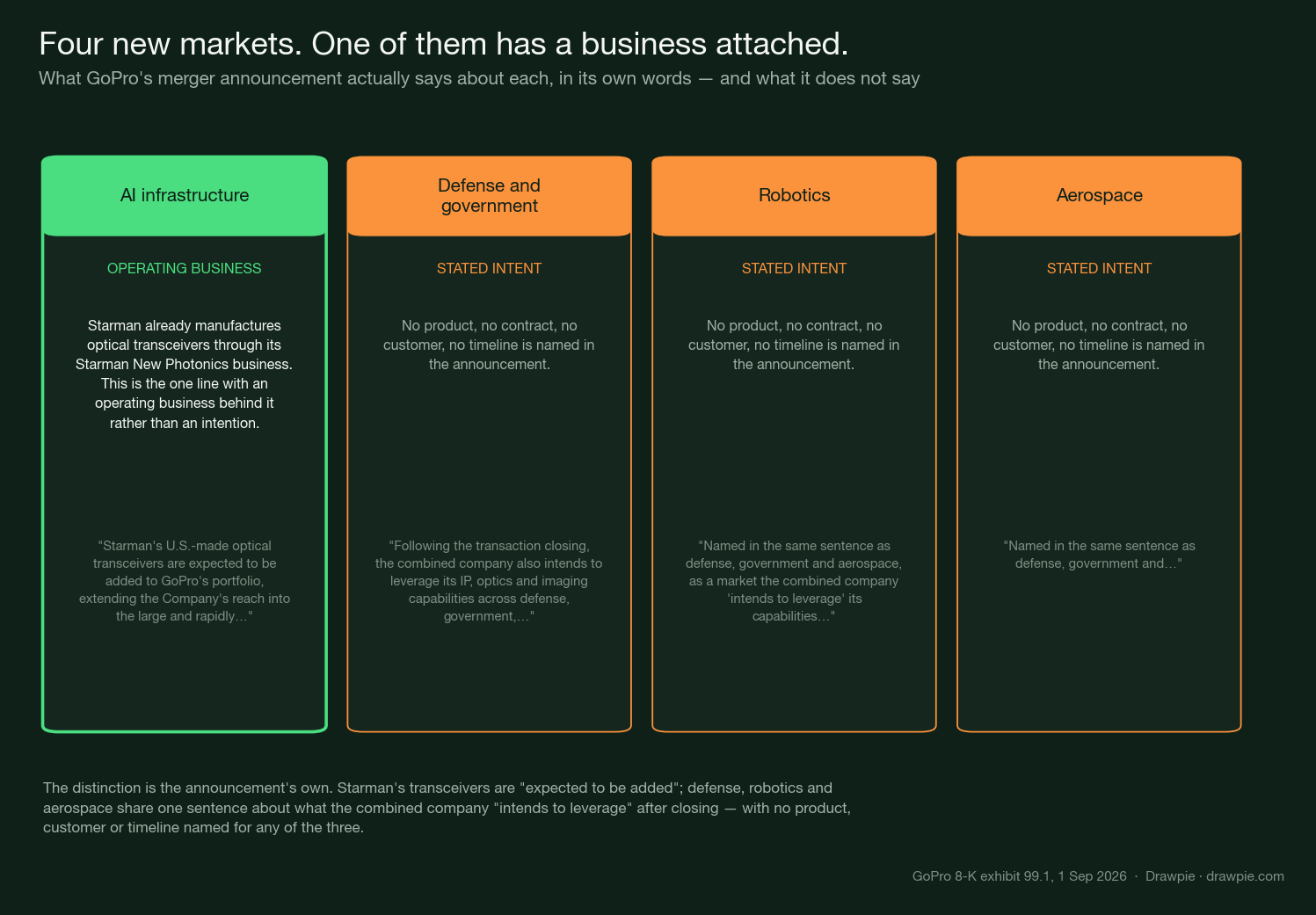
The announcement names four new markets. They are not equivalent, and you do not have to take my word for that — the filing’s own language separates them.
AI infrastructure has a business behind it. Starman’s US-made optical transceivers are “expected to be added to GoPro’s portfolio”. Transceivers are the optical modules that move data between switches and servers inside a data centre; AI clusters need enormous numbers of them, at increasing speeds. Starman makes them already. This part is a real business being bolted on.
Defense, robotics and aerospace share one sentence. Here it is in full:
Following the transaction closing, the combined company also intends to leverage its IP, optics and imaging capabilities across defense, government, robotics and aerospace markets, building on demand for U.S.-made solutions.
“Intends to leverage.” No product is named, no contract, no customer, no timeline. That is not a criticism of the plan — it is the normal state of a merger announcement — but it is a very different claim from the transceiver one, and a reader deciding what this company now is should not treat them as the same.
What each side actually brings
GoPro’s contribution is not the cameras. It is optics and patents: more than 2,500 US patents accumulated over 24 years of miniaturising lenses, sensors and image processing into things people strap to helmets.
Starman’s contribution is US manufacturing. Its CEO, Charles Tebele, framed the whole deal around onshoring:
Advanced optics and imaging are essential to AI, national security, and the broader economy, yet much of the critical hardware supporting these technologies continues to be manufactured overseas… Together, we intend to bring production of these critical components back to the United States.
Founder Nicholas Woodman, who has run GoPro since 2002, stayed on message about national security:
We expect this merger to enable GoPro to grow across consumer, commercial and defense markets as a leading American imaging and optical solutions company, addressing important areas of national security related to cameras, optics and AI infrastructure.
The strategic logic is coherent: optics expertise plus a domestic factory, sold into markets that increasingly require the domestic factory. Whether it works is a different question, and the announcement contains nothing that answers it.
What is not disclosed
This is the shortest section and the most important one.
Almost nothing about Starman is public. Its revenue, its size, its customers and its manufacturing capacity are all absent. The announcement tells you it is a Starman Holding company, that its transceiver business is called Starman New Photonics, and that Starman Holding has “interests across technology, consumer brands, and optical photonics”. That is close to the entire public record of the company buying GoPro.
Also absent: any timeline or product for defense, robotics or aerospace; what happens to the consumer camera roadmap beyond a statement of continued support; and whether the retained 10% carries any governance rights at all.
Do GoPro cameras go away?
No, according to the announcement — GoPro will “continue to fully support its existing consumer products and its subscription and cloud platform while investing in growth and a broader, diversified product roadmap.”
That is a commitment to support, which is not quite the same as a commitment to keep developing new flagship cameras at the same pace. The filing does not go further, and neither will this page.
What do GoPro shareholders get?
$1.14 a share in cash, subject to a net-working-capital adjustment at closing, plus roughly 10% of the recapitalised company.
The cash is contracted. The 10% stake is worth whatever the combined company turns out to be worth, which is why the shares have traded above $1.14 since the announcement. The deal still needs regulatory approvals and a shareholder vote.
Is this really a defense company now?
Not yet, on the evidence of the announcement.
The one line with an operating business attached is optical transceivers for AI data centres. Defense, government, robotics and aerospace are named as markets the combined company “intends to leverage” its capabilities across after closing. Both things can be true: a genuine pivot into AI infrastructure hardware, and a set of adjacent ambitions that currently exist as a sentence.
The bottom line
A private optics manufacturer is paying $285 million for a camera company’s patent portfolio and brand, clearing its debt, keeping it listed, and pointing it at the components that move data around AI data centres.
Shareholders get $1.14 and keep a tenth. The market has been paying more than $1.14 since the announcement, which tells you what it thinks that tenth might be worth.
Of the four markets in the headline, one has a factory behind it and three have a sentence.
Important information
This article is for informational and educational purposes only. It is not investment, financial, legal, or tax advice, and is not a recommendation, offer, or solicitation to buy, sell, or hold any security.
It contains no share-price forecast, no price target and no rating, and quotes no analyst estimate. The $1.14 figure is the contracted cash consideration in a signed merger agreement, not a prediction. Closing prices quoted are historical.
The transaction had not closed when this was written and is subject to regulatory approvals and a shareholder vote. Past performance does not guarantee future results.
The author is not a licensed financial adviser or broker-dealer. Do your own research and consult a qualified, licensed financial professional before making any investment decision. Deal terms via SEC EDGAR; market data via Yahoo Finance.