'Never Vance': Inside the GOP Fight Over JD Vance, Iran and the 2028 Race With Rubio
Update log (1)
- — Published 24 July 2026, nine days after the podcast. No public poll has yet been fielded after it — that is the single biggest gap in this story.

- The flashpoint is a Joe Rogan podcast published on 15 July 2026, in which Vance said some people inside the Israeli system were trying to shift American opinion to keep the Iran war going, and told his critics to go to hell.
- The underlying dispute is Iran policy — Vance has pursued negotiations, and the party’s hawkish wing opposes that. Trump himself has said Vance is philosophically a little bit different on Iran.
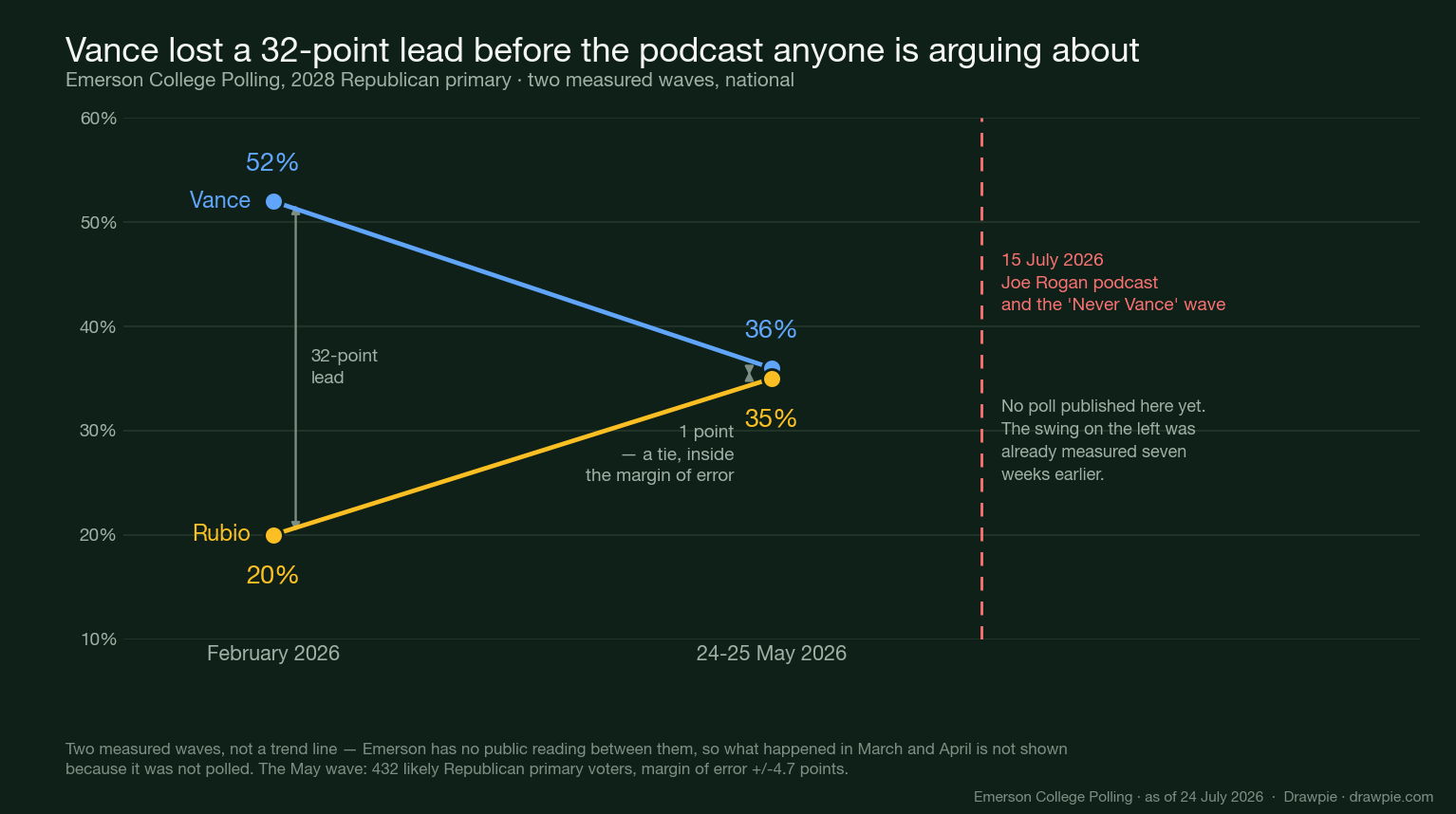
- The ‘Never Vance’ wave is real, but the polling that matters predates it. Emerson had Vance at 52% and Rubio at 20% in February; by late May it was 36–35, a statistical tie. That was measured seven weeks before the podcast.
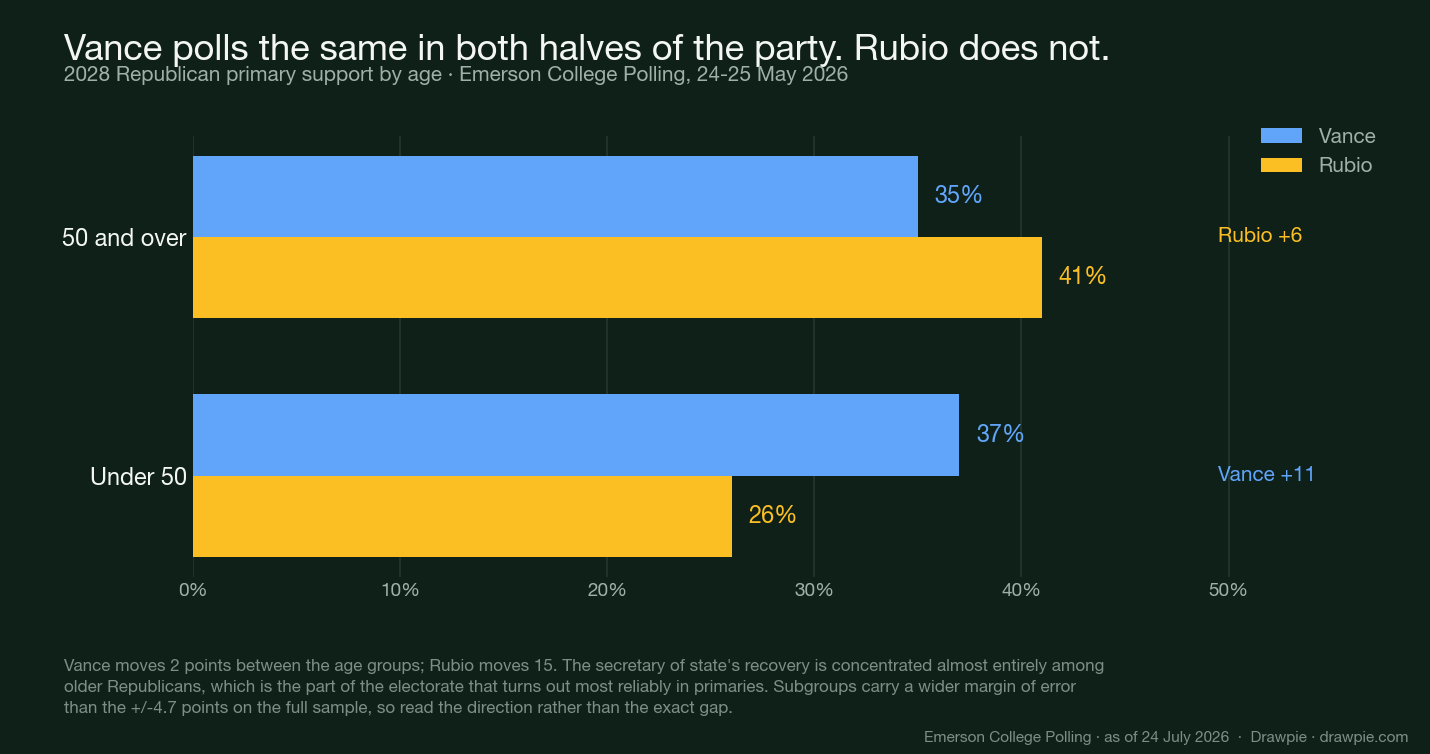
- Read the age crosstabs rather than the noise: Vance polls 37% with under-50s and 35% with over-50s. Rubio goes from 26% to 41%. The swing is almost entirely older Republicans moving to Rubio.
On 15 July 2026 the vice president went on Joe Rogan’s podcast and said that some people inside the Israeli system were working to shift American public opinion in order to keep the war with Iran going. Asked about the campaign against him, JD Vance told his critics to go to hell, and said he would do what he had to do for the American people.
Within days a slogan was circulating among Republicans: “Never Vance.”
It is a genuinely unusual moment — a sitting vice president under sustained attack from his own party’s commentariat. It is also a story where the loudest framing and the measurable facts point in different directions, and the gap between them is the most interesting thing about it.
Everything below was checked on 24 July 2026, nine days after the podcast.
What actually happened
| Date | Event |
|---|---|
| 15 July 2026 | Vance appears on Joe Rogan’s podcast; makes the remarks about Israeli officials and Iran, and tells critics to “go to hell” |
| Within 24 hours | Named conservative commentators — Ben Shapiro, Marc Thiessen, Batya Ungar-Sargon among them — publish attacks |
| Following week | The “Never Vance” slogan spreads across social media |
| Ongoing | Vance’s allies describe the campaign as coordinated; Vance remains the nominal 2028 frontrunner |
The specific claim Vance made matters, so it is worth stating precisely. He said that within the Israeli system there are people — he did not name them — who are trying to change American public opinion to keep the war going indefinitely, in the context of a failed interim US–Iran memorandum of understanding. That is a serious allegation from a sitting vice president about officials of an allied government. We have found no independent corroboration of it, and we are not presenting it as established. What is established is that he said it, and that saying it is what triggered the reaction.
The dispute underneath is Iran, not personality
Strip away the slogan and there is a real policy disagreement with a long history in the party.
Vance has pursued negotiations with Iran. The hawkish wing of the Republican coalition opposes that approach, and has since long before Vance was on a ticket. This is the restraint-versus-intervention argument that has run through Republican foreign policy for two decades, now being conducted through the sitting vice president.
Trump has publicly acknowledged the split, describing Vance as philosophically a little bit different on Iran and less enthusiastic about going to war. That is a striking thing for a president to say about his own vice president, and it is the detail that makes this different from ordinary intra-party grumbling.
And that difference is precisely what critics are attacking. Ben Shapiro’s line of criticism was that Vance sounded like a Democrat — that what he was hearing was Bernie Sanders on economics and Barack Obama on foreign policy. Whatever one makes of that, it is an argument about ideological placement, not about competence or loyalty.
⚠️ One thing to be careful about. Reporting on this fight notes that some detractors asserted, without evidence, that Vance is making policy decisions Trump does not support. That is a claim about the vice president that has not been substantiated, and it should not be repeated as though it had been. Equally, the suggestion from Vance’s allies that some of the attacking accounts are not American is their claim, and we have seen nothing establishing it.
Now look at the numbers, and at when they were taken
Here is where the coverage and the evidence part company.
| Emerson College Polling | Vance | Rubio | Gap |
|---|---|---|---|
| February 2026 | 52% | 20% | Vance +32 |
| 24–25 May 2026 | 36% | 35% | +1 — a tie |
The podcast was on 15 July. The poll was in late May. Vance’s 32-point lead had already evaporated seven weeks before the episode that everyone is now arguing about, and no public poll has been fielded since it.
That does not mean the “Never Vance” campaign is meaningless — it may well show up in the next wave. It means the campaign cannot be the explanation for a collapse that was already measured, and any analysis that treats the podcast as the turning point has the sequence wrong.
The more useful question is what happened in March and April. Emerson has no public reading between the two waves, so honestly: we do not know, and neither does anyone writing confidently about it.
Who is actually moving
The crosstabs are more revealing than the headline.
| Age group | Vance | Rubio |
|---|---|---|
| Under 50 | 37% | 26% |
| 50 and over | 35% | 41% |
Vance moves two points between the age groups. Rubio moves fifteen.
That is the finding worth sitting with. Vance’s support is remarkably flat across the party’s generations — he is not a candidate of the young wing in any polling sense. Rubio’s recovery is almost entirely older Republicans, which matters because older voters are the most reliable primary participants. A tie in a national poll of the whole party is not a tie in a primary electorate that skews old.
And the rest of the field barely exists yet:
| Candidate | Support |
|---|---|
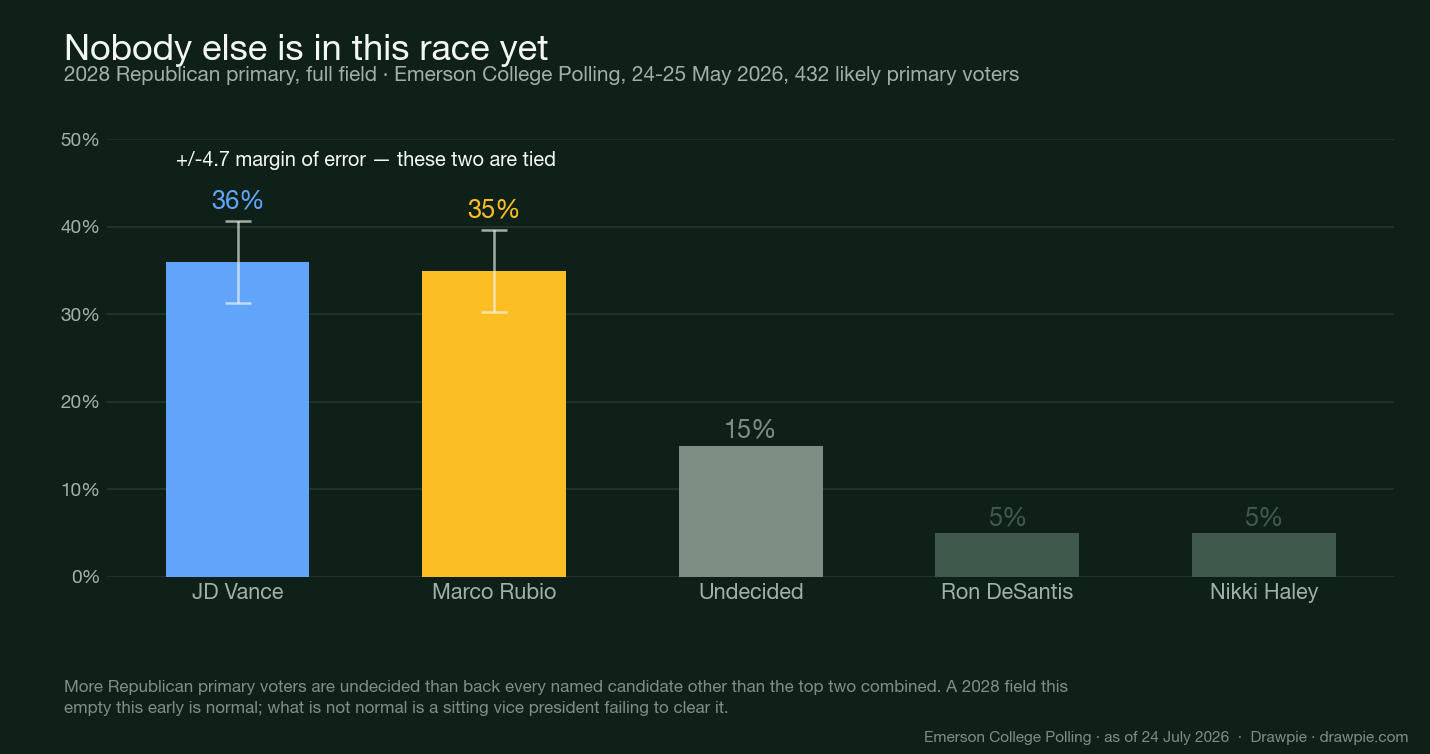
| JD Vance | 36% |
| Marco Rubio | 35% |
| Undecided | 15% |
| Ron DeSantis | 5% |
| Nikki Haley | 5% |
More Republicans are undecided than back DeSantis and Haley combined. A two-person race this early is unusual; a sitting vice president unable to clear the field is more unusual still.
The Rubio complication
Marco Rubio is Trump’s secretary of state, and Trump has praised him effusively — saying he would go down as the greatest secretary of state in history. Rubio has said he would support Vance if Vance runs, and the two describe each other as friends. What the two of them look like when pollsters put them side by side, primary and general, is in the Vance vs Rubio numbers .
Take that at face value and there is no rivalry. Take the polling at face value and there obviously is one. Both things are true at once, which is the normal condition of a primary that is three years away and in which nobody can afford to be seen campaigning yet.
What makes Rubio the natural beneficiary is structural rather than personal: he occupies the foreign-policy position that Vance’s critics are demanding, he holds it inside the administration rather than against it, and he can therefore absorb hawkish support without breaking with Trump. He does not need to attack Vance. The people attacking Vance are doing the work.
What this is really a fight about
A useful comparison: Marc Short, who was Mike Pence’s chief of staff, has observed that Vance is taking far more intense fire than Pence ever did — and attributes the difference to the fact that Vance publicly signals disagreement with the president on policy, where Pence maintained total alignment.
That is the actual mechanism here. Vance is trying to do something structurally difficult: be a vice president with an independent foreign-policy identity, inside a coalition whose hawkish wing regards that identity as disqualifying, while the president himself describes the difference out loud.
The “Never Vance” campaign is a symptom of that, not a cause. And the thing to watch is not the volume of the attacks but the next Emerson wave — the first one fielded after 15 July. If Vance’s number holds, his team’s argument that establishment hostility helps him will look correct. If it drops again, the February-to-May slide was a trend rather than a correction, and the podcast simply accelerated it.
Right now, nobody has that data. Anyone telling you otherwise is guessing.
Frequently asked questions
What is the “Never Vance” movement?
A slogan adopted by Republican critics of JD Vance, which spread across social media after his 15 July 2026 Joe Rogan podcast appearance. Detractors have characterised him as unfit for the vice presidency, largely over his approach to Iran. His allies describe it as a coordinated attempt to damage his 2028 prospects.
What did JD Vance say on Joe Rogan?
He said that some people within the Israeli system are working to change American public opinion in order to keep the war with Iran going, in the context of a failed interim US–Iran agreement, and responded to critics of his approach by telling them to go to hell. His claim about Israeli officials has not been independently corroborated.
Why are Republicans criticising Vance over Iran?
Because he has pursued negotiations, and the party’s hawkish wing opposes that. Trump has publicly said Vance is philosophically a little different on Iran and less enthusiastic about going to war.
Is Marco Rubio running against Vance in 2028?
Neither has declared. Rubio has said he would support Vance if Vance runs, and they describe each other as friends. But Emerson’s May 2026 polling has them at 36% and 35% — a statistical tie — after Vance led 52% to 20% in February.
Is Vance still the 2028 frontrunner?
Nominally, by one point in the most recent public national poll, which is well inside the ±4.7-point margin of error. Functionally that is a tie, and Rubio leads among Republicans aged 50 and over.
Did the podcast cause Vance’s poll numbers to fall?
No public evidence supports that. The Emerson wave showing the collapse was fielded 24–25 May 2026, roughly seven weeks before the 15 July podcast, and no poll conducted after the podcast had been published at the time of writing.