2026 FIBA Women's World Cup Predictions: Power Rankings, Bracket Picks & Championship Favorites
The group stage ends on 7 September and the quarter-final pairings are known that day, which retires this page’s whole bracket section. Results also accumulate daily. Re-read on 8 September and either rebuild around the actual bracket or retire the page.
Everything else on the page is unaffected; the figures below still say when they were read.

- The tournament runs 4–13 September 2026 in Berlin. It is already under way: this page was written on day two.
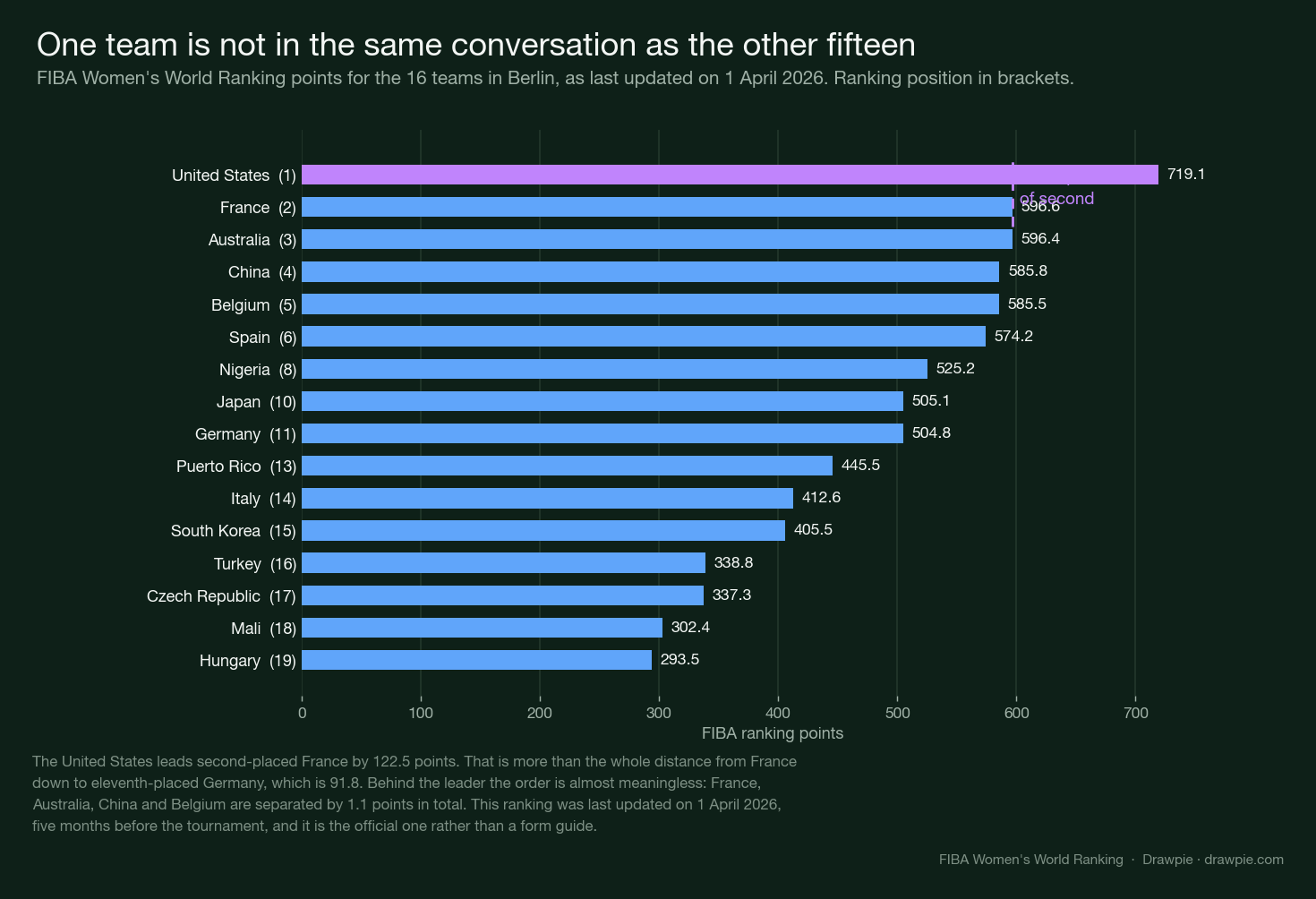
- The United States leads the FIBA ranking with 719.1 points, 122.5 clear of second-placed France — more than the whole distance from France down to eleventh.
- Behind them the order barely means anything. France, Australia, China and Belgium are covered by 1.1 ranking points.
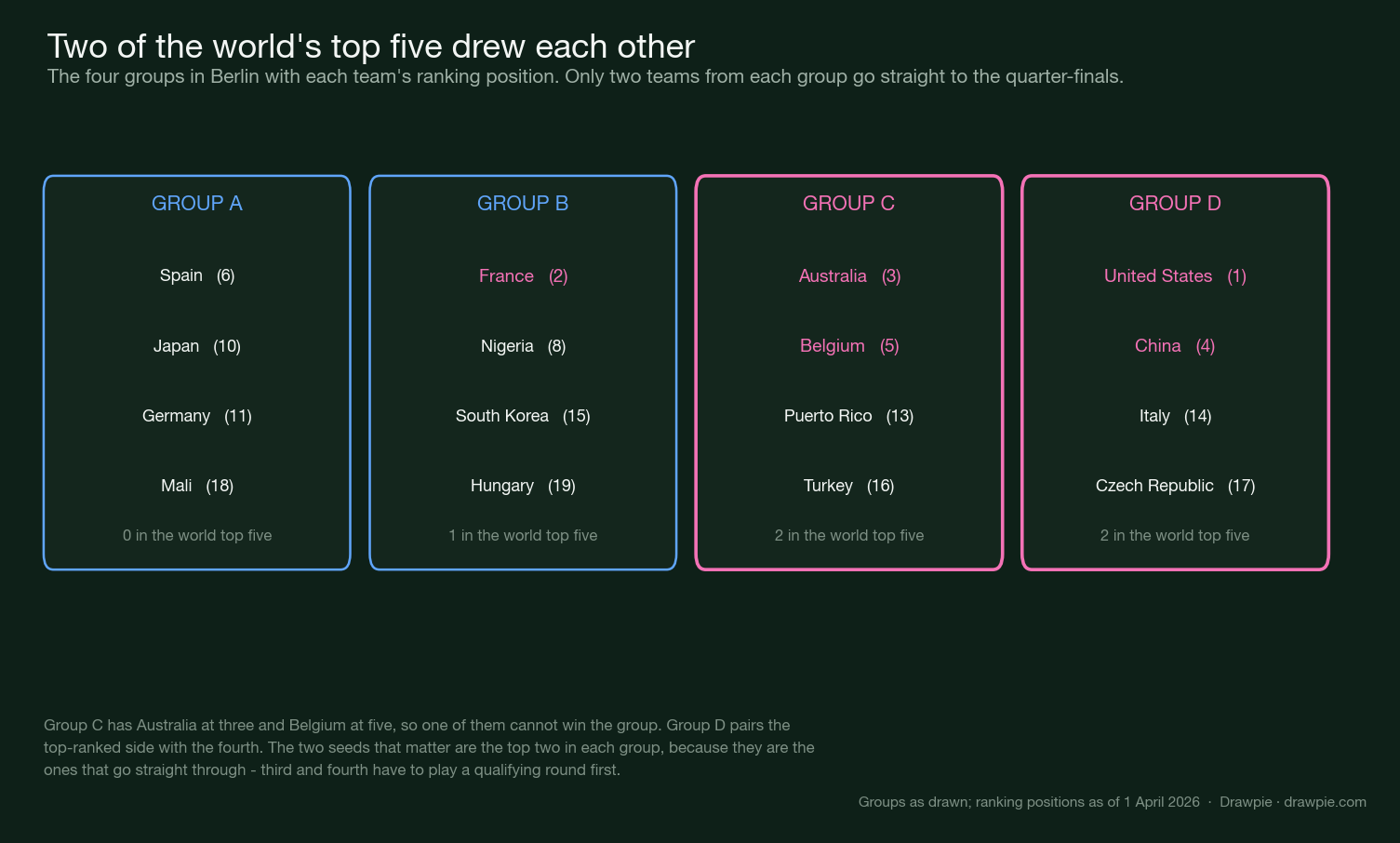
- Group C drew Australia (3rd) and Belgium (5th) together, so one of the world’s top five cannot win its group.
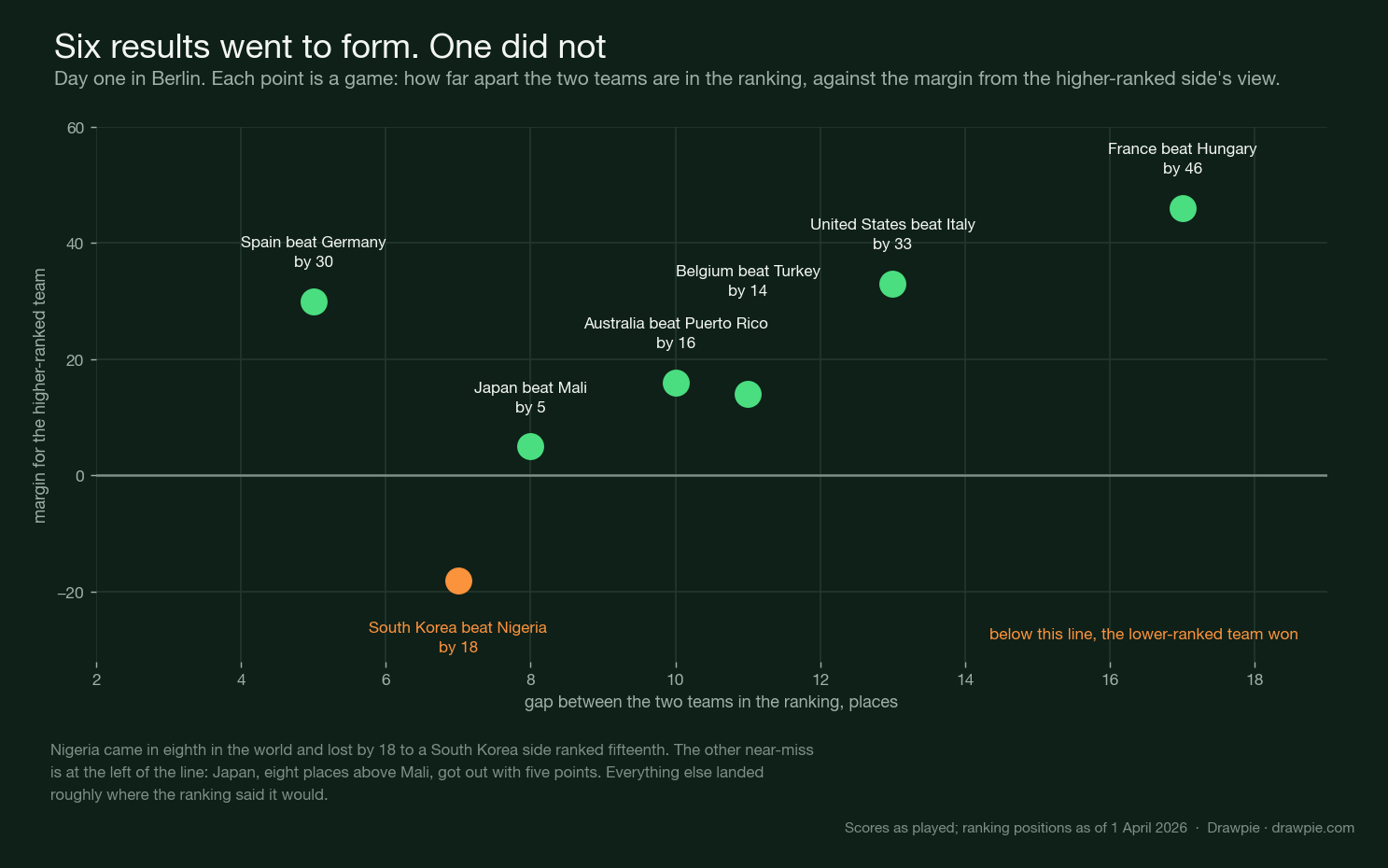
- Six of day one’s seven games went to the higher-ranked side. The exception was South Korea beating Nigeria by 18.
- There is no bracket yet. Group games finish on 7 September and only then are the quarter-final pairings set.
- The top two in each group go straight to the quarter-finals; third and fourth play a qualifying round first.
The United States is 122 ranking points clear of the field. Everyone else is separated by rounding errors.
The 2026 FIBA Women’s Basketball World Cup is in Berlin from 4 to 13 September, and it has already started — this was written on day two. Here is where every team stands, why the bracket does not exist yet, and the one result that has already broken the form book.
One thing you will not find here: odds. This page ranks teams on FIBA’s published points and on games that have been played, and nothing else.
Power rankings
| # | Team | FIBA points | Group |
|---|---|---|---|
| 1 | United States | 719.1 | D |
| 2 | France | 596.6 | B |
| 3 | Australia | 596.4 | C |
| 4 | China | 585.8 | D |
| 5 | Belgium | 585.5 | C |
| 6 | Spain | 574.2 | A |
| 8 | Nigeria | 525.2 | B |
| 10 | Japan | 505.1 | A |
| 11 | Germany | 504.8 | A |
| 13 | Puerto Rico | 445.5 | C |
| 14 | Italy | 412.6 | D |
| 15 | South Korea | 405.5 | B |
| 16 | Turkey | 338.8 | C |
| 17 | Czech Republic | 337.3 | D |
| 18 | Mali | 302.4 | A |
| 19 | Hungary | 293.5 | B |
FIBA Women’s World Ranking, last updated 1 April 2026.
Two features of that table matter more than the order itself.
The gap at the top is enormous. The USA’s 122.5-point lead over France is larger than the entire distance from France down to eleventh-placed Germany, which is 91.8 points. In ranking terms the field is not chasing the leader; it is a different bracket of the same list.
And the chasing pack is not a pack, it is a tie. France 596.6, Australia 596.4, China 585.8, Belgium 585.5 — 1.1 points covers ranks two to five. Anyone treating “second in the world” as meaningfully better than “fifth in the world” is reading noise.
Championship favourites
On the published evidence rather than on a market price:
The United States. Reigning ranking leader by a distance, and they opened by beating Italy 94–61. Nothing on day one suggested the gap has closed.
France, Australia, China and Belgium — as a group, not as an order. All four are inside 1.1 ranking points of each other, and all four won or were expected to win their openers. Picking between them on ranking alone is not possible, and this page is not going to pretend otherwise.
Spain are sixth and made the loudest statement of day one, beating the hosts by 30.
Where the draw complicates it: Australia and Belgium are in the same group. One of them will not win Group C, which changes their route regardless of how good they are.
Bracket — why it is not set until 7 September
There is no bracket yet, and any bracket you see published today is a guess about who finishes where.
The mechanics:
- Sixteen teams, four groups of four. Group games run to 7 September.
- The top two in each group go straight to the quarter-finals.
- Third and fourth enter a qualification-to-quarter-finals round before the last eight.
- Quarter-finals begin 10 September.
So the pairings depend on final group positions that do not exist until the last group game is played. What can be said now is which groups are hard to escape in the top two.
| Group | Teams (ranking) | Top-five sides |
|---|---|---|
| A | Spain (6), Japan (10), Germany (11), Mali (18) | 0 |
| B | France (2), Nigeria (8), South Korea (15), Hungary (19) | 0 |
| C | Australia (3), Belgium (5), Puerto Rico (13), Turkey (16) | 2 |
| D | United States (1), China (4), Italy (14), Czech Republic (17) | 1 |
Group C is the one to watch. Two of the world’s top five drew each other, and only one can top the group. Group D pairs the top-ranked side with the fourth, but the drop to Italy and the Czech Republic is steep enough that both should expect to go through.
Day one results
| Result | Score | Margin |
|---|---|---|
| France beat Hungary | 99–53 | 46 |
| United States beat Italy | 94–61 | 33 |
| Spain beat Germany | 83–53 | 30 |
| South Korea beat Nigeria | 99–81 | 18 |
| Australia beat Puerto Rico | 70–54 | 16 |
| Belgium beat Turkey | 89–75 | 14 |
| Japan beat Mali | 102–97 | 5 |
Played 4 September. China v Czech Republic is not included — it was not among the results read for this page.
Six went to form. One did not.
South Korea, ranked fifteenth, beat eighth-ranked Nigeria by 18. Nigeria arrived as the reigning AfroBasket champions. That is the only result so far that the ranking got wrong, and it got it wrong by a distance.
The other one to note is at the other end of the scale. Japan are ten in the world and Mali are eighteen, and Japan got out with five points in a 102–97 game. On the ranking gap that should have been comfortable. It was not.
And Spain’s 30-point win over the hosts was the biggest statement by a team outside the top five.
What to watch
- Whether Group C settles by the head-to-head. Australia and Belgium meeting decides more than one game’s worth of seeding.
- Whether Nigeria recover. They are the highest-ranked side to lose so far, and in a four-team group one defeat leaves very little room.
- Whether Mali’s near-miss was a fluke. Ranked eighteenth of the sixteen teams here and five points from beating Japan.
- 7 September, when the groups finish and the bracket finally exists.
The bottom line
The USA is the favourite by a margin the ranking cannot really express, and the four teams behind them are functionally tied.
The draw has already done some of the work: two top-five sides are in the same group and one of them will come second.
And after one round, the ranking has been right six times out of seven — with the exception being a fifteenth-ranked side winning by eighteen, which is the sort of result that makes the next nine days worth watching.
Rankings from FIBA’s own list, last updated 1 April 2026. Scores as played on 4 September. Written on 5 September with the tournament in progress. No odds appear on this page.