F1 Monza Predictions 2026: Who Wins, Who Moves Up and What Decides the Race
The race starts at 13:00 UTC on Sunday 6 September 2026. Everything on this page was written between qualifying and the race and is superseded the moment it starts.
Everything else on the page is unaffected; the figures below still say when they were read.

- Pierre Gasly took pole for Alpine at 1:21.786 — from a car that was ninth in final practice.
- The qualifying order is not the grid. Piastri drops three places for impeding, and Lawson starts from the back after a power unit change.
- Those penalties put both Ferraris on the second row at Monza: Leclerc third, Hamilton fourth.
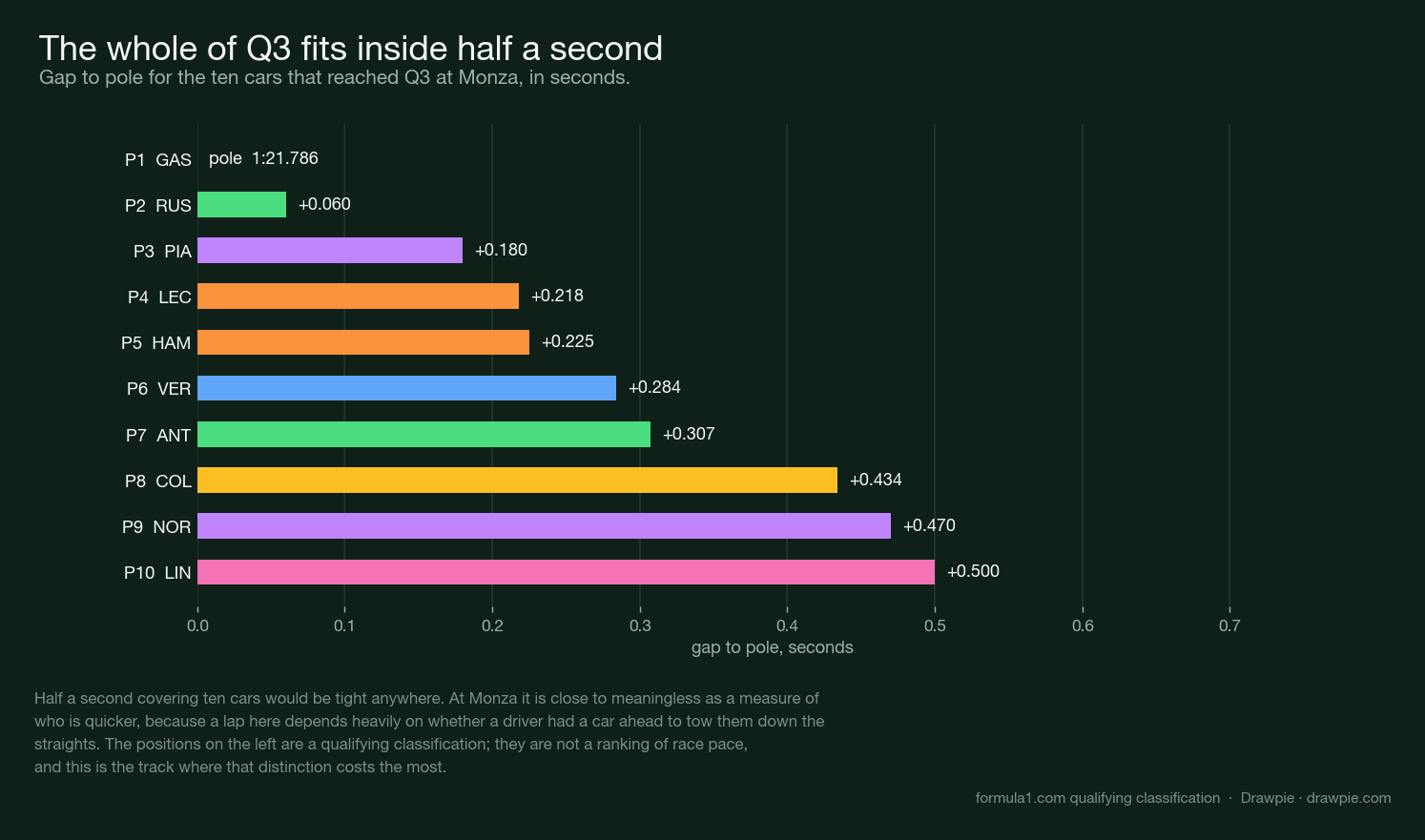
- The whole of Q3 is covered by exactly 0.500s, at the track where a slipstream is worth more than anywhere else.
- Antonelli set a Q2 lap worth third on the grid and starts seventh. Norris set one worth sixth and starts ninth.
- Antonelli is Italian, leads the championship by 59 points, and starts his home race seventh.
- There are no odds on this page, and there will not be.
Sunday’s race at Monza starts at 13:00 UTC, and the grid it starts from is not the one qualifying produced.
Two penalties moved it. The whole of Q3 fits inside half a second. And two of the quickest cars in the session line up well behind where their pace belonged. Here is how that reads for the race.
What Sunday actually turns on
Monza is the cheapest place on the calendar to overtake, which makes this grid worth less than it looks.
That is the single most important thing to hold on to. Three long straights, a slipstream that is worth real lap time, and 53 laps to use them. A driver starting seventh here is in a very different position from a driver starting seventh at Zandvoort last month.
So the question is not who is on pole. It is who has the pace and the room to use it. On that reading, three things matter:
- Alpine are on pole with a car that was ninth in final practice.
- Antonelli and Norris are both starting behind their own qualifying pace.
- Ferrari are on the second row without having earned it on track.
Who wins from here
The front row is Gasly and Russell, and they are not equally likely to still be there at the end.
George Russell is the most straightforward answer to who wins. He was quickest in final practice, he qualified second by six hundredths, and he is in the car leading both championships. He starts on the clean side of a track where the run to the first chicane is long enough for the front row to be decided before anyone brakes.
Pierre Gasly has pole and a genuine chance to lead into turn one. What he does not obviously have is race pace — Alpine were ninth and tenth in FP3, and the team is sixth in the constructors’ championship on 63 points against Mercedes’ 425. Holding a position at Monza is harder than taking one.
Behind them the pack is dense enough that a first-lap slipstream reshuffles it. Leclerc, Hamilton and Verstappen fill row two and the inside of row three, all within three tenths of pole.
The honest reading: Russell is the most likely winner from this grid, Gasly the most interesting, and the field close enough that neither is safe.
The two who should come forward
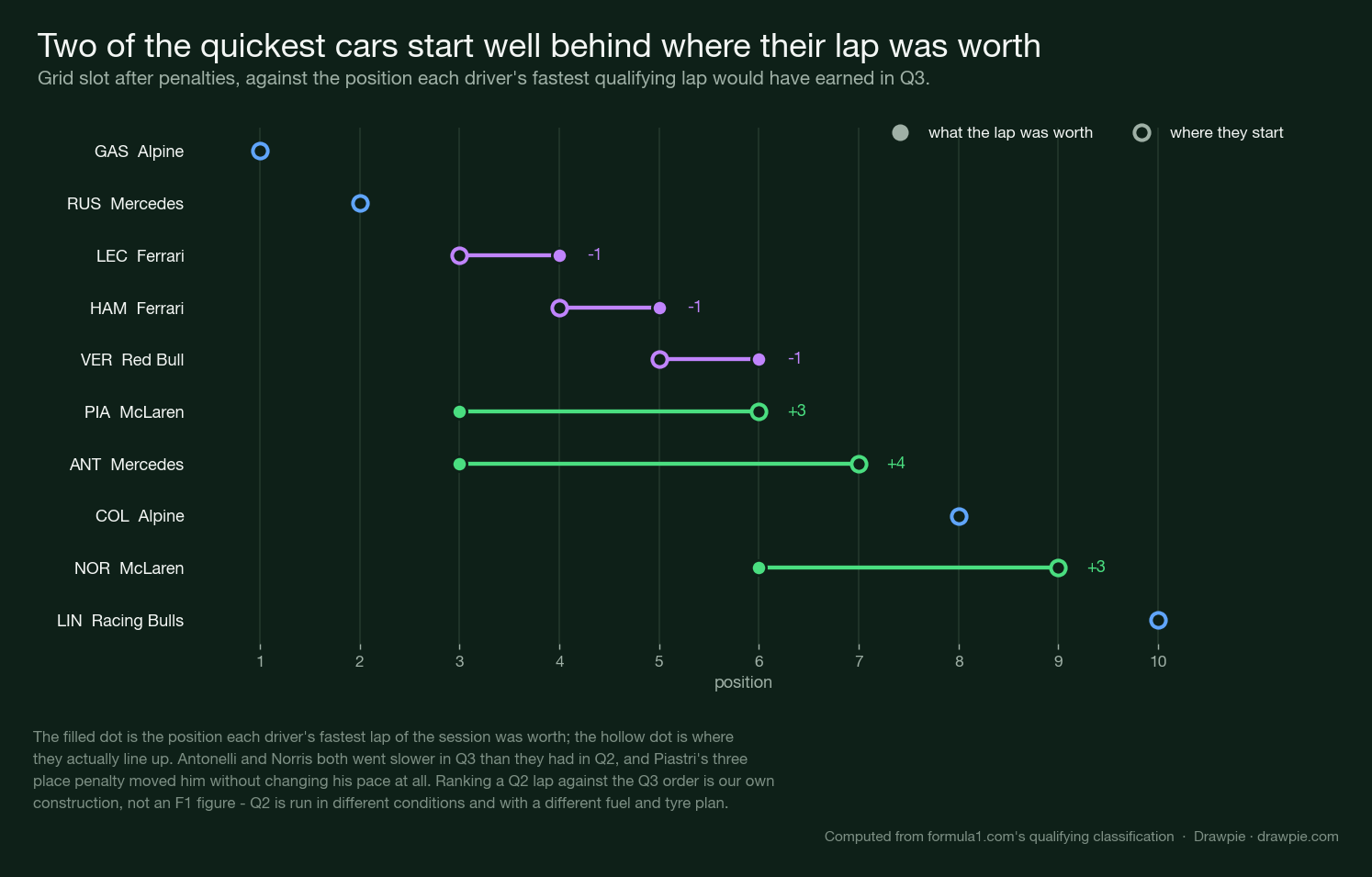
This is where the race is most likely to be decided.
Kimi Antonelli set a lap of 1:21.882 in Q2 — quick enough for third on the Q3 order — and then went 0.211s slower in Q3. He starts seventh. He is Italian, this is his home race, and he leads the drivers’ championship by 59 points.
Lando Norris did the same thing. His Q2 lap of 1:22.067 was worth sixth; his Q3 lap put him ninth.
Oscar Piastri is out of position too, but for a different reason — his pace was third-quickest and a three-place penalty moved him to sixth. Nothing about his car changed.
Three of the fastest six cars start between sixth and ninth. At most circuits that is a problem. At Monza it is an opportunity, and it is the strongest single reason to expect the order to change substantially in the first ten laps.
Ferrari’s race
Leclerc third, Hamilton fourth, at Monza, in front of that crowd — and both of them promoted by someone else’s penalty.
They qualified fourth and fifth, +0.218 and +0.225 off pole, and moved up when Piastri’s penalty was applied. Both drivers were publicly critical of how the session was run afterwards; Leclerc’s assessment was that the team needs to be perfect and has not been, and Hamilton said they did not execute well.
Second row at Monza is a real chance and they know it. It is also the position from which a Ferrari home race most often goes wrong: the run to the first chicane rewards whoever gets the tow, and third and fourth is exactly where you can lose two places before the lap is a mile old.
What would have to happen for Gasly to win
He would have to lead into the first chicane and then be difficult to pass for 53 laps.
The first part is plausible — he is on pole and the first braking zone is a long way from the line. The second is the hard part, because Monza does not reward defending. There is no sequence of corners here where a slower car can hide, and the cars behind him are from the three teams that have scored 1,026 of the season’s constructors’ points between them.
The scenario that makes it work is the one Monza produces more than any other circuit: a leading group that stays close enough to slipstream each other, nobody able to break away, and the driver in front still there at the end because the cars behind spend the race passing each other rather than him.
The grid, in full
| Grid | Driver | Team | Qualified |
|---|---|---|---|
| 1 | Pierre Gasly | Alpine | 1st — 1:21.786 |
| 2 | George Russell | Mercedes | 2nd |
| 3 | Charles Leclerc | Ferrari | 4th ▲ |
| 4 | Lewis Hamilton | Ferrari | 5th ▲ |
| 5 | Max Verstappen | Red Bull | 6th ▲ |
| 6 | Oscar Piastri | McLaren | 3rd ▼▼▼ |
| 7 | Kimi Antonelli | Mercedes | 7th |
| 8 | Franco Colapinto | Alpine | 8th |
| 9 | Lando Norris | McLaren | 9th |
| 10 | Arvid Lindblad | Racing Bulls | 10th |
The two penalties:
- Piastri, three places, for impeding Lawson in Q2. The stewards’ finding was that, having been told on leaving the pits to watch for Verstappen and Lawson, he “inadvertently, and also unnecessarily” impeded Lawson’s car.
- Lawson, to the back of the grid, for new power unit components in his Red Bull. He had already been eliminated in Q2 by the incident that earned Piastri the penalty.
Half a second covers all ten Q3 cars, and at this circuit that gap says less about who is quicker than it does about who had a car ahead to tow them. The qualifying classification is a qualifying classification. It is not a ranking of race pace, and Monza is where that distinction costs the most.
What is at stake
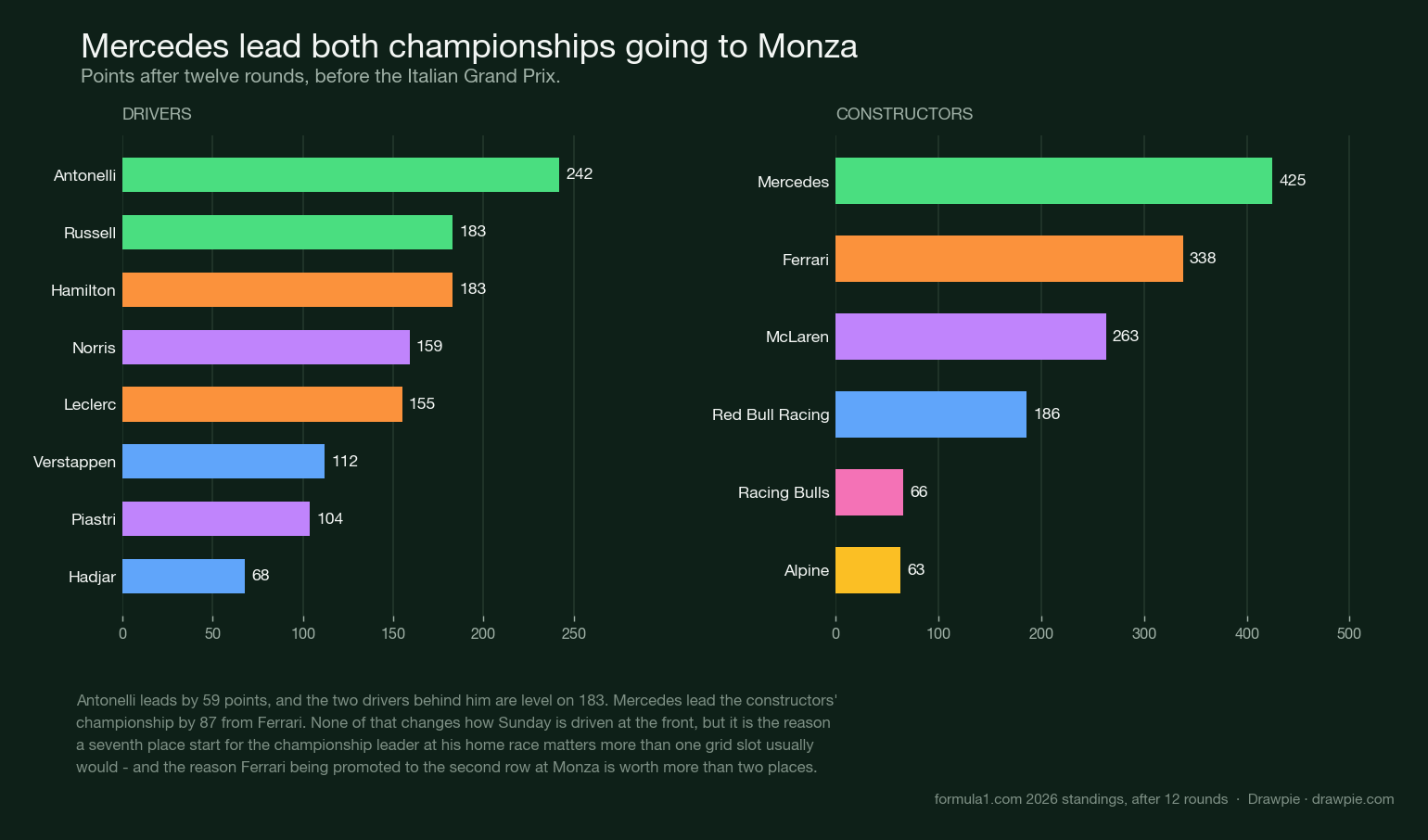
Antonelli leads by 59 points. Russell and Hamilton are level on 183. Mercedes lead Ferrari by 87.
None of that changes how the first lap is driven. It does change what a bad afternoon costs: the championship leader starting seventh at his home race with the two cars nearest him in the standings on the second row and the front row is a genuinely awkward Sunday, and it is the reason Ferrari’s promotion is worth more than the two places it looks like.
What this page will not tell you
Anyone’s odds, from a bookmaker or a prediction market. Not because they are unavailable — because a number produced by a betting market is not analysis, and quoting one dressed up as a forecast is the most common way a race preview stops being useful.
And no tyre strategy. None of the F1 pages read for this carried compounds or expected stop counts. Rather than invent a one-stop and present it as a plan, this page says there is a gap where that section would be.
The bottom line
Russell is the most likely winner. Gasly is the most interesting one. And three of the six quickest cars start behind where their pace put them.
Monza is the track that punishes a compromised grid least and rewards a slipstream most. Expect the first ten laps to matter more than qualifying did.
Grid, lap times and standings from formula1.com, read after qualifying on Saturday 5 September 2026. Race starts 13:00 UTC, Sunday 6 September.