EU Entry/Exit System: What UK Travellers Need to Know in 2026

- The Entry/Exit System has been fully operational since 10 April 2026. The phased rollout ended the day before, on 9 April.
- UK travel advice pages still describe it as ’now being implemented’ and say you ‘may need to’ register. On the EU’s own account, that transition finished about five months ago.
- British travellers are visa-free, which means the system takes four fingerprints and a facial image. Short-stay visa holders give only a facial image.
- Refusing to give your biometrics means being refused entry. There is no charge for any of it.
- Your passport is no longer stamped. Entry and exit dates are recorded electronically instead, which is what makes the 90-days-in-180 rule enforceable by machine.
- It applies in 29 countries. Cyprus and Ireland are in the EU but outside the EES, and still stamp by hand.
- At Dover, Eurotunnel and St Pancras your details are taken before you leave the UK, not on arrival.
- Records are kept for three years — or five, if the system never recorded you leaving.
Your passport does not get stamped any more. Instead, a European border system takes four of your fingerprints and a photograph of your face, and remembers you for three years.
The EU’s Entry/Exit System is not coming. It arrived, finished rolling out in April, and has been running at every external crossing point since. Here is what actually happens, what gets stored, and the part where official UK advice has not quite caught up.
It is fully live — and some advice still says otherwise
The European Commission’s position is unambiguous: the phased introduction ended on 9 April 2026, and from 10 April the EES has been fully operational at all external border crossing points of the countries using it.
That matters because the phased period was the one where you might or might not have been registered, depending on which crossing you used. That period is over.
UK travel advice has not been rewritten to match. The Foreign Office entry-requirements pages still describe the EES as “now being implemented across the Schengen area” and tell travellers they “may need to” register their biometric details. We checked two countries — Spain and France — and the wording is identical, so this is the department’s standard text rather than one page nobody got to.
Nothing about that is dangerous. It is simply behind: on the EU’s own account, “may need to” is now “will”.
The practical difference is what you plan for. Under the old wording, biometric enrolment was a possibility to be aware of. Under the current reality it is the default at every external crossing, and the first time you do it takes longer than the times after.
What actually happens at the border now
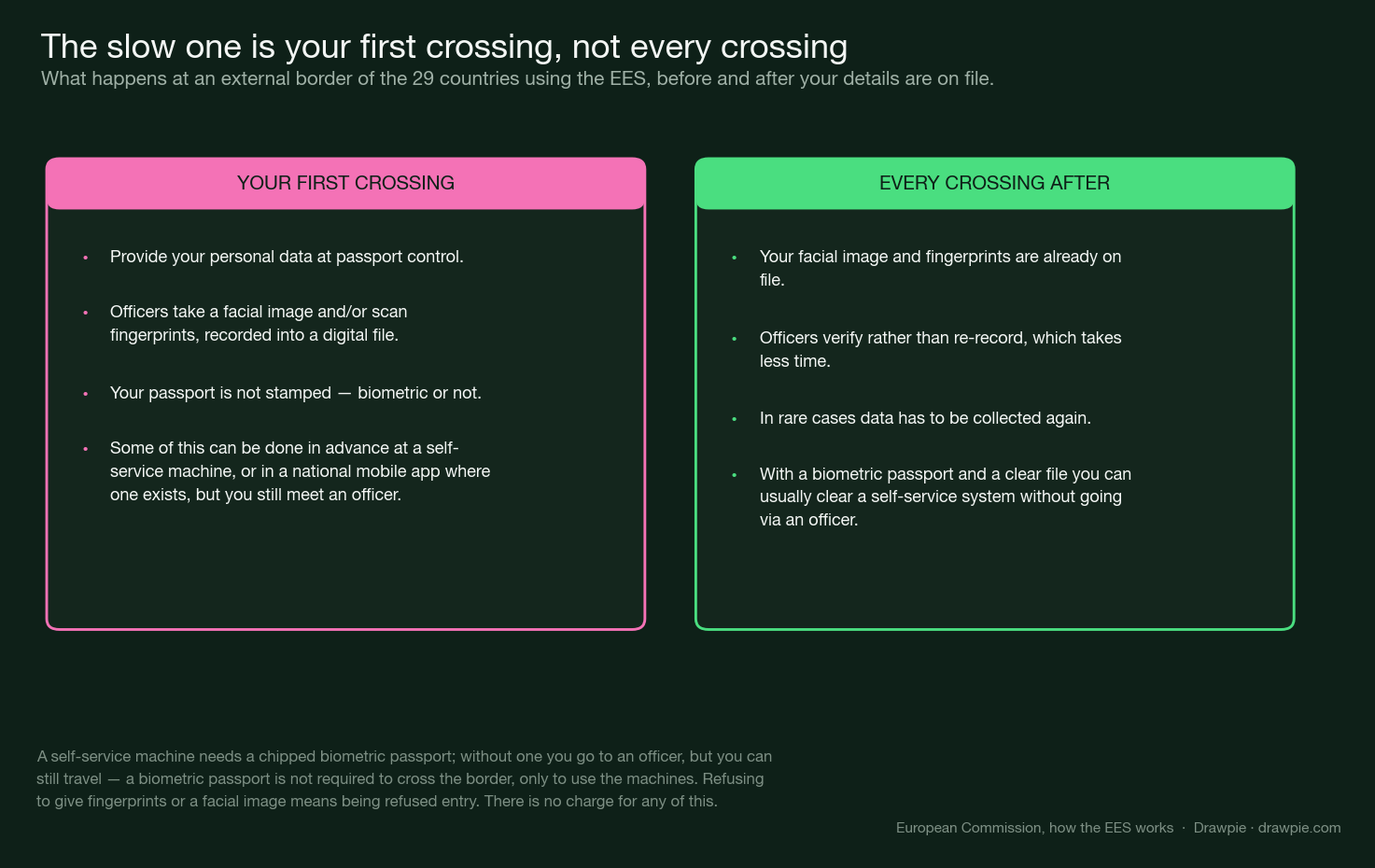
On your first crossing since the system started, you give your personal data at passport control. Officers take a facial image and scan your fingerprints, and the result goes into a digital file against your travel document. Your passport is not stamped — and that applies whether or not it is a biometric one.
Some border points have self-service machines, and some countries offer a mobile app, either of which lets you enter part of the information before you reach the desk. Neither removes the officer: you still see one on a first crossing.
On every crossing after that, your face and fingerprints are already on file. Officers verify rather than record, which is faster. Occasionally data has to be captured again, but that is the exception.
The self-service route has one requirement worth knowing. To use a machine you need a biometric passport — one with a chip. Without a chip you cannot use the machines, and you go to an officer instead.
But a chip is not required to travel. Biometric and non-biometric passports are both accepted at the border, provided the passport is valid and the other entry conditions are met. The chip only decides which lane is open to you.
Fingerprints, photos and what gets stored
What is taken depends on whether you need a visa, and British travellers are in the visa-free group.
| Fingerprints | Facial image | |
|---|---|---|
| Visa-free — this is UK travellers | 4 | Yes |
| Short-stay visa holders | None taken | Yes |
| Children under 12 | Not scanned | Can be required |
Short-stay visa holders give no fingerprints at the border because theirs were already recorded in the Visa Information System when they applied for the visa. There is nothing gentler about that route — it is the same data, collected earlier.
What the system records:
- the details in your travel document, such as name and date of birth
- the date and place of every entry and every exit
- your facial image and fingerprints
- whether you were ever refused entry
Two things to be clear about.
There is no charge. EES registration is free.
Refusing is not an option that leaves you travelling. If you decline to give fingerprints or a facial image, you are refused entry to the territory of the countries using the system.
Where it applies — and where you still get a stamp
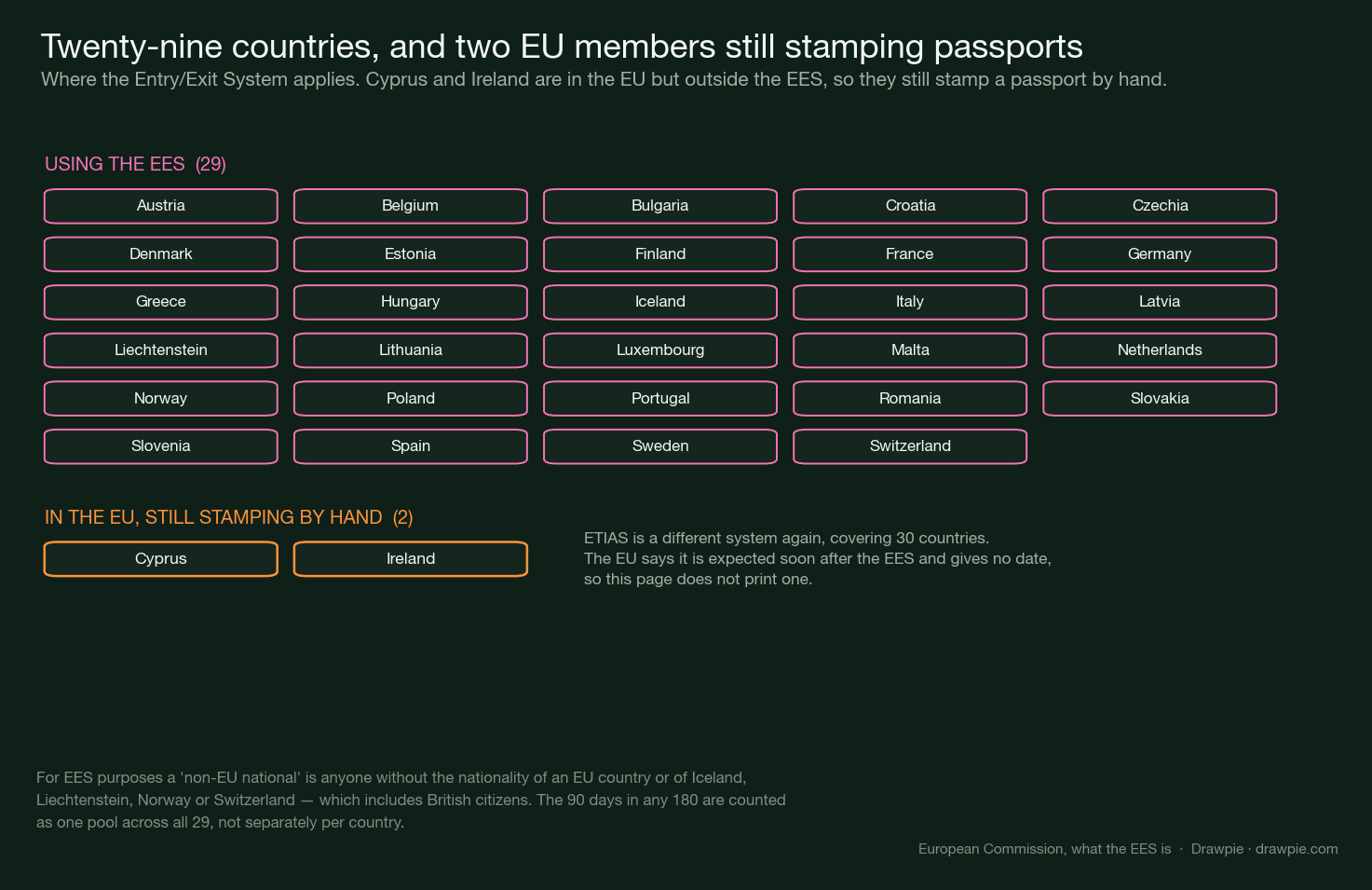
Twenty-nine countries use the EES: Austria, Belgium, Bulgaria, Croatia, Czechia, Denmark, Estonia, Finland, France, Germany, Greece, Hungary, Iceland, Italy, Latvia, Liechtenstein, Lithuania, Luxembourg, Malta, Netherlands, Norway, Poland, Portugal, Romania, Slovakia, Slovenia, Spain, Sweden and Switzerland.
Cyprus and Ireland are EU members and are not among them. Arriving there, your passport is still stamped by hand.
ETIAS is a different thing entirely, and it is the single most common confusion. It covers 30 countries, it is a travel authorisation rather than a border record, and the EU says only that it is expected to launch after the EES. No start date has been published, so this page does not print one — and you should be wary of any page that does.
The 90-day rule did not change. The enforcement did.
You can still spend 90 days in any 180-day period in those countries without a visa. The EES did not alter that.
Two things about it that catch people out, and neither is new:
- The 90 days are one shared pool, counted across all 29 countries together — not 90 days per country.
- Days you have already spent there in the previous 180 count against you before you even set off.
What has changed is that your entries and exits are now a database record rather than a row of ink stamps for an officer to interpret. An overstay is identified by the system. If you were relying on a stamp being missed, that era is over.
Dover, Eurotunnel and St Pancras are different
At the Port of Dover, at Eurotunnel and at St Pancras International, your EES details are taken before you leave the UK.
These are juxtaposed controls — French border officers operating on British soil — so the enrolment happens on the way out rather than on arrival. If you are driving to the ferry or taking the train, build the extra time into the British end of the journey, not the French one.
Flying home has its own wrinkle. UK advice tells travellers leaving the Schengen area by air to allow extra time to reach the gate, because EES checks can happen before boarding rather than at a central exit desk.
Who is exempt
The EES does not apply to everyone crossing. The exempt groups include:
- holders of residence permits and long-stay visas — the category that covers most British people living in the EU
- nationals of the countries using the EES, plus Cyprus and Ireland
- non-EU nationals holding a residence card as an immediate family member of an EU national, or of a non-EU national with equivalent free-movement rights
- people travelling for an intra-corporate transfer, research, study, training, voluntary service, a pupil exchange, an educational project or au-pairing
- nationals of Andorra, Monaco and San Marino, and holders of a Vatican or Holy See passport
- people exempt from border checks or holding certain privileges — heads of state, accredited diplomats, cross-border workers
- NATO and Partnership for Peace forces on official business, with NATO International Civilians and dependants
- holders of a valid local border traffic permit
- crew on international passenger and goods trains, and holders of Facilitated Rail Transit or Facilitated Transit Documents who do not disembark
If you are a long-term resident of one of these countries, that exemption follows you into all of them, not just the one that issued your permit.
How long your data is kept
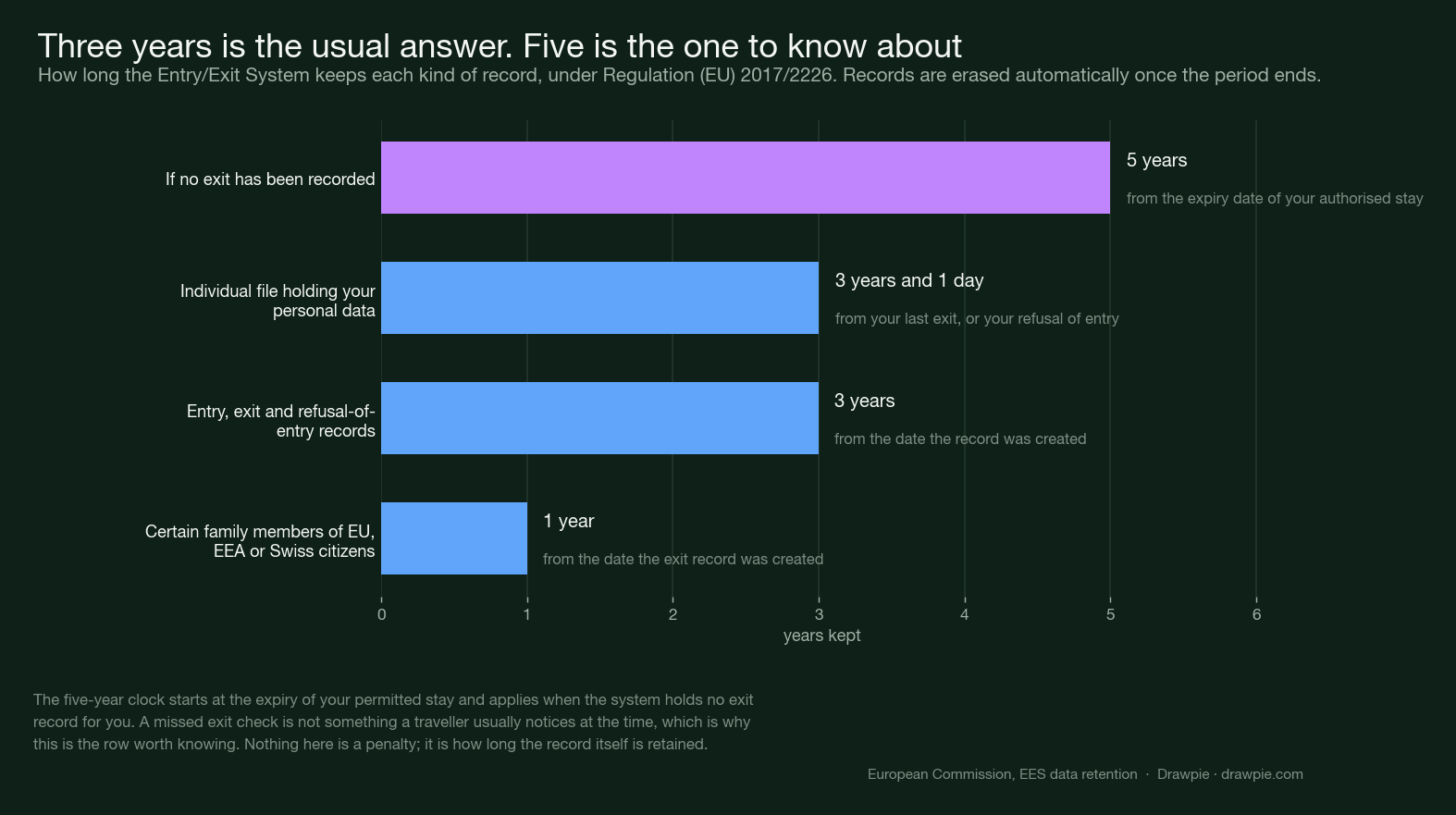
| Record | Kept for | Counted from |
|---|---|---|
| Entry, exit and refusal-of-entry records | 3 years | the date the record was created |
| Your individual personal-data file | 3 years and 1 day | your last exit, or your refusal of entry |
| If no exit was ever recorded | 5 years | the expiry date of your authorised stay |
| Certain family members of EU, EEA or Swiss citizens | 1 year | the date the exit record was created |
Records are erased automatically once the period runs out.
The row worth reading twice is the five-year one. It applies when the system holds no exit record for you — and a missed exit check is not something most travellers would notice at the time. That is not a penalty, and it does not mean you did anything wrong. It is simply how long the record sticks around when the file is incomplete.
Who can look at it: border, visa and immigration authorities in the countries using the system; their law enforcement authorities and Europol; and, under strict conditions, a transfer to another country or a listed international body for return or law-enforcement purposes. Transport carriers see only whether a short-stay visa holder has used up their authorised entries, and nothing else.
What you can do about it: you have the right to ask for access to your data, to have inaccurate or incomplete entries corrected, and to have unlawfully processed data erased. Complaints go to the national supervisory authority of the country that processed your data, or to the European Data Protection Supervisor. UK advice also points travellers who think they have been wrongly entered into the EES towards the EU’s own process.
The bottom line
It is live everywhere, it takes four fingerprints and your face, it replaces the stamp, and refusing means not going in.
Your first crossing is the slow one. After that the system is verifying you rather than learning you, and it is quicker than the queue you remember.
And if you read a travel-advice page telling you the EES “may” apply — that page is describing a rollout that ended on 9 April.
Process, data categories, retention periods and exemptions from the European Commission’s own EES pages. UK-specific arrangements from Foreign Office travel advice, read on 4 September 2026. An explainer, not immigration advice.