Erling Haaland's Most Dangerous Run Against England — and How to Stop It
The Norway vs England quarter-final this preview built to kicked off on 11 July 2026 — the team news and match-up analysis here predate the game.
Everything else on the page is unaffected; the figures below still say when they were read.

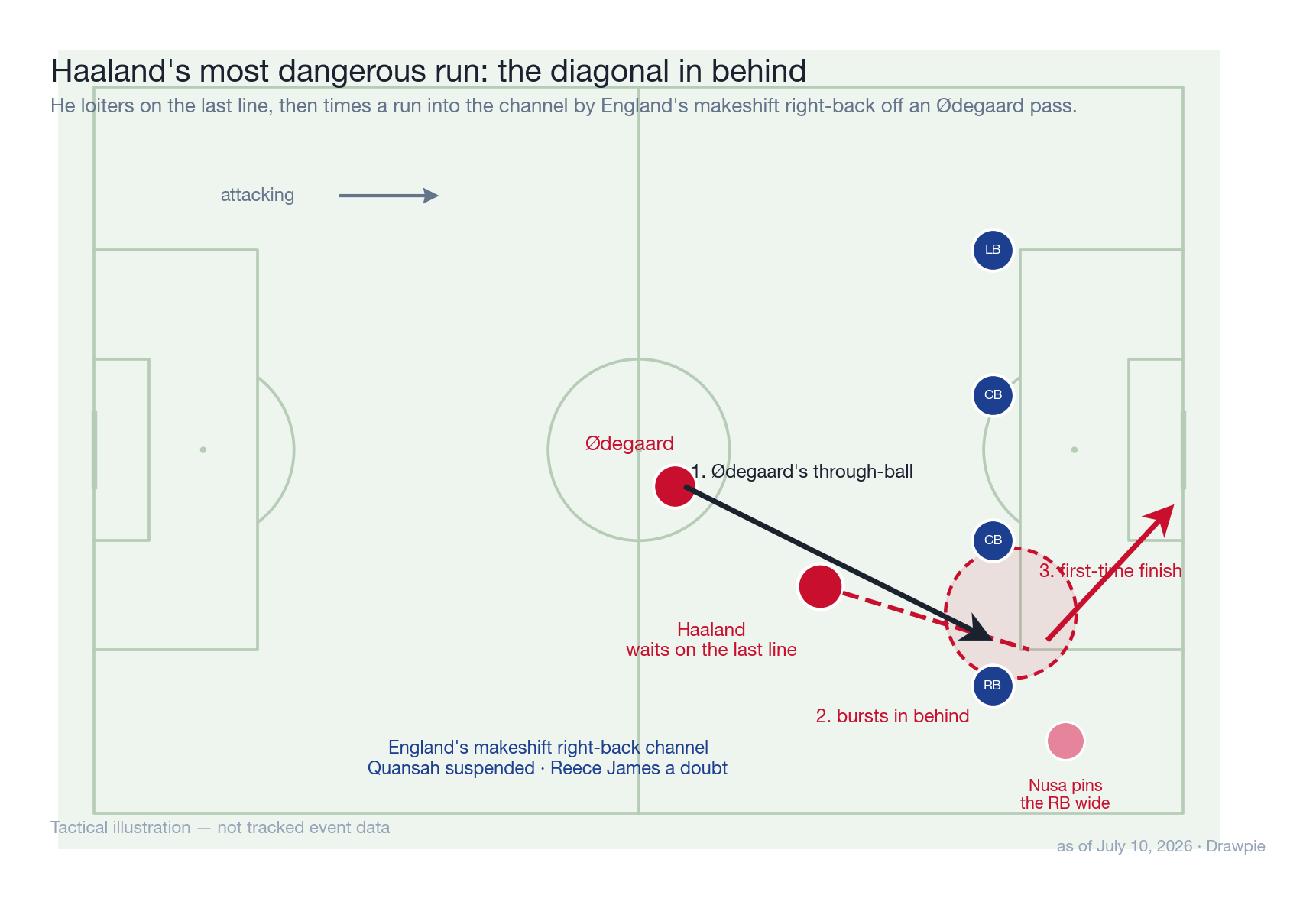
- Erling Haaland’s most dangerous weapon against England is his diagonal run in behind: he loiters on the last line, then bursts into the channel by England’s makeshift right-back off a Martin Ødegaard through-ball.
- England’s right side is the soft spot — Jarell Quansah is suspended and Reece James is a major fitness doubt, likely leaving Ezri Konsa as a makeshift right-back against Norway on July 11.
- Haaland is lethal on the rare chance: 7 goals from 18 shots (39%), the best conversion at a World Cup since 1986, and he takes his chances first-time.
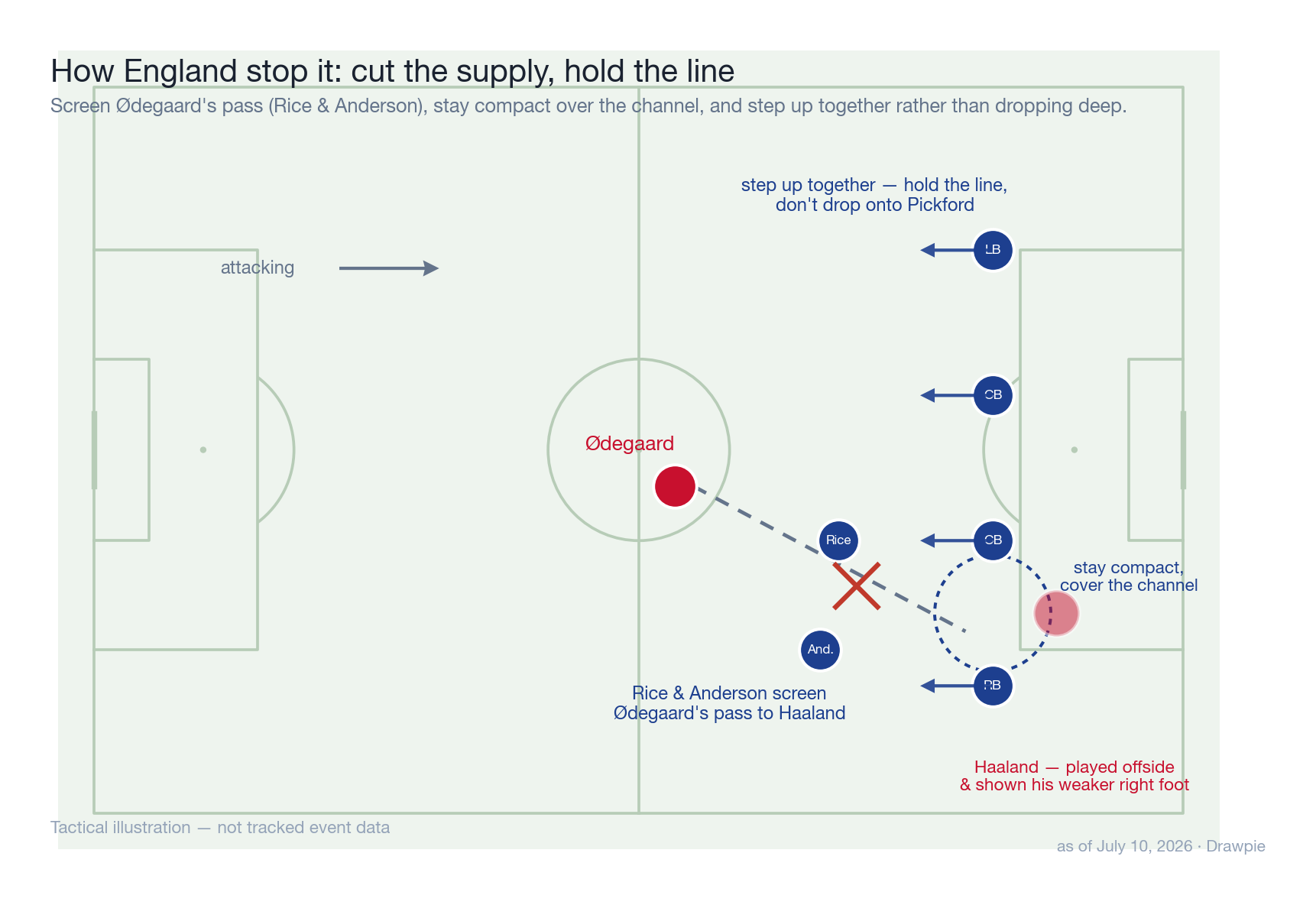
- Stopping him is a whole-team job: screen Ødegaard’s supply (Declan Rice and Elliot Anderson), stay compact and never leave him 1v1, force him onto his weaker right foot, and — crucially — hold the line rather than dropping deep onto the goalkeeper.
When Norway meet England in the World Cup 2026 quarter-final in Miami on Saturday, July 11, one moment will worry Thomas Tuchel more than any other: Erling Haaland running in behind. It is Norway’s most dangerous weapon and Haaland’s signature threat — and against a patched-up England back line, it is exactly the kind of game a single ball over the top can settle. Here is the run itself, and how England should try to stop it. This is analysis and opinion, not betting advice.
Haaland’s most dangerous run: the diagonal in behind
Haaland scores few of his goals from build-up play; he lives on the last line. His most dangerous run is a diagonal in behind: he loiters, deliberately “anonymous,” on a defender’s blind shoulder, then uses a sharp double movement — a check to fix the defender, then a change of angle and an explosive acceleration — to attack the channel between the full-back and centre-back the instant the ball is played. Last season he shook off his marker on 35.5% of his runs into the final third, the best rate of any striker in the Premier League.
The release usually comes from Martin Ødegaard, who has completed 12 passes to Haaland at this tournament — more than any player to a team-mate. The template was Norway’s group game against Senegal: Ødegaard slid a pass through the line, Haaland ran onto it and finished first-time past the goalkeeper. The alternative is a quick transition — Norway win the ball and the very first pass goes over the top before the defence can reset.
| Haaland’s run | Detail |
|---|---|
| The start | Loiters on the last line, on a centre-back’s blind shoulder |
| The trigger | An Ødegaard through-ball (12 passes to Haaland — most at the World Cup) |
| The target | The channel beside England’s makeshift right-back |
| The finish | First-time, usually left-footed — 7 goals from 18 shots (39%) |
Why England’s right side is the target
The channel Haaland wants is on England’s right, and it is a genuine weak spot. Jarell Quansah is suspended after his red card against Mexico, and Reece James is a major fitness doubt — he has barely trained in two weeks with a hamstring problem and is “almost certainly not” able to last 90 minutes. Djed Spence is carrying a minor knock and looked uncomfortable against Mexico. That most likely leaves Ezri Konsa filling in at right-back — a centre-back playing out of position, exactly the kind of makeshift full-back Haaland’s runs are designed to punish, especially when Norway’s wingers pin him wide to open the inside channel.
How England can stop it
The good news for England: Haaland can be stopped, and it is a whole-team job rather than a single duel. As Aston Villa’s Morgan Rogers put it, “it takes a whole team effort… stop their supply line.” The plan has four parts.
Cut the supply. The through-ball has to be denied at source. Declan Rice and Elliot Anderson are tasked with screening the space in front of the back four and getting tight to Ødegaard so the pass to Haaland never leaves his foot.
Stay compact and never leave him 1v1. The back line must stay connected, with a covering defender always aware of Haaland’s blind-side run, so the channels never open up. Ezri Konsa has actually handled Haaland well before — five Premier League meetings, conceding just once — and the physical Dan Burn has won the majority of his duels with him, so England do have bodies who can cope if they stay organised.
Hold the line — don’t drop deep. This is the crucial one. Gary Neville’s warning is blunt: “You can’t drop back onto your goalkeeper with Haaland.” Retreating hands him the space he wants; instead England should hold a controlled, medium-high line and step up together as the pass is struck, using the offside line as a weapon.
Show him his weaker side. When he does get away, funnel him onto his right foot, which accounts for only about 11.6% of his Premier League goals.
| England’s job | How |
|---|---|
| Cut the supply | Rice & Anderson screen Ødegaard’s passing lane |
| Cover the channel | Stay compact and connected — never leave Haaland 1v1 |
| Hold the line | Step up together; don’t drop onto Pickford |
| Show him his weak side | Force him onto his right foot (~11.6% of his Premier League goals) |
The bottom line
None of this makes Haaland easy to handle. With seven goals and a 39% conversion — the best at a World Cup since Gary Lineker in 1986 — England may only need to switch off once. But the run is stoppable if England do the unglamorous things well: choke Ødegaard’s supply, stay connected across the back, and resist the urge to sit deep. Get any of those wrong on Saturday, and Haaland will be gone before anyone can turn.
What is Erling Haaland’s most dangerous run?
His diagonal run in behind: Haaland loiters on the last defensive line, then makes a sharp, well-timed run into the channel between a full-back and centre-back to get onto a through-ball — usually finishing first-time. Against England he targets the channel beside their makeshift right-back.
How can England stop Erling Haaland?
By treating it as a team job: screening the supply to him (Declan Rice and Elliot Anderson getting tight to Ødegaard), staying compact so he is never one-on-one, holding a high line and stepping up rather than dropping onto the goalkeeper, and forcing him onto his weaker right foot.
Why is England’s right-back a problem against Norway?
Jarell Quansah is suspended and Reece James is a major fitness doubt, so England are likely to use a makeshift right-back — probably centre-back Ezri Konsa out of position — exactly the area Haaland’s runs are designed to exploit.
When is Norway vs England?
The World Cup 2026 quarter-final kicks off at the Hard Rock Stadium in Miami on Saturday, July 11, 2026 (10pm BST / 5pm ET).
For the full match preview, see our Norway vs England prediction and tactics , and track every remaining tie on the World Cup 2026 hub .