Elize: Shadows of a Woman — True Story Behind the Elize Matsunaga Case, and Our Review (2026)

- Elize: Shadows of a Woman landed on Netflix on 22 July 2026 and went straight to number two on the global chart and number four in the US. It runs 93 minutes, is directed by Felipe Vellas and written by Raphael Montes and Mariana Torres, and Lorena Comparato plays Elize.
- It is a dramatisation, not a documentary. The film reorders the case into four chapters, opens with the killing and then rewinds — and it is told almost entirely from Elize’s point of view, which is a choice with consequences.
- Reviewers agree on one thing and split on everything else: Comparato’s performance is the reason to watch. Scores from the outlets that have published run from 2.5/5 to 3.5/5. Rotten Tomatoes has no Tomatometer yet — three reviews logged, and fewer than fifty audience ratings.
- The real case: Marcos Matsunaga was killed in May 2012 and Elize was arrested that June. She was convicted in December 2016, had the sentence reduced in 2019, and was released on parole in 2022 after roughly ten years inside.
- The film’s real problem is not accuracy. It is that Netflix already made a four-part documentary about this case in 2021, with the woman herself on camera — and 93 minutes of drama struggles to say anything the interviews did not.
Netflix put a dramatised Elize Matsunaga on screen five years after it put the real one there, and the new film has to survive the comparison. Elize: Shadows of a Woman arrived on 22 July 2026, went to number two worldwide within days, and runs 93 minutes — about a third of the time the 2021 documentary had.
This covers what the film is, where it departs from the record, and whether it earns its place. The plot section is marked; the verdict and the case facts are safe to read.
Is Elize: Shadows of a Woman based on a true story?
Yes — it dramatises the 2012 killing of Marcos Matsunaga in São Paulo, for which Elize Matsunaga was convicted in 2016. The film is fiction built on a documented case, not a documentary, and it says so.
Two things are worth separating before anything else, because the film deliberately blurs them.
What the court established. Marcos Matsunaga was killed in May 2012. Elize was arrested that June and held until her trial. In December 2016 she was convicted of the killing and of concealing the body, and sentenced to just under twenty years. The sentence was recalculated for time served and work credits, then reduced again in 2019 after she confessed. She was released on parole in 2022, having served about ten years.
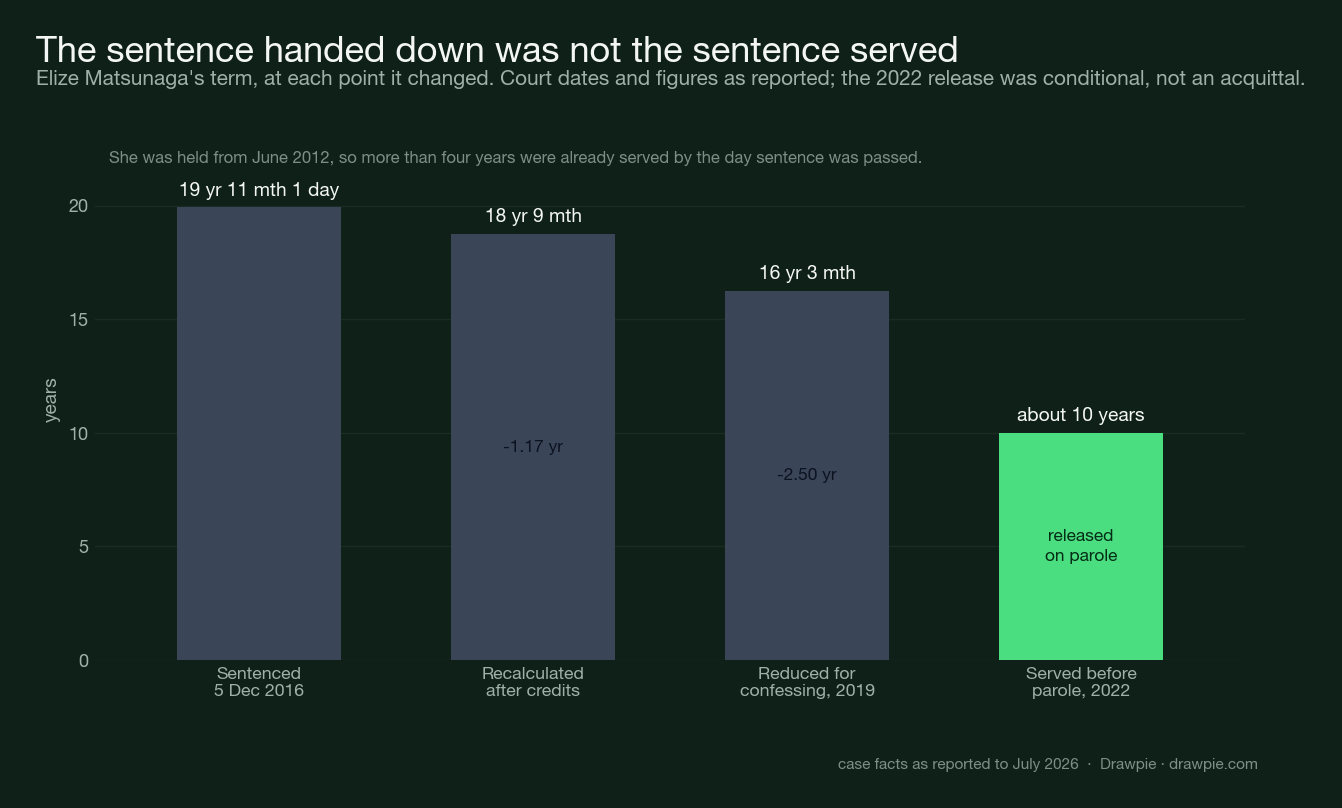
| Stage | Term | Note |
|---|---|---|
| Sentenced, 5 Dec 2016 | 19 yr 11 mth 1 day | Murder and concealment of a body |
| Recalculated | 18 yr 9 mth | Credit for time served and prison work |
| Reduced, 2019 | 16 yr 3 mth | Reduction after confessing |
| Released on parole, 2022 | about 10 yr served | Conditional release, not an acquittal |
What remains contested. Whether the killing was a crime of passion or a planned one was the whole argument at trial — the defence said passion and self-defence, the prosecution said premeditation — and the jury landed on the former. The film takes a position on that question. A court taking one view does not make the other reading disappear, and reviewers noticed the film choosing.
Where does the film sit in the timeline?
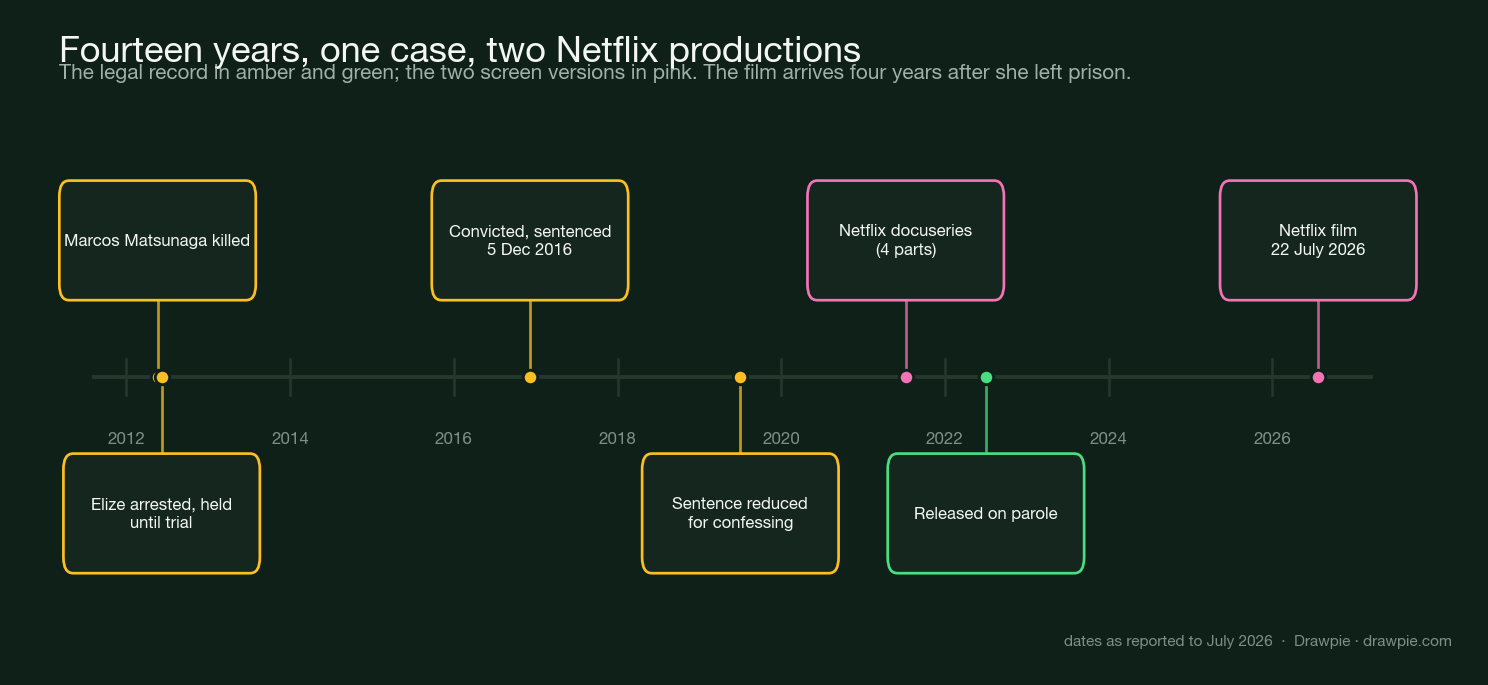
| Date | Event |
|---|---|
| May 2012 | Marcos Matsunaga killed in São Paulo |
| June 2012 | Elize arrested; held until trial |
| 5 December 2016 | Convicted and sentenced |
| 2019 | Sentence reduced after confessing |
| 8 July 2021 | Netflix docuseries Once Upon a Crime (4 parts) |
| 2022 | Released on parole after about ten years |
| 22 July 2026 | Netflix film Elize: Shadows of a Woman |
⚠️ One date to be careful with: at least one English-language outlet gives the arrest as June 2013. Brazilian records and Portuguese-language coverage put it in June 2012, weeks after the killing — and she was held continuously from then until the 2016 trial, which is why so much time had already been served when sentence was passed.
The gap matters. Netflix released Elize Matsunaga: Once Upon a Crime, a four-part documentary with Elize herself interviewed at length, in July 2021 — while she was still in prison. The drama arrives five years after that and four years after her release. Everything the film dramatises has already been described on the same platform by the person who did it.
What happens in the film?
⚠️ Spoilers from here.
The film opens at the end: Elize in the aftermath, and then it rewinds. What follows is arranged in four chapters that track her from a hard childhood, through work as an escort, to meeting Marcos as a client and marrying into serious money.
The marriage curdles in stages. She finds evidence of his infidelity, and the discovery lands on top of a fertility struggle and a pregnancy. The film’s account of the night itself has an argument escalating to violence, and a remark about her past that functions as the trigger. She shoots him.
What the film does with the aftermath is the most clinical stretch: the disposal, the suitcases, the drives out of the city. It is not lingered over for effect, which is to its credit. The investigation closes in through ordinary police work — an electronic trail, a search of the flat, and finally security footage of her leaving with three suitcases and coming back without them. She confesses.
The last chapter is the trial and what it cost her, and the film ends where the record does: convicted, imprisoned, and separated from her daughter, who has been raised by her paternal grandparents since the killing and whom the courts have kept apart from her.
We are not going to detail the child further. She is a minor and a private person, and the coverage that identifies her is not a reason for us to.
Does the film change the real case?
It compresses and it chooses a perspective; those are the two real departures.
Compression is the visible one. Fourteen years of case and a whole marriage go into 93 minutes, and several reviewers said the same thing independently — that events with enormous weight go past in a scene or two and never land. The four-chapter structure is borrowed from the documentary, which had four episodes to fill and used them.
Perspective is the consequential one. The film is told from inside Elize’s experience: her childhood, her fear of losing custody because of her past, her husband’s control. Reviewers who liked the film and reviewers who did not both noted that it makes sympathy hard to avoid — and that it stops short of turning Marcos into a monster, presenting a marriage that collapsed through deception on both sides rather than a simple victim and villain.
Whether that is honest framing or a thumb on the scale depends on which reading of the killing you already hold, which is exactly the film’s problem. It has taken a case whose central question a jury answered narrowly, and answered it again, more warmly, without new evidence.
Is Elize: Shadows of a Woman worth watching?
Watch it for Lorena Comparato. There is not much else here that the documentary did not do better.
Every review we read said a version of the same sentence: the lead performance is the film. Comparato carries a character who has to be seductive, domestic, frightened and capable of what follows, and she gets all of it into a runtime that gives her no room. It is a genuinely good piece of acting inside a film that keeps getting in its way.
The writing is where it thins out. There are soapy passages, some heavy signposting of Elize’s supposed coldness, and a tonal wobble about what kind of film this wants to be — psychological study, procedural, or a story about money and class. Ninety-three minutes cannot hold all three.
Published scores from the outlets that have reviewed it sit between 2.5/5 and 3.5/5, which is about right: not a failure, not a film anyone will insist you see. There is no Tomatometer yet — three critic reviews logged and fewer than fifty audience ratings, so we publish no aggregate figure rather than a meaningless one.
Who should watch it: anyone who has not seen the 2021 documentary and wants the case in one sitting, and anyone who will watch a good actor do difficult work — and if fact-versus-drama Netflix retellings are your lane, Facing El Chapo gives the 2016 Guzmán capture the same single-sitting treatment, in 91 minutes .
Who should skip it: anyone who has seen the documentary. You will spend 93 minutes noticing what has been left out.
Where can you watch it?
Elize: Shadows of a Woman streams on Netflix , which produced it and released it worldwide on 22 July 2026. The 2021 documentary Elize Matsunaga: Once Upon a Crime is on the same service, and if you are choosing between them, start there.
One note on the runtime: Netflix and most coverage list 93 minutes, though some reviews say 90. It is a short film either way, and the shortness is the point of most of the criticism.