Dyson CameraJet Buying Guide: Price, Features, Replacement Costs & Where to Buy
Update log (1)
- — Re-read the day after release. The framing has flipped: this was a guide to a product you could not buy yet, and it is now a guide to a product that launched and sold out. Best Buy shows Sold Out on both colours, Sephora Out of Stock, and Amazon has withdrawn the price entirely. Three things were also resolved that the original page had to leave open — the £8.49 is the 400ml mouth rinse alone (Dyson UK's own store, which also sells it as 6 bottles per quarter, i.e. 24 a year, corroborating our ~23 estimate); Dyson's own retailer copy now says the device works with any toothpaste or mouth rinse, so the fluids are a recommendation and only the heads are locked; and the 'single published review' line is retired, with Engadget's 4 September hands-on and three Sephora customer reviews now on the record. The '13x more effective' claim has moved from Best Buy's copy to Sephora's. We could not re-read dyson.com — it returns 403 to us on every path — and did not try to work around it.

- The Dyson CameraJet released on 8 September 2026 at $499.99 and sold out. As of 9 September it is out of stock at Best Buy, Sephora and Amazon, and Amazon has withdrawn the price from its listing.
- The price is no longer uniform: Best Buy $499.99, Sephora $499.00.
- Replacement brush heads are $29.99 a pair and last three months, so about $60 a year — but they are Sold Out at Best Buy and still ‘Coming Soon’ at Sephora. The two in the box run out in three months.
- There is no third-party route. Dyson’s own wording is that the toothbrush “only works properly with a genuine Dyson brush head”, and every head carries an RFID tag that tells the app when it is worn.
- The mouthrinse is the bigger running cost and nobody can price it. A 400ml bottle gives 32 doses — about 16 days at twice daily, so roughly 23 bottles a year — and Dyson has published no US price for it.
- Dyson has now confirmed you are not locked in on the fluids: its own retailer copy says the CameraJet “can be used with any toothpaste or mouth rinse”. Only the brush heads are a closed system, via an RFID tag in every head.
- The £8.49 UK figure is the 400ml mouth rinse alone, not a bundle. Dyson UK sells it as 6 bottles a quarter — 24 a year, which matches this page’s own ~23-bottle estimate.
- There is more than one review now: TechRadar’s week with it, Engadget’s 4 September hands-on, and three Sephora customer reviews averaging 3.7/5, one of which reports a unit failing inside a day.
The Dyson CameraJet went on sale on 8 September and sold out the same week. It is $499.99, and as of 9 September every US retailer we can read is out of stock.
Dyson announced it in Paris on 1 September 2026 — a toothbrush with a camera in it that watches for the gaps between your teeth and fires a jet of mouthrinse at them while you brush.
This guide covers what it costs, what it does, what it costs to keep running, and where to buy it in the US. The running-cost section is the one worth reading twice, because one half of the answer still does not exist.
How much is the Dyson CameraJet?
$499.99 in the US, in two colourways: Ceramic Ultra Blue and Ceramic Pink.
| Price | $499.99 at Best Buy · $499.00 at Sephora |
| Pre-orders opened | 1 September 2026 |
| Released | 8 September 2026 |
| Stock, 9 September | Sold out at every US retailer we can read |
| Warranty | 2 years limited |
Dyson’s press release rounds the figure to $499. Best Buy’s product data now carries a street date of 8 September 2026 with the release-date field cleared and the buy button in a sold-out state, not a pre-order one — so this is a released product that is unavailable, which is a different thing from a product you can still reserve.
The price is no longer uniform. Sephora lists it a dollar lower at $499.00. Amazon has withdrawn the price from its listing altogether and shows “currently unavailable”.
What’s actually in the box
This is worth checking before you pick a retailer, because the answer is not the same everywhere.
Dyson describes what it sells as the Dyson Dental System: the CameraJet toothbrush, charging dock, travel case, Dyson Toothpaste and Dyson Mouthrinse. Best Buy’s listing describes the box as the toothbrush, two dual-bristle brush heads, refill dock, travel case and a waterproof USB-C to Pogo-pin charging cable — with no toothpaste or mouthrinse named.
Both were read on 2 September and both are quoted as found. Since the consumables are the part with no published US price, it matters whether your retailer includes them.
What it does
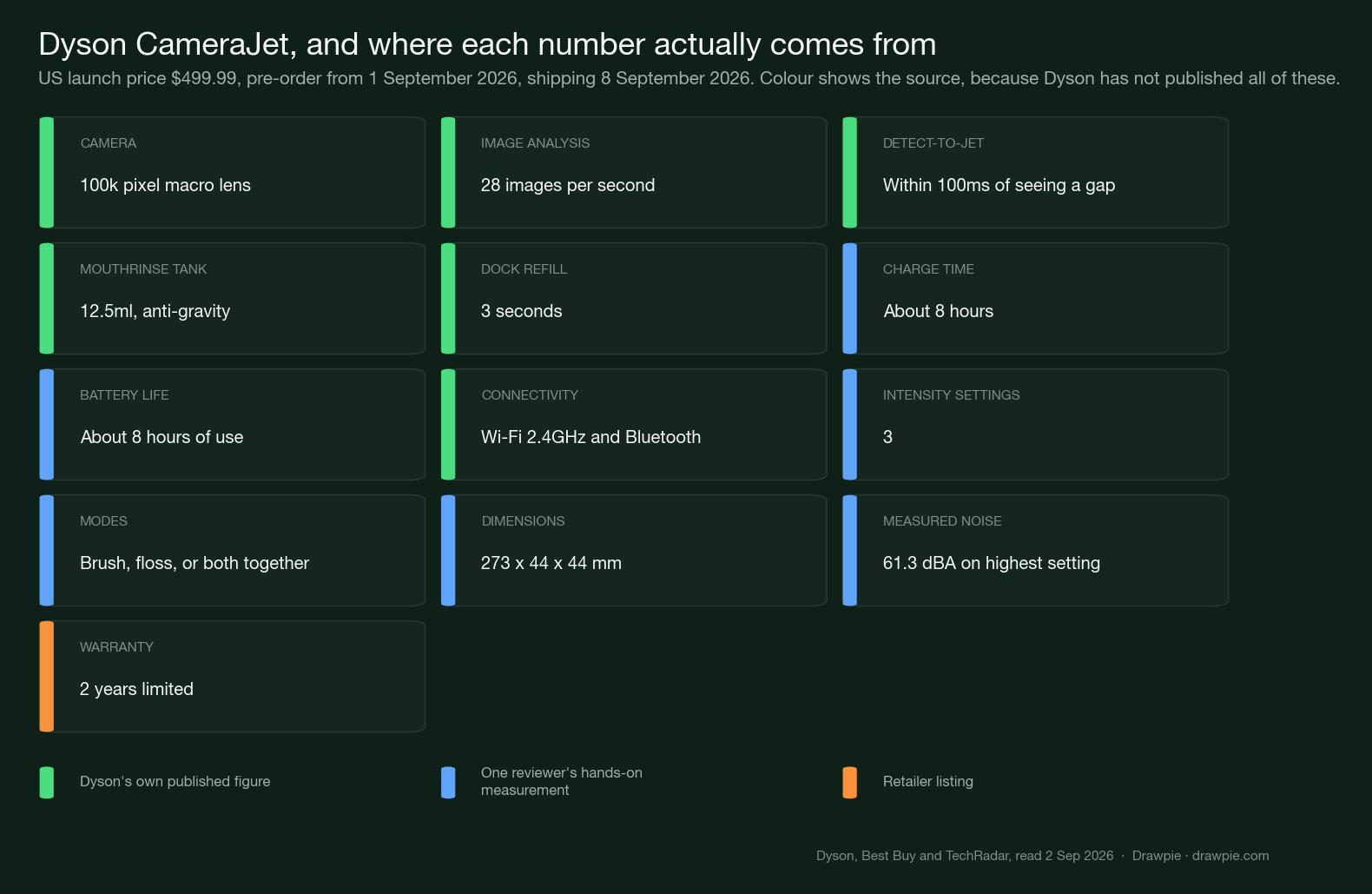
The mechanism is genuinely new. A 100k pixel macro lens camera sits below the brush head and analyses 28 images a second. Dyson’s machine-learning system, which it calls Gap Optical Targeting, identifies the gaps between your teeth and — within 100 milliseconds of spotting one — fires a burst of mouthrinse into it.
Three things support that:
- A conical jet instead of a needle jet. Dyson’s fluid dynamicists argue that the needle-shaped jets used by conventional water flossers punch a hole through plaque without removing it. The conical spray is wider and runs at lower pressure.
- An anti-gravity tank. A 12.5ml tank with a diaphragm pump and pressure chamber, so it keeps jetting when the brush is horizontal — which is where you are when cleaning the backs of teeth. Conventional “straw in a cup” designs draw air and fire blanks.
- Variable sonic oscillation. Dyson says conventional sonic bristles stall against the tooth; varying the angle of oscillation keeps them moving.
It is Wi-Fi connected at 2.4GHz, and the camera doubles as an endoscope streaming to the MyDyson app so you can watch your own mouth while you brush.
On development: six years, 661 engineers, 38 patents filed, 16 million lines of code, and a machine-learning system trained on 470,000 dental images. Dyson developed a proxy plaque with the National University of Singapore’s dental faculty so it could iterate without running a clinical trial each time.
One caution on the performance claims. Most of Dyson’s headline numbers compare the CameraJet against a manual toothbrush, which is a low bar for a $499.99 device. The clinical study behind the gum-health claim ran six weeks with 204 participants, against a manual brush. The only claim benchmarked against rival premium electric toothbrushes is that variable sonic oscillation removes up to 69% more plaque in hard-to-reach areas. Best Buy’s listing adds a “13x more effective” figure that does not appear on Dyson’s own product page.
Replacement costs: what it costs to keep
Here is where a buying guide earns its keep, and where the honest answer is uncomfortable.
Brush heads: $29.99, and there is no way around them
Replacement heads are $29.99 for a pack of two, in regular or sensitive. Each is engineered for three months’ use. That is four heads a year, two packs, about $60 a year.
You cannot shop around. Dyson’s own product page says:
The Dyson CameraJet™ electric toothbrush only works properly with a genuine Dyson brush head.
And every head carries an RFID tag that identifies itself to the device, counts how many cleans it has done, and tells the app when to replace it. That is a closed loop by design — no third-party head is going to satisfy it.
The heads are in a worse position than the toothbrush itself. A week after launch they are still not buyable anywhere we can read: Best Buy lists both variants and shows them Sold Out, and Sephora has them at $30.00 marked “Coming Soon” — it has never had them in stock. Dyson’s own US site was showing both variants out of stock on 2 September and we could not re-read it on 9 September, because dyson.com returns 403 to us on every path.
That matters more than it sounds. The two heads in the box last three months. Anyone who did get a CameraJet in the launch window has no published route to a replacement when those run out.
The mouthrinse: the bigger cost, and nobody can price it
The arithmetic on the rinse is straightforward and the conclusion is not.
A bottle is 400ml. A dose is 12.5ml. That is 32 uses per bottle — about 16 days if you brush twice a day. Over a year that is roughly 23 bottles.
Twenty-three bottles a year is a real recurring cost, and it is very likely larger than the brush heads. Dyson has not published a US price for it.
That is not a gap in this guide’s research. Dyson’s US oral-care accessories page and its brush-heads listing page both return an error instead of any product. To be sure that was Dyson and not a browser problem, the same session loaded Dyson’s hair-care accessories page — 98 products, all priced — and its vacuum accessories page, priced with part numbers. The listing system works. The oral-care catalogue is empty.
The £8.49 ambiguity is now resolved, and it is the rinse alone. This guide previously flagged that TechRadar’s £8.49 / AU$15.99 might cover the toothpaste and the mouthrinse together. Dyson’s own UK store settles it: £8.49 buys one 400ml bottle of low-foaming mouth rinse, and nothing else.
Dyson UK also sells it on subscription — 6 bottles every three months, £50.94 list or £45.90 subscribed. That is 24 bottles a year, from Dyson’s own order form, which independently corroborates the ~23-bottle arithmetic above rather than contradicting it.
It is still not a US price and this guide will not convert it into one. A converted figure would read as Dyson’s American price, and Dyson has not published one.
So there is still no total cost of ownership on this page. Brush heads: about $60 a year, known — but currently unbuyable. Mouthrinse: about 23 bottles a year, and Dyson’s own UK cadence says 24, still unpriced in dollars. Any five-year US figure would be an invention.
Do you have to use Dyson’s own mouthrinse?
Dyson does not say that you do — and the difference between how it talks about the fluid and how it talks about the brush heads is worth noticing.
For brush heads, Dyson says the toothbrush “only works properly with a genuine Dyson brush head.” For the fluid, it says it has “engineered a complete dental system to optimise the performance” of the device, with “a low-foaming mouthrinse formulated for use with the precision jet.”
Those are different claims. One is a compatibility statement; the other is a performance argument.
The performance argument is not empty, though. Dyson’s stated reason for making both the toothpaste and rinse non-foaming — formulated without SLS — is that foam gets in front of the camera and blocks Gap Optical Targeting. Since the camera is the entire reason to buy this device over a $200 competitor, filling it with an ordinary foaming mouthwash would plausibly degrade the one thing you paid for.
Dyson has since answered this directly, and the answer is that you are not locked in. Its own retailer-supplied copy now states: the CameraJet “can be used with any toothpaste or mouth rinse, but for best performance pair with an alcohol-free, non-foaming mouth rinse and low-foaming toothpaste.” Engadget’s 4 September hands-on reports the same distinction independently — the brush heads must be Dyson’s, the fluids need not be.
So the split this section describes is confirmed by the manufacturer: the heads are a closed system, the consumables are a recommendation. Whether plain water performs acceptably is still not something anyone has tested and published.
Where to buy the Dyson CameraJet in the US
Dyson’s press release names dyson.com, Dyson Demo Stores and “selected retailers”. WWD’s launch report names the retailers, and the Amazon and Best Buy listings were confirmed directly.
| Retailer | Status on 9 September | Price |
|---|---|---|
| Best Buy | Sold Out, “Notify Me”, both colours | $499.99 |
| Sephora | Out of Stock, “Notify Me When Available” | $499.00 |
| Amazon | “Currently unavailable”, price withdrawn | — |
| Dyson.com | Could not read — 403 to every request we make | — |
| Dyson Demo Stores | Named in the press release | — |
| Costco | Could not confirm a listing exists — bot wall | — |
The comparison has changed shape. A week ago the question was which retailer to pre-order from. Today there is nothing to compare: the only two US listings we can read are both out of stock, a dollar apart, and Amazon has stopped quoting a price at all.
⚠️ We could not read Dyson’s own US store for this update. dyson.com returns HTTP 403 to every request we make, on every path tried, and we did not attempt to work around it. Everything above comes from retailers we could read first-hand.
Is there a privacy issue with a camera in your bathroom?
It’s a fair question to ask about a Wi-Fi-connected camera pointed inside your body, and Dyson has answered it directly.
Dyson’s statement is that the camera is only active during live viewing or auto-jetting, that no images are recorded or stored on the product or in the cloud, and that images remain private to the user. TechRadar’s reviewer wrote that a Wi-Fi camera in the bathroom “does make me feel a little uneasy” and reported that assurance in the same terms.
That is Dyson’s own claim about its own product. It has not been independently audited by anyone as of publication.
How much do Dyson CameraJet brush heads cost?
$29.99 for a pack of two, in either regular or sensitive.
Each head is designed for three months, so a single user needs four a year — two packs, about $60 annually. The heads are RFID-tagged so the device knows how worn yours is and prompts you through the app. Both variants were out of stock on Dyson’s US site on 2 September.
Can you use other brush heads with the Dyson CameraJet?
No. Dyson states that the toothbrush “only works properly with a genuine Dyson brush head”, and each head carries an RFID tag the device reads.
Anyone used to buying generic replacement heads for an Oral-B or Philips brush should price that in: with the CameraJet, the $60 a year is not optional and not competitive.
Is the Dyson CameraJet worth it?
That depends on something you cannot currently find out, which is what the mouthrinse costs.
At $499.99 it is roughly two and a half times a high-end Philips or Oral-B, and it does something none of them do.
There is more than one review now. TechRadar’s Emily Peck spent a week with it and scored 4/5 on design and 3.5/5 on value, listing “premium price tag with refill costs to consider” as a con and noting it can be messy in flossing mode. Engadget added a hands-on from IFA on 4 September — mixed but intrigued, and explicitly limited to demo units with artificial teeth rather than a real mouth. Tom’s Guide ran a piece on 1 September, the day before this guide first went up.
⚠️ The first buyer-side signal exists, and it is small and unverified. Sephora carries three customer reviews dated 4 to 7 September, averaging 3.7 out of 5: two five-star, and one one-star from a buyer who says the unit stopped working within a day of purchase and that Dyson offered a replacement but not a refund. Three retailer reviews is not evidence about reliability, and we cannot verify any of them — but it is the first thing on the record from people who paid, and Best Buy still shows no reviews at all.
The case for buying: nothing else has the camera, the endoscope view is genuinely novel, and if it gets you flossing when you currently don’t, that is a real health outcome.
The case for waiting is now mostly decided for you: it is sold out everywhere we can read. The replacement heads are also sold out or not yet stocked, which is the sharper problem — the pair in the box lasts three months. And the recurring cost of the fluid still has no US price. None of those is a reason it is a bad device. They are reasons that the information you would want does not exist yet, and now neither does the stock.
The bottom line
$499.99, ships 8 September, sold at Dyson, Amazon, Best Buy, Sephora and Costco. Brush heads are $29.99 a pair, need replacing quarterly, and are locked to Dyson by both policy and RFID — call it $60 a year.
The number missing from every version of this story, including this one, is what the mouthrinse costs in the US. A 400ml bottle lasts about 16 days. Dyson hasn’t said what it charges for one, and its own accessories page can’t tell you today.
Prices and availability were read on 2 September 2026, the day after the announcement, and will change. Nothing here is medical or dental advice; talk to your dentist about your own oral care routine.