Dune 3: The Cast, the Novel It Adapts, and the Potential Ending Explained

- The film is officially titled Dune: Part Three — not Dune Messiah — and opens on 18 December 2026 in IMAX. It wrapped shooting in November 2025 and is in post-production; the first full trailer arrived in early July 2026.
- It adapts Frank Herbert’s 1969 novel Dune Messiah, set twelve years into Paul Atreides’s reign as Emperor. Denis Villeneuve says it is his last Dune film and repeatedly calls it ‘inspired’ by the book rather than a literal adaptation.
- Timothée Chalamet, Zendaya, Rebecca Ferguson, Javier Bardem, Florence Pugh, Josh Brolin, Charlotte Rampling and Jason Momoa return; Robert Pattinson joins as the Face Dancer Scytale and Anya Taylor-Joy steps up as Alia.
- In the novel, Paul is blinded, Chani dies bearing twins, and Paul walks into the desert. But the film’s ending is not knowable — Dune: Part Two already changed Chani’s story, so the book’s ending is a guide, not a spoiler.
Denis Villeneuve’s third and final Dune film is real, it is finished shooting, and it has a date: 18 December 2026. It adapts Dune Messiah, the strange, bitter little novel Frank Herbert wrote in 1969 to tell readers they had misunderstood his hero.
Here is the confirmed cast, where the film sits in ten thousand years of Dune history, what happens in the novel — and, honestly labelled, why the film’s ending may not be the novel’s at all. The film is unreleased, so nobody outside the production knows how it ends. This piece keeps three things separate: the novel, what the filmmakers have actually said, and speculation.
When does Dune 3 come out?
The official title is Dune: Part Three. Warner Bros. announced it in July 2025, a day after cameras rolled — a deliberate choice of the numbered title over the book’s name.
| Detail | |
|---|---|
| Title | Dune: Part Three |
| Release | 18 December 2026 (US/Canada), in IMAX |
| Status | Post-production; shot 8 July – 11 November 2025 |
| Locations | Origo Film Studios, Budapest; Liwa Oasis, Abu Dhabi |
| Director | Denis Villeneuve (his final Dune) |
| Screenplay | Denis Villeneuve and Brian K. Vaughan |
| Score | Hans Zimmer, returning |
| Source novel | Dune Messiah (Frank Herbert, 1969) |
Warner Bros. has held the December date even after Avengers: Doomsday moved onto the same day; the studio’s reported position is that Dune claimed the slot first and is not budging. The first full trailer arrived in early July 2026.
Villeneuve has been clear this is the end of the road for him: “It will be the third and last Dune movie.” He has also said it is “not like a trilogy,” and that he would not direct a fourth himself, while leaving the door open for someone else.
Dune 3 cast: who plays whom
Thirteen names are confirmed to date. This is not the novel’s full roster — several major Messiah characters have no announced actor.
Returning
| Actor | Role | |
|---|---|---|
| Timothée Chalamet | Paul “Muad’Dib” Atreides, now Emperor | @tchalamet |
| Zendaya | Chani | @zendaya |
| Rebecca Ferguson | Lady Jessica | no public Instagram |
| Javier Bardem | Stilgar | no public Instagram |
| Florence Pugh | Princess Irulan | @florencepugh |
| Josh Brolin | Gurney Halleck | @joshbrolin |
| Charlotte Rampling | Reverend Mother Gaius Helen Mohiam | no public Instagram |
| Jason Momoa | Hayt, a ghola of the dead Duncan Idaho | @prideofgypsies |
New to the franchise
| Actor | Role | |
|---|---|---|
| Robert Pattinson | Scytale, a Tleilaxu Face Dancer | no public Instagram |
| Anya Taylor-Joy | Alia Atreides, Paul’s sister | @anyataylorjoy |
| Nakoa-Wolf Momoa | Leto II | none public |
| Ida Brooke | Ghanima | no verified public account |
| Isaach de Bankolé | Fremen role | no verified public account |
Two notes on that table, because both are easy to get wrong. Jason Momoa’s handle is @prideofgypsies, named after his production company — not the handle most people would guess from his name. And Rebecca Ferguson has no public Instagram; the Swedish actress has said she stays off social media. Search carefully: a British singer of the same name is active on Instagram, so accounts bearing “Rebecca Ferguson” are not the actress.
Anya Taylor-Joy appeared only as a brief adult-Alia vision in Part Two; this is her first real role in the story. Character assignments for the newest additions come from trade reporting rather than a Warner Bros. credit list, so treat those specific pairings as reported rather than final.
Where Dune 3 sits in the Dune chronology
Herbert’s saga spans more than fifteen thousand years. Dune: Part Three sits very early in it — barely a decade past the first film.
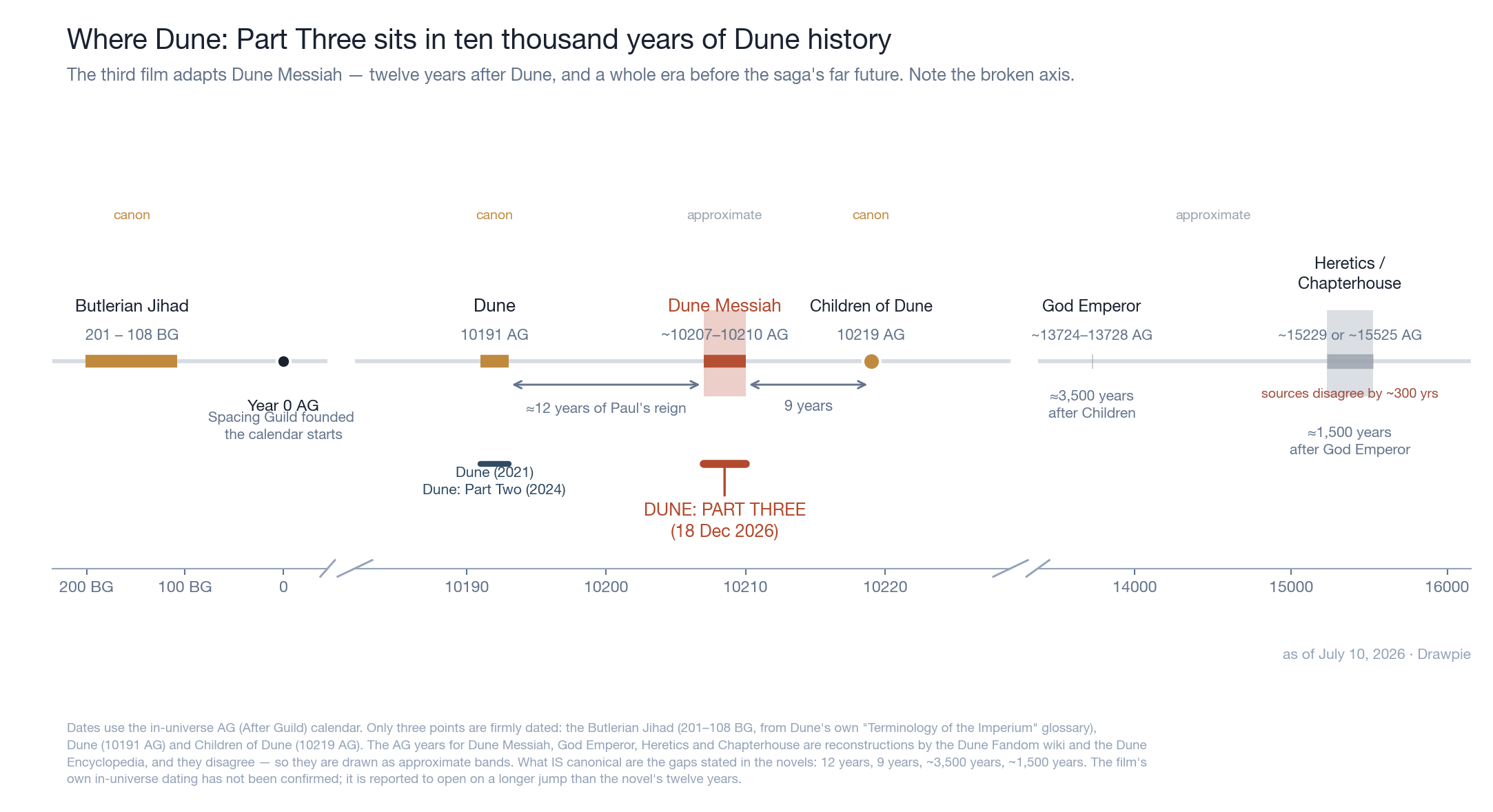
| Book | In-universe date | Gap | Covered by |
|---|---|---|---|
| Dune | 10191 AG | — | Dune (2021) + Dune: Part Two (2024) |
| Dune Messiah | ~10207–10210 AG (approx.) | Paul has reigned 12 years | Dune: Part Three (2026) |
| Children of Dune | 10219 AG | 9 years later | — |
| God Emperor of Dune | ~13724–13728 AG (approx.) | ~3,500 years later | — |
| Heretics / Chapterhouse | ~15229 or ~15525 AG (disputed) | ~1,500 years later | — |
A caveat worth stating plainly: only a few of these dates are firm. The Butlerian Jihad’s 201–108 BG comes straight from Herbert’s own glossary in Dune, and Dune itself is 10191 AG. Children of Dune at 10219 AG follows from the novel’s own “nine years after.” Everything else is a reconstruction by the Dune Fandom wiki and the Dune Encyclopedia, and those sources disagree — by about 300 years on Heretics. What is canonical are the gaps the novels state: twelve years, nine years, roughly 3,500, roughly 1,500.
One more: the film’s own in-universe dating has never been confirmed. It has been reported to open on a longer jump than the book’s twelve years, but that traces to coverage of a trailer Q&A rather than a direct quote.
What is Dune Messiah about?
Twelve years after the events of Dune, Paul Atreides sits on the throne of a galactic empire — and hates it. The holy war unleashed in his name has killed roughly 61 billion people. He is worshipped as a god by a religion he cannot control, married politically to Princess Irulan while loving Chani, and trapped inside a prescient vision whose only exits are all monstrous.
Herbert wrote the book precisely because readers had taken Dune as a straightforward hero’s triumph. Messiah is the correction: a short, claustrophobic anti-thriller about what a charismatic leader actually costs. Both Villeneuve and Chalamet have cited that reading in interviews.
Against Paul, four parties conspire: the Bene Gesserit (Reverend Mother Mohiam), the Spacing Guild (the Navigator Edric), the Bene Tleilaxu (the Face Dancer Scytale), and Irulan herself, who has been secretly dosing Chani with contraceptives to deny Paul an heir. Their instrument is a gift: Hayt, a ghola — a body regrown from the dead Duncan Idaho’s flesh — presented to Paul by Edric, with a hidden command buried inside him.
Dune Messiah’s ending explained — the novel, not the film
Spoilers for the 1969 novel follow. They are not necessarily spoilers for the film. Dune: Part Two already rewrote Chani, so treat what follows as the source text, not a leak.
The conspirators detonate a stone burner, an atomic weapon that scorches Paul’s eyes and leaves him physically blind. For a while it barely matters: his prescient vision is so exact that he walks through the world by memory of the future, seeing nothing yet missing nothing.
Chani, her body weakened by years of Irulan’s hidden contraceptives, turns to a Fremen fertility diet, conceives, and dies giving birth to twins — a son and a daughter, Leto II and Ghanima, both born already awake with ancestral memory, as Alia was.
And here the trap closes. Paul had foreseen a daughter. He had not foreseen the son. It is that unforeseen birth — not Chani’s death, which he had seen coming — that snaps the thread of the vision he was walking inside. He is left genuinely, ordinarily blind.
Chani’s death was supposed to trigger the kill-command inside Hayt. Instead the shock breaks the Tleilaxu conditioning, and the original Duncan Idaho surfaces intact. Scytale, cornered, holds a knife to the newborns and offers Paul a bargain: he can have Chani back, restored as a ghola, if he surrenders his empire. Paul kills him — aiming through the eyes of his infant son, whose prescience he borrows for a heartbeat.
Then, blind, Paul follows Fremen law. The blind are given to the desert. He walks out into the sand alone, as a man rather than a god, abandoning the throne and the religion built on him. Alia rules as regent for the twins; Irulan renounces the Bene Gesserit and becomes the children’s guardian.
Why the film’s ending may not be the book’s
This is the speculative part, and it is worth being precise about what is known and what is not.
What the filmmakers have said. Villeneuve calls the film “inspired” by Dune Messiah, approached “with a critical eye and not to be self-indulgent” — not a literal adaptation. On tone: “If the first movie was more of a contemplation about a boy discovering a new world, and the second one is a war, then this one is a thriller,” and it is “more action-packed and more dense, more muscular than the other two films.” Asked whether Part Two’s altered ending forced big changes to the book, he answered: “It’s not that different.” Chalamet has said the biggest liberty is Villeneuve “weaving in storylines that weren’t explicit in the book,” particularly expanding a Paul–Chani romance that Herbert kept marginal.
The structural problem. Dune: Part Two ends with Chani rejecting Paul and riding into the desert alone. In the novel, she never leaves. Every beat above — the contraceptives, the pregnancy, the death in childbirth — assumes a Chani at Paul’s side. The film has to rebuild that, which is presumably why Villeneuve describes the Paul–Chani relationship as the film’s spine.
What that implies. A reasonable expectation is that the novel’s architecture survives — the conspiracy, Hayt, the stone burner, the twins, a blind Paul walking away from his own godhood — while the emotional route there is different, and Chani is a participant rather than a casualty. That is inference, not information.
Two things worth resisting. This is not an adaptation of Children of Dune, whatever the casting of teenage twins suggests. And it is not, in Chalamet’s own framing, Paul’s “villain era” — he has rejected that reading, describing something more nuanced: a cautionary tale rather than a heel turn.
The bottom line
Dune: Part Three arrives on 18 December 2026 as the closing statement of the most successful serious sci-fi adaptation in decades, made by a director who says he is done. The novel it draws on is the one that kills the hero’s myth. What the film keeps of that — and what it rewrites for a Chani who already walked away — is the only real question, and it stays open until December.
When is Dune 3 released?
Dune: Part Three opens on 18 December 2026 in the US and Canada, in IMAX. It wrapped principal photography in November 2025 and is in post-production.
Is Dune 3 called Dune Messiah?
No. The official title is Dune: Part Three. It adapts the novel Dune Messiah, but Warner Bros. chose the numbered title instead of the book’s name.
Who is in the Dune 3 cast?
Returning are Timothée Chalamet, Zendaya, Rebecca Ferguson, Javier Bardem, Florence Pugh, Josh Brolin, Charlotte Rampling and Jason Momoa. New to the franchise are Robert Pattinson as the Face Dancer Scytale, Anya Taylor-Joy as Alia, Nakoa-Wolf Momoa as Leto II and Ida Brooke as Ghanima.
How does Dune Messiah end?
Paul is blinded by a stone burner, Chani dies giving birth to the twins Leto II and Ghanima, and the birth of the unforeseen son destroys Paul’s prescience. He kills the Face Dancer Scytale, then walks alone into the desert as Fremen law demands, leaving Alia as regent. Whether the film follows this is unknown.
Is Dune 3 the last Dune film?
It is Villeneuve’s last. He has said “it will be the third and last Dune movie” and that he would not direct another, though he has not ruled out another filmmaker continuing the saga.
For more on this year’s biggest releases, see our guides to The Odyssey and Project Hail Mary , or browse everything in Screen .