Dover Protest: What Happened at the Port, and What Is Actually Confirmed
Written on the day. Kent Police had not said who organised the protest and no arrests had been made; the Dover and Deal MP said he would ask questions on the Monday. Any of those can change within days — re-read Kent Police and BBC Kent before relying on the unresolved sections.
Everything else on the page is unaffected; the figures below still say when they were read.

- Hundreds of protesters in black with their faces covered blocked roads in and out of the Port of Dover on Saturday 5 September 2026, chanting ‘stop the boats’.
- It began about 07:00 BST. Kent Police moved the crowd to Dover Priory station at about 11:30 and said all involved had dispersed by 12:00.
- No arrests were made. The Port of Dover said operations returned to normal and all routes reopened.
- Kent Police described the protest as ‘spontaneous’. Four elected representatives described overnight coordination, rental vans and an overnight stop on a village green in a neighbouring constituency.
- Covering your face at a protest is only an offence in an area a police inspector has designated first. Kent Police have not said whether any area was designated.
- Kent Police had not commented on who organised it. One campaigning organisation has named a group; that is a claim, not a confirmation.
- National Highways reported a four-mile tailback. Ferry operators P&O and DFDS said they would move affected passengers to the next sailing.
Hundreds of protesters, dressed in black with their faces covered, blocked roads in and out of the Port of Dover on Saturday morning, chanting “stop the boats”. It lasted about five hours and ended with no arrests.
What follows separates three things that are easy to run together: what is confirmed, what is attributed to a named person, and what is only claimed.
The timeline
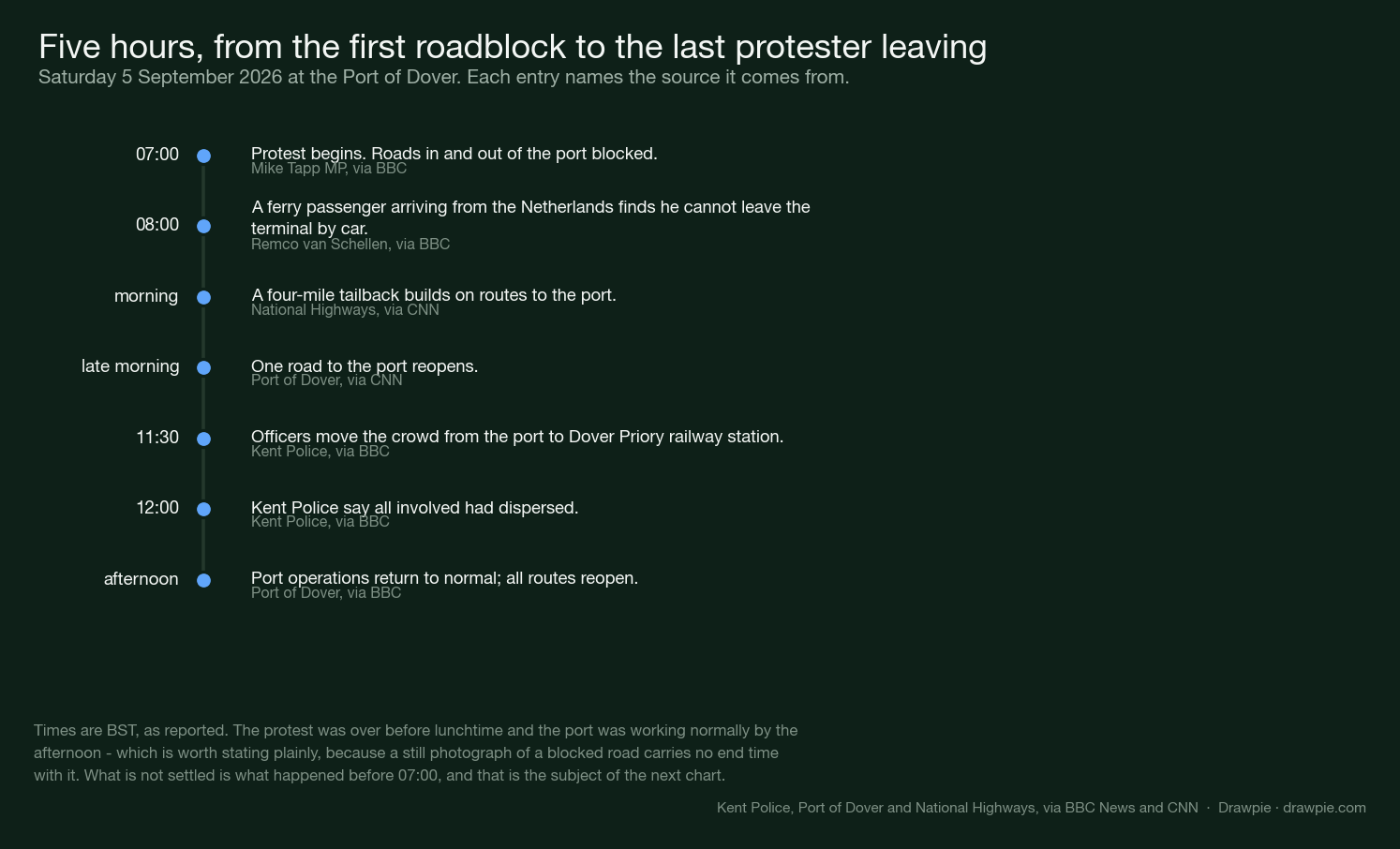
| Time (BST) | What happened | Source |
|---|---|---|
| ~07:00 | Protest begins; roads in and out of the port blocked | Mike Tapp MP |
| ~08:00 | A ferry passenger from the Netherlands cannot drive out of the terminal | Remco van Schellen |
| Morning | A four-mile tailback builds on routes to the port | National Highways |
| Late morning | One road to the port reopens | Port of Dover |
| 11:30 | Officers move the crowd from the port to Dover Priory railway station | Kent Police |
| 12:00 | Kent Police say all involved had dispersed | Kent Police |
| Afternoon | Port operations return to normal; all routes reopen | Port of Dover |
It was over before lunchtime. That is worth stating plainly, because a photograph of a blocked road carries no end time with it.
What Kent Police said
Three things, and one silence.
- The force described the protest as “spontaneous”.
- Officers moved the crowd to Dover Priory station at about 11:30, and said “all involved had dispersed by 12:00”.
- No arrests were made.
And the silence: Kent Police had not commented on who was behind the demonstration. That was still the position when this was written.
What elected representatives said
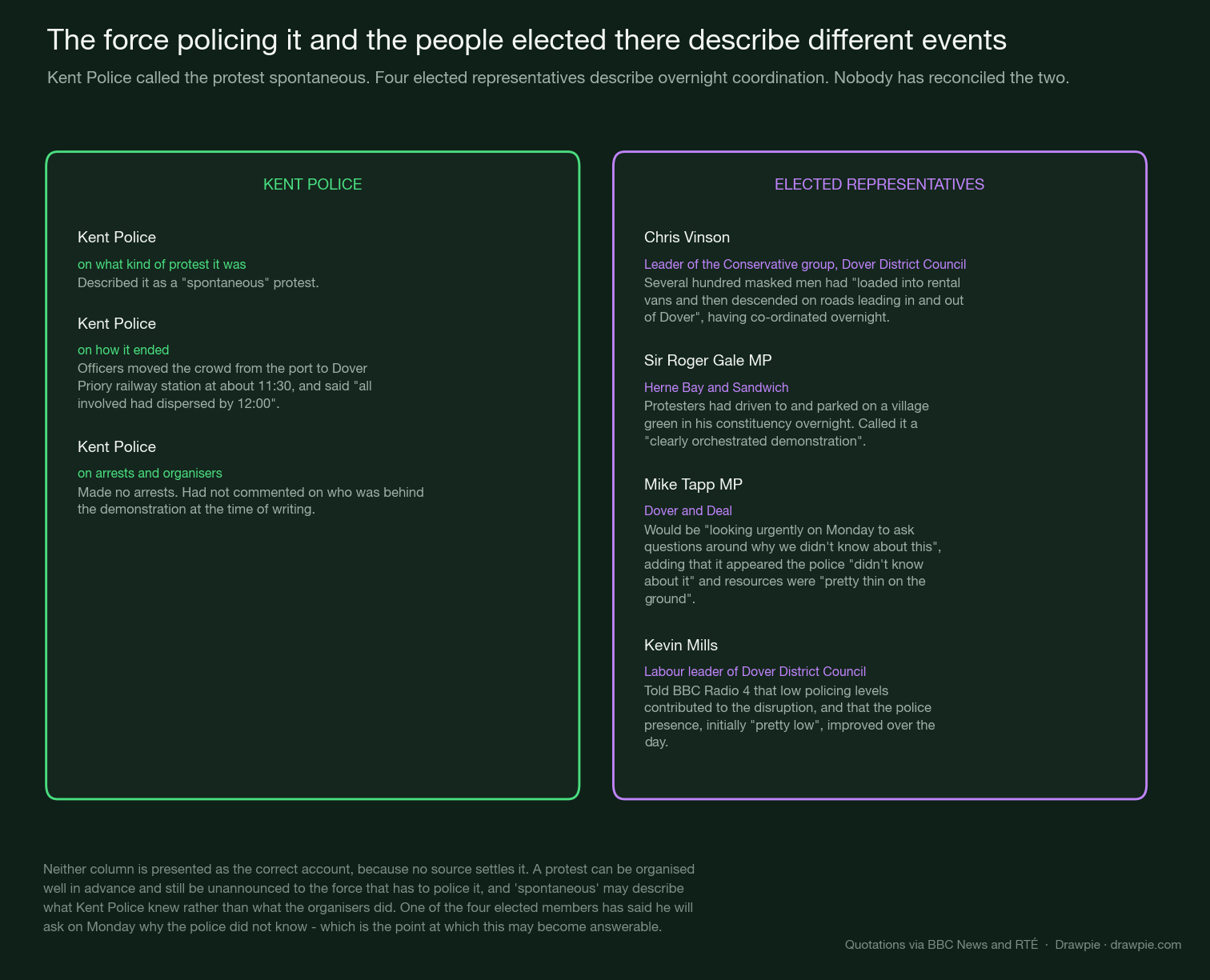
Four of them described something that does not sound spontaneous.
Chris Vinson, leader of the Conservative group on Dover District Council, said several hundred masked men had “loaded into rental vans and then descended on roads leading in and out of Dover”, having co-ordinated overnight. He added that people who worked night shifts at the port were “prevented from leaving for fears for their safety”.
Sir Roger Gale MP (Herne Bay and Sandwich) said protesters had driven to and parked on a village green in his constituency overnight, and called it a “clearly orchestrated demonstration”. He said the migration issue “does need to be addressed”, but not by young men in balaclavas “seeking to terrorise the local population of east Kent”.
Mike Tapp MP (Dover and Deal) said he would be “looking urgently on Monday to ask questions around why we didn’t know about this”, adding that it appeared the police “didn’t know about it” and that resources were “pretty thin on the ground”.
Kevin Mills, Labour leader of Dover District Council, told BBC Radio 4 that low policing levels contributed to the disruption, and that the police presence — initially “pretty low” — improved over the day.
This page does not adjudicate between those accounts, because no source does. A protest can be organised well in advance and still be unannounced to the force that has to police it, and “spontaneous” may describe what Kent Police knew rather than what the organisers did. Monday is when it may become answerable.
Why nobody was arrested
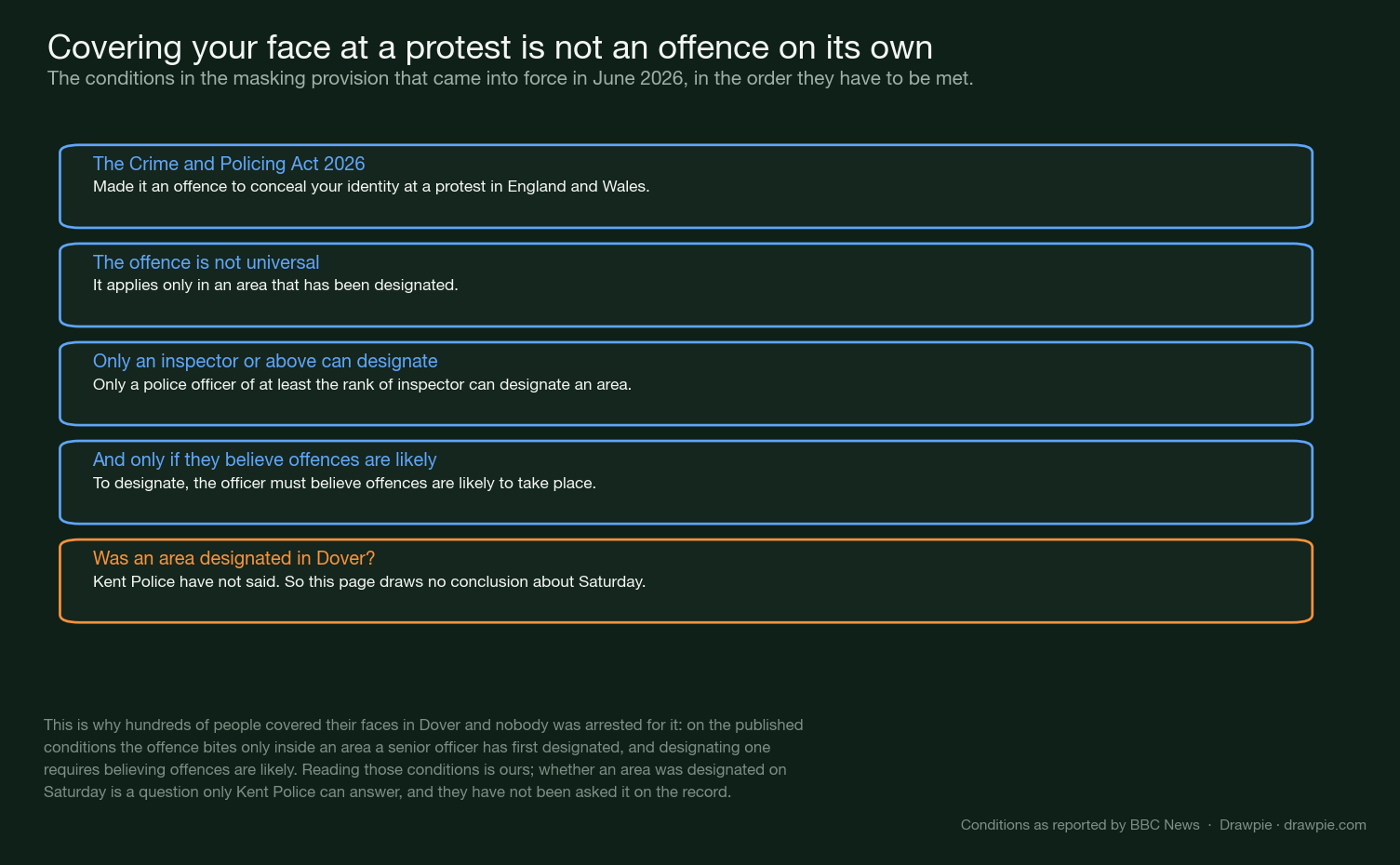
Because covering your face at a protest is not, by itself, an offence.
The Crime and Policing Act 2026 made it an offence to conceal your identity at a protest in England and Wales — but only in an area that has been designated. Only an officer of at least the rank of inspector can designate one, and to do so they must believe offences are likely to take place. That section came into force in June 2026.
Whether any area was designated in Dover on Saturday, Kent Police have not said. So this page draws no conclusion about the policing of this particular protest — only that the offence people assume exists does not exist in the form they assume.
Reform leader Nigel Farage told the BBC he “deplored” anyone wearing masks or balaclavas at public demonstrations: “You should not be allowed to be masked-up, balaclavaed-up and go out and protest on the streets of our country.”
Who was behind it — and what is only claimed
Confirmed: nothing. Kent Police had not commented on organisers.
Reported, with the status of each:
- Paul King, Reform UK councillor for Dover West, said he had been told it was a “stop the boats protest”. Attributed to a named councillor, who says he was told.
- Activists Tommy Robinson and Danny Thomas both posted about the protest on X, praising those involved. Reported. Posting in support is not evidence of organising.
- Thomas is believed to be the founder of the Patriot Platform network. Reported as belief, not established fact.
- The anti-hate organisation Hope Not Hate claims Patriot Platform arranged the protest, saying the group began meeting in July and has brought together members of anti-migrant groups from around the country. This is a claim by a campaigning organisation, reported as a claim. It is not confirmed by police and it is not adopted here.
The protesters themselves mostly declined to speak. Demonstrators told the BBC they did not want to talk to the media; one said “send them back” and another “stop the boats” when approached. A tour guide said protesters told him they were protesting against illegal migration.
The disruption
A four-mile tailback, a port that handles more than nine million passengers a year, and a lot of people stuck in cars.
- Remco van Schellen, arriving by ferry from the Netherlands at about 08:00, could not drive out of the terminal: “There were people in black clothing, their faces masked, so we couldn’t see who they were.”
- Rafael Pittman, a tour guide from London, described three hours of “absolute chaos” waiting to collect tourists. Passengers did not disembark and he could not enter the terminal. He said the protesters “looked quite frightening” but were “friendly-ish”.
- Lania Tkaczyk, from Cheshire, was delayed leaving her hotel and at risk of missing her two children swim a Channel relay at Folkestone. “It was quite intimidating seeing the men head-to-toe in black.”
P&O and DFDS both said they would move passengers who missed a scheduled crossing onto the next available sailing.
A Government spokesperson said: “The right to peaceful protest is fundamental to our democracy, but we condemn the behaviour in Dover and the travel disruption it has caused.”
Demonstrations against immigration are common in Dover, because it is where migrants picked up from small boats in the Channel are brought ashore. The BBC notes they are typically advertised in advance, and that Saturday’s was on a larger scale.
What is still unknown
Five things, and they are the ones worth watching:
- Who organised it. Kent Police had not said.
- Whether any area was designated under the masking provisions.
- How many people took part. Accounts say “hundreds” and “several hundred”. No official figure was given.
- Whether any arrests follow. None had been made.
- What Kent Police say in response to the Dover and Deal MP’s stated intention to ask questions on Monday.
One figure quoted above is a politician’s rather than a checked one: Mike Tapp MP wrote that small boat crossings are “down by 40%”. That is his claim, and it was not verified against Home Office statistics for this page.
The bottom line
A five-hour blockade of Britain’s busiest ferry port, no arrests, and no official account of who arranged it.
The single most consequential open question is not what the protesters believe — several told reporters plainly — but whether the police knew it was coming. The force says spontaneous; four elected representatives describe rental vans and an overnight stop on a village green in a neighbouring constituency. Monday is when someone has to reconcile those.
Statements from Kent Police, the Port of Dover, National Highways and the Government as reported by BBC News on 5 September 2026, corroborated against RTÉ, CNN and ITV. Written the same afternoon.