Dolly Parton Dies at 80: Her Essential Songs, Explained

- Dolly Parton died on 25 August 2026 in Nashville, aged 80. Her family announced it in a video statement on her own accounts, and her team said she had faced a brief battle with cancer. She had 25 No. 1 country singles, more than any other woman, and wrote over 3,000 songs.
- The song she is best known for made her the most money by being turned down: she refused to give Colonel Tom Parker half the publishing on I Will Always Love You, so Elvis never recorded it and she still owned it when Whitney Houston did.
- Her records topped the country chart for a decade before pop radio caught up. Her first Hot 100 top 40 hit did not arrive until 1978.
- The most repeated fact about her songwriting - that she wrote Jolene and I Will Always Love You on the same day - is her own recollection, not a documented one. She has said she is not certain.
Dolly Parton died on Tuesday 25 August 2026 in Nashville, aged 80. Her family announced it in a video statement posted to her own accounts, delivered by her nephew Bryan Seaver, who had also worked as her head of security. Her team said she had faced a brief battle with cancer and that she died surrounded by her family. A small private service is planned, and the family has asked that donations go to her Imagination Library rather than flowers.
She had been openly unwell for months. She postponed a Las Vegas residency, and on 14 August she missed the opening of a new attraction at Dollywood, telling fans in a video that her Nashville doctors had “clipped my wings” about travelling. Her husband of nearly 60 years, Carl Dean, died in March 2025.
What follows is not a ranking. It is the six songs that explain why the rest of her career was possible, and what the numbers underneath them actually say.
What are Dolly Parton’s most essential songs?
Six, spanning twelve years, and every one of them still does work that the others cannot.
| Song | Year | What it is | Peak, Hot Country Songs |
|---|---|---|---|
| Coat of Many Colors | 1971 | The autobiography. A poor childhood told without asking to be pitied. | No. 4 |
| Jolene | 1973 | Two chords, one plea, and the most covered song she ever wrote. | No. 1 |
| I Will Always Love You | 1974 | A goodbye to her mentor that became the most valuable copyright she owned. | No. 1 |
| Here You Come Again | 1977 | The crossover. The record that made pop radio take her seriously. | No. 1 |
| 9 to 5 | 1980 | A protest song disguised as a theme tune. The typewriter clatter on the record is her acrylic nails. | No. 1 |
| Islands in the Stream | 1983 | The duet, written by the Bee Gees, sung with Kenny Rogers. | No. 1 |
Five of those six went to No. 1 on the country chart. Only three of them ever registered a verified peak on the Hot 100 at all.
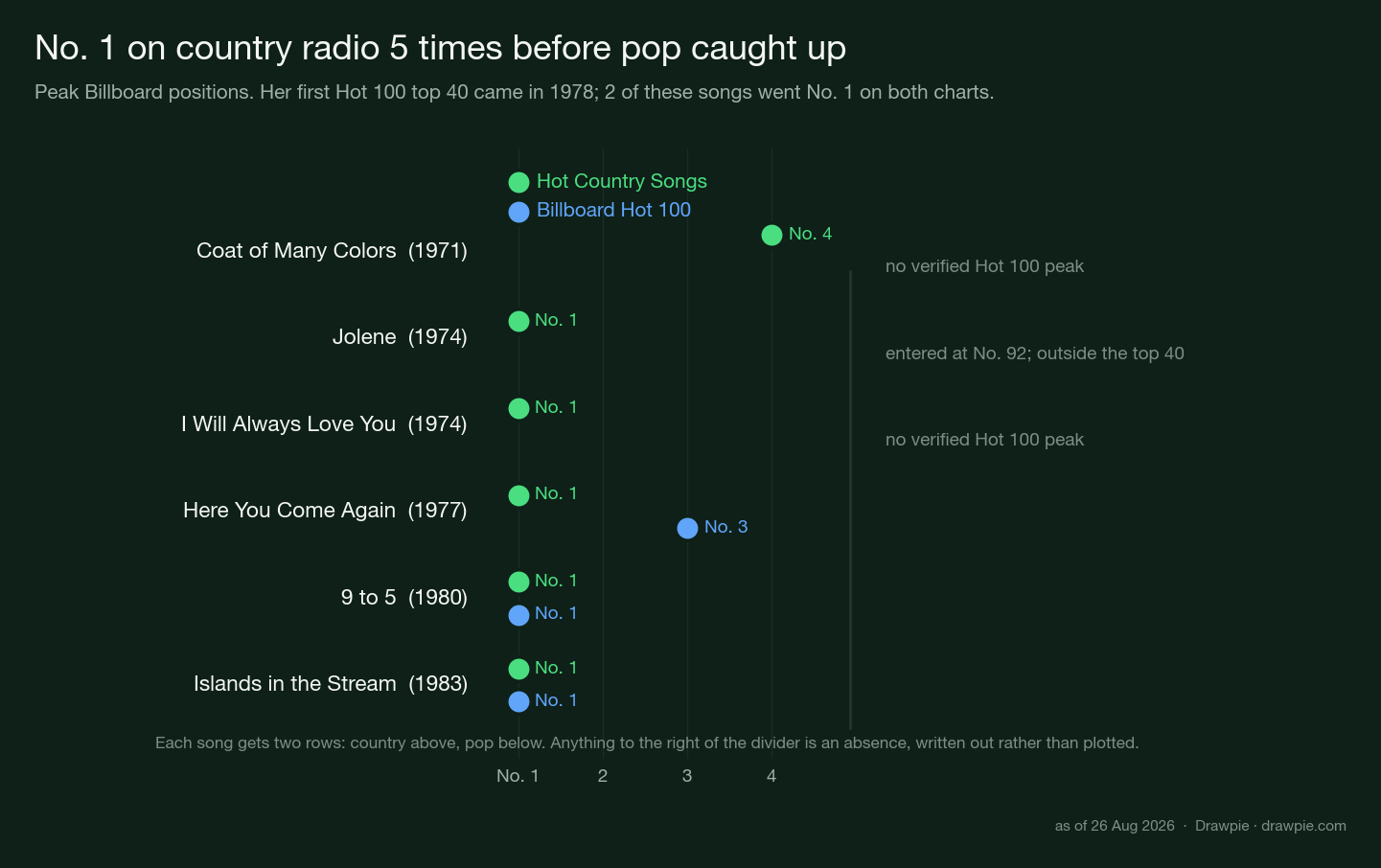
| Song | Hot Country Songs | Billboard Hot 100 |
|---|---|---|
| Coat of Many Colors (1971) | No. 4 | No verified peak |
| Jolene (1974) | No. 1 | Entered at No. 92; outside the top 40 |
| I Will Always Love You (1974) | No. 1 | No verified peak |
| Here You Come Again (1977) | No. 1 | No. 3 |
| 9 to 5 (1980) | No. 1 | No. 1 |
| Islands in the Stream (1983) | No. 1 | No. 1 |
The gap is the story. She was already the biggest woman in country music years before pop radio would play her, and the record that finally broke through, Here You Come Again, is the one she did not write - it came from Barry Mann and Cynthia Weil. When she did top the Hot 100 herself, with 9 to 5 in 1981, it was with a song whose percussion track is the sound of her own fingernails.
Why did Dolly Parton refuse to let Elvis Presley record I Will Always Love You?
Because saying yes would have cost her half the song, permanently.
She wrote it in 1973 as a farewell to Porter Wagoner, the singer whose television show had made her famous and whose partnership she was leaving. It went to No. 1 on the country chart in June 1974. Elvis Presley heard it and wanted to record it.
She agreed. Then, the night before the session, Colonel Tom Parker called with the condition: Elvis did not record anything unless his side took half the publishing. Parton refused, and her reason was not artistic. The song was already a hit, she already owned it, and it was what she intended to leave to her family.
She has said she cried all night. She also kept the copyright, and eighteen years later Whitney Houston recorded it for The Bodyguard.
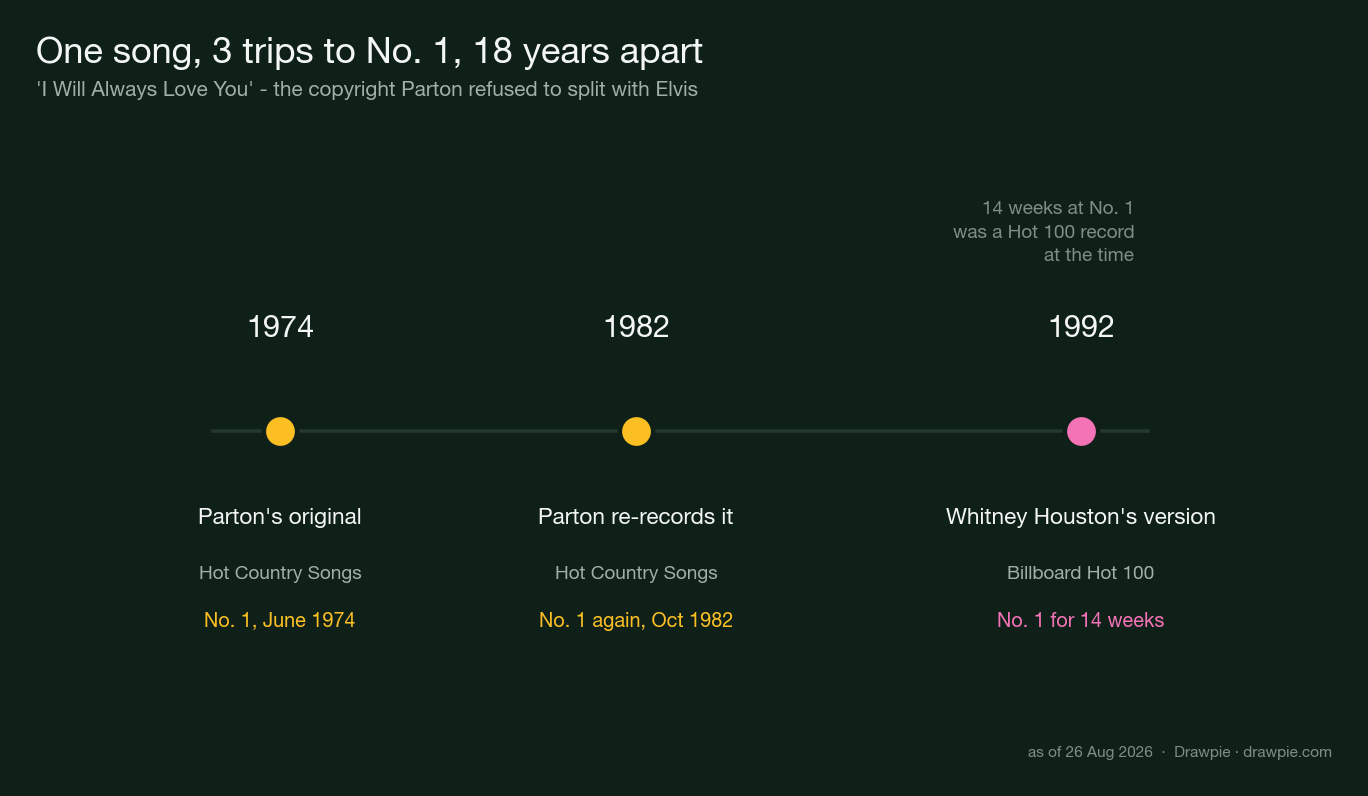
| When | Whose version | Chart | Result |
|---|---|---|---|
| June 1974 | Parton’s original | Hot Country Songs | No. 1 |
| October 1982 | Parton’s re-recording, for The Best Little Whorehouse in Texas | Hot Country Songs | No. 1 again |
| November 1992 | Whitney Houston, from The Bodyguard | Billboard Hot 100 | No. 1 for 14 weeks, a record at the time |
Topping the same chart twice with the same song, eight years apart, is rare on its own. Doing it and then having a third artist take the identical composition to the top of a different chart a decade later is the part that makes the Parker phone call look less like stubbornness and more like the best business decision of her life.
Did Dolly Parton write Jolene and I Will Always Love You on the same day?
Probably, by her own account — but she has never been certain, and it is worth being honest about that.
The story is repeated constantly, and it comes from Parton herself: she has described finding an old cassette of early songwriting attempts with both songs on it, and concluding they must have come from the same writing session. When Snopes examined the claim, what it found was exactly that — her recollection, offered as a recollection, not a documented fact. Parton has said she does not firmly remember.
What is documented is how close together they were recorded. She cut Jolene at RCA Studio B in Nashville on 22 May 1973, and returned to the same room on 12 June to record I Will Always Love You. Three weeks apart, in the same building, in the same year.
The Jolene character was real enough. Parton has said the situation came from a bank teller who flirted with her husband, and the name from a young fan who came up for an autograph.
What do Dolly Parton’s career numbers actually say?
That the songwriting, not the singing, is the part the records cannot fully show.
- 25 No. 1 singles on Billboard’s Hot Country Songs chart — more than any other woman in the chart’s history.
- 11 Grammy wins from 55 nominations, one of the most-nominated women in the awards’ history.
- More than 3,000 songs written, the body of work cited when she was inducted into the Rock and Roll Hall of Fame on 5 November 2022 — an induction she had initially tried to decline, saying she had not earned a rock honour, before agreeing to accept it gracefully.
The Rock Hall episode is a useful summary of her, in miniature: she thought the category did not fit, said so publicly rather than quietly accepting, and then took it anyway with the grace of someone who had never needed the validation.
What was announced about a funeral?
Nothing yet.
The family statement said a small private service will be held for close family, and asked that donations be made to Dolly Parton’s Imagination Library, the childhood book-gifting programme she founded. No public memorial had been announced at the time of writing, and no cause of death has been released beyond her team’s reference to cancer.
Sources
Checked 26 August 2026.
| Source | What it supports here |
|---|---|
| NPR | The death, date, age and family statement |
| Billboard, Hot 100 legacy | Jolene entering at No. 92 on the 26 January 1974 chart; Here You Come Again at No. 3 as her first Hot 100 top 40 hit, in 1978 |
| Billboard, Islands in the Stream | Islands in the Stream topping the Hot 100, and its Bee Gees authorship |
| Snopes | The same-day songwriting claim, and Parton’s own uncertainty about it |
How we verified this
The death. Confirmed against five independent outlets carrying the same family statement - NPR, CNN, NBC News, CBS News and Variety - plus the statement itself, delivered by her nephew Bryan Seaver in a video posted to her official accounts. Date, city and age agree across all of them. No cause of death has been released beyond her team’s reference to a brief battle with cancer, and no funeral or memorial arrangements had been announced when this was published; both are written here as open, not filled in.
The chart figures. Peak positions were taken from Billboard’s own pages rather than from aggregators. Two numbers were deliberately left out. A No. 60 Hot 100 peak for Jolene is widely repeated but traces to a single Forbes piece that returns 403 to every fetch attempted here, so this article says only what Billboard’s own wording supports: Jolene entered at No. 92, and Here You Come Again in 1978 was her first Hot 100 top 40 hit, which places Jolene outside it. Coat of Many Colors and Parton’s own recording of I Will Always Love You have no verified Hot 100 peak, so the chart marks them as absences rather than plotting a number.
The same-day songwriting story. Snopes examined it and found Parton herself does not firmly recall; the anecdote traces to a 2017 radio interview in which she described finding an old cassette with both songs on it. It is presented here as her account, which is what it is.