Dell AI Server Sales Surge: $16.4B Revenue, $95B Backlog & What It Means for DELL

- Dell booked a record $60.9 billion in AI server orders in the quarter to 31 July 2026, recognised a record $16.4 billion of AI server revenue, and ended the quarter with a record $95 billion backlog.
- The backlog is larger than the whole year Dell is guiding to. It now expects $74 billion of AI server revenue across all of fiscal 2027 — so the order book already stretches past the full-year target.
- Orders ran about 3.7 times revenue. That is why the backlog grew in a quarter that shipped a record amount.
- The fastest-growing line was not the AI one. Traditional servers and networking rose 122% year on year, against 100% for AI-optimized servers. Storage rose 26% and the PC business 20%.
- Margins went the opposite way to the usual assumption. Gross margin was 20.9% against 18.3%, and ISG operating margin went from 8.8% to 15.0%. Over six months, though, gross margin is essentially flat at 19.4% against 19.5%.
- Net income rose 255% while cash from operations fell 13%, to $2.2 billion. Building AI servers means paying for components long before customers pay for the servers.
Dell booked $60.9 billion of AI server orders in three months and shipped $16.4 billion of them. The difference is why the company ended the quarter with a record $95 billion backlog — a number larger than the entire year it is now guiding to.
Dell reported its fiscal 2027 second quarter, covering the three months to 31 July 2026, on 1 September. Revenue was $47.0 billion, up 58%. Every figure below is from the company’s own filing.
The order book is bigger than the year
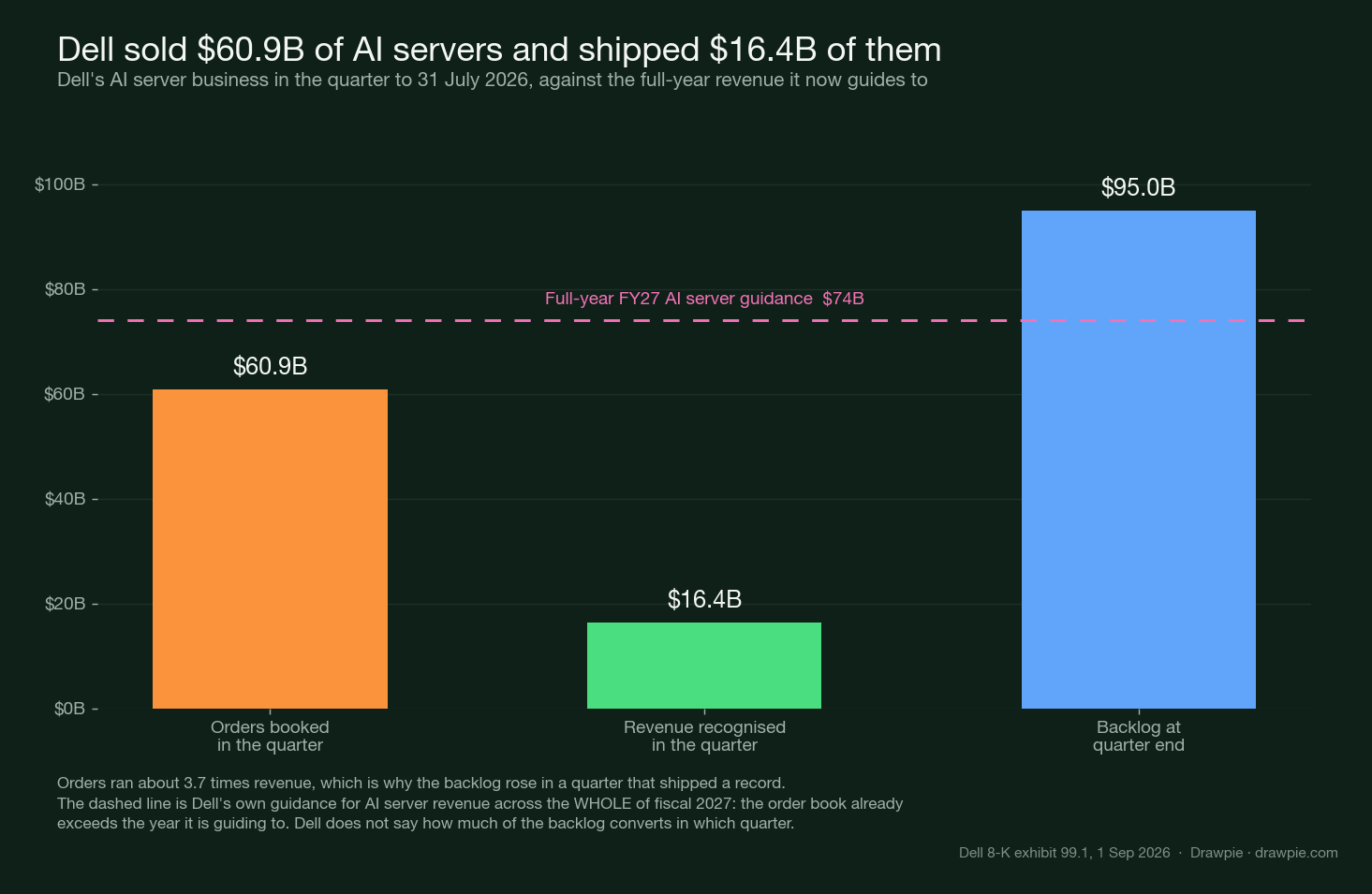
This is the chart that matters, and the dashed line is the reason.
Dell now guides to $74 billion of AI-optimized server revenue for the whole of fiscal 2027 — itself a raise, from $60 billion. Its backlog at the end of the second quarter was $95 billion. The order book is already larger than the full year the company is guiding to.
Orders ran about 3.7 times revenue in the quarter. That ratio is the whole story: Dell shipped a record $16.4 billion of AI servers and the backlog still went up, because it sold far more than it could deliver.
Two things are worth holding onto here. A backlog is a genuinely better indicator than a quarter’s revenue, because it is contracted demand rather than a single period’s shipments. But it is not the same as revenue, and Dell does not say how much of the $95 billion converts in which quarter, or on what margin.
What Dell actually sold
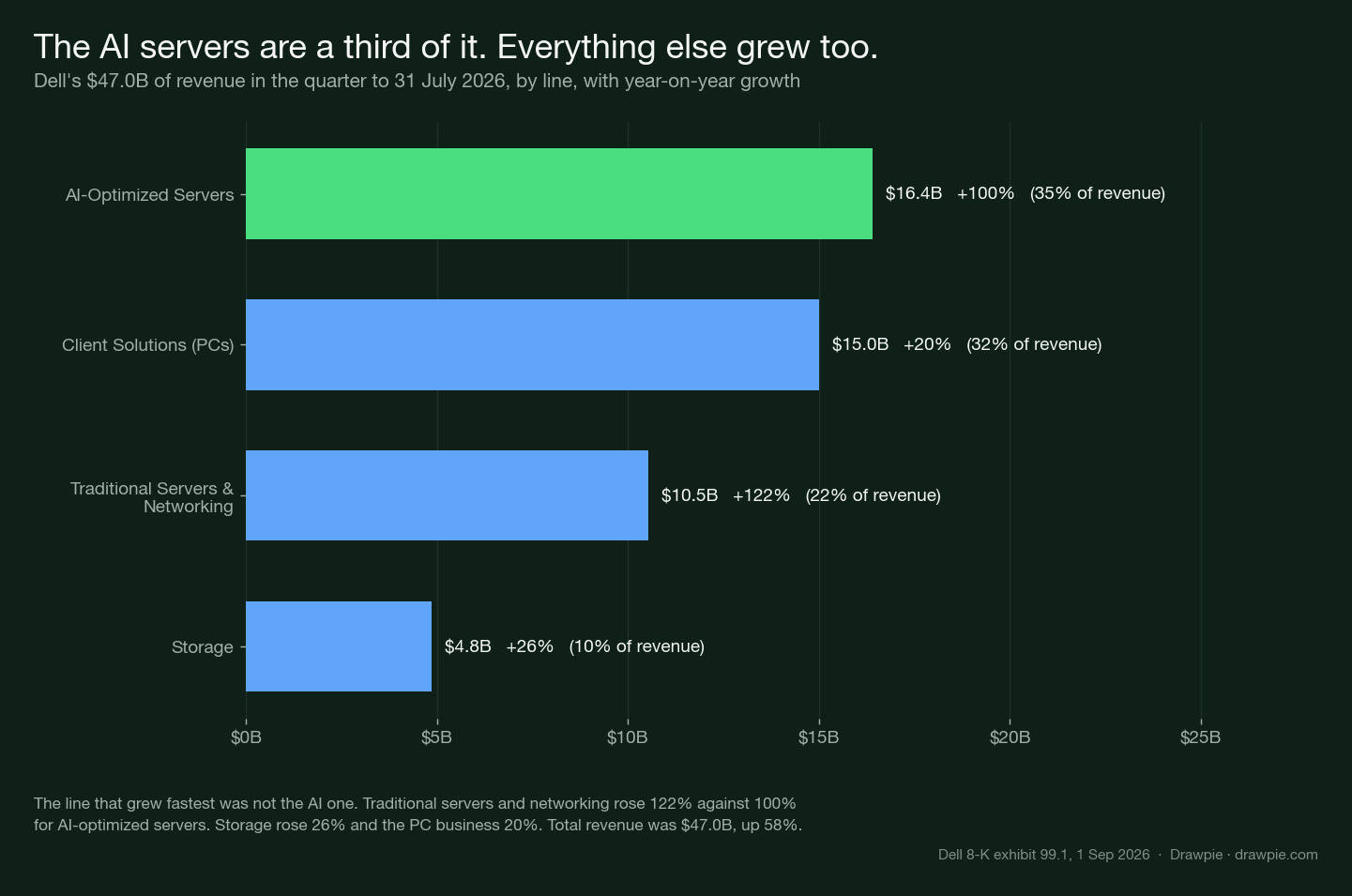
The AI servers are about a third of the company’s revenue. The more interesting fact is in the growth rates.
| Line | Revenue | Growth |
|---|---|---|
| AI-Optimized Servers | $16.4bn | +100% |
| Client Solutions (PCs) | $15.0bn | +20% |
| Traditional Servers and Networking | $10.5bn | +122% |
| Storage | $4.9bn | +26% |
The fastest-growing line was not the AI one. Traditional servers and networking grew 122%, against 100% for AI-optimized servers.
That cuts against the common framing in which AI is the only thing happening and everything else is a declining legacy business being carried. On these numbers the ordinary server business grew faster than the AI one, storage grew 26%, and the PC business — the part of Dell most often written off — grew 20%.
Dell’s chief operating officer Jeff Clarke put the general version of it this way:
IT environments have shifted from cost centers to value drivers that fuel growth and competitive advantage, and customers are investing accordingly – creating opportunity across our portfolio.
Did AI servers crush the margins?
Not this quarter, which is the opposite of what is usually assumed.
Gross margin was 20.9%, against 18.3% a year earlier. The Infrastructure Solutions Group’s operating margin went from 8.8% to 15.0%, and its operating income rose 225% to $4.8 billion.
The standard argument is that AI servers are effectively pass-through boxes: Dell buys expensive GPUs, adds integration, and sells at thin margin, so more AI revenue means worse margins. That is not what this quarter shows.
But one quarter is not a trend. Across the first six months of the fiscal year, gross margin is 19.4% against 19.5% — flat. Dell also does not break out margin on AI-optimized servers specifically, only for ISG as a whole, so the mix effects inside that 15.0% are not visible from outside.
The part that went the other way
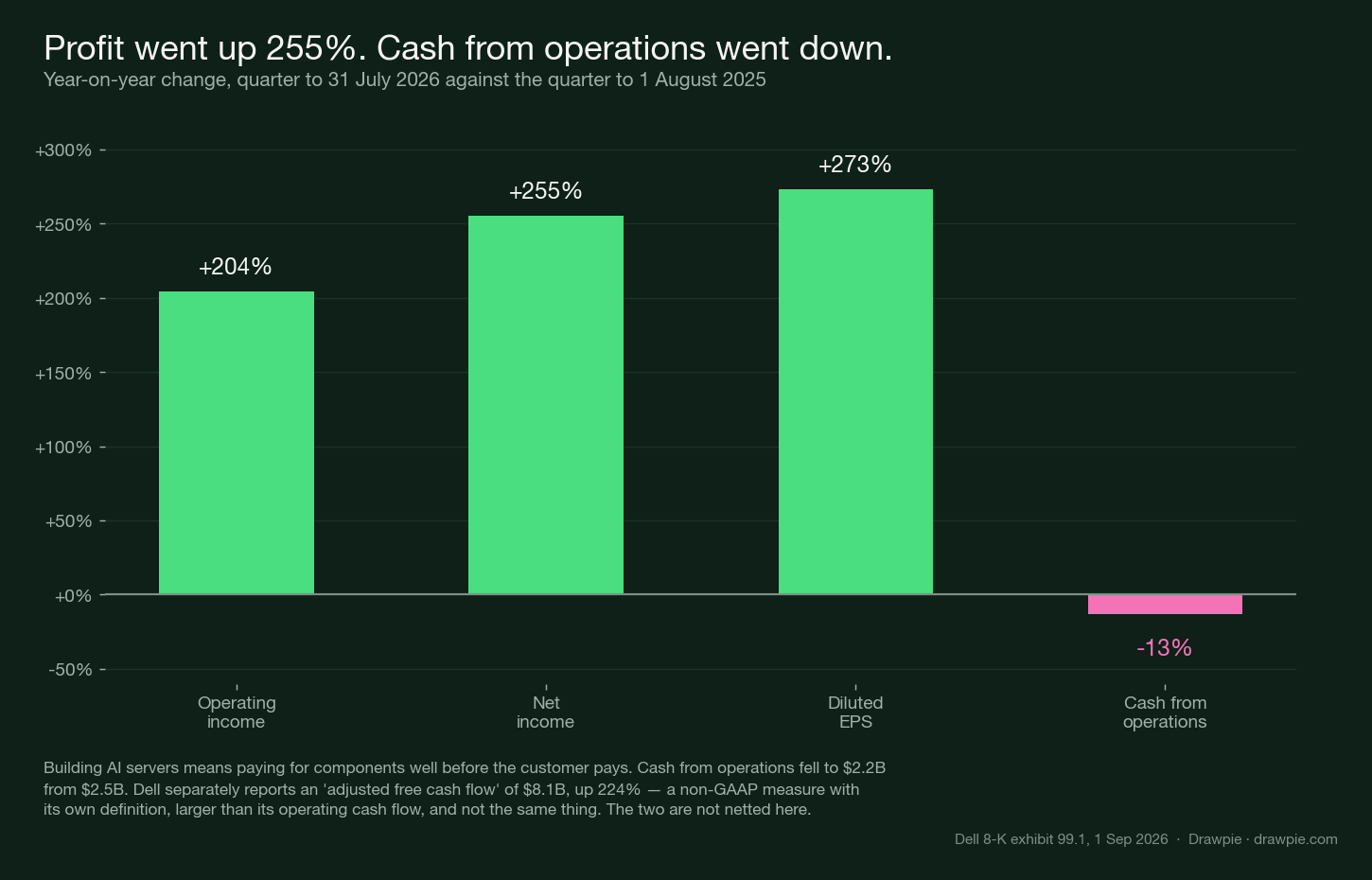
Net income rose 255%. Diluted EPS rose 273%. Cash from operations fell 13%, to $2.2 billion from $2.5 billion.
That divergence is not an accounting oddity, it is the physical shape of the business. To ship an AI server you buy the GPUs and the memory first, hold them as inventory, build the rack, deliver it, and then wait to be paid. Growing that business quickly consumes working capital, and it consumes more the faster you grow.
A caution on which cash number you read. Dell also reports “adjusted free cash flow” of $8.1 billion, up 224%. That figure is larger than its operating cash flow, which is unusual on its face; it is a non-GAAP measure with its own definition, set out in Dell’s release, and it is not the same quantity as cash from operations. This page reports both and does not net one against the other.
What Dell told investors to expect
This is the company’s own outlook for its own business, quoted as such.
| Previous | Updated | |
|---|---|---|
| FY27 revenue | $167.0bn | $192.0bn (+69%) |
| FY27 AI server revenue | $60.0bn | $74.0bn (+200%) |
| FY27 GAAP EPS | $17.31 | $24.37 |
| FY27 non-GAAP EPS | $17.90 | $25.50 |
Third-quarter guidance is revenue of $49.0 billion, up 81%.
A $25 billion raise to a full-year revenue outlook, mid-year, is a large move. CFO David Kennedy tied it directly to the order book:
With AI momentum accelerating and our opportunity expanding across the portfolio, we’re raising our full-year FY27 revenue outlook by $25 billion to $192 billion, up nearly 70% year over year.
Dell also returned a record $4.3 billion to shareholders in the quarter and declared a quarterly dividend of $0.63 a share, payable 30 October.
What this means for the business
Three things follow from the filing, and one important thing does not.
It follows that demand is real and contracted. A $95 billion backlog is not a sentiment survey; it is orders. And it grew despite record shipments.
It follows that this is a working-capital business now. Whatever else the AI build-out does to Dell, it consumes cash to grow. That is visible in the one negative number on the page.
It follows that the non-AI business is healthier than its reputation. Traditional servers grew faster than AI servers; PCs grew 20%.
What does not follow is anything about durability, and that is the gap worth naming. Dell discloses no customer concentration for the AI business: no customer is named, no share of the $60.9 billion of orders is attributed, and there is no schedule for how the $95 billion converts. A backlog built on a handful of hyperscalers behaves very differently from the same number spread across hundreds of enterprises — and from outside the filing, you cannot tell which one this is.
How big is Dell’s AI server backlog?
$95 billion at the end of the quarter on 31 July 2026, which Dell describes as a record.
For scale, that is larger than the $74 billion of AI server revenue Dell now guides to for the whole of fiscal 2027, and roughly twice the company’s total revenue in the quarter just reported. Dell does not disclose how much of it converts in which period.
Why did Dell’s backlog grow if it shipped a record quarter?
Because it took orders about 3.7 times faster than it shipped.
Dell recognised $16.4 billion of AI server revenue and booked $60.9 billion of new orders in the same three months. Backlog is what is sold but not yet delivered, so it rises whenever orders outrun shipments — which is what happened, by a wide margin, even though the shipments themselves set a record.
Are AI servers lower margin for Dell?
Dell does not disclose margin on AI-optimized servers separately, so the honest answer is that it cannot be read directly from the filing.
What can be read is that group gross margin rose to 20.9% from 18.3%, and that the whole infrastructure segment’s operating margin went from 8.8% to 15.0%, in a quarter when AI server revenue doubled. That is not consistent with AI volume dragging margins down. But over six months the group gross margin is flat at 19.4% versus 19.5%, so one quarter should not be read as a change in the structure.
The bottom line
Dell sold $60.9 billion of AI servers in three months, delivered $16.4 billion, and is sitting on $95 billion of orders it has not yet filled — more than the full year it is guiding to. It raised that full-year outlook by $25 billion on the strength of it.
The two things the filing shows that the headline numbers do not: the ordinary server business grew faster than the AI one, and the cash conversion went backwards while profit tripled.
The thing the filing does not show at all is who is placing the orders.
Important information
This article is for informational and educational purposes only. It is not investment, financial, legal, or tax advice, and is not a recommendation, offer, or solicitation to buy, sell, or hold any security.
It contains no share-price forecast, no price target and no rating, for Dell Technologies or anything else, and quotes no analyst estimate. Where guidance is quoted it is the company’s own published outlook for its own business, attributed as such.
Figures are as reported for the quarter ended 31 July 2026 and will be superseded by Dell’s next results. Past performance does not guarantee future results.
The author is not a licensed financial adviser or broker-dealer. Do your own research and consult a qualified, licensed financial professional before making any investment decision. Financial data via SEC EDGAR.