Defence Pacts: Who Will Actually Fight for Whom?
Update log (1)
- — Written five days after the trilateral Mecca agreement of 7 August 2026 and while the US-Iran memorandum signed on 17 June remains in an implementation phase. Nothing here forecasts what any government does next; the position described is the one on the public record as of this date.

- This question already has a real answer, not a predicted one. Pakistan and Saudi Arabia signed a mutual defence pact in September 2025. Saudi territory was struck by Iranian drones and missiles from February 2026. Pakistan sent fighter and support aircraft in April — and the pact was never formally invoked.
- Not one of these agreements commits anyone to fight. NATO’s Article 5, the only one whose full text you can actually read, says each ally takes ‘such action as it deems necessary’. The Pakistan-Saudi text has never been published, and the trilateral Mecca agreement carries no troop commitments or trigger conditions.
- Pakistan has been asked once before, and said no. In April 2015 Saudi Arabia requested jets, ground troops and warships for Yemen; Pakistan’s parliament voted unanimously for neutrality. The same resolution promised to ‘stand shoulder to shoulder’ if Saudi territory or the holy sites were threatened — which is the condition that was actually met in 2026.
- The nuclear question is unresolved on purpose. Pakistan’s defence minister told Geo TV the country’s capabilities would be available to Saudi Arabia, then told Reuters nuclear weapons were ’not on the radar’. A Saudi official asked directly said only that the pact covers ‘all military means’.
The honest answer is that this question has already been tested, and the result is on the record. Pakistan and Saudi Arabia signed a mutual defence pact in September 2025. Five months later Saudi territory was under Iranian drone and missile attack. In April 2026 Pakistan flew fighter and support aircraft into the kingdom.
And the pact was never formally invoked. Pakistan did not enter the war.
So this article does not predict who fights for whom. It sets out what the agreements actually say, what happened when one of them was tested, and what the same countries did the last time the question came up.
What does the Pakistan-Saudi defence pact actually say?
In public, one sentence: any aggression against either country shall be considered aggression against both. That wording comes from the joint statement issued around the signing at Al-Yamamah Palace in Riyadh on 17 September 2025, by Saudi Crown Prince Mohammed bin Salman and Pakistani Prime Minister Shehbaz Sharif.
Everything past that sentence is not public. The agreement’s full text has never been released.
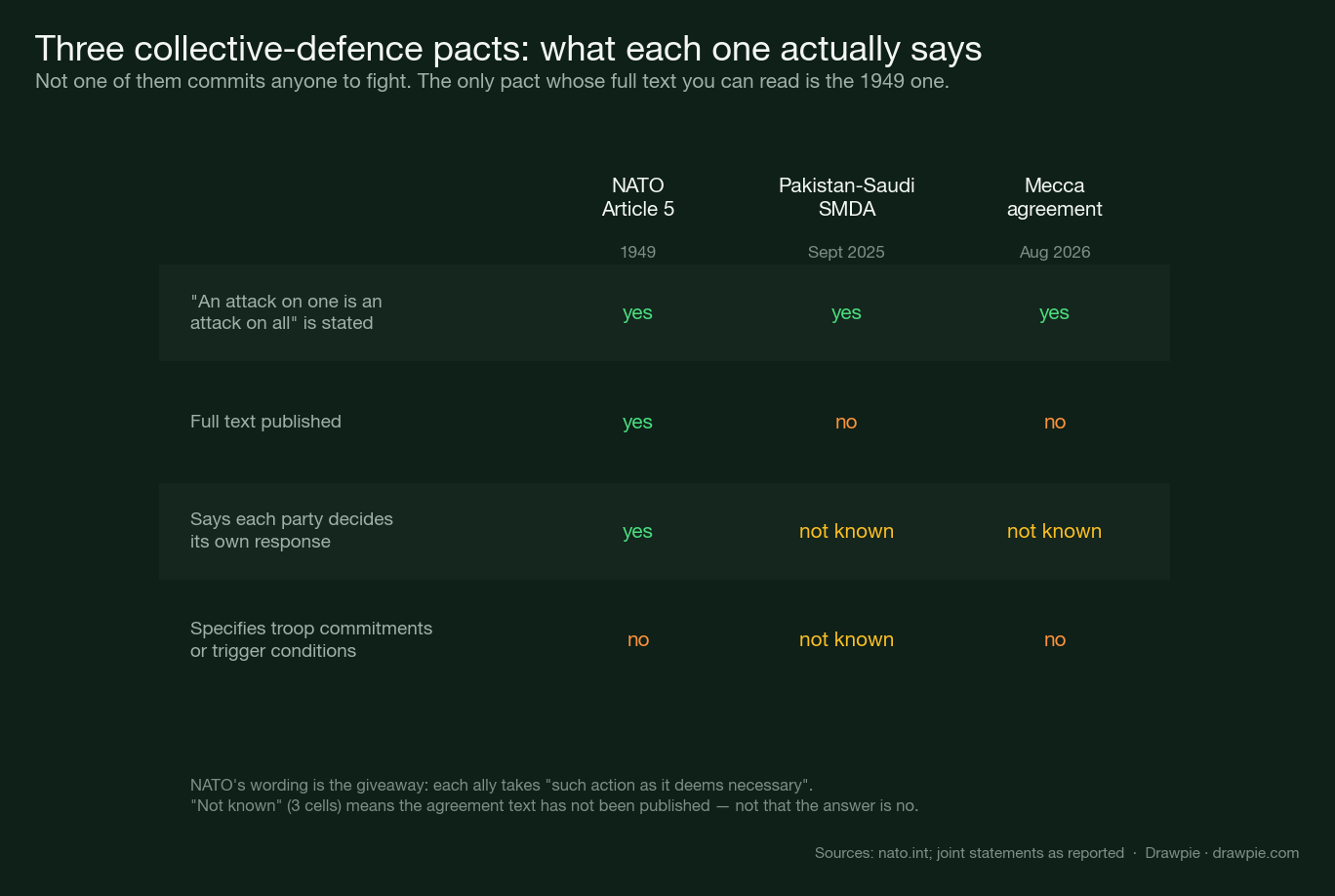
| Pact | Signed | Full text public |
|---|---|---|
| NATO Article 5 | 1949 | Yes |
| Pakistan-Saudi | Sept 2025 | No |
| Mecca | Aug 2026 | No |
That comparison is worth sitting with, because the oldest and most famous collective-defence clause in the world is also the one that promises the least automatically.
NATO’s Article 5 does not commit anyone to war. Its actual text says each party will assist the attacked party “by taking forthwith, individually and in concert with the other Parties, such action as it deems necessary, including the use of armed force”. The phrase that does the work is as it deems necessary — the decision stays with each capital.
If the most institutionalised alliance on earth writes its obligation that way, a two-page joint statement is not a stronger guarantee. It is a weaker one, and an unpublished weaker one.
Has the pact ever been invoked?
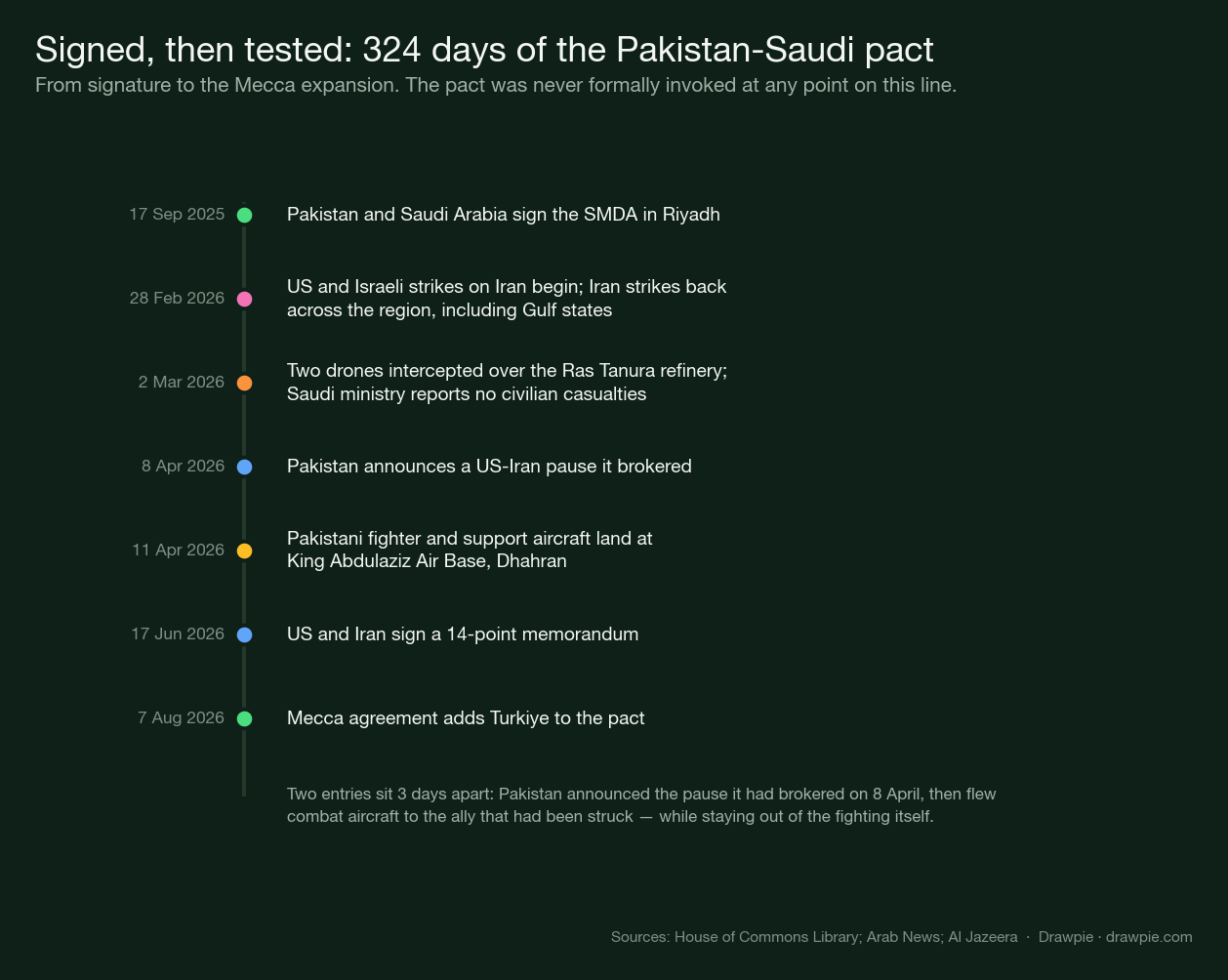
No. Not in the 324 days between the signing and the trilateral agreement that followed it, and not during the period when Saudi Arabia was being struck.
| Date | What happened |
|---|---|
| 17 Sep 2025 | Pact signed |
| 28 Feb 2026 | Strikes on Iran begin |
| 8 Apr 2026 | Pakistan brokers pause |
| 11 Apr 2026 | Pakistani aircraft arrive |
| 7 Aug 2026 | Mecca agreement |
The two April entries are three days apart, and the order of them is the story. On 8 April, Pakistan announced that the United States and Iran had agreed a two-week pause — a pause Pakistan itself had brokered. On 11 April, Pakistani aircraft landed at King Abdulaziz Air Base in Dhahran.
The same government was mediating the war and reinforcing an ally inside it, in the same week.
Did Pakistan fight for Saudi Arabia?
No. It deployed aircraft and it stayed out of the fighting. Saudi Arabia’s defence ministry said a Pakistani force of fighter and support aircraft had arrived at King Abdulaziz Air Base, and framed the purpose as strengthening joint defence cooperation and raising operational readiness.
It did not say the mutual defence agreement had been triggered. Al Jazeera reported that the pact was not formally invoked.
The analysts quoted at the time read the move as signalling rather than combat power. One, Imtiaz Gul, put it bluntly: “Three jets won’t make much of a difference militarily.” Another, Michael Kugelman, called it “a bit of a risky gambit” aimed at telling Iran that escalation would pull Pakistan and Saudi Arabia closer together.
Pakistan’s own position through the war was neutrality, and it applied that in both directions — its foreign ministry condemned the attacks on Iran and the attacks on the Gulf states.
What happened when Saudi Arabia asked in 2015?
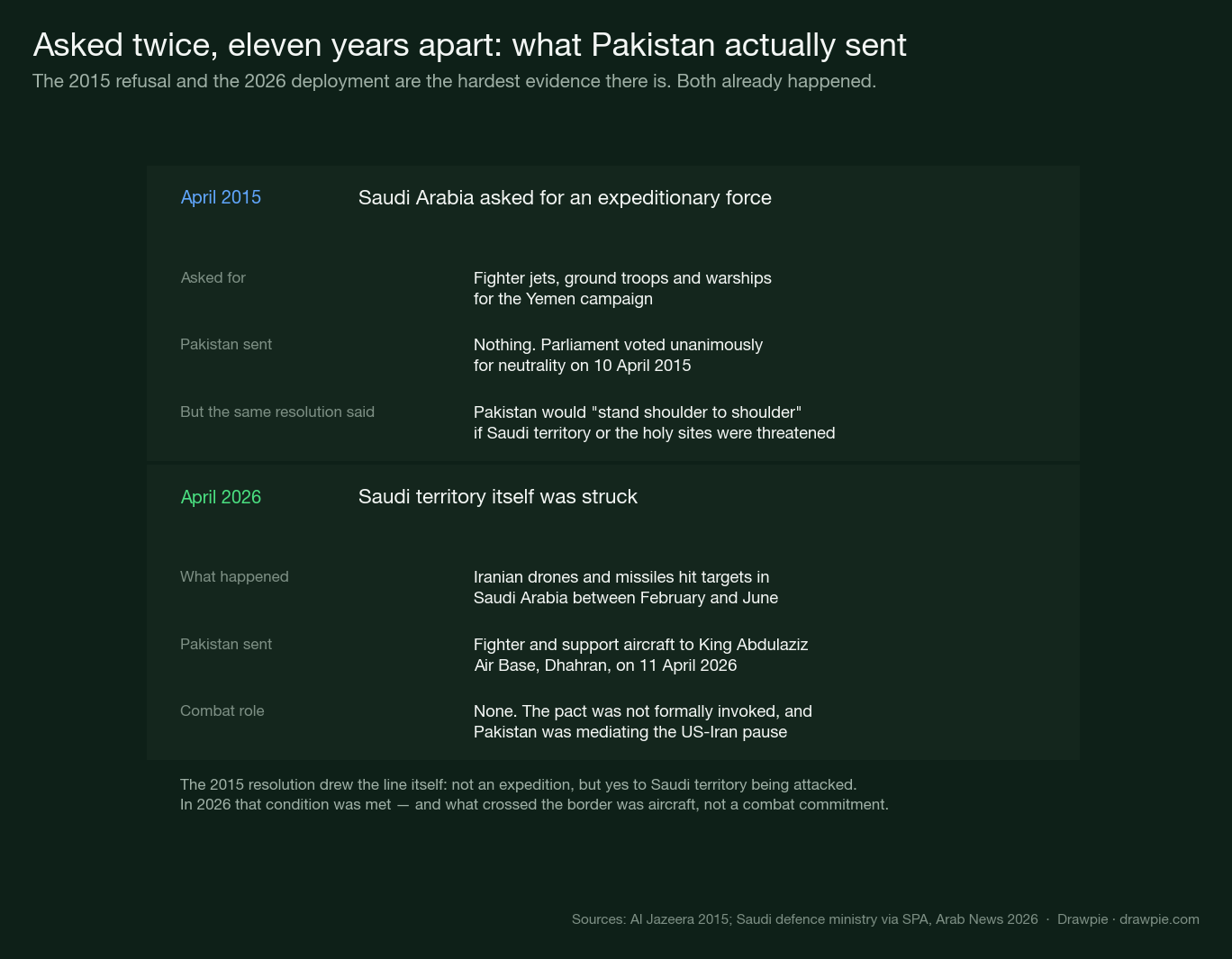
Saudi Arabia asked for a full expeditionary force, and Pakistan’s parliament voted unanimously to refuse. This is the precedent that matters most, because it is the only time the question has been put to Pakistan’s legislature directly.
| Year | Asked for | Sent |
|---|---|---|
| 2015 | Jets, troops, ships | Nothing |
| 2026 | Not a public request | Aircraft |
In April 2015, Riyadh wanted fighter jets, ground troops and warships for the campaign in Yemen. After five days of debate, Pakistan’s parliament passed a resolution on 10 April stating that Pakistan should maintain neutrality.
But the same resolution drew a line it was willing to cross. It said Pakistan would “stand shoulder to shoulder” with Saudi Arabia if the kingdom’s territorial integrity was violated, or if the holy sites in Mecca and Medina were threatened.
That is not a small detail. It is the clearest statement anyone has of the condition under which Pakistan says it would act — written down eleven years ago, by the body that would have to approve it.
And in 2026 that condition was met. Saudi territory was struck. What crossed the border in response was aircraft on a readiness deployment, not a combat commitment.
Both halves of that are worth holding at once: Pakistan did more than it did in 2015, and it still did not go to war.
Does the pact cover nuclear weapons?
Nobody outside the two governments knows, and their own officials have said opposite things. This is the part of the story that generated the most coverage and the least clarity.
On 18 September 2025, the day after signing, Pakistan’s defence minister Khawaja Asif told Geo TV that the country’s capabilities would be available to Saudi Arabia: “What we have, and the capabilities we possess, will be made available to (Saudi Arabia) according to this agreement.”
Asif later told Reuters that nuclear weapons were “not on the radar” of the pact.
Asked directly by Reuters whether the agreement obliged Pakistan to extend a nuclear umbrella, a senior Saudi official said it was a comprehensive defensive agreement encompassing all military means — language that confirms nothing and denies nothing.
The most useful outside assessment came from Rabia Akhtar at the Belfer Center, published the day after the signing. Her conclusion: “the nuclear umbrella idea remains speculative, a dramatic extrapolation unsupported by the actual text of the pact or Pakistan’s stated doctrine.” She notes that nowhere does the public agreement mention nuclear weapons, and makes the general point this whole article rests on — “signaling solidarity is not the same as issuing a blank check of military intervention.”
She also supplies a second precedent: Pakistan’s earlier defence arrangements with the United States, and through SEATO and CENTO, did not produce automatic military intervention either.
What does the Mecca agreement change?
It adds Türkiye and repeats the same formula, with the same silences. On 7 August 2026 in Mecca, Erdoğan, Mohammed bin Salman and Shehbaz Sharif signed a trilateral pact stating that any armed attack against any one of the three states shall be regarded as an attack against them all.
What it does not contain is the interesting part: no specified military obligations, no troop commitments, no trigger conditions. A Turkish official described it as purely defensive and not directed at any particular country.
The reaction from Tehran was not the one the framing would suggest. Iran’s foreign minister Abbas Araghchi posted that it was “Time to rely only on ourselves and embrace true brotherhood”, without naming the agreement. A foreign ministry official, Hossein Noushabadi, told ISNA it represented “the beginning of the collapse of US security hegemony in West Asia”. The three signatories have stressed the pact is not targeted at any country, Iran included.
India said it was watching for its own interests and sensitivities.
So who will actually fight for whom?
On the evidence available, nobody has yet agreed to fight for anybody — and the one time it was tested, nobody did. That is not a cynical reading. It is what collective-defence clauses have always been.
Three things are established and none of them is a forecast:
- The texts do not compel war. NATO’s says each ally decides for itself; the other two do not say, because they have not been published.
- The tested case produced a deployment, not a combat role. Aircraft moved, the pact stayed dormant, and the deploying country spent that same week mediating.
- The one written condition anyone has stated is territorial. Pakistan’s parliament said in 2015 it would stand with Saudi Arabia over Saudi territory and the holy sites — not over expeditions abroad.
What is genuinely unknown is also worth stating plainly: the full text of both recent agreements, whether either contains a nuclear provision, what would count as the threshold for invoking them, and what any government would do in a case more severe than the one that has already occurred.
Anyone offering you a confident answer to those is filling in blanks that the documents leave empty.
Bottom line
A defence pact is a signal before it is a commitment, and these signals are unusually quiet ones — two of the three cannot even be read.
The most informative fact in this whole story is not in any treaty. It is that in April 2026, with its ally under fire and a mutual defence agreement in hand, Pakistan flew aircraft to Dhahran, brokered a ceasefire three days earlier, and declined to join the war. For a comparable case of a future-tense question answered with what is already on the record, our piece on the search for an off-ramp from the same war covers the reported shape of a decision rather than a guess at it.
Sources
Read on 12 August 2026.
| Source | What it supports here |
|---|---|
| NATO: The North Atlantic Treaty | The verbatim Article 5 wording, including “such action as it deems necessary, including the use of armed force”, and the 1949 date |
| Al Jazeera: Pakistan sends fighter jets to Saudi Arabia (11 Apr 2026) | That the pact was not formally invoked, the fighter and support aircraft description, and the Imtiaz Gul and Michael Kugelman quotes |
| Arab News: Saudi defence ministry on the Pakistani force at King Abdulaziz Air Base | The Saudi defence ministry statement via SPA — the arrival at Dhahran, the “fighter and support aircraft” composition, the stated purpose of strengthening joint defence cooperation, and the absence of any troop figure |
| Al Jazeera: Türkiye, Saudi Arabia, Pakistan sign joint defence agreement (7 Aug 2026) | The Mecca agreement’s date, signatories and “attack on all” wording, and that it builds on the September 2025 pact |
| Al Jazeera: Where does Iran stand on the pact? (9 Aug 2026) | The Araghchi and Noushabadi quotes, the signatories’ statement that the pact targets no country, and India’s response |
| Al Jazeera: Pakistan parliament backs neutrality in Yemen (10 Apr 2015) | The unanimous 2015 vote, the Saudi request for jets, ground troops and warships, and the “stand shoulder to shoulder” caveat covering territorial integrity and the holy sites |
| House of Commons Library: US-Iran ceasefire and nuclear talks in 2026 | The 28 February start of strikes, Pakistan’s announcement of the pause on 8 April, the Pakistan-mediated talks, the 17 June 14-point memorandum, and that no official text of that memorandum has been published |
| Belfer Center: Beyond the Hype, Rabia Akhtar (18 Sept 2025) | The “speculative” assessment of the nuclear-umbrella reading, that the public agreement does not mention nuclear weapons, the “blank check” formulation, and the SEATO/CENTO precedent |
| The Times of Israel: Pakistan says its nuclear program available to Saudi Arabia | Khawaja Asif’s 18 September 2025 Geo TV quote in full |
| The Jerusalem Post: Iranian drones and the Ras Tanura refinery (2 Mar 2026) | The Saudi defence ministry spokesperson’s statement that two drones were intercepted, that debris caused a limited fire, and that there were no injuries |
How we verified this
🚫 This article contains no prediction and no betting or prediction-market price. The headline question is a future-tense one, and it is answered here only with what has already happened and what the published texts say. No forecast of any government’s future conduct appears, and nothing from a bookmaker or prediction market is used.
🔴 The single most important fact about the Pakistan-Saudi agreement is that its full text has not been published. What exists in public is a joint-statement sentence, reported consistently across outlets: any aggression against either country shall be considered aggression against both. Everything else about its terms — triggers, obligations, force commitments, duration — is not on the public record. This article therefore describes what the agreement is reported to state and marks everything else as unknown rather than inferring it. The same is true of the 7 August 2026 Mecca agreement, and, as the House of Commons Library notes, of the 14-point US-Iran memorandum signed on 17 June.
🔴 A widely circulated figure of 13,000 Pakistani troops is not used here. That number appears on social posts and aggregator sites. It does not appear in the Saudi defence ministry’s own statement on the deployment, which describes “fighter and support aircraft” and gives no personnel count, nor in the Al Jazeera or Arab News reporting of that day. One analyst quoted at the time referred to “three jets” — a figure three orders of magnitude away from 13,000. With the official statement silent and the reporting inconsistent, no troop number is printed in this article.
The deployment is described as reported, not as an invocation. Saudi Arabia’s defence ministry said a Pakistani force had arrived at King Abdulaziz Air Base to strengthen joint defence cooperation and raise operational readiness. It did not describe the mutual defence agreement as having been triggered, and Al Jazeera reported explicitly that the pact was not formally invoked. Those are two different claims and this article keeps them apart.
The nuclear section reports a contradiction rather than resolving it. Pakistan’s defence minister said one thing to Geo TV on 18 September 2025 and another to Reuters; a senior Saudi official, asked directly, used language that neither confirmed nor denied. The Belfer Center analysis by Rabia Akhtar, published the day after the signing, concludes the nuclear-umbrella reading is “speculative”. This article quotes all of those positions and does not pick a winner, because the underlying document is not public.
⚠️ Pakistan’s foreign ministry site could not be reached from this connection, returning a refused connection to a command-line request and a failed navigation in a browser. The joint-statement wording is therefore carried as reported by multiple outlets rather than read on the ministry’s own page, and is described that way in the sources table.
Two of the ten sources refused command-line requests and were read another way. The House of Commons Library briefing returns HTTP 403 to a plain request — and so does a fabricated control URL on the same host, which means that channel cannot tell a real page from a missing one. It was read in full in a browser instead. The Times of Israel page also returned 403 to the command line and was read through a fetch tool. The other eight sources were checked by status code against fabricated control URLs on the same hosts; every control returned 404 while every cited page returned 200.
Spelling note: this article uses “defence” throughout because that is the spelling in the agreements’ own names — the Strategic Mutual Defence Agreement and the Mecca Joint Defence Agreement.
No judgement is offered about the conduct or legitimacy of any party to the 2026 war. The war appears here only where it is the mechanism testing these agreements. Casualty figures are not compiled, and the only one cited is a Saudi defence ministry statement that a specific strike caused no injuries.