Dan Caine's Off-Ramp From the 2026 Iran War: What It Takes

- No plan called an off-ramp has been reported. What has been reported is its shape: something that gives the president a win he can sell, does not foreclose diplomacy, and starts with an agreement to reopen the Strait of Hormuz. Everything else is inference from constraints.
- Gen. Dan Caine’s argument is not that the war is wrong. It is that airpower alone will not deliver the stated objective and the munitions are running down — the same argument that has already changed two decisions.
- One off-ramp has already been tried. The Islamabad Memorandum of 17 June suspended hostilities for 60 days; the president declared it over 21 days later, on 8 July.
On 7 August 2026, CNN reported that Gen. Dan Caine, chairman of the Joint Chiefs of Staff, has been telling other senior Trump administration officials that the United States needs to find a way out of its war with Iran. One source summed it up in seven words: “Caine is looking for an off ramp.”
The war has been running since 28 February and is now in its sixth month. It has already produced one negotiated pause that collapsed after three weeks. So the question is not whether an off-ramp is conceivable — one has been signed once already — but what a second one would have to contain, and what has changed since the first one failed.
What follows separates three things that are easy to blur: what Caine has said in public, what unnamed sources say he has said in private, and what can be measured.
What is Dan Caine’s off-ramp from the Iran war?
No plan has been reported. What has been reported is the shape of one. According to CNN, the focus among Caine and like-minded officials is on finding an exit that gives the president a win he can present to the American public — “symbolic” at minimum — without closing off a diplomatic breakthrough, and that it starts with an agreement to reopen the Strait of Hormuz.
That single sentence carries most of the answer, and it is worth taking apart.
It starts at the strait, not at the nuclear programme. The stated war aim has been preventing Iran from obtaining a nuclear weapon. The off-ramp being described begins somewhere else entirely — with the waterway that carried roughly a quarter of the world’s seaborne oil trade and a fifth of its liquefied natural gas before the war, and which Iran has largely blocked since the first day of it. That is a tell about sequencing: the thing that can be traded first is the thing hurting everyone fastest.
It has to be sellable, not necessarily large. The word reported is “symbolic”. An off-ramp of this kind is not a victory condition; it is a deliverable the president can stand behind while talks continue.
It has to leave the door open. The explicit constraint is that whatever is agreed must not prevent a later diplomatic settlement — which rules out the more punitive options precisely because they would harden Tehran’s position.
Beyond that, nothing has been reported: no timetable, no terms, no indication that the president has accepted the premise. Anyone offering you a five-point Caine plan is writing it themselves.
Who is Dan Caine, and why does his view carry weight?
He is the president’s most senior military adviser, and he is the officer who helped make the case that this war was viable. That second part is what makes the reporting significant rather than routine.
John Daniel “Razin” Caine, 57, is a career Air Force F-16 pilot with around 2,800 flight hours and 150 combat hours, two tours in Iraq, and a stint as the CIA’s associate director for military affairs. He left the service at the end of 2024 and went into venture capital. Trump nominated him anyway, which required a waiver: the law normally reserves the chairmanship for officers who have served as a combatant commander, a service chief or vice chairman, and Caine had done none of those. The Senate confirmed him 60–25 on 11 April 2025, and he was sworn in three days later — the first chairman never to have held a four-star rank before taking the job.
In February 2026, in the run-up to the war, Caine warned the president about the risks of a prolonged conflict — an account Trump later denied. He was also, by the same reporting, the only military leader briefing Trump on Iran, and he helped convince him the war was viable, after conversations with the Israeli chief of staff, Lt. Gen. Eyal Zamir, who made the case to him and to Central Command’s Adm. Brad Cooper.
At the 12 February meeting between Trump and Benjamin Netanyahu, the Israeli prime minister presented a four-step plan. Caine and Cooper backed the first two steps — the strike that killed Supreme Leader Ali Khamenei, and strikes on Iran’s ballistic missile and drone programmes — and were more hesitant about the last two, which aimed at fomenting an uprising and pursuing regime change. Caine kept the American share of the campaign pointed at military capability and never publicly endorsed regime change, even as the president called for it repeatedly.
One detail from that period matters more than any other for the present moment: neither Caine nor Cooper gave the president much information about the possibility that Iran would close the Strait of Hormuz. The variable that now defines the war, and that the reported off-ramp starts with, is the one that was not on the table when the decision was made.
What has Caine said on the record?
Four words, in public, on 21 July: airpower has its limits. He said it to senators, and CNN reports that a good part of the administration’s national security leadership now agrees with it.
That is the entire on-the-record basis for the story. Everything else attributed to Caine in the reporting is from unnamed sources. It is worth being precise about what each side has actually put its name to.
| Who | On the record |
|---|---|
| Caine, 21 July | In testimony: “airpower has its limits”. He has otherwise avoided direct questions about US strategy in the war, including at hearings in May. |
| Spokesperson | Joseph Holstead declines to discuss the chairman’s confidential conversations, and rejects “anonymous, agenda-driven characterizations” of them by people who were not present. Does not deny that Caine holds the views described. |
| White House | An official calls Caine “an incredible asset”, cites the named operations as successes, and says he supplies unbiased options while the president decides. Does not address whether an off-ramp is being sought. |
| State Dept, CIA | Declined to comment. |
Two things follow. First, nobody has denied the substance. Second, the denial that was issued attacks the sourcing rather than the claim, which is a narrower move than it looks.
Why is bombing not a way out?
Because the reported assessment is that the remaining military options either cannot achieve the objective or would cost more than they gain — and the munitions to sustain them are running down. This is the argument, not a judgment about whether the war should have been fought.
The constraints reported are specific.
| Constraint | What has been reported |
|---|---|
| Airpower’s ceiling | Caine’s public position, and the private one attributed to him, is that bombing alone is unlikely to deliver the president’s stated objectives at this stage |
| Munitions | Senior commanders consider the stockpile “dangerously low”; Gulf partners have told Washington that a shortage of high-end air defences would limit their ability to absorb Iranian retaliation |
| Target exhaustion | One source characterised the remaining military target set as diminishing returns against dispersed drone and missile sites |
| Escalation against infrastructure | Repeatedly threatened; sources describe it as unlikely to force capitulation, likely to draw retaliation against Gulf energy infrastructure, and likely to turn Iranian public opinion against the US rather than the government |
| Ground troops | Widely assessed inside and outside the administration as the only decisive option, at a potential cost of thousands of American lives. Plans exist. Nobody in the administration is arguing for it |
| Allied appetite | Trump stood down a planned escalation in late July after Middle Eastern allies told him they feared retaliation against their energy infrastructure |
The last line is the important one, because it shows the mechanism actually working: the constraint that stopped an operation was not a military argument at all. It was allies saying they would take the return fire.
Money is the other measurable pressure. On 21 July, Defense Secretary Pete Hegseth told Congress the war had cost about $37.5bn so far and asked for roughly $67bn more for Middle East operations.
What has already been tried, and how long did it hold?
A full off-ramp was signed on 17 June and declared over on 8 July — it held 21 days. That is the single most useful data point for anyone trying to guess what comes next, because it establishes both that a deal is reachable and what happens to one.
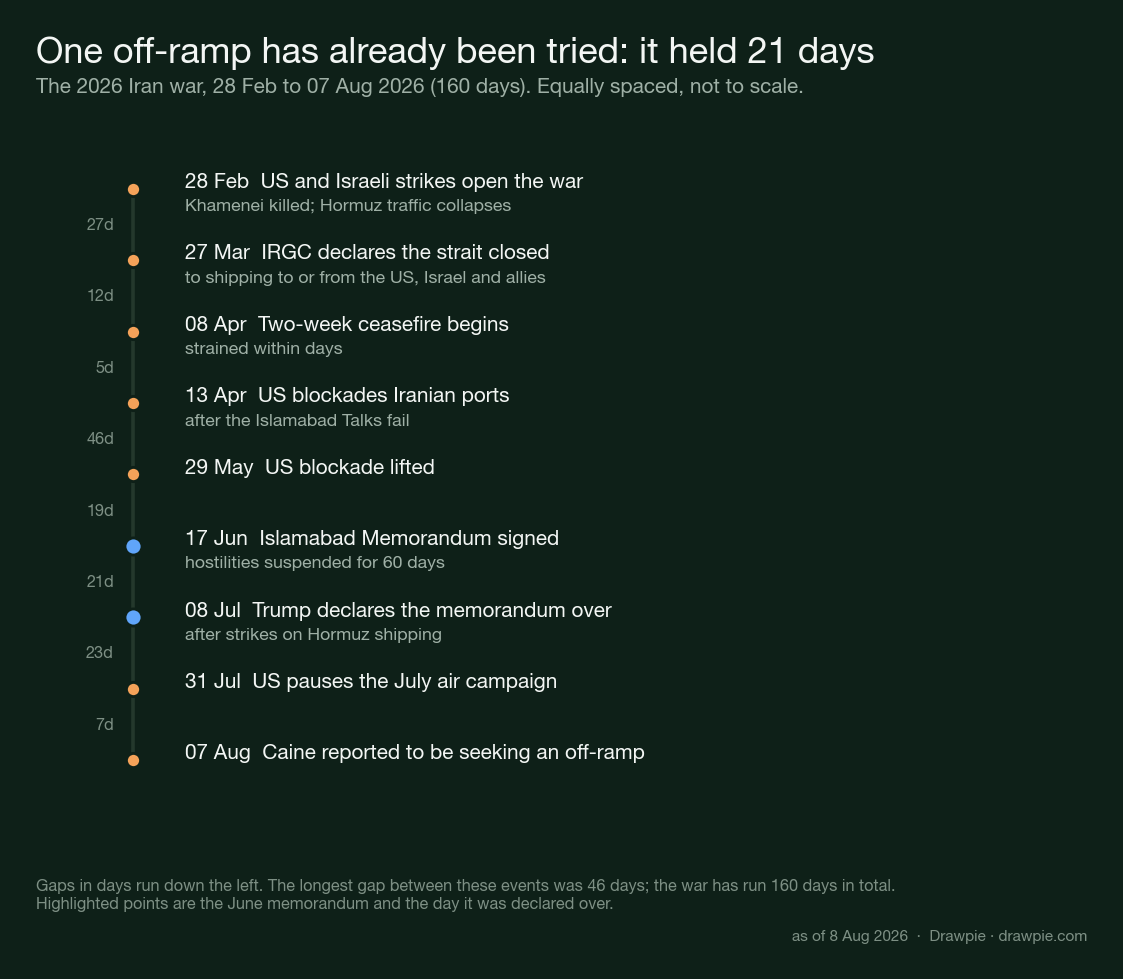
| Date | Event |
|---|---|
| 28 Feb | US and Israeli strikes open the war; Khamenei killed; Hormuz traffic collapses |
| 27 Mar | IRGC declares the strait closed to shipping to or from the US, Israel and their allies |
| 8 Apr | Two-week ceasefire begins, and is strained within days |
| 13 Apr | US blockades Iranian ports after the Islamabad Talks fail |
| 29 May | US blockade lifted |
| 17 Jun | Islamabad Memorandum signed; hostilities suspended for 60 days |
| 8 Jul | President declares the memorandum over after strikes on Hormuz shipping |
| 31 Jul | US pauses the July air campaign |
| 7 Aug | Caine reported to be seeking an off-ramp |
The June memorandum was signed after the administration concluded that continuing risked economic damage it did not want. It committed both sides to suspend hostilities for 60 days and to build a framework for a permanent settlement involving significant American financial and political concessions. Reaction among American foreign policy figures was harsh — the deal was widely described as a defeat, with critics pointing to the survival of the Iranian government, Iran’s retention of its missile arsenal, the deferral of the nuclear question and the commitment not to interfere in Iran’s internal affairs.
It came apart over the ambiguity in its own text. On 7 July, Iran struck three tankers in the southern strait. Washington called that a violation; Tehran pointed to the memorandum’s wording — that it would “make arrangements” — and said it was not. The next day the president declared the deal over.
The lesson for a second off-ramp is not that deals are impossible. It is that vague language about the strait is what broke the first one, which is a reason to expect any successor to be far more specific about exactly that — and a reason it will be harder to agree.
What is the oil price telling the White House?
That the market has already priced in a settlement, and would take back a great deal if one failed. Brent’s front-month settlement closed at $83.55 on 7 August — 15% above the pre-war level, but 29% below where it peaked in March.
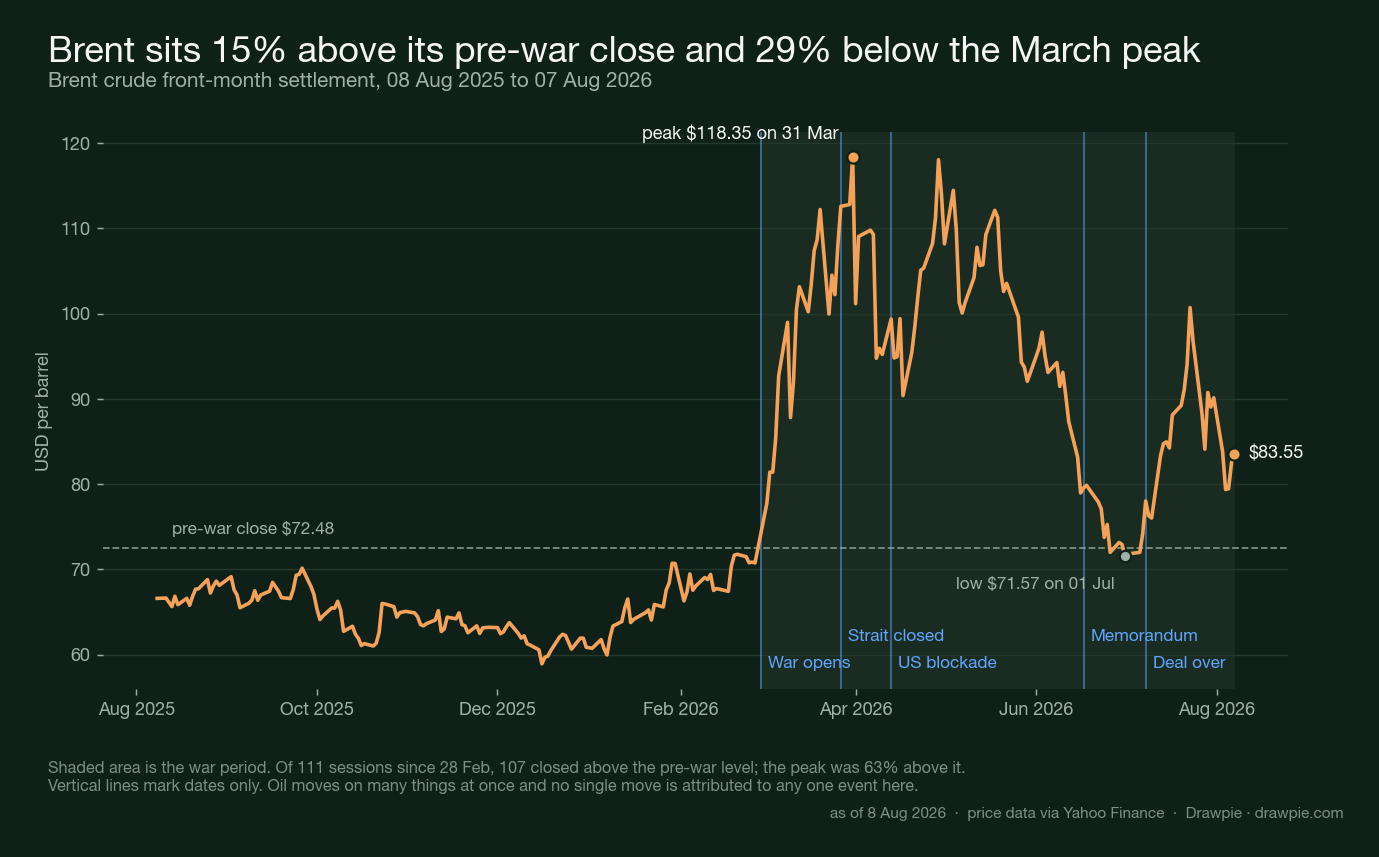
| Point | Date | Brent settlement |
|---|---|---|
| Last close before the war | 27 Feb 2026 | $72.48 |
| Peak | 31 Mar 2026 | $118.35 |
| Low since the war began | 1 Jul 2026 | $71.57 |
| Latest close | 7 Aug 2026 | $83.55 |
Of the 111 sessions since the war began, 107 have closed above the pre-war level. The peak came on 31 March, four days after the IRGC declared the strait closed, and was 63% above the pre-war close.
Read the right-hand side of that chart carefully, because it is the part that constrains everyone. Prices sat below the pre-war line in early July — after the June memorandum and before it collapsed — and have climbed roughly $12 since. The market is not pricing a war; it is pricing a war that keeps almost settling. That cuts both ways for the White House. It means the current level is tolerable, which reduces urgency. It also means the downside of a durable agreement is already partly banked, so a deal would deliver less visible economic relief than the June one did, while a decisive breakdown still has a long way to fall.
Note what the chart does not claim. The vertical lines mark dates. Oil moves on inventories, OPEC decisions, demand and a dozen other things at once, and no single move here is attributed to any single event.
Has Caine’s advice changed a decision before?
Twice, and both times the argument was about ammunition rather than about whether the war was right. This is the most concrete thing in the whole story, because it is a pattern with outcomes attached rather than a characterisation of someone’s views.
In May 2025, during the American air campaign against the Houthis in Yemen, Caine privately raised concerns that extending it would strain assets he considered necessary elsewhere. Trump declared victory and stopped shortly afterwards.
In late July 2026, during the two-week campaign in southern Iran, Caine warned the president that a shortage of air-defence interceptors could leave American forces exposed to Iranian retaliation. The air campaign was paused at the end of the month.
The shape of the argument is identical both times, and it is not moral. It is a supply argument that lets a commander-in-chief stop without conceding anything about the merits. If you want to know what Caine’s off-ramp looks like in practice, that is the closest available model: not a peace proposal, but a series of resource facts presented at the moment a decision is being made, each one making the next escalation harder to order.
It is also worth noting how he reportedly frames the alternative. In the same late-July White House meeting where he raised the depleted stockpile, he is described as telling the president that if the order came, American forces could inflict devastating damage. He is not arguing that the military cannot do it. He is arguing about what it would cost and what it would achieve.
What is disputed, and what is still unknown?
Quite a lot, and the gaps matter more than usual here because the entire story runs on unnamed sources.
Disputed. Caine’s office rejects the characterisation of his private conversations. The White House says he presents unbiased options and does not advocate. Assessments of his performance in the reporting run in both directions — one source says he has been pulling his punches with the president, another that he is out of his depth managing an extended conflict — and neither is verifiable from outside.
Unknown. Whether the president accepts any of it. Trump has consistently resisted ground troops while maintaining that bombing can force a deal on his terms, and he explicitly kept the late-July strike package available for a later date. Whether Iran would accept a strait-first sequence. Whether the concessions that made the June memorandum signable are still on offer after it collapsed. And whether any of the officials named as sympathetic — the vice president, the secretary of state, the CIA director — will press the case in the room.
One thing to watch that is not a leak. The June memorandum suspended hostilities for 60 days from 17 June, which would have run to mid-August. It was declared over on 8 July, but the calendar it created has not gone away: Iran’s chief negotiator said Tehran would begin imposing permanent tolls on shipping through the strait 60 days after the US Navy withdrew. Any second agreement has to deal with that clock, and it is the kind of detail that tells you whether a deal is real or a pause.
Sources
Checked on 8 August 2026.
| Source | What it supports here |
|---|---|
| CNN, 7 Aug 2026 — Trump’s top general is ’looking for an off-ramp’ from Iran war | The off-ramp reporting and its sourcing; the “symbolic win” and Strait-first sequencing; the constraint list; the late-July stood-down operation; the official responses quoted |
| The Jerusalem Post, 7 Aug 2026 — US Gen. Dan Caine looking for alternatives to military escalation | Independent write-up of the same reporting, used only to confirm how it was reported, not as separate corroboration |
| Wikipedia — Dan Caine | Biography, confirmation vote and waiver, the February 2026 advice, the four-step plan, the Yemen 2025 and late-July 2026 interventions |
| Wikipedia — 2026 Iran war | War timeline, operation names, the Islamabad Memorandum and reaction to it, the negotiator’s toll statement |
| Wikipedia — 2026 Strait of Hormuz crisis | The 27 March closure declaration, the blockade dates, the pre-war share of oil and LNG traffic |
| BBC, 21 Jul 2026 — Iran war has cost US $37.5bn so far, Hegseth says | The war cost to date and the additional request |
Brent figures are our own reading of the daily front-month settlement series via Yahoo Finance, taken to the last complete session on 7 August 2026. Every number in the chart and the table above is computed from that series.
For background on why the strait matters so much to the American side of this, our earlier piece on US crude exports and the Strait of Hormuz covers what the waterway actually carries and what can and cannot be backfilled from elsewhere.
How we verified this
Reporting. The core of this article rests on a single piece of original reporting: CNN’s 7 August 2026 story by Zachary Cohen, with Haley Britzky and Alayna Treene, which cites three sources familiar with the matter. It is not independently corroborated at the time of writing. Later write-ups elsewhere are aggregations of it, not separate reporting, and are not counted as confirmation here.
Anonymous versus on the record. Every claim about what Caine said privately comes from unnamed sources and is written that way throughout. The only Caine statements treated as established are ones he made in public testimony. The Chairman’s office disputes the characterisation of his private conversations, and that response is quoted rather than summarised.
A framing we did not adopt. One outlet headlined the same reporting as secret talks held behind the president’s back. The underlying account describes coordination with cabinet colleagues before meetings with the president, which is not the same thing, so the stronger framing is not used here.
Numbers. Brent prices are our own reading of the daily front-month settlement series to the last complete session, 7 August 2026; every figure in the chart is computed from that series rather than quoted from a report. War costs are Hegseth’s own figures given to Congress on 21 July. Dates come from the published timeline of the war and are stated as dates, not as causes.
What we did not do. We do not describe target sets, force dispositions or operational options beyond naming, as reporting has, the broad categories already under public discussion. We take no position on the war’s legality or its conduct.