ChatGPT Slips Below 50% — Why Claude's Agentic Edge Could Keep Taking Share

In May 2026, OpenAI’s ChatGPT did something it had never done before: it lost the outright majority of the AI assistant market. According to data-analytics firm Sensor Tower’s State of AI 2026 report, published in mid-June, ChatGPT’s global share of AI-assistant usage fell to 46.4%, the first time it has dropped below 50% since launching in late 2022.
It is still, by a wide margin, the most-used assistant on the planet. But the trend line is what matters — and it points toward a more competitive, multi-model market in which Anthropic’s Claude is quietly building the kind of moat that is hardest to take back.
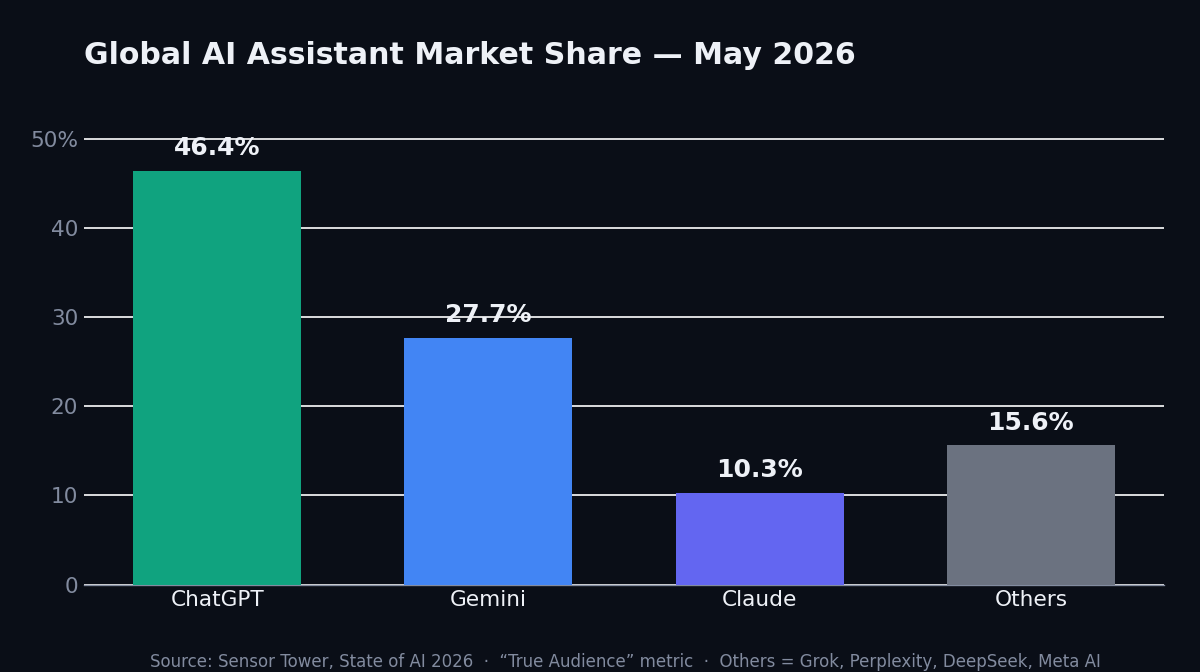
AI assistant market share, May 2026. Source: Sensor Tower, State of AI 2026.
The first crack in ChatGPT’s dominance
ChatGPT held more than half the market through January 2026. The slip began in March and accelerated through spring. By the end of May, Sensor Tower put the standings at:
- ChatGPT — 46.4%
- Gemini — 27.7%
- Claude — 10.3%
- Everyone else (Grok, Perplexity, DeepSeek, Meta AI) — under 5% each
What market share means
One caveat up front: these figures track usage — Sensor Tower’s “True Audience” measure of active users across web and mobile — not revenue or enterprise spend. By revenue the picture looks different (more on that below). But usage share is the leading indicator of mindshare, and for the first time it shows ChatGPT sharing the stage rather than owning it.
Where the share is going
Two names are absorbing most of the defectors. Gemini’s rise is powered by sheer distribution: Google has woven it into Search, Workspace, and Android, so hundreds of millions of people meet it without ever choosing to. Claude’s growth is a different story — Sensor Tower described its expansion as “explosive,” noting that Claude’s True Audience in the US has more than tripled, driven by a strong web presence and a reputation for getting real work done.
Crucially, this is an and market, not an or market. Users increasingly keep several assistants open and switch between them depending on the task — which means share can move quickly in both directions. Competition is just as sharp one layer down: on the API side, models with near-identical capability scores now sell at vastly different token prices .
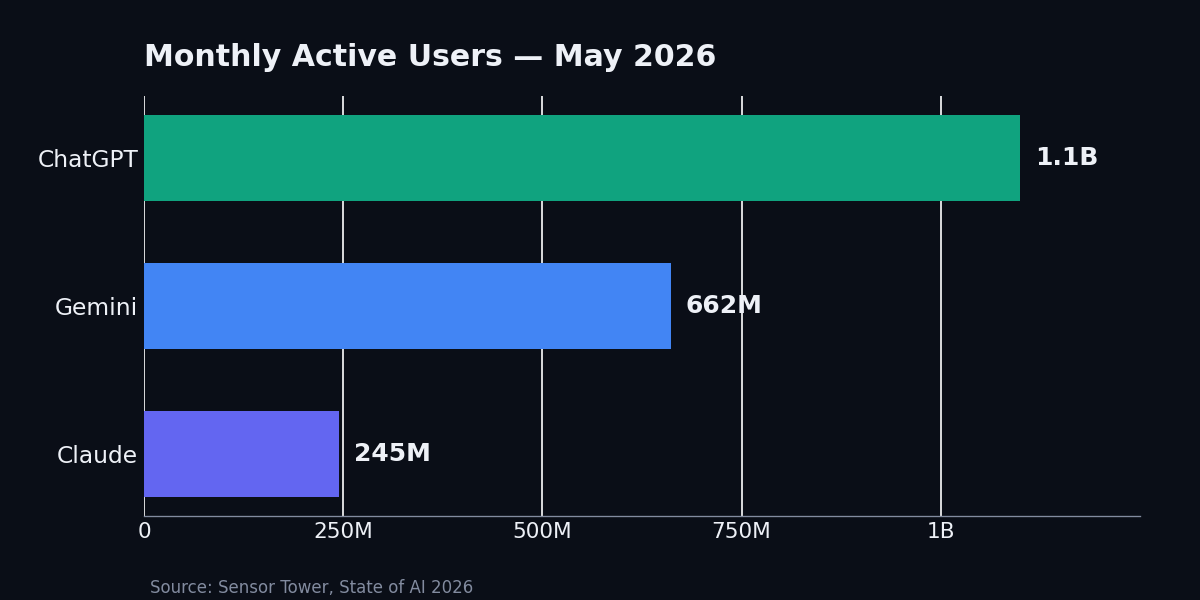
Monthly active users, May 2026. Source: Sensor Tower, State of AI 2026.
The scale gap is still enormous
Before anyone declares a changing of the guard: ChatGPT still reports more than 1.1 billion monthly users, versus 662 million for Gemini and 245 million for Claude. ChatGPT remains roughly five times Claude’s size. A dip below 50% is a milestone, not a collapse.
Why ChatGPT is leaking users
Part of the story is simple maturation — when every major lab ships a capable model, the first mover stops being the only option. But Sensor Tower also flagged something more pointed: brand trust matters. OpenAI’s February 2026 defense contract reportedly triggered a measurable spike in app uninstalls, a sign that some users weigh a provider’s values, not just its features. OpenAI has also begun showing ads inside ChatGPT, reaching a meaningful slice of daily users by May — a monetization push that can nudge power users toward cleaner alternatives.
Claude’s real edge: agents, not just chat
Here is the part the usage charts don’t fully capture. Anthropic has spent the past year reorienting Claude from a chatbot into an agent — a system that doesn’t just answer, but executes multi-step work with tools. Its agentic coding product, Claude Code, has become one of the fastest-growing software products on record; reporting puts its run-rate revenue past $2.5 billion by early 2026, with the majority coming from enterprises such as Netflix, Spotify, and Salesforce. In January 2026 Anthropic extended the same idea beyond developers with Cowork, an agent for general computing tasks like spreadsheets, files, and reports.
Enterprise is stickier than consumer
This matters because enterprise share behaves nothing like consumer share. A consumer can delete an app on a whim — which is part of why ChatGPT’s usage numbers are volatile. An enterprise contract, by contrast, gets embedded into workflows, renews annually, and requires a procurement cycle to unwind. By several estimates, the large majority of Anthropic’s revenue already comes from business and API customers. Quiet, compounding, and hard to dislodge — that is the kind of share that tends to last.
Will agents keep expanding Claude’s share?
This is where analysis takes over from data, so treat it as a view, not a forecast.
The bull case is straightforward: as work shifts from “ask a chatbot a question” to “hand an agent a task,” the winning model is the one that is most reliable at long, tool-using, multi-step jobs — and that is the exact territory where Claude has built its reputation. Industry estimates already suggest AI agents write or assist a large and rising share of production code — and the capability ceiling keeps rising in less comfortable directions too: OpenAI’s own models broke into Hugging Face during an internal hacking evaluation . If agentic usage keeps growing across coding, operations, and knowledge work, Claude’s strengths compound in the highest-value seat at the table.
The reality check
None of that is guaranteed. In raw consumer share, Gemini is currently growing faster than Claude, and Google’s distribution advantage is immense. ChatGPT is still five times larger and is now monetizing aggressively. And because users mix and match, “winning” may look less like one model taking over and more like a durable three-way race. Claude’s path to more share runs through capability and trust, not virality.
Why it matters
For anyone watching the AI platforms as a market rather than a gadget, the takeaway is that the scoreboard is changing. The metric that mattered in 2023 — raw consumer reach — is giving way to ones that are harder to game: enterprise adoption, retention, and agentic capability. ChatGPT slipping below 50% is the headline. The slower, stickier story underneath it is Claude turning agentic capability into the kind of share that doesn’t churn.
Usage figures are Sensor Tower’s “True Audience” metric for May 2026, from its “State of AI 2026” report. This article is market commentary, not investment advice.