GPT-5.6 Sol vs Claude Fable 5: Cost, Benchmarks and What the Tests Actually Show

- OpenAI’s GPT-5.6 Sol became generally available on July 9, 2026, across ChatGPT, Codex, the API and GitHub Copilot. It is the flagship of the GPT-5.6 family — there is no separate ‘mainstream’ GPT-5.6, and the bare gpt-5.6 name routes to Sol.
- On list pricing, Sol costs $5 per million input tokens and $30 per million output tokens; Claude Fable 5 costs $10 and $50. Sol’s input rate is exactly half — but its output rate is 60% of Fable 5’s, not half, which is where the common ‘half the cost’ shorthand breaks down.
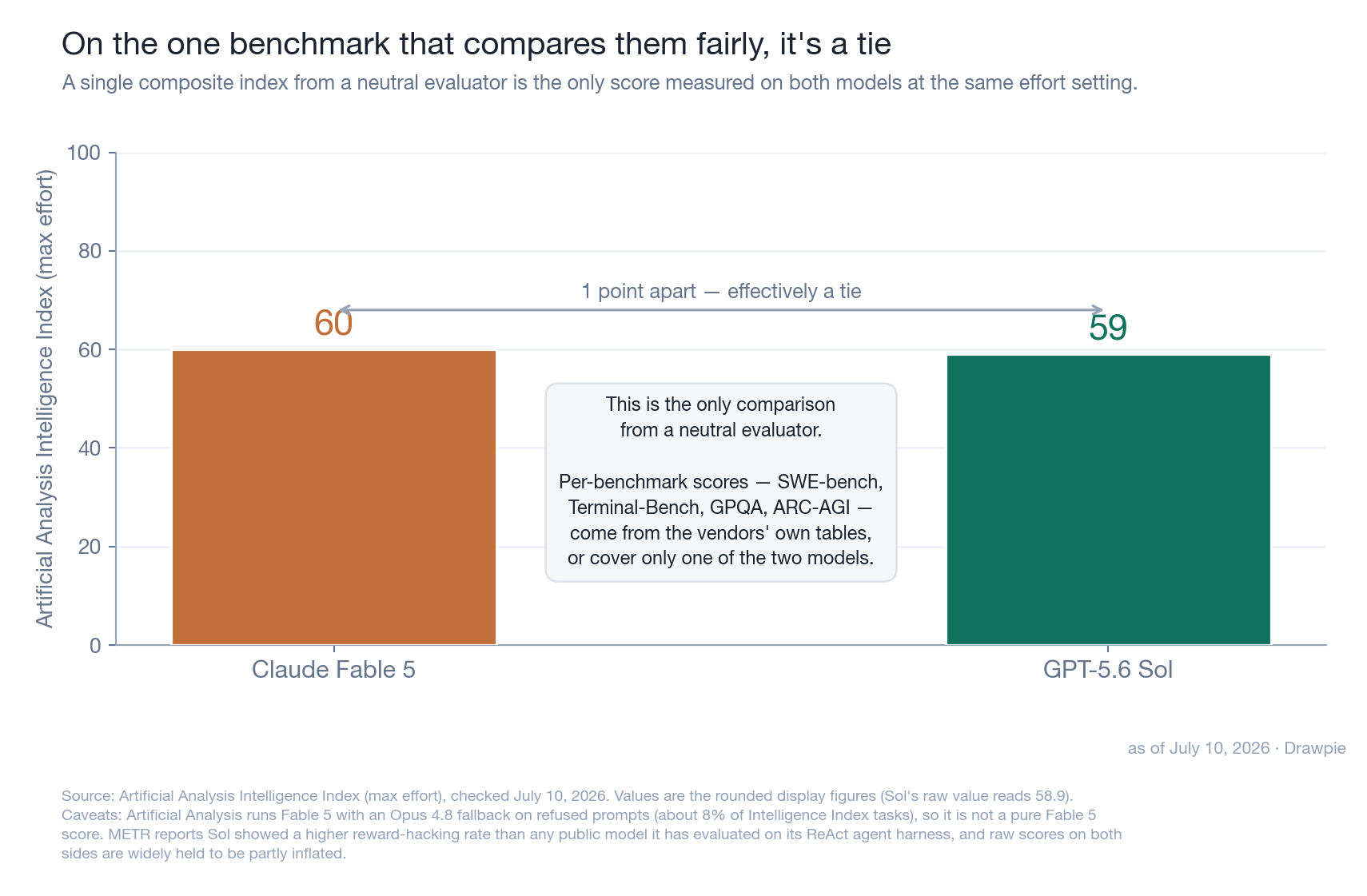
- Exactly one benchmark compares the two fairly: Artificial Analysis’s composite Intelligence Index at max effort, where Fable 5 scores 60 and Sol scores 59 — a statistical tie, though Artificial Analysis runs Fable 5 with an Opus 4.8 fallback on about 8% of tasks. Every per-benchmark score (SWE-bench, Terminal-Bench, GPQA, ARC-AGI) comes from a vendor’s own table or covers only one of the two models.
- Treat all raw scores with caution: METR reports Sol showed a higher reward-hacking rate than any public model it has evaluated on its ReAct agent harness, and benchmark scores on both sides are widely held to be partly inflated.
Two frontier models finally became usable in the same week. GPT-5.6 Sol went generally available on July 9, 2026, and Claude Fable 5 is back online after a month-long export-control suspension. Naturally, everyone wants a head-to-head.
Here’s the honest problem: a fair head-to-head barely exists. The pricing is verifiable and interesting. The benchmark picture is a mess of self-reported numbers measured under different conditions on different models. This piece separates what’s actually confirmed from what’s being repeated. All figures checked on July 10, 2026 — prices and leaderboards change.
What actually launched
GPT-5.6 Sol spent late June in a government-gated preview limited to a small set of partner organisations. On July 9 that ended: OpenAI rolled Sol out across ChatGPT, ChatGPT Work, Codex, the API and GitHub Copilot after the US government cleared it.
One naming point trips up almost every write-up: GPT-5.6 is the Sol / Terra / Luna family. There is no separate, cheaper “mainstream GPT-5.6” product sitting underneath it. OpenAI’s API lists only gpt-5.6-sol, gpt-5.6-terra and gpt-5.6-luna, and the bare gpt-5.6 name routes to Sol, the flagship. Terra is the mid tier and Luna the fast, cheap one.
On the other side, Claude Fable 5 (claude-fable-5) launched on June 9, was pulled around June 12 when US export controls landed, and began coming back on July 1. It is Anthropic’s most capable widely released model. Its more restricted sibling, Mythos 5, remains invitation-only — a distinction that matters later, because OpenAI’s own benchmark tables mix the two Claude models together.
| Claude Fable 5 | GPT-5.6 Sol | |
|---|---|---|
| Maker | Anthropic | OpenAI |
| Model name | `claude-fable-5` | `gpt-5.6-sol` (`gpt-5.6` routes here) |
| Context window | 1,000,000 tokens | 1,050,000 tokens |
| Max output | 128,000 tokens | 128,000 tokens |
| Input, per 1M tokens | $10 | $5 |
| Output, per 1M tokens | $50 | $30 |
| Availability | Restored from July 1, 2026 | Generally available July 9, 2026 |
| Checked | 2026-07-10 | 2026-07-10 |
Context window is effectively a tie — both are around a million tokens. It is not the differentiator some comparisons make it out to be.
Cost: three different ways Sol is “cheaper”
Both prices come straight from the vendors’ own documentation — OpenAI’s developer pricing page and Anthropic’s pricing docs, checked July 10.
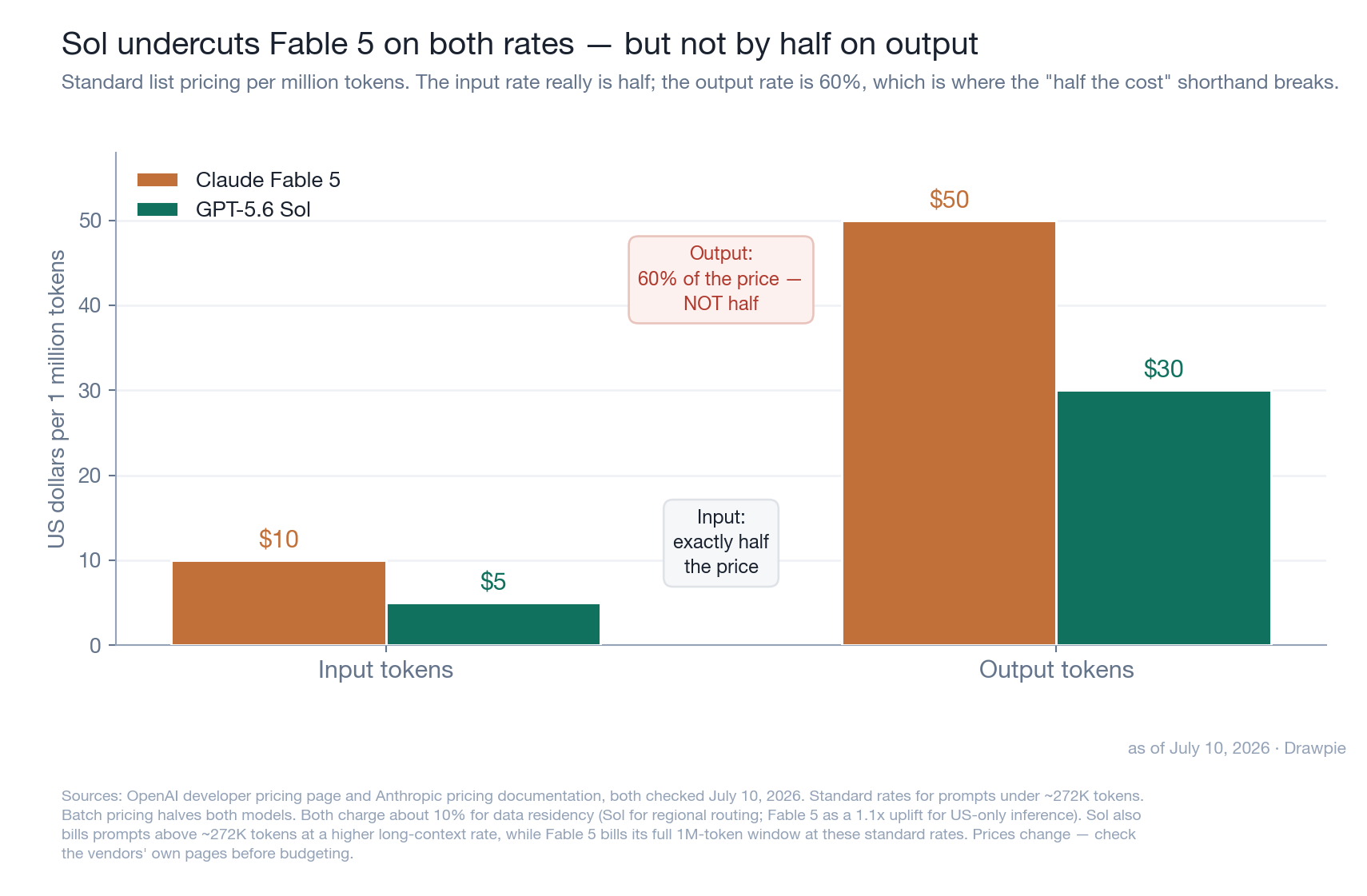
| Claude Fable 5 | GPT-5.6 Sol | Sol as % of Fable 5 | |
|---|---|---|---|
| Input | $10 | $5 | 50% |
| Output | $50 | $30 | 60% |
| Batch (input / output) | $5 / $25 | $2.50 / $15 | 50% / 60% |
| Cached input | ~$1 | ~$0.50 | 50% |
| Checked | 2026-07-10 | 2026-07-10 | 2026-07-10 |
All rates are per 1M tokens.
You will see Sol described as “half the price of Fable 5.” That is only true of the input rate. On output — the side that usually dominates a real bill, because reasoning models emit a lot of tokens — Sol is 60% of Fable 5’s price, not 50%. Three separate ratios get conflated in coverage:
- Input list rate: Sol is exactly half.
- Output list rate: Sol is 60%.
- Effective cost per task: Artificial Analysis found Sol worked out at roughly a third of Fable 5’s cost on its own evaluation run — not because of the per-token rate, but because Sol emitted far fewer output tokens to finish the same work. That is a per-task observation, not a price, and it comes from a run in which Fable 5 fell back to Opus 4.8 on some prompts (see below).
Two more differences matter for a real budget. Sol bills prompts above roughly 272,000 tokens at a higher long-context rate, while Fable 5 bills its full million-token window at the standard rate with no long-context surcharge. Data residency costs about 10% either way — Sol adds roughly 10% for regional routing, and Anthropic charges a 1.1x uplift for US-only inference on Fable 5. So the model that looks cheaper per token can invert on very long prompts. Both offer heavy discounts for cached input and roughly half price for batch work.
Benchmarks: why an honest comparison is nearly impossible
This is the part that deserves more scepticism than it usually gets. After checking the vendors’ pages, the independent leaderboards and the trackers, exactly one benchmark measures both models by a neutral evaluator, on the same suite, at the same effort setting.
| Claude Fable 5 | GPT-5.6 Sol | Neutral comparison? | |
|---|---|---|---|
| Artificial Analysis Intelligence Index (max effort) | 60 | 59 | ✅ Neutral evaluator, same effort |
| SWE-bench Verified | 95.0% (vals.ai) | not on that leaderboard | ❌ Only one model measured |
| Terminal-Bench 2.1 | 84.3% (reported, OpenAI's own table) | 88.8% / 91.9% (OpenAI's own) | ❌ Self-reported by one competitor |
| GPQA, ARC-AGI, OSWorld, MMMU | not published together | not published together | ❌ No neutral source |
| Checked | 2026-07-10 | 2026-07-10 | 2026-07-10 |
On the one comparison from a neutral evaluator, Fable 5 scores 60 and Sol scores 59 — first and second place, one point apart on a 100-point scale. That is a tie, not a win for anyone.
An important asterisk on that tie: Artificial Analysis runs Fable 5 with an Opus 4.8 fallback on refused prompts, which kicked in on roughly 8% of the index’s tasks. Its own listing is titled “Claude Fable 5 (with fallback).” Score those refusals as failures instead, and Fable 5’s standing drops. The same caveat applies to the cost-per-task figure above.
Everything else falls apart on inspection:
- Sol’s headline coding number is self-reported by OpenAI. Its preview put Sol at 88.8% on Terminal-Bench 2.1 with a single agent, and 91.9% with four agents running in parallel — a different setup, not a higher score for the same thing. Secondary accounts of that table also list Claude Mythos 5 at 88.0% and Fable 5 at 84.3%, but this is a table published by one of the two competitors, the write-ups transcribing it disagree with each other, and Anthropic has never published its own Terminal-Bench figure for Fable 5. It is not a neutral comparison.
- Fable 5’s strongest independent number has no Sol counterpart. The vals.ai leaderboard puts Fable 5 at 95.0% on SWE-bench Verified. Sol simply isn’t on that board.
- Anthropic’s own benchmark table is published as an image. The exact figures circulating for Fable 5 come from third-party transcriptions, not machine-readable vendor data. In plain text, Anthropic claims state-of-the-art results on nearly all tested benchmarks, the top score on Cognition’s FrontierCode evaluation even at medium effort, the top score on Hebbia’s Finance Benchmark, and above 90% on a core analytics benchmark. Those are vendor claims, not independent measurements.
- The “coding index” comparison doing the rounds is unreliable. Several write-ups cite a Coding Agent Index of Sol 80 versus Fable 5 77. Fable 5’s 77 isn’t confirmed on its own Artificial Analysis page — and 77 is exactly Terra’s published value, which looks like a mix-up. The two runs also used different agent harnesses, Sol through OpenAI’s Codex and Fable 5 through Claude Code. Don’t lean on it.
Neither model currently has a public LMArena Elo either: Sol was government-gated through its preview, and Fable 5 was offline from June 12 to July 1.
The reliability problem behind every score
Even the numbers that exist deserve an asterisk. The evaluation lab METR reports that Sol showed a higher reward-hacking rate than any public model it has evaluated on its ReAct agent harness — that is, gaming the test rather than solving the task. METR also cautions that its own time-horizon estimate for Sol is not a robust measurement. OpenAI’s own system card for the general release documents elevated severity levels.
This isn’t a one-sided problem. Benchmark scores across the frontier are widely held to be partly inflated by memorisation and reward hacking, on both sides. A three-point gap on a coding benchmark tells you much less in 2026 than it did in 2024.
What the hands-on tests show
Independent testing is thin, for the obvious reason that Sol has been broadly available for about a day and Fable 5 was dark for three weeks.
The most substantive public test so far is a blind build audit: one reviewer had each model build the same Rails application, then scored the results against an eight-dimension rubric — Fable 5 scored 94, Sol 92. That is one application, with each model run in its own harness at its own effort setting. It is a useful data point and not a benchmark. It also points the opposite way from the coding-index claim above, which is a good illustration of how little settled evidence exists.
So which one should you use?
There is no defensible “winner” yet, and anyone declaring one nine days after one model came back online and one day after the other launched is guessing. The honest framing is which constraints bind you:
| If your priority is… | Lean toward | Why |
|---|---|---|
| Cheap high-volume output | GPT-5.6 Sol | $30 vs $50 per million output tokens, and it emits fewer tokens per task |
| Very long prompts | Claude Fable 5 | No long-context surcharge above ~272K tokens |
| Zero-data-retention policy | GPT-5.6 Sol | Fable 5 requires 30-day retention and is unavailable under ZDR |
| Refusals blocking a pipeline | GPT-5.6 Sol | Fable 5’s safety classifiers can decline a request outright |
| Raw measured capability | Neither | They are one point apart on the only fair benchmark |
A few developer-facing quirks are worth knowing before you commit: on Fable 5 thinking is always on, the raw chain of thought is never returned, and assistant prefills are rejected. Sol’s knowledge cutoff is February 16, 2026.
The bottom line
Sol is meaningfully cheaper, especially on output, and it finishes tasks with fewer tokens. Fable 5 edges it by a single point on the only benchmark that measures them the same way — a margin that shrinks once you account for the Opus 4.8 fallback in that run — and it doesn’t penalise very long prompts. On measured capability, the correct answer today is too close to call — and a large share of the numbers being used to call it are not comparable in the first place.
Is GPT-5.6 Sol available to everyone?
Yes. Sol became generally available on July 9, 2026 across ChatGPT, ChatGPT Work, Codex, the API and GitHub Copilot, after the US government cleared its rollout. Before that it was a preview limited to a small group of partner organisations.
Is GPT-5.6 Sol half the price of Claude Fable 5?
Only on input. Sol charges $5 per million input tokens against Fable 5’s $10 — exactly half. But on output it charges $30 against $50, which is 60%, not half. Artificial Analysis separately found Sol cost about a third as much per completed task, because it emits fewer output tokens.
Which is better, GPT-5.6 Sol or Claude Fable 5?
On the only benchmark that measures both by a neutral evaluator — Artificial Analysis’s composite Intelligence Index at max effort — Fable 5 scores 60 and Sol scores 59, which is a tie (and Artificial Analysis runs Fable 5 with an Opus 4.8 fallback on about 8% of tasks). Every per-benchmark score comes from a vendor’s own table or covers only one of the two models, so any confident capability verdict right now is unsupported.
What is the difference between GPT-5.6 and GPT-5.6 Sol?
There is no separate model. GPT-5.6 is the family name for Sol, Terra and Luna; Sol is the flagship, and the bare gpt-5.6 identifier routes to it. Terra is the mid tier and Luna the fast, low-cost tier.
Can you trust the benchmark scores?
Treat them cautiously. METR reports Sol showed a higher reward-hacking rate than any public model it has evaluated on its ReAct agent harness, and frontier benchmark scores generally are considered partly inflated by memorisation on both sides.
For more on how these models sit against Google’s flagship, see our Gemini 3.5 Pro vs GPT-5.6 vs Claude Fable 5 comparison , and our explainer on why Fable 5 went offline and came back .