What Canada's September 8 Tariffs Actually Hit: Steel, Appliances, Food, Clothing & What They'll Cost You (2026)
The Department of Finance sets these countermeasures in force at 12:01 a.m. on 8 September 2026. From that morning this page stops describing something coming and starts describing something in force, and the goods-in-transit exemption below stops applying to anything shipped after it. The date is the government’s own, printed in its backgrounder.
Everything else on the page is unaffected; the figures below still say when they were read.

- Cars are not on this list. Passenger vehicles, trucks, buses and vehicle parts appear nowhere in the 629 items — chapter 87 contributes one motorcycle line and four trailer lines. Cars are already tariffed under a separate April 2025 measure that this announcement does not change.
- Half the list is metal. Steel, aluminium and other metals account for 307 of the 629 items, and 276 of those carry the top 50% rate. This is a list aimed at industrial inputs, and the consumer goods sit in its tail.
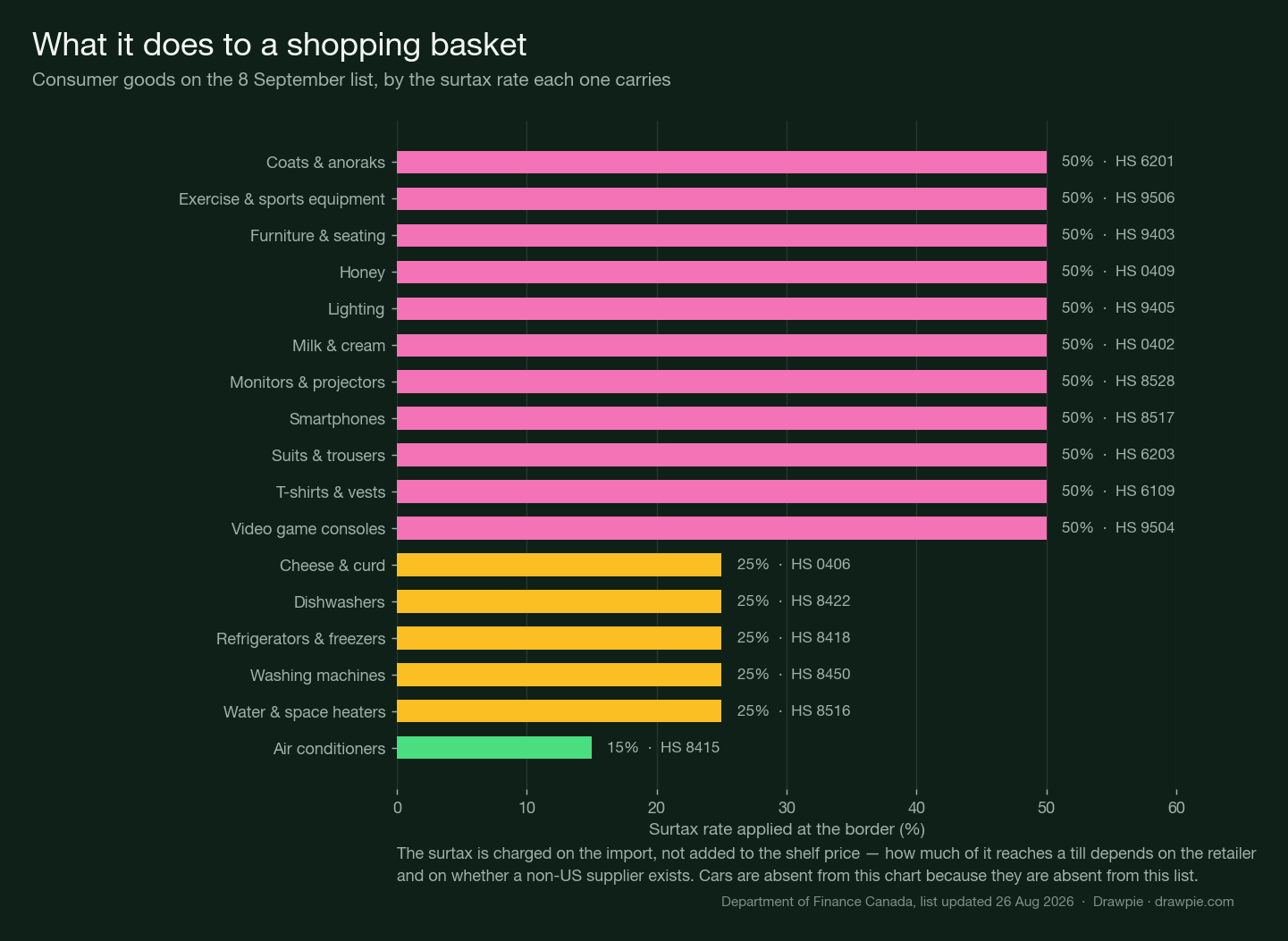
- The 50% tier reaches further into a shopping basket than you would expect: smartphones, monitors, video game consoles, all clothing on the list, furniture, lighting, milk and honey.
- Appliances are mostly the 25% tier — fridges, washing machines, dishwashers, water heaters — and air conditioners are the single cheapest thing on the list at 15%.
Ottawa’s new counter-tariffs take effect at 12:01 a.m. on Monday 8 September. We pulled all 629 items off the government’s list and sorted them, and the shape of it is not what the coverage suggests.
What are Canada’s new tariffs, and when do they start?
Fifteen, 25 and 50 per cent surtaxes on 629 categories of US goods, in force from 12:01 a.m. on 8 September 2026. The Department of Finance describes it as matching, dollar for dollar, the 50% tariff the US imposed on $27.6 billion of Canadian goods on 22 August under Section 338. Canada’s list covers the same $27.6 billion going the other way, and each product’s rate is set to match the US rate on the same goods.
Two administrative points that matter more than they sound:
- Origin is decided by marking rules, not by where you bought it. The surtax applies to goods that qualify as US-origin under Canada’s CUSMA marking regulations. A US-branded product made elsewhere is not automatically caught.
- Goods already in transit on 8 September are exempt. Anything on the water or on a truck heading north before that morning comes in at the old rate.
Do Canada’s new tariffs cover cars?
No. Passenger cars are not on this list at all — but they are already tariffed by a different measure that has been running since April 2025.
This is the single most misread thing about the announcement, so here is the check. Searching the 629 items for the tariff headings that cover vehicles returns nothing:
| Heading | Covers | On this list? |
|---|---|---|
| 8703 | Passenger cars | No |
| 8704 | Trucks and goods vehicles | No |
| 8702 | Buses | No |
| 8708 | Vehicle parts | No |
| 8711 | Motorcycles | Yes — one item, 50% |
| 8716 | Trailers and semi-trailers | Yes — four items, 25% |
The entire “vehicles and transport” group in the chart below is 21 items, and 16 of them are railway: locomotives, coaches, rolling-stock parts and shipping containers.
What does hit cars is separate and older. Since 9 April 2025 Canada has applied 25% to non-CUSMA-compliant vehicles imported from the US, and to the non-Canadian and non-Mexican content of CUSMA-compliant vehicles from the US. That measure is still in force and this announcement does not change it. So if you are shopping for a US-built car, your position on 9 September is exactly what it was on 7 September.
What is actually on the list?
Half of it is metal. Group the 629 items by what they physically are and one bar dwarfs the rest: 307 lines of steel, aluminium and other metals, 276 of them in the top tier.
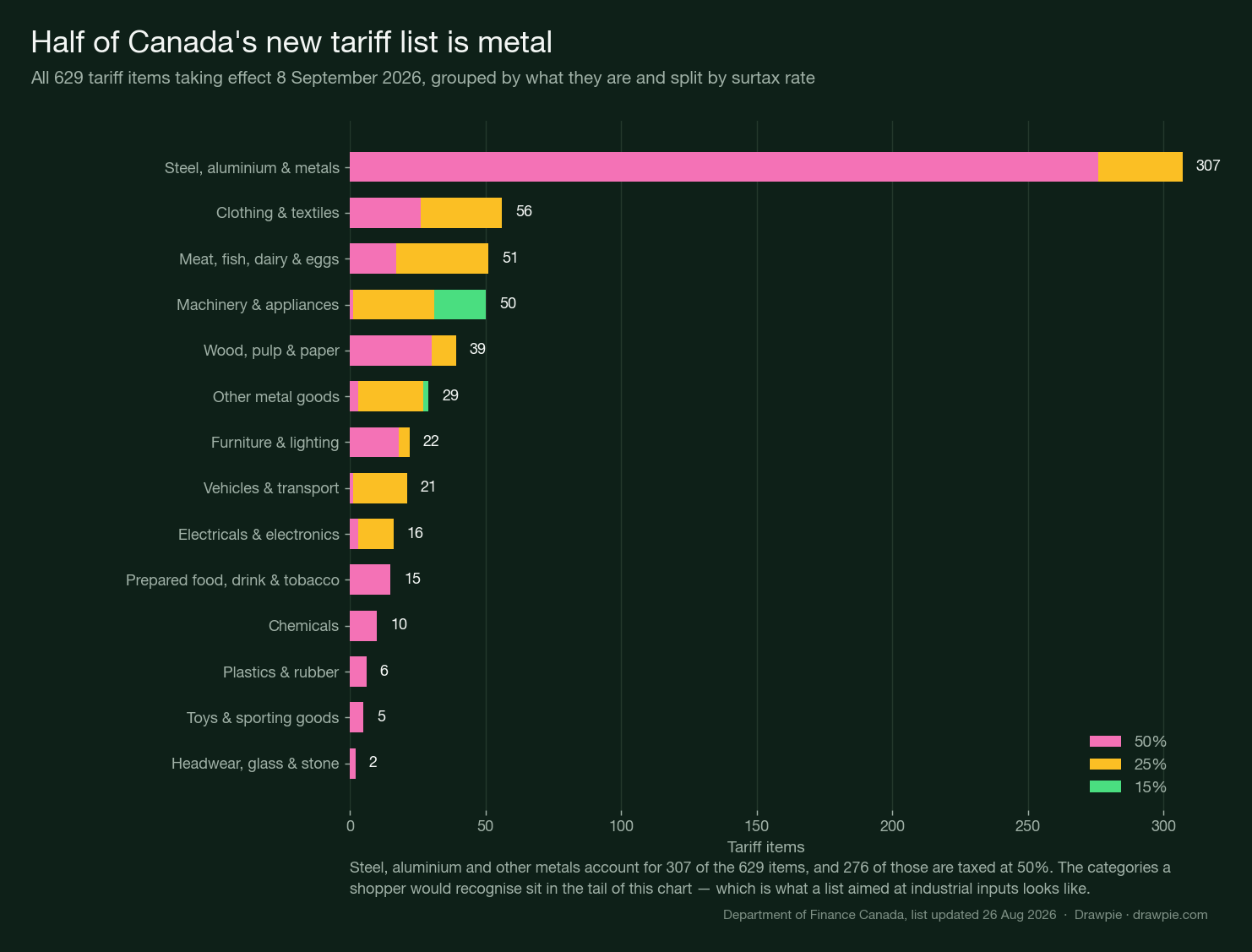
That is the correct way to read this policy: it is aimed at industrial inputs, mirroring what the US did to Canadian steel and aluminium. The categories a shopper recognises are real, but they are the tail of the distribution, not the point of it.
Which food gets more expensive?
Dairy leads, and the rates split in a way that will surprise people: milk and cream at 50%, cheese at 25%. Meat, fish, dairy and eggs contribute 51 items, of which 34 are at 25% and 17 at 50%. A further 15 items cover prepared food, drink and tobacco, and every one of those is at 50%.
The named categories include milk and cream in powder and other concentrated forms, whey and whey protein concentrate, natural honey, molasses, and malt extract and flour-based food preparations.
Two things worth holding onto. Dairy is the category where Canada’s supply management already limits US imports, so the surtax is layered on top of a system that was never a free market. And the 50% lines are heavily weighted toward ingredients — powders, concentrates, whey — which reach you through processed food rather than off the dairy shelf.
Which appliances are on the list?
Most of the big ones, mostly at 25% — and the cheapest thing on the whole list is an air conditioner at 15%.
| Item | Heading | Rate |
|---|---|---|
| Refrigerators and freezers | 8418 | 25% |
| Washing machines | 8450 | 25% |
| Dishwashers | 8422 | 25% |
| Water and space heaters | 8516 | 25% |
| Domestic electro-mechanical appliances | 8509 | 25% |
| Air conditioners | 8415 | 15% |
The machinery and appliances group is where the 15% tier lives — 19 of the 21 items at that rate are in it, alongside forklifts, hoists and lifting machinery. It is the one part of the list Ottawa has taxed gently.
Is clothing affected, and by how much?
Yes, heavily, and almost all of it at 50%. Clothing and textiles is the second-largest group on the list at 56 items. The headings named include T-shirts and vests, jerseys and pullovers, gloves, men’s and women’s overcoats and anoraks, suits and trousers, dresses and skirts, and track suits, ski suits and swimwear.
Alongside them, three consumer categories are at 50% across the board: furniture and seating, lighting, and toys and sporting goods — the last of which includes video game consoles, exercise equipment and fishing tackle.
And the two that will get the most attention: smartphones and monitors are both on the list at 50%.
How much of this actually reaches the price you pay?
Less than the headline rate, and by an amount nobody can tell you in advance. A surtax is charged on the value of the import when it crosses the border, not added to the shelf price. Between those two points sit the importer’s margin, the retailer’s pricing decision, and the question of whether a non-US supplier exists for that product.
That last one does most of the work. A category with Canadian, Mexican or European alternatives absorbs a tariff by switching suppliers, and the shelf price moves little. A category where the US is effectively the only source has nowhere to go, and more of the surtax travels.
This page is not going to put a figure on your receipt, because the honest answer is that it depends on decisions retailers have not made yet.
What is not on the list?
Quite a lot, and the gaps are as informative as the entries. Beyond cars, the 629 items contain no fresh produce chapters, no pharmaceuticals, and only ten chemical lines. Fuel and minerals do not appear.
Read together with the 307 metal items, the omissions describe a policy that is trying to hit US industrial exports hard while leaving Canadian households’ unavoidable purchases largely alone. Whether it succeeds at the second half is what the next few months will show.
Can a business get relief from these tariffs?
Yes, through remission, and it is worth knowing the route exists. The government operates a remission process for cases where alternative sourcing is not available or where the duties would cause material economic harm, and the Canada Border Services Agency publishes the administrative detail in its customs notices.
For the auto measure specifically, a separate remission framework lets producers manufacturing in Canada import US-made vehicles tariff-free up to a quota, provided they maintain production and follow through on planned investment here.
If you import for a living, the customs notices are the document to read on 8 September — not the press release, and not this page.
How we verified this
✅ Every number here was counted off the government’s own table, not taken from coverage. The Department of Finance page “List of products from the United States subject to counter-tariffs effective September 8, 2026” was opened on 30 August 2026, the pager set to show all entries, and all 629 rows extracted and grouped by the HS chapter in each tariff item. The page states “List updated as of August 26, 2026”. Both charts are generated from that extraction rather than typed.
🔴 The item count in circulation is wrong. Several outlets report 874 tariff items. The government page itself says 629, and the rate split is 413 items at 50%, 195 at 25% and 21 at 15%.
🔴 The cars finding was tested with a control before it was published. Searching the extracted list for headings 8703 (passenger cars), 8704 (goods vehicles), 8702 (buses) and 8708 (vehicle parts) returns nothing; the whole of chapter 87 is one motorcycle line and four trailer lines. To prove the matcher worked rather than the data being missing, the same search for heading 0402 returns its 10 dairy lines and an invented 9999 prefix returns none.
⚠️ “Not on this list” is not “not tariffed”. Canada’s separate automobile countermeasure — 25% on non-CUSMA-compliant vehicles from the US, and on the non-Canadian and non-Mexican content of CUSMA-compliant ones — has applied since 9 April 2025 and remains in force, per the Department of Finance’s own automobiles page read the same day. The article says both things.
⚠️ No price rise is forecast anywhere on this page. A surtax is charged on the import value at the border. What reaches a shelf depends on the retailer, on whether a non-US supplier exists, and on the remission process — none of which is knowable in advance, so this page describes the mechanism and declines to put a number on your receipt.