Andy Burnham Announces 24/7 Free Bus Travel for Disabled Pass Holders in England

- From 1 April 2027, an English disabled person’s bus pass will be valid at any time of day. Nothing changes before that date — the announcement is a commitment, not a switch that has been flipped.
- Today the pass is only valid between 9.30am and 11pm on weekdays, unless your local authority pays to extend it. On a weekday that is 13.5 hours; from April 2027 it is 24.
- It is funded by £60 million from existing budgets — £40 million from the DWP and £20 million from the DfT — not by new money.
- Greater Manchester did this for itself in March 2026, when Burnham was still its mayor. His own line in the announcement is that he did it there and is proud to do it now for the whole country.
From Wednesday 1 April 2027, a disabled person’s bus pass in England will work at any hour of the day. Today it stops working before 9.30am and after 11pm on weekdays.
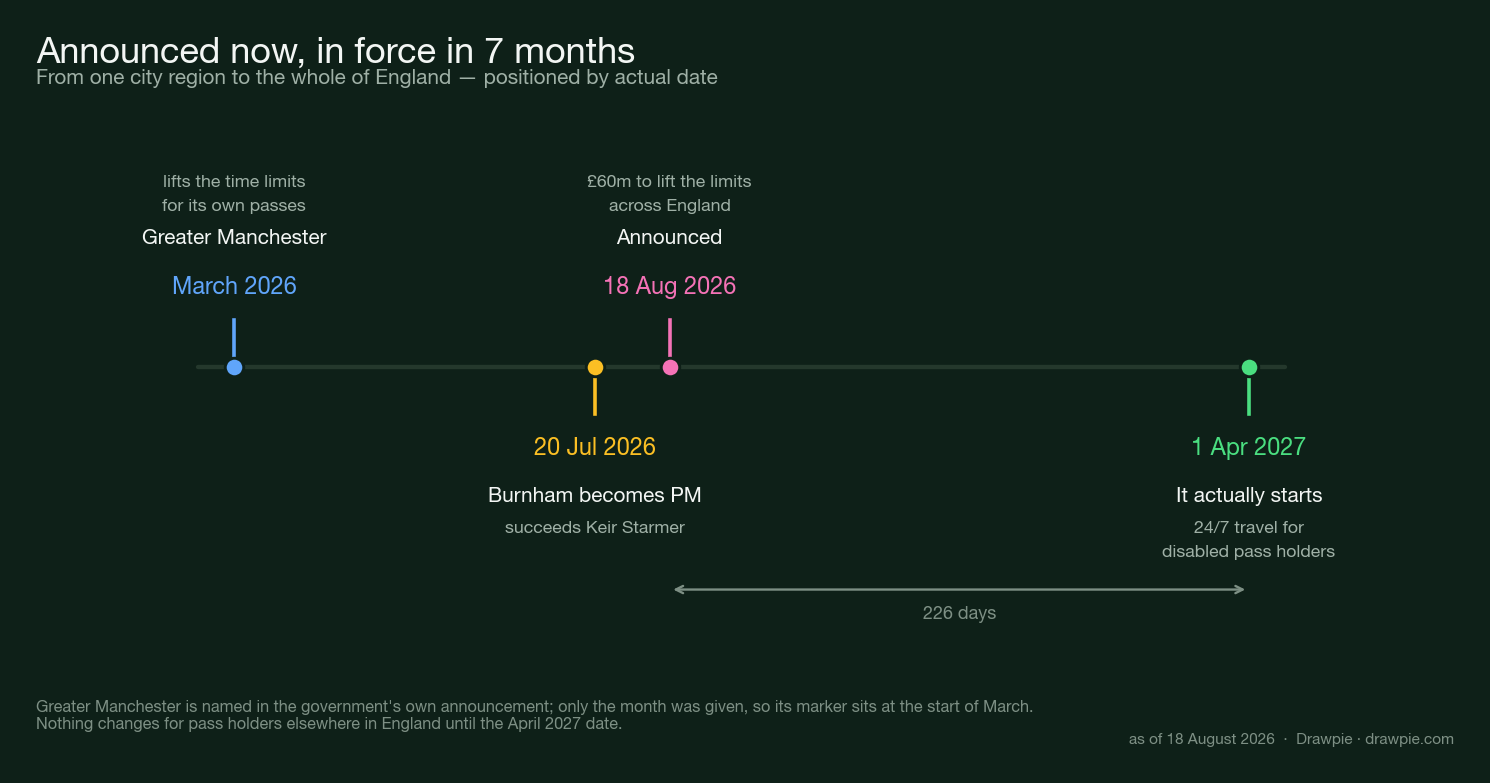
The prime minister announced the change today. The change itself is 226 days away.
What exactly is changing?
One restriction is being removed: the time-of-day limit on disabled person’s passes in England.
| Now | From 1 April 2027 | |
|---|---|---|
| Weekday hours | 9.30am to 11pm | Any time |
| Who it covers | Disabled person’s pass holders in England | Same |
| What it costs you | Free within those hours | Free at any hour |
| Local top-ups | Some councils already fund longer hours | National minimum becomes 24/7 |
Nothing about eligibility changes. If you hold the pass you keep it, and if you do not hold one this does not create a new route to getting one.
What are the current rules?
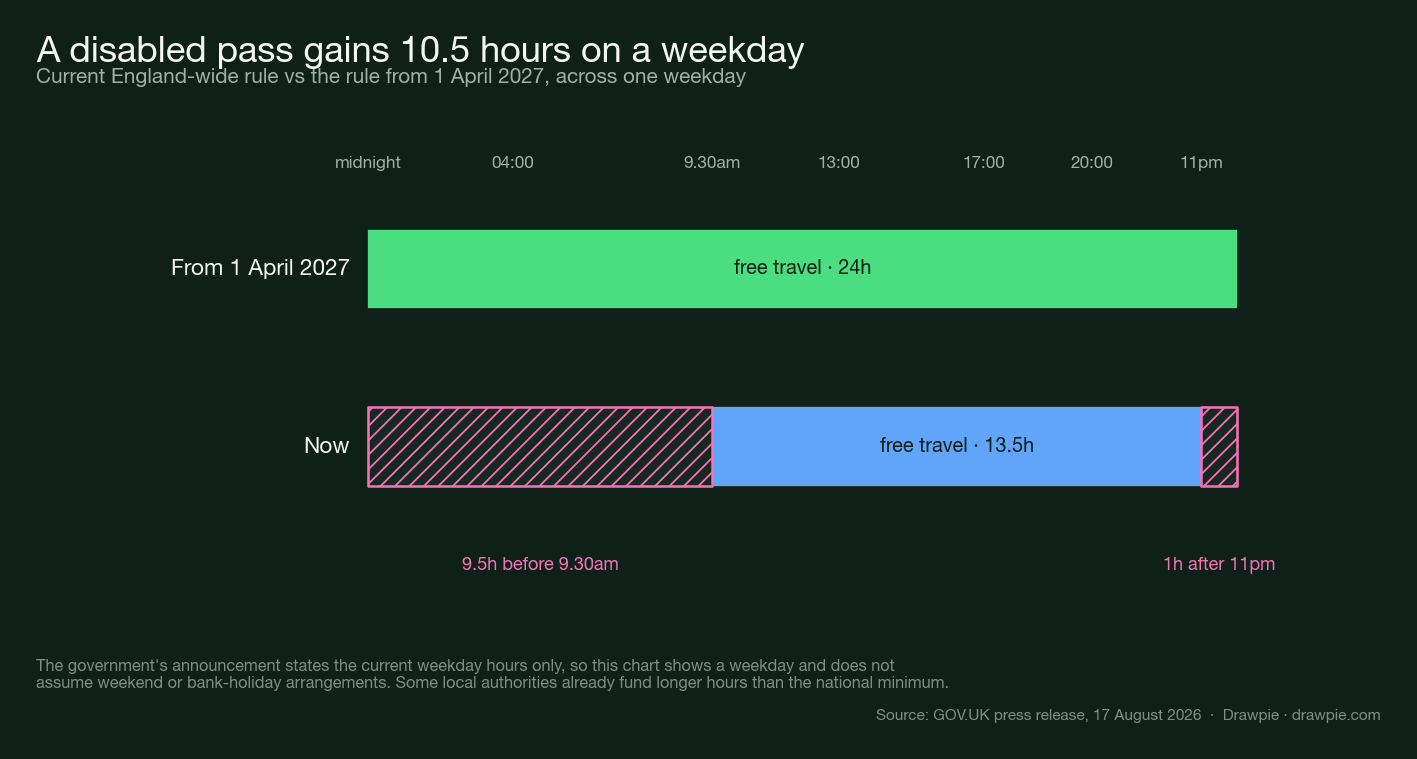
On a weekday the pass is valid for 13.5 hours — from 9.30am until 11pm — unless your local authority has paid to widen that.
| Period | Status now |
|---|---|
| Midnight to 9.30am | Not covered — 9.5 hours |
| 9.30am to 11pm | Free travel — 13.5 hours |
| 11pm to midnight | Not covered — 1 hour |
The morning is the part that matters most. A 9.30am start excludes the entire commute, most hospital appointment slots and the school run — which is the specific complaint the government’s announcement addresses when it talks about access to “workplaces, education, training”.
⚠️ The announcement describes the current entitlement in terms of weekdays only. We could not verify the statutory weekend and bank holiday position from a primary source, so this page does not state one.
When does it actually start?
1 April 2027 — and the gap between the announcement and the start is more than seven months.
| Date | What happened |
|---|---|
| March 2026 | Greater Manchester permanently lifts the time limits for its own pass holders |
| 20 July 2026 | Andy Burnham becomes prime minister, succeeding Keir Starmer |
| 18 August 2026 | Government announces the change for all of England, backed by £60m |
| 1 April 2027 | Time restrictions lifted across England |
If you hold a pass and live outside an area that already funds longer hours, your pass behaves exactly as it did yesterday until that April date.
Who pays for it?
£60 million, taken from budgets that already exist rather than from new spending.
| Source | Amount |
|---|---|
| Department for Work and Pensions | £40 million |
| Department for Transport | £20 million |
| Total | £60 million |
The government frames it as part of a wider set of bus measures that includes the £2 fare cap, free bus travel for children over the summer, and handing local leaders control over their bus networks.
Why does Greater Manchester keep coming up?
Because it did this first, and because the prime minister used to run it.
Greater Manchester Combined Authority lifted the time restrictions permanently in March 2026, while Burnham was still mayor. The government’s own announcement names it as the example. Burnham’s line in the release makes the connection himself:
“I did it before in Greater Manchester and I’m proud to do it now for the whole country. This is part of our ongoing action to bring back hope and give people some much needed breathing space on the cost of living.”
He also put the case for the change in plain terms: “It’s simply not right that many disabled people cannot travel using their pass during certain times of the day. So we’re fixing that.”
Does this apply outside England?
No. This is an England-only change, because the scheme it amends is an England-only scheme.
The pass in question is issued under the English National Concessionary Travel Scheme, and GOV.UK’s own page states it is available in England only. Scotland, Wales and Northern Ireland each run their own concessionary travel arrangements, and none of them is altered by this announcement.
If you are following the other change to bus passes this year — the rise in the qualifying age for the older person’s pass — we cover that separately in our guide to the 2026 free bus pass eligibility change , including how it differs across the four nations.
What does this mean if you have a pass?
Nothing you need to act on. Your pass, your eligibility and the way you use it are all unchanged until April 2027.
- Do nothing today. There is no application, no reissue and no action attached to this. Your existing pass carries over.
- Keep using it within the current hours until April 2027. Turning up at 8am next week will still cost you a fare.
- Check whether your area already funds longer hours. Several authorities do, and if yours is one of them you may already have what the rest of England gets in 2027.
- The pass itself is unchanged. Eligibility, how you apply and who issues it are all untouched by this.
What to take from it
- The headline is 24/7; the date is April 2027. Both halves matter, and only one of them has happened.
- 10.5 hours a weekday is the actual size of the change, split between 9.5 hours before 9.30am and one hour after 11pm.
- It is £60m reallocated, not £60m of new money — £40m DWP, £20m DfT.
- Greater Manchester has had this since March 2026. If you live there, nothing changes for you at all.
- England only. The other three nations run their own schemes and are unaffected.
Sources
| Source | What it supports here |
|---|---|
| GOV.UK: Free bus travel 24/7 for disabled people as Prime Minister takes further action to ease cost of living | The 1 April 2027 start date, the current 9.30am–11pm weekday rule, the £60m total and its £40m/£20m split, the Greater Manchester precedent, and both Burnham quotes |
| GOV.UK: Apply for a disabled person’s bus pass | That the pass is issued under the English National Concessionary Travel Scheme and is available in England only, with separate arrangements in Scotland, Wales and Northern Ireland |
Checked 18 August 2026. Figures and dates are those in the government’s announcement; the statutory weekend position is not stated there and is not claimed here. No affiliate links, and no payment was received for any link on this page.
How we verified this
Every figure and date on this page comes from the government’s own press release, published on GOV.UK at 22:30 on 17 August 2026 and written to be read on Tuesday 18 August. That is where the 1 April 2027 start, the 9.30am-to-11pm current rule, the £60 million total and its £40m/£20m split between departments, and the Greater Manchester precedent all come from.
The distinction between announced and in force is the main thing this page is careful about. Nothing changes for pass holders today. The commitment is for 1 April 2027, which is 226 days after the announcement, and a reader who arrives at a bus stop tomorrow morning expecting free travel before 9.30am will be charged.
The chart shows a weekday only, because that is all the announcement supports. The release states the current entitlement as “between 9.30am and 11pm during weekdays” and says nothing about weekends or bank holidays. We could not verify the statutory weekend position from a primary source — the GOV.UK pass pages set out eligibility rather than hours, and the underlying section of the Transport Act does not display the times — so the chart is labelled as a weekday and makes no weekend claim.
The £60 million is described as coming from existing budgets, which is what the release says. It is a reallocation within DWP and DfT budgets rather than announced new spending, and this page does not present it as new money or estimate what it works out at per pass holder.
The Greater Manchester precedent is the government’s own example, not our framing. The release names Greater Manchester Combined Authority as having permanently lifted the restrictions “from March this year”. Only the month is given, so the chart places that marker at the start of March and the text says March 2026 rather than a specific day.
Andy Burnham’s role is stated as of today. He became Labour leader on 17 July 2026 and prime minister on 20 July 2026, succeeding Keir Starmer. The policy is a central government one covering England, which is why a mayor’s announcement and a prime minister’s announcement are different things here.
England only, and that is a limit rather than an oversight. The English National Concessionary Travel Scheme applies in England; Scotland, Wales and Northern Ireland run their own concessionary schemes, and this announcement does not change them. GOV.UK’s own pass page is explicit that it is available in England only.
No forecast is offered. Whether the date holds, whether local authorities that already fund extensions get their money back, and what operators do about early-morning capacity are all open, and none of them is predicted here.