Luke Bronin vs. Amy Chai: Polls and Prediction for Connecticut's 1st District in 2026

- Luke Bronin is the overwhelming favourite on 3 November 2026. The district’s Cook PVI is D+12, the Democrat won it by 28 points in 2024, all six published race ratings call it safe or solid Democratic, and Bronin has more than 100 times as much campaign money as Amy Chai. The competitive election here already happened, on 11 August.
- There is no Bronin-versus-Chai poll. Not one public general-election survey of this district has been published. The only two polls of the whole race were primary polls, and both were paid for by a side.
- Those two polls captured a 44-point swing between them. In late January, a poll paid for by Larson’s campaign had him ahead 49-26. In May, one paid for by a group backing Bronin had Bronin ahead 38-30. On 11 August, Bronin won 54.3-33.0.
- Every published rating predates the primary. Three of the six were issued in June 2025 — six weeks before Bronin even entered the race, and fourteen months before the incumbent they assume is running lost his seat.
Luke Bronin is the overwhelming favourite, and the competitive election in this district has already happened. It was the Democratic primary on 11 August 2026, when Bronin unseated John Larson after 14 terms. The general election on 3 November is a formality by every measure available: a Cook PVI of D+12, a 28-point Democratic margin in 2024, six published ratings that all say the seat is safe, and a Republican opponent whose campaign has reported $344 in the bank.
The word “polls” in this matchup needs a caveat before anything else. No public poll of Bronin against Amy Chai exists. Nobody has surveyed this general election, because nobody surveys a D+12 seat. The only two polls anyone conducted were of the primary, and both were bought by a side in it.
What do the polls say about Bronin vs Chai?
Nothing, because there aren’t any. What follows is the only polling this race has produced — two primary surveys, three and six months before the vote, each released by the campaign or group that paid for it.
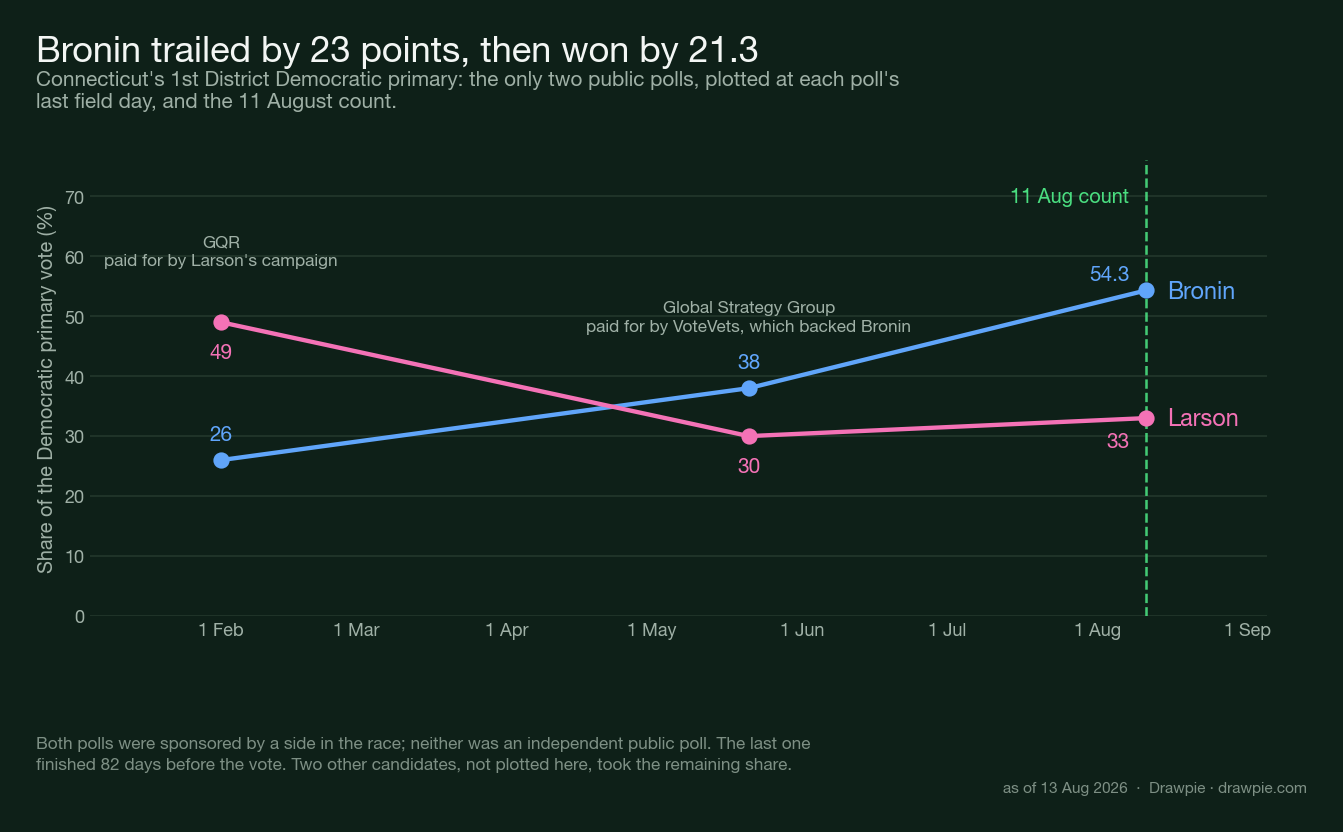
| Poll | Bronin | Larson |
|---|---|---|
| GQR, 1 Feb | 26% | 49% |
| GSG, 21 May | 38% | 30% |
| Count, 11 Aug | 54.3% | 33.0% |
The January-February poll was GQR’s, fielded 27 January to 1 February for Larson’s own campaign — 400 likely voters, margin ±4.9 points. It had Larson at 49% and Bronin at 26%. The May poll was Global Strategy Group’s, fielded 18 to 21 May for VoteVets, which had endorsed Bronin — 500 likely voters, ±4.4 points. It had Bronin at 38% and Larson at 30%.
Between those two field windows the race moved 44 points. Then it moved another 13 in Bronin’s favour over the 82 days between the last poll and the vote. Two data points, both partisan, neither recent: that is the entire polling record of this contest, which is worth knowing before anyone quotes a number from it.
How did Luke Bronin beat John Larson?
By 21.3 points, in a four-way race that was not fought on ideology. Bronin, mayor of Hartford from 2016 to 2024, entered the race on 30 July 2025 and beat Larson for the state party’s endorsement at the May 2026 convention — an unusual rebuke of a sitting member by his own party organisation.
| Candidate | Votes | Share |
|---|---|---|
| Luke Bronin | 30,362 | 54.3% |
| John Larson | 18,444 | 33.0% |
| Jillian Gilchrest | 4,518 | 8.1% |
| Ruth Fortune | 2,647 | 4.7% |
Larson had almost everything an incumbent can have. Both Connecticut senators endorsed him, as did House minority leader Hakeem Jeffries and all four of the state’s other House Democrats. He raised $2.73m. Bronin’s pitch was not that Larson was wrong about policy — it was generational: Larson is 78 and would turn 80 during the next term, and he had a seizure on the House floor last year. Larson became the seventh House Democrat to lose a primary in 2026.
One number is worth holding onto. That primary drew 55,971 votes. The 2024 general election in the same district drew 330,482. The contest that decided who represents this district was settled by about 17% as many voters as will turn out in November — which is what “safe seat” actually means in practice.
What do the race ratings say about the 2026 election?
All six say the seat is safe or solid Democratic, and all six were issued before the primary.
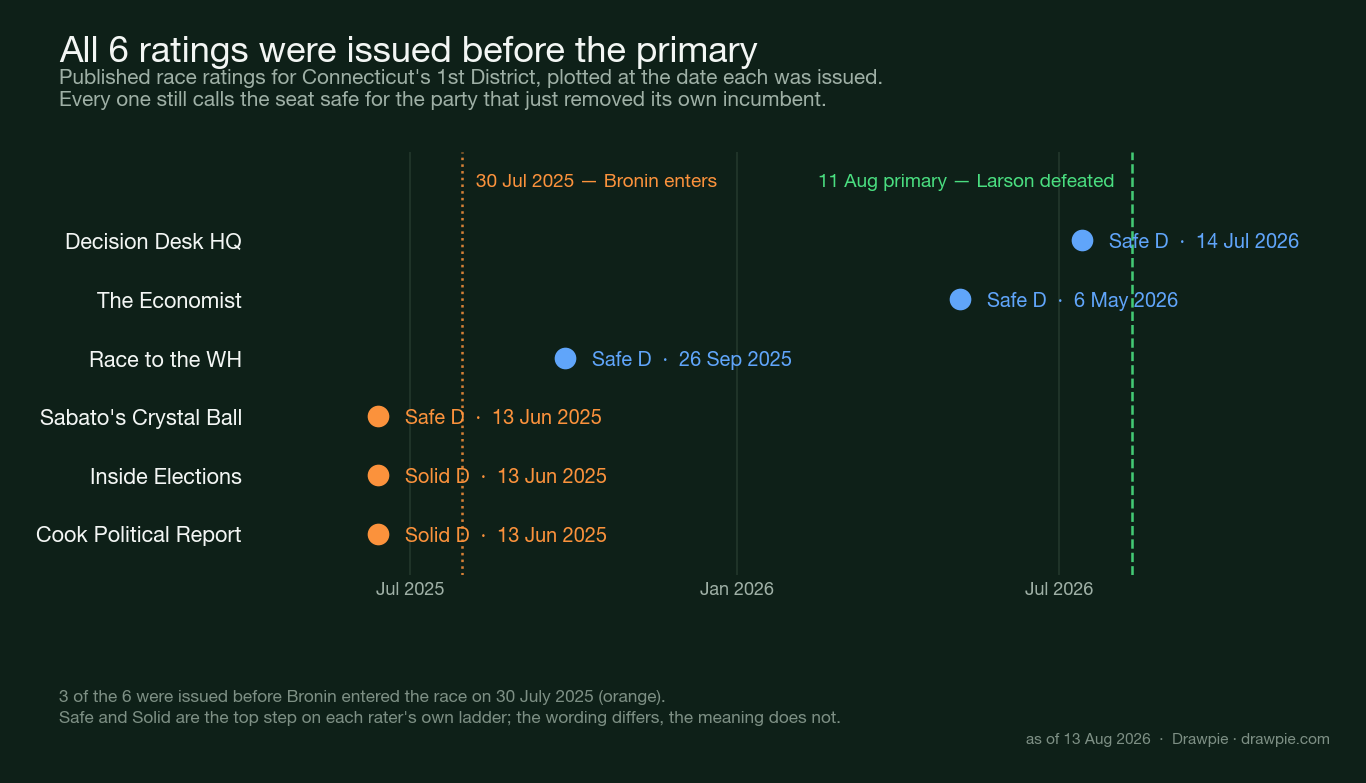
| Rater | Rating | Issued |
|---|---|---|
| Decision Desk HQ | Safe D | 14 Jul 2026 |
| The Economist | Safe D | 6 May 2026 |
| Race to the WH | Safe D | 26 Sep 2025 |
| Cook | Solid D | 13 Jun 2025 |
| Inside Elections | Solid D | 13 Jun 2025 |
| Sabato’s | Safe D | 13 Jun 2025 |
Safe and Solid are the top rung on each rater’s own ladder; the labels differ, the meaning does not. But look at the right-hand column. Three of these ratings are from 13 June 2025 — issued six weeks before Bronin announced, and fourteen months before the incumbent they implicitly describe was thrown out by his own party’s voters.
That does not make them wrong. A D+12 district does not stop being D+12 because the nominee changed, which is precisely why nobody has bothered to update. It does mean that “four forecasters rate this Safe Democratic” is a weaker statement than it sounds: none of them has looked at the race since it became a different race. The rating is about the district, not the candidates.
Who is Amy Chai?
A physician and addiction medicine specialist, running the smallest congressional campaign in the state by a wide margin. She was unopposed for the Republican nomination — the Associated Press does not tabulate uncontested primaries, so there is no Republican vote total for 11 August. She has the Connecticut Republican Party’s endorsement and that of Veterans for America First, and campaigns on mental health and addiction, household costs, border security and term limits.
Her committee’s FEC summary for the 2025-26 cycle is the clearest single fact in this race:
| Candidate | Raised | Cash on hand |
|---|---|---|
| Luke Bronin | $3,070,150 | $600,894 |
| John Larson | $2,733,259 | $809,902 |
| Amy Chai | $20,827 | $344 |
Chai’s figures are as of 30 June 2026; the Democratic figures are as of 22 July 2026, so these are not the same reporting window. Even allowing for that, the gap is not a gap of degree. Of Chai’s $20,827, $16,036 is a loan from the candidate to her own campaign and $4,769 came from contributions. A House campaign in a district of roughly three-quarters of a million people is being run on under $5,000 of other people’s money.
That is the answer to the prediction question, and it is more informative than any rating. Safe-seat ratings describe how the district votes. The FEC filing describes whether there is a campaign on the other side at all.
What could actually change this?
Almost nothing that is visible today, and it is worth being precise about why. A House seat at D+12 that voted 63-35 in 2024 does not flip on candidate quality alone; it flips in a national wave running the other way, and 2026 is not shaping up as a Republican wave year in the Northeast. Bronin enters November with $600,894 in hand against $344.
The honest caveats are narrow ones. Connecticut’s results are unofficial until the state canvass, so even the primary numbers here can move slightly. No general-election poll exists, so there is no independent measurement of this specific matchup to point at — the case rests entirely on the district’s history, the ratings and the filings. And the raters have not revisited the seat since the nominee changed, so nobody has professionally assessed Bronin-versus-Chai either.
None of that makes the race close. It does mean that anyone claiming a precise margin for November is making it up, and we are not going to. What can be said from the record is that the district is heavily Democratic, the Democrat has a campaign, and the Republican has $344.
When is the Connecticut 1st District election?
Tuesday 3 November 2026, with polls open 6 a.m. to 8 p.m. The primary was 11 August and the candidate filing deadline was 9 June. The 1st District covers the north-central part of Connecticut and is anchored by Hartford, the state capital.
For the races where the arithmetic genuinely is in doubt this November, the 2026 Senate control map is where the published ratings actually disagree with each other — and for two more primaries that turned on turnout rather than polling, see Wisconsin and Minnesota .
How we verified this
The primary numbers are the AP count, not a mid-count snapshot. We use AP’s tally as carried by NPR’s results app, stamped 13 August 2026 at 7:44 a.m. with 99% of results in: 30,362 / 18,444 / 4,518 / 2,647. Those four add to 55,971 and each candidate’s published share matches that total to one decimal place, which is the check we ran before printing them.
We deliberately did not use the figures most widely quoted on election night. The 53.5%-34.7% pair that circulated came from a count of 32,893 votes — about 59% of the final total, taken before Hartford had reported. Ballotpedia’s table still carries that snapshot, and it is internally consistent, which is exactly what makes it easy to mistake for a result. Its own note says totals may change until certification.
Both primary polls were sponsored, and we say by whom on the chart as well as in the text. The January-February poll was conducted by GQR for Larson’s campaign; the May poll by Global Strategy Group for VoteVets, which endorsed Bronin. Neither was an independent public poll. We found no general-election poll of this district at all — the polling table in the district’s own record stops at the primary.
The ratings and their dates come from two places that agree. Six raters are listed with issue dates; Ballotpedia separately lists Cook, Inside Elections, Sabato’s Crystal Ball and DDHQ/The Hill with the same calls. Where the two disagree on nothing, we print the dates because the dates are the story: all six predate the 11 August primary.
The money is from the Federal Election Commission, and the two sides have different reporting dates. Democratic figures are as of 22 July 2026; Amy Chai’s are as of 30 June 2026, from her committee’s own FEC summary. They are not the same reporting period and the article says so rather than presenting them as a like-for-like snapshot.
We do not publish betting or prediction-market prices. Odds sites carry this race. We do not carry those numbers in any category, so the assessment here rests on the district’s voting record, the published ratings and the FEC filings.
Nothing here is certified. Connecticut results remain unofficial until the state canvass. This article reports the count as it stands and the general election has not happened.