Best Portable Air Conditioners UK 2026 — and What They Cost to Run
Update log (1)
- — Prices and stock checked on 14 August 2026, and stock is now the binding constraint rather than price: seven of the eight portable units on Meaco's own store were out of stock, leaving the MeacoCool MC Series Pro 9000 CH at £399.99 as the only one that could be bought. Currys listed two Meaco units, both out of stock, and John Lewis had the Cirro 12000 with heating marked as no longer available online. The article also previously referred to a MeacoCool Pro 16,000 BTU model at £550-£600; Meaco's 16,000 BTU units are the Cirro+ range, at £629.99 and £659.99.

When a UK heatwave hits, a portable air conditioner is the quickest way to cool a room without fixed installation. But choosing well matters: the right size for your room keeps both the temperature and the running costs down. In short, match the cooling power (BTU) to your room size, prioritise an energy-efficient unit, and expect to pay roughly 21p to 37p an hour to run one — around £50 to £88 a month if used about eight hours a day at current UK electricity rates. Here’s how to pick the best portable air conditioner for 2026 and exactly what it’ll cost to run. (Prices below are dated: see the 14 August 2026 price-and-stock check further down.)
How do you choose a portable air conditioner?
The most important decision is matching the unit’s cooling capacity, measured in BTU (British Thermal Units per hour), to your room size. Get this wrong and a unit will either run constantly without ever cooling the room, or cost more than necessary.
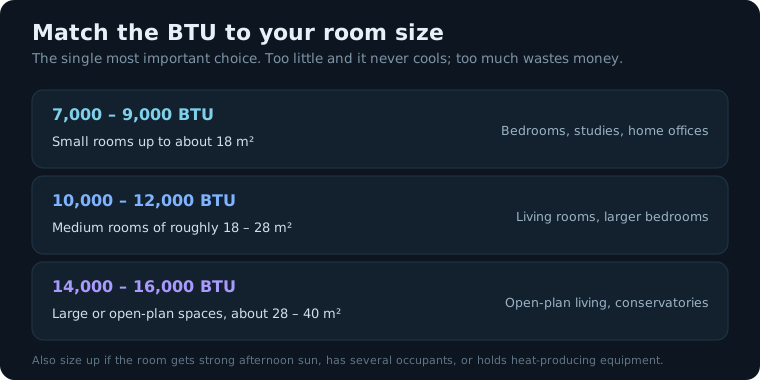
As a rough guide, rooms up to about 18 m² (bedrooms, studies) suit a 7,000–9,000 BTU unit; medium rooms of roughly 18–28 m² need around 10,000–12,000 BTU; and large or open-plan spaces up to 40 m² call for 14,000–16,000 BTU. Size up if the room catches strong afternoon sun, has several people in it, or holds heat-producing equipment. It’s also worth noting capacity is sometimes given in kilowatts (kW) rather than BTU — kW is the more useful figure when comparing energy use and running costs.
What are the best portable air conditioners in the UK for 2026?
Across independent UK testing and reviews, one brand comes up repeatedly: Meaco. Its MeacoCool range is the one heating and cooling professionals tend to recommend, balancing cooling power, low noise and build quality.
- Best overall: the MeacoCool MC Series Pro 9000 BTU is widely rated the top all-rounder — quiet, Wi-Fi enabled and well built, suited to most bedrooms and medium rooms (around £400). Meaco has also launched a new “Cirro” range for 2026 that claims to be roughly twice as quiet as its predecessors.
- Best on a budget: capable units from brands like HOMCOM, Pro Breeze and Belaco can be found under about £250, typically offering 4-in-1 cooling, fan, dehumidifier and heating functions.
- Best for large rooms: the 16,000 BTU models cool spaces up to roughly 40 m², though they’re heavier and cost more. Note the naming: Meaco’s 16,000 BTU units are Cirro+, not MeacoCool Pro — the MeacoCool Pro line tops out at 10,000 BTU on Meaco’s own store, and the Cirro+ 16000 lists at £629.99 cooling-only or £659.99 with heating.
For independent, paid-for testing rather than marketing claims, consumer bodies such as Which? regularly test these units. Prices shift with demand and the season, which is why the next section gives dated figures rather than a range.
What do portable air conditioners cost in the UK right now?
Meaco’s own store lists eight portable units from £399.99 to £659.99 — and on 14 August 2026, seven of the eight were out of stock. This is the part a “best of” list cannot tell you, because it changes weekly and it decides whether you can buy anything at all.
| Model | Price | In stock |
|---|---|---|
| MC Pro 9000 CH | £399.99 | Yes |
| MC Pro 10000 | £429.99 | No |
| Cirro 12000 | £519.99 | No |
| Cirro 12000 heat | £539.99 | No |
| Cirro+ 14000 | £599.99 | No |
| Cirro+ 14000 heat | £629.99 | No |
| Cirro+ 16000 | £629.99 | No |
| Cirro+ 16000 heat | £659.99 | No |
Those are the manufacturer’s own prices and its own stock flags, read on 14 August 2026. The one unit still buyable is the MeacoCool MC Series Pro 9000 CH at £399.99 — which happens to be the model most UK reviewers pick as the best all-rounder anyway.
It is not just Meaco’s own shop. On the same day, Currys listed exactly two Meaco air conditioners — the MeacoCool MC12000CHR Pro at £479.00 and the MeacoCool 8000CHR Pro at £379.00 — and both carried the line “Sorry, this item is currently out of stock.” At John Lewis, the Meaco Cirro 12000 with heating was marked “No longer available online”.
So the honest answer to “where do I buy one online in mid-August” is narrower than a comparison table suggests: the question is not who is cheapest, it is who still has one. If you find the model you want in stock anywhere at close to the prices above, that is the deal — waiting for a discount at this point in the season is waiting for stock that may not return until spring.
Two gaps worth stating plainly. Argos and AO would not load for us — one returned an access error and the other a bot-check screen — so their absence here is about what we could open, not about what they stock. And we do not quote Amazon prices, because Amazon renders prices in the visitor’s currency and adjusts VAT by delivery address, so a figure read from outside Britain is not a British price.
How much does it cost to run a portable air conditioner?
This is where the real running costs come in, and they’re very calculable. A typical portable air conditioner draws somewhere between 0.8 and 1.4 kWh of electricity per hour depending on its size and how hard it’s working.
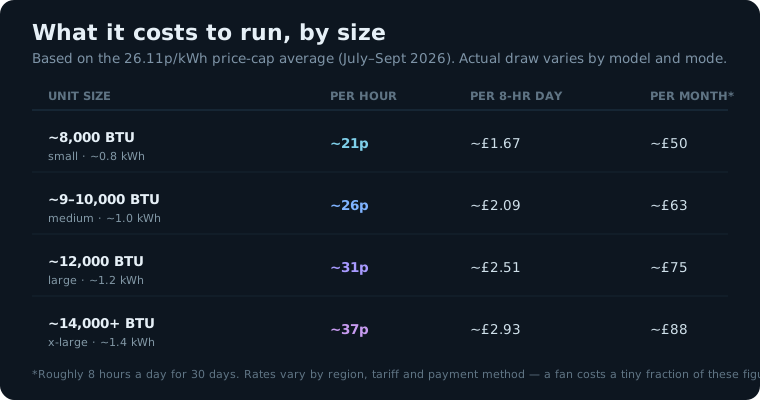
All figures below are approximate, and the monthly column assumes eight hours of use a day for 30 days.
| Size | Power | Hourly | Monthly |
|---|---|---|---|
| 8,000 BTU | 0.8 kWh | 21p | £50 |
| 9–10,000 BTU | 1.0 kWh | 26p | £63 |
| 12,000 BTU | 1.2 kWh | 31p | £75 |
| 14,000+ BTU | 1.4 kWh | 37p | £88 |
These figures use the Ofgem price-cap average electricity rate of 26.11p per kWh that applies from July 2026, including VAT. The exact cost depends on your region, tariff and how long the unit actually runs at full power. The key takeaway: a portable air conditioner is far from the cheapest thing to run. For comparison, the Energy Saving Trust notes that running one all day can cost almost 20 times as much as running a freestanding fan, so on milder days a fan may be all you need.
How can you cut your running costs?
A few practical steps make a real difference. Don’t oversize the unit; choose an A-rated, energy-efficient model with a good energy-efficiency ratio; use the timer and sleep modes so it isn’t running unnecessarily overnight; and cool just the room you’re in rather than trying to chill the whole house. Crucially, seal the window around the exhaust hose properly, because any gap lets warm air back in and makes the unit work harder. Good sealing alone can noticeably improve both cooling and cost.
Single-hose vs dual-hose: which is more efficient?
It’s a detail many buyers miss, but it matters. Single-hose units (the most common type) expel hot air out of the window, which creates slight negative pressure in the room and pulls warm air in from elsewhere to replace it. Dual-hose units add a second hose that draws outside air specifically to cool the internal components, so the air you’ve paid to cool stays in the room. Independent testing suggests dual-hose models can outperform single-hose ones by 30–40% in real-world conditions, even at the same rated BTU. The trade-off is that dual-hose units are larger, heavier, pricier and less common in the UK — but in a draughty or older home, or during a serious heatwave, the efficiency gain can be worth it.
Is a portable air conditioner worth it in the UK?
For most people, yes — with realistic expectations. Portable units are flexible, need no permanent installation, and are ideal for the handful of genuinely hot weeks the UK gets. The downsides are that they’re noisier and less efficient than a fixed split-system air conditioner, they must vent hot air out of a window, and running costs add up if used heavily. If you only need to take the edge off on warmer days, a fan is dramatically cheaper. But for sleeping through a heatwave or cooling a home office during a hot spell, a well-chosen portable unit earns its place. Renters can usually use them freely, though it’s worth checking your tenancy agreement first.
The bottom line
The best portable air conditioner for you is the one sized correctly for your room: 7,000–9,000 BTU for small rooms, up to 14,000+ for large spaces. Meaco’s MeacoCool range is the standout UK choice, with solid budget options under £250. Expect to pay roughly 21p to 37p an hour to run one — about £50 to £88 a month with regular use — so size sensibly, seal the window well, and lean on a fan when the heat is only mild.
For more on coping with the heat, see our coverage of the UK heatwave warnings .
Prices are approximate and change frequently; check retailers for current pricing. Running costs are based on the Ofgem price-cap average electricity rate from July 2026 and will vary by region, tariff, payment method and actual usage.
How we verified this
The prices and stock in the “right now” section were read on 14 August 2026 from the sellers’ own pages. Meaco’s figures and its in-stock flags come from the manufacturer’s own shop, which is also the authority on which models exist: its MeacoCool Pro line runs to 10,000 BTU and its 16,000 BTU units are branded Cirro+. The Currys figures and the “currently out of stock” wording are quoted from Currys’ own Meaco air-conditioner listing, and the John Lewis status is that retailer’s own “No longer available online” label.
A collection page is not an inventory. Read as rendered, Meaco’s category page shows eight units and no stock warnings at all; the store’s own product data marks seven of them unavailable. We used the stock flags, not the page furniture, and that is the difference between this section and a list that tells you to go and buy something you cannot buy.
Two large UK retailers are missing rather than excluded. Argos returned an access error and AO returned a bot-check screen on the day, so neither could be read. Amazon is deliberately absent: it renders prices in the visitor’s currency and adjusts VAT by delivery address, so a price read from outside the UK is not a UK consumer price.
The running-cost figures elsewhere in this article are unchanged from the original publication and were not re-derived in this update; they are based on tariff rates as stated in that section rather than on today’s prices.