$AVGO vs. Nvidia: Why Broadcom's Custom AI Chips Could Win More Hyperscaler Spending

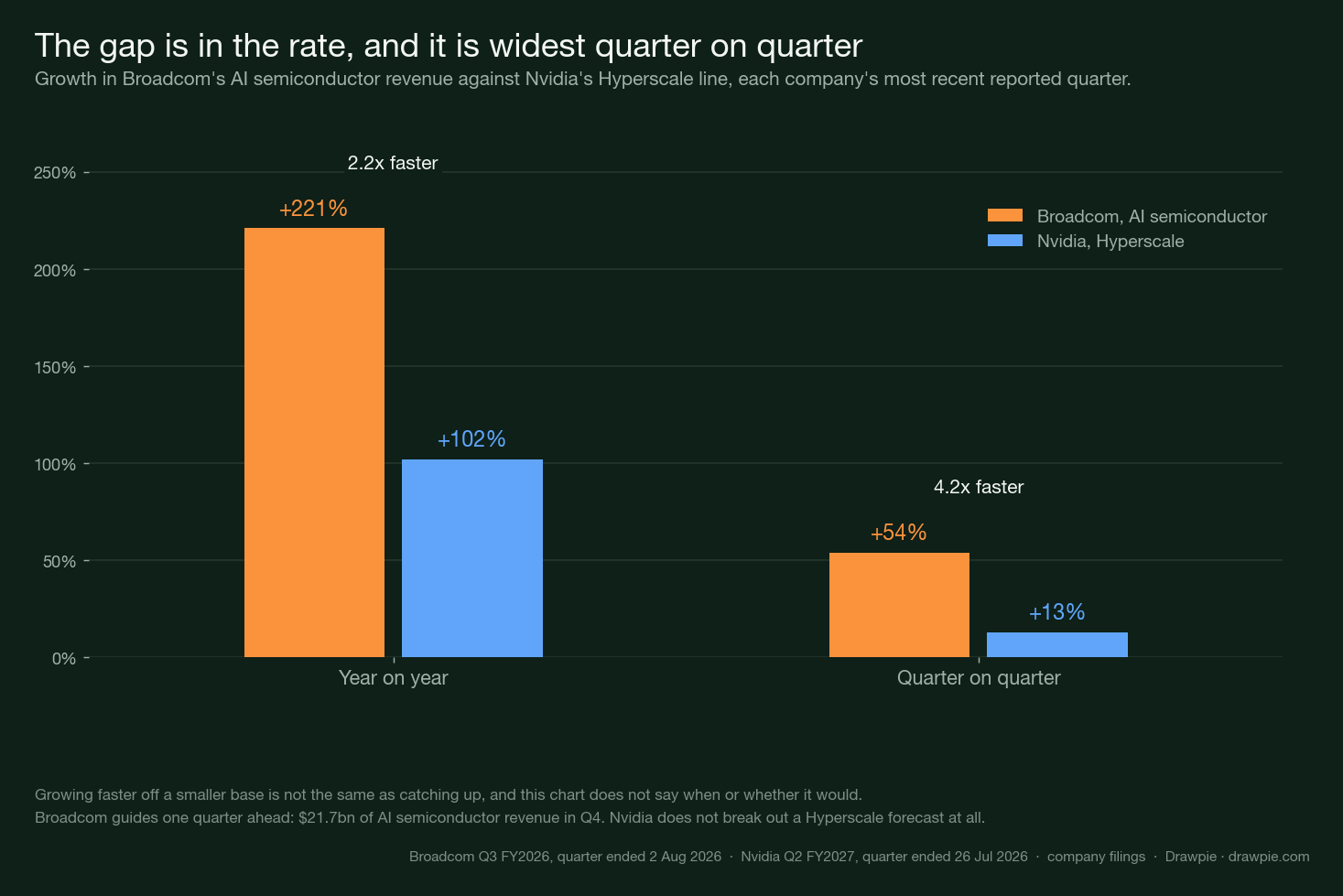
- Broadcom’s AI semiconductor revenue was $16.7 billion in the quarter to 2 August 2026, up 221% year on year and 54% quarter on quarter. It guides to $21.7 billion in the current quarter.
- Nvidia’s comparable line — revenue from hyperscale customers, in the quarter to 26 July 2026 — was $48.7 billion, up 102%. Broadcom’s whole AI business is about a third of it.
- So the growth gap is real and the scale gap is bigger. Broadcom is growing roughly twice as fast year on year and about four times as fast quarter on quarter, from a base one third the size.
- Custom accelerators are now the majority of what Broadcom sells into AI. XPUs were 73% of AI revenue, with shipments up more than 3.5 times.
- The named programmes are unusually specific: 5 gigawatts of TPU 8i for Anthropic in 2027, continued Jalapeno shipments for OpenAI with a second-generation chip taping out, and production MTIA shipments for Meta.
- The counter-evidence is in the margin. Broadcom’s non-GAAP gross margin has gone from 78.4% a year ago to 75.0%, and it guides to about 73% — and it names the XPU mix as the reason. Nvidia’s went the other way, from 72.5% to 75.0%.
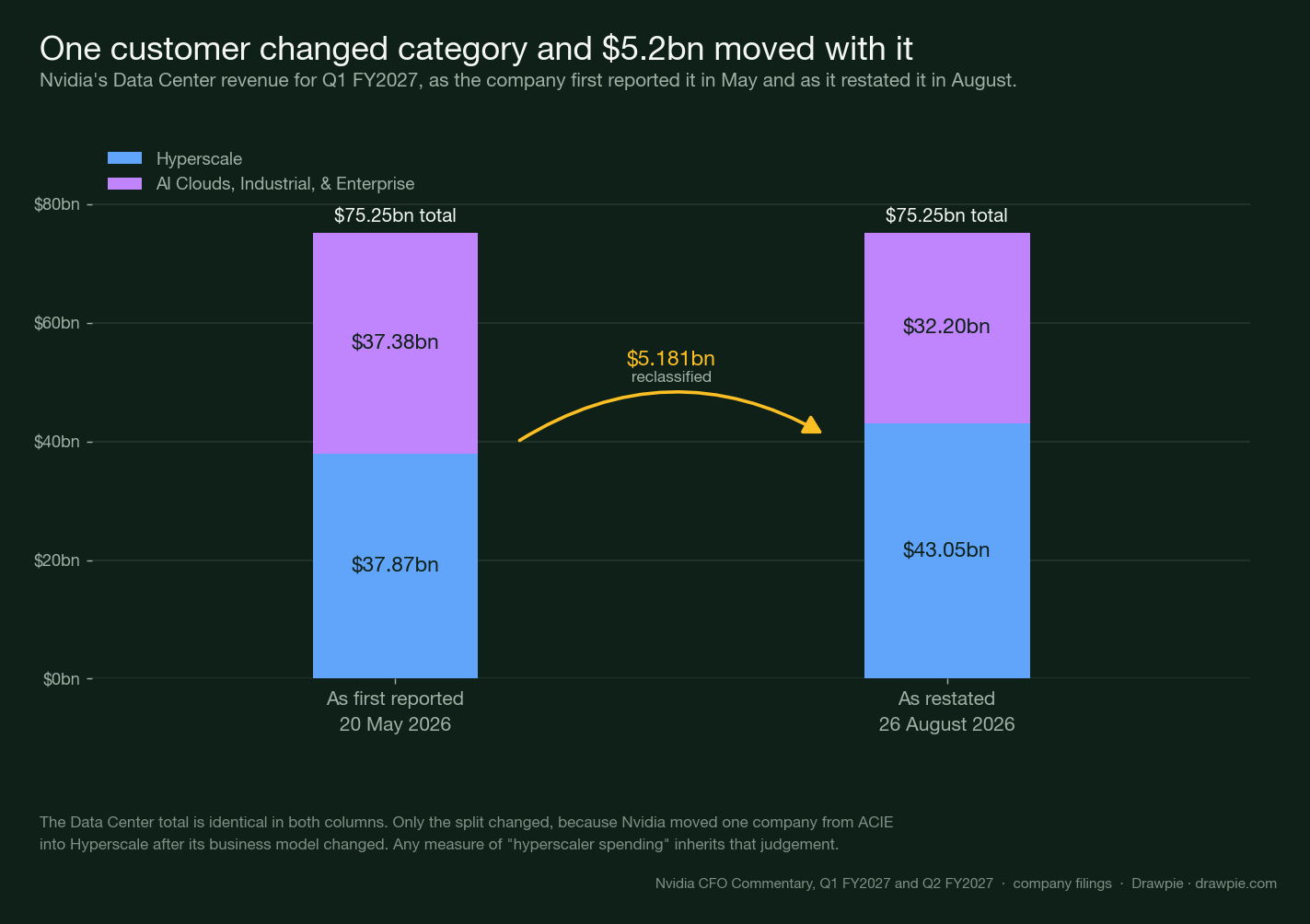
- “Hyperscaler spending” is a soft measure. Nvidia moved one customer between two Data Center buckets this quarter and $5.181 billion of a single quarter’s revenue moved with it.
Broadcom’s AI chip revenue grew 221% last quarter. Nvidia’s hyperscaler revenue grew 102%. Both figures are from filings made in the last two weeks, and together they are the clearest picture yet of whether custom silicon is taking budget away from general-purpose GPUs.
The short answer is that it is growing much faster, from much further behind, at a lower margin, in a market whose boundaries one of the two companies redrew this quarter.
Broadcom reported on 2 September; Nvidia on 26 August. Every number below is from those documents.
Start with the scale, because it is the part that gets skipped
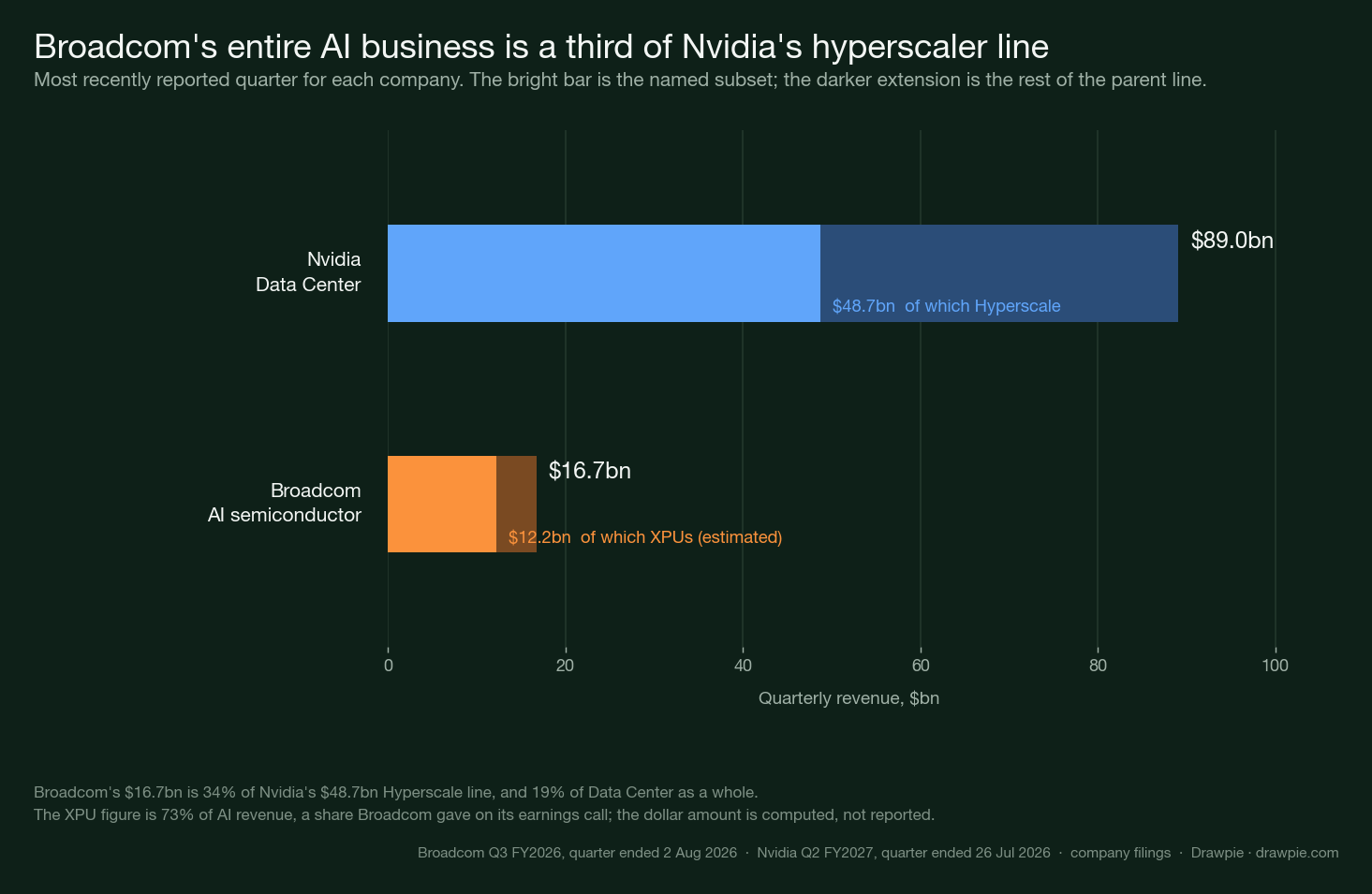
Nvidia’s Data Center revenue was $89.0 billion in the quarter to 26 July 2026. Within that, revenue from hyperscale customers was $48.7 billion.
Broadcom’s entire AI semiconductor business was $16.7 billion in the quarter to 2 August 2026 — about 34% of Nvidia’s hyperscale line, and 19% of Nvidia’s Data Center revenue as a whole.
The two quarters end seven days apart, which is close enough to compare and not close enough to call identical.
That is the base rate for everything that follows. Any story about Broadcom winning hyperscaler budget starts three times behind on the line that most directly measures it.
The argument is the growth rate, and it is genuinely striking
| Broadcom, AI semiconductor | Nvidia, Hyperscale | |
|---|---|---|
| Latest quarter | $16.7bn | $48.7bn |
| Year on year | +221% | +102% |
| Quarter on quarter | +54% | +13% |
| Next quarter | $21.7bn guided | not broken out |
Year on year, Broadcom is growing about 2.2 times as fast. Quarter on quarter — the measure that picks up a turn earliest — it is growing about 4.2 times as fast.
Growing faster off a smaller base is not the same as catching up, and nothing here says when or whether it would. But a 54% sequential quarter is not a rounding difference, and Broadcom guides to another large step: $21.7 billion of AI semiconductor revenue in the current quarter, which would be up 236% on the year.
What Broadcom is actually selling
The word “custom” is doing real work here.
Nvidia sells a GPU that many customers buy. Broadcom co-designs an accelerator that one customer buys — the customer supplies the architecture, Broadcom supplies the physical design, the IP blocks, the packaging and the manufacturing relationship. Broadcom calls the result an XPU.
Last quarter XPUs were 73% of Broadcom’s AI revenue, with shipments up more than 3.5 times year on year. The rest is networking — Ethernet switching and optics, the parts that connect accelerators to each other.
That mix matters, because it is the part of Broadcom’s AI business that is structurally not substitutable for an Nvidia GPU. A hyperscaler that has designed its own accelerator is not comparison-shopping it against an H-series part; it has already made that decision, years earlier, and Broadcom is the manufacturing partner that decision implies.
The customer list is unusually specific
On the call, Broadcom named programmes rather than gesturing at demand:
| Customer | Chip | What Broadcom said |
|---|---|---|
| Anthropic | TPU 8i | 5 gigawatts targeted for 2027, with line of sight to a further 10 GW |
| Anthropic | Google Ironwood TPU | shipments to be accelerated |
| TPU 8i | shipments to be accelerated | |
| OpenAI | Jalapeno | shipments continue; a second-generation chip taping out, a third being planned |
| Meta | MTIA | production shipments of its inference and recommendation accelerator |
Two things are worth noticing.
Capacity is quoted in gigawatts, not chips. That is now standard for large AI deployments, because power — not silicon — is the binding constraint. Five gigawatts is a figure about substations and grid connections as much as about wafers.
“Taping out” a second-generation chip is the real signal. Tape-out is the point where a design is committed to manufacturing. A customer taping out a second generation and planning a third is a customer that has made custom silicon a permanent line item, not an experiment.
Now the problem with the question itself
“Hyperscaler spending” sounds like a measurable quantity. It is not, quite.
Nvidia splits its Data Center revenue into Hyperscale and AI Clouds, Industrial, & Enterprise. In August it restated the previous quarter’s split: Hyperscale went from $37.869 billion to $43.050 billion, and the other bucket fell by exactly the same amount.
Nvidia’s explanation, in its own words: it “reclassified a company from AI Clouds, Industrial, & Enterprise (ACIE) to Hyperscale due to a change in their business model.”
The Data Center total did not move at all. One customer changed category and $5.181 billion of a single quarter’s revenue moved with it — about 12% of the Hyperscale line.
That is not an accounting irregularity; recasting prior periods after a reclassification is exactly correct. But it tells you how much judgement sits inside the number. Anyone comparing “who wins hyperscaler spending” is comparing against a line that one of the two vendors defines, and redefined by $5.2 billion in a quarter.
The evidence that cuts the other way
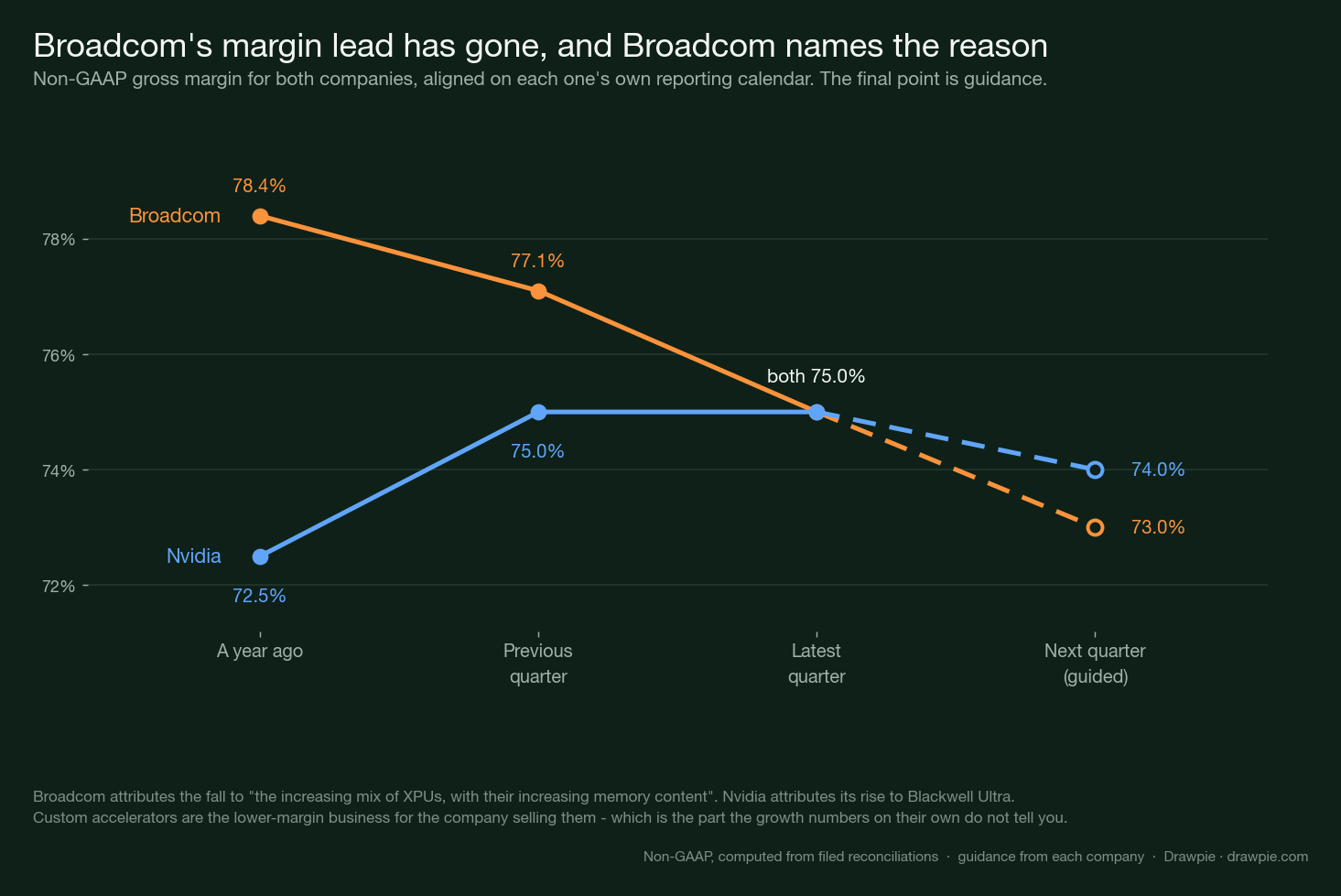
If custom accelerators were straightforwardly better business, Broadcom’s margins would be going up. They are going down, and Broadcom says why.
| Non-GAAP gross margin | A year ago | Previous quarter | Latest quarter | Next quarter (guided) |
|---|---|---|---|---|
| Broadcom | 78.4% | 77.1% | 75.0% | ~73% |
| Nvidia | 72.5% | 75.0% | 75.0% | 74.0% |
A year ago Broadcom’s gross margin led Nvidia’s by 5.9 points. In the most recent reported quarter they are both at 75.0%. On each company’s own guidance for the current quarter, Nvidia is ahead.
Broadcom attributes the fall to “the increasing mix of XPUs, with their increasing memory content.” Custom accelerators carry more memory, and memory is bought in, so a larger share of each dollar of XPU revenue leaves as cost. Nvidia attributes its own rise to Blackwell Ultra.
The business Broadcom is winning is the lower-margin one, and Broadcom is the one saying so. That is not a small caveat to a growth story; it is the price of the growth.
And Nvidia is not standing still on this
The usual framing is that a hyperscaler building its own chip buys less from Nvidia. Nvidia’s answer has been to sell the rest of the rack around someone else’s compute die — the interconnect, the CPU link, the memory, the packaging — which is what its $3.5 billion NVLink Fusion arrangement with MediaTek is for.
Under that model, a custom accelerator does not remove a customer from Nvidia’s revenue line. It changes what they buy. Which means “Broadcom wins more hyperscaler spending” and “Nvidia loses hyperscaler spending” are not automatically the same statement, and the second one does not follow from anything on this page.
What is an XPU, and how is it different from a GPU?
An XPU is a custom accelerator designed for one customer and built by Broadcom; a GPU is a general-purpose part Nvidia designs and sells to everyone.
The practical difference is who owns the architecture. Google’s TPUs, Meta’s MTIA and OpenAI’s chip are the customer’s designs — Broadcom contributes the physical implementation, the serialisers and interconnect IP, the packaging and the foundry relationship. The customer gets silicon tuned to its own workload and no one else’s; it also takes on the design risk, the multi-year commitment and the software work that Nvidia’s CUDA ecosystem would otherwise have done for it.
Is Broadcom taking market share from Nvidia?
On the evidence in these two filings, Broadcom is growing much faster than Nvidia’s hyperscale line, which by definition means its share of that spending is rising. Whether that constitutes “taking” is less clear.
Total spending is growing so fast that both can grow enormously at once — Nvidia’s hyperscale revenue still doubled year on year. And because Nvidia is now selling infrastructure around third-party accelerators as well as its own GPUs, some custom-silicon deployments show up as Nvidia revenue too. Rising share of a market that is itself more than doubling is not the same as displacement.
How much of Broadcom’s business is AI now?
Just over half of the whole company, and about four fifths of its chip business.
Broadcom’s total revenue was $29.591 billion, of which semiconductor solutions were $20.839 billion and infrastructure software $8.752 billion. The $16.7 billion of AI semiconductor revenue is about 56% of total revenue and roughly 80% of the semiconductor segment. On the Q4 guide — $21.7 billion of AI revenue against $34.8 billion total — AI would be over 60% of the company.
What does “line of sight to $115 billion” mean?
It means Broadcom’s chief executive says he can see that much demand and has secured the supply for it. It is not formal guidance.
Broadcom guides one quarter at a time, and the only guided figure here is the current quarter’s $21.7 billion. On the call the company put fiscal 2026 AI revenue at about $58 billion and described a line of sight to $115 billion in fiscal 2027 and $230 billion in fiscal 2028. Those are the company’s own characterisations of its order book, reported from the call rather than filed, and the hedge in them is the company’s, not this page’s. For scale: Nvidia’s most recent single quarter of total revenue was $96.2 billion.
Are hyperscalers moving away from Nvidia?
Not on these numbers. They are adding a second supply route rather than switching.
Every named Broadcom customer here — Google, Meta, OpenAI, Anthropic — is also a large Nvidia customer, and Nvidia’s revenue from hyperscale customers still grew 102% year on year while all of these custom programmes were running. The realistic reading is that the largest buyers are building their own silicon for the workloads they run at enormous, predictable scale, and continuing to buy GPUs for everything else.
The bottom line
The case for Broadcom winning more hyperscaler spending is real and it is made of three things: a 221% growth rate against Nvidia’s 102%, custom accelerators at 73% of AI revenue with shipments up more than 3.5 times, and named multi-year programmes at four of the largest AI buyers in the world.
The case against it being decisive is made of three others: Broadcom’s entire AI business is still about a third of Nvidia’s hyperscale line, the margin on the business it is winning is falling by its own account, and the measure everyone is arguing about moved $5.2 billion this quarter because one company was filed under a different heading.
Both sets of facts are in the same two filings. Anyone telling you only one of them is telling you half of it.
All figures are from Broadcom’s and Nvidia’s SEC filings and were checked on 3 September 2026. Figures attributed to earnings calls are marked as such. This article contains no forecast of either company’s share price and no analyst estimates.