August 2026 Lunar Eclipse: Exact Times, Live Stream, Visibility Map & Where to Watch
Update log (1)
- — 2026-09-02: rewritten after the event. Times, visibility and stream schedules moved to past tense; added what observers actually saw (~96% coverage, deep coppery Moon, photos from Oregon, Maine, Montana, California, Mississippi, Alberta, Quebec, Sicily, Spain and Turkey), the East Coast storms and Griffith Observatory's cancelled in-person event, replay links in place of live schedules, and the next lunar eclipses (20 Feb 2027 penumbral; 31 Dec 2028 total, western US/Alaska; 25–26 June 2029 total across most of the US).

- For most of the US it fell on Thursday night, 27 August, not Friday. Greatest eclipse was 12:13 a.m. ET on the 28th, but 11:13 p.m. CT, 10:13 p.m. MT and 9:13 p.m. PT — all on the 27th.
- The lower 48 is well placed. From New York, Chicago, Denver, Houston, Miami, Phoenix and Los Angeles the Moon is above the horizon for the whole three-hour partial phase. Seattle misses the first 17 minutes.
- Alaska and Hawaii are the exceptions. In Anchorage and Honolulu the Moon is still below the horizon at greatest eclipse — NASA’s own summary excludes Alaska, and our independent computation puts the Moon 7° below the horizon there.
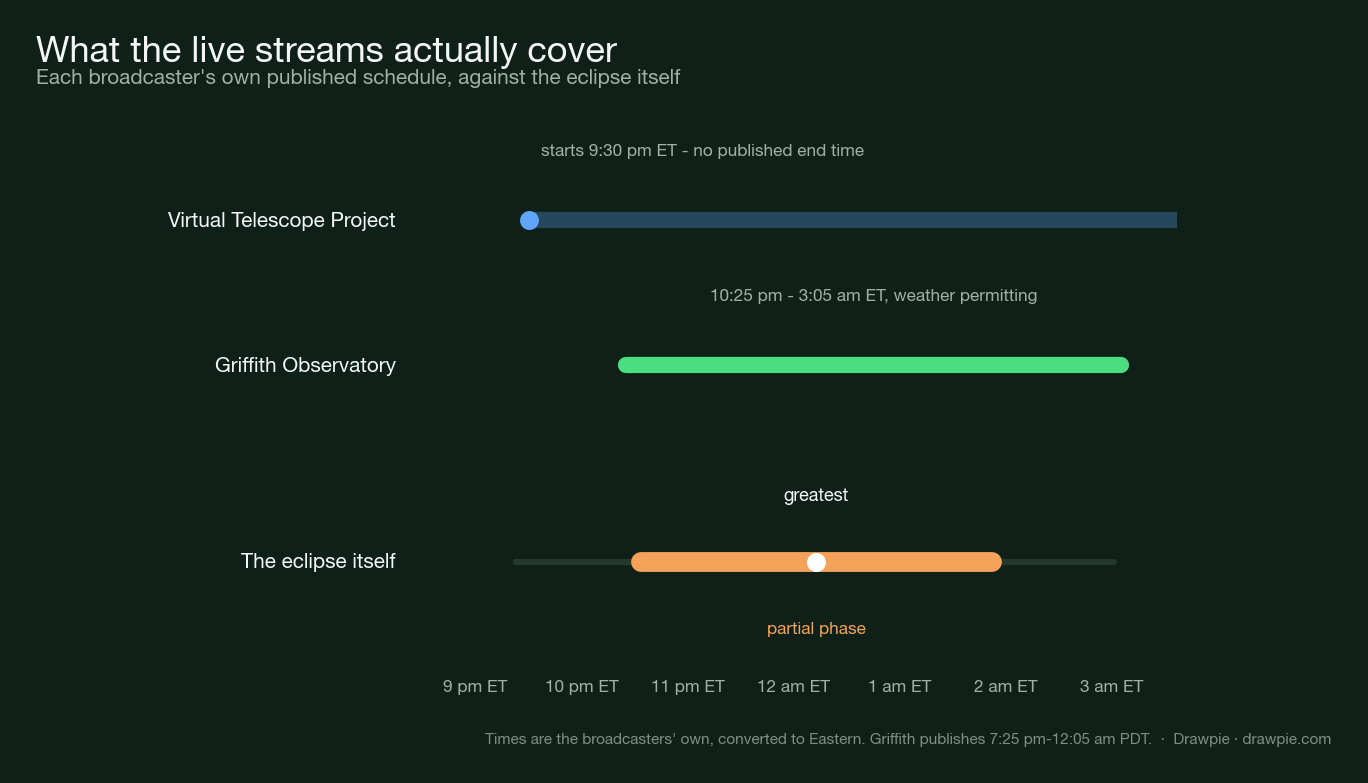
- Two free live streams cover it. Griffith Observatory broadcasts 10:25 p.m.–3:05 a.m. ET, weather permitting; the Virtual Telescope Project starts at 9:30 p.m. ET with telescopes in Italy and Chile.
The last lunar eclipse of 2026 came on the night of Thursday 27 August, and almost every national headline called it the 28th.
Both are right, which is the problem. The eclipse happens at one instant everywhere on Earth, and that instant falls on 28 August in Universal Time. In the United States it lands on Thursday evening — except on the East Coast, where it slips past midnight into Friday by thirteen minutes.
When was the August 2026 lunar eclipse?
Greatest eclipse was at 04:13 UTC on 28 August, which was 12:13 a.m. Eastern, 11:13 p.m. Central, 10:13 p.m. Mountain and 9:13 p.m. Pacific. Only the Eastern zone crossed midnight; everyone else watched on Thursday night.
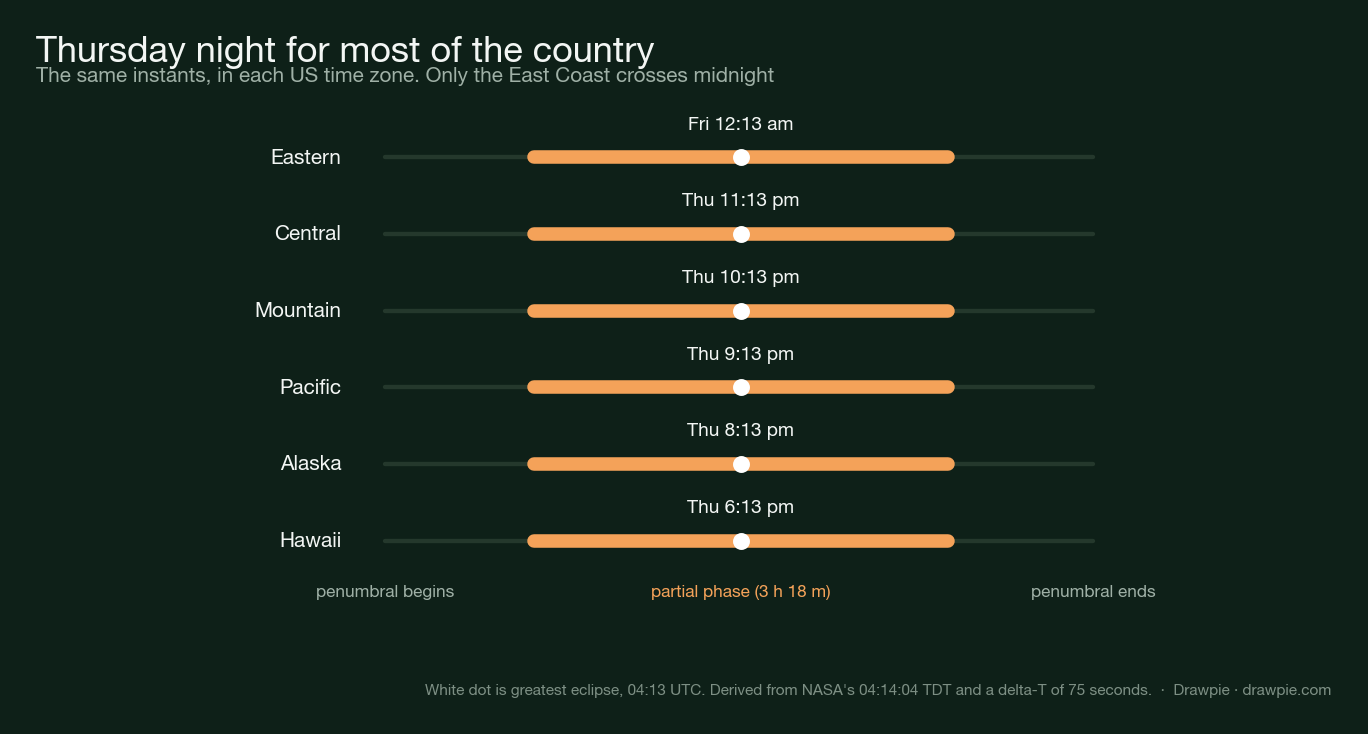
A lunar eclipse is the Earth’s shadow falling on the Moon, so unlike a solar eclipse there is no path and no local timing. Everyone who can see the Moon sees the same thing at the same moment. Here is the full sequence:
| Stage | Eastern | Pacific |
|---|---|---|
| Penumbral begins | Thu 9:23 p.m. | Thu 6:23 p.m. |
| Partial begins | Thu 10:34 p.m. | Thu 7:34 p.m. |
| Greatest eclipse | Fri 12:13 a.m. | Thu 9:13 p.m. |
| Partial ends | Fri 1:52 a.m. | Thu 10:52 p.m. |
| Penumbral ends | Fri 3:01 a.m. | Fri 12:01 a.m. |
For Central, subtract one hour from Eastern. For Mountain, subtract two. The penumbral phases at either end are the subtle ones — the Moon dims slightly but keeps its shape. The three hours and eighteen minutes in the middle were the main event.
Where in the US is the eclipse visible?
Everywhere in the lower 48 except the far northwest corner, and not in Alaska or Hawaii. For most of the country the Moon was comfortably above the horizon from the first bite to the last — where the sky was clear, which on the night it often was not.
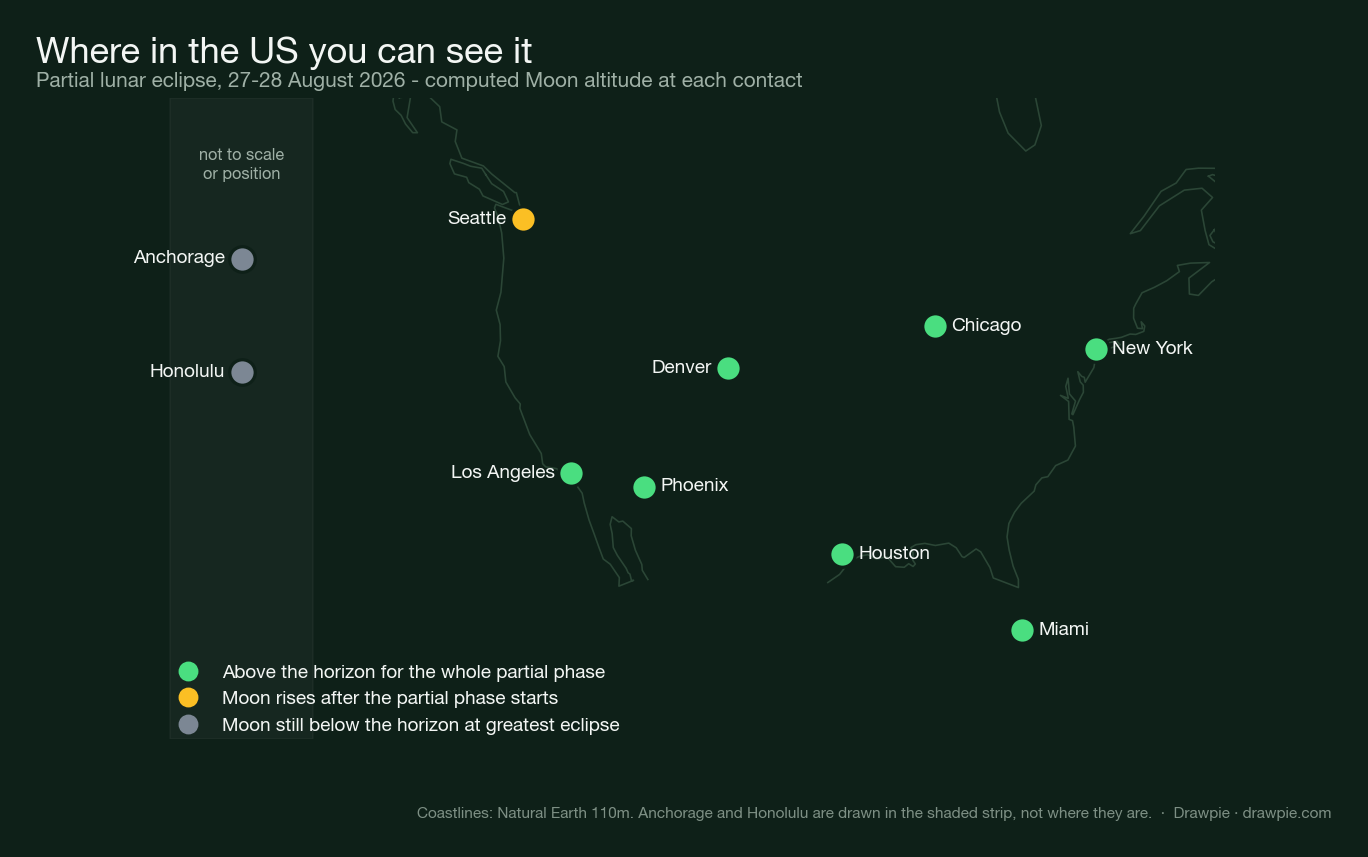
Seven of the ten cities we computed — New York, Miami, Chicago, Houston, Denver, Phoenix and Los Angeles — have the Moon up for the entire partial phase. Seattle is the near miss: the Moon rises at 7:51 p.m. local time, seventeen minutes after the partial phase has already begun, so the first bite happens below the horizon.
Alaska and Hawaii are genuinely out. In both Anchorage and Honolulu the Moon is still below the horizon when the eclipse peaks — about 7° below in each case — and rises only in time for the closing stages. NASA’s own summary reaches the same conclusion, describing the umbral phase as visible in the Americas “except Alaska and northwestern Canada”.
How high was the Moon?
High, and getting higher — which is the opposite of what British readers got. From the East Coast the Moon is around 38° up at greatest eclipse, and from Miami it is above 50°.
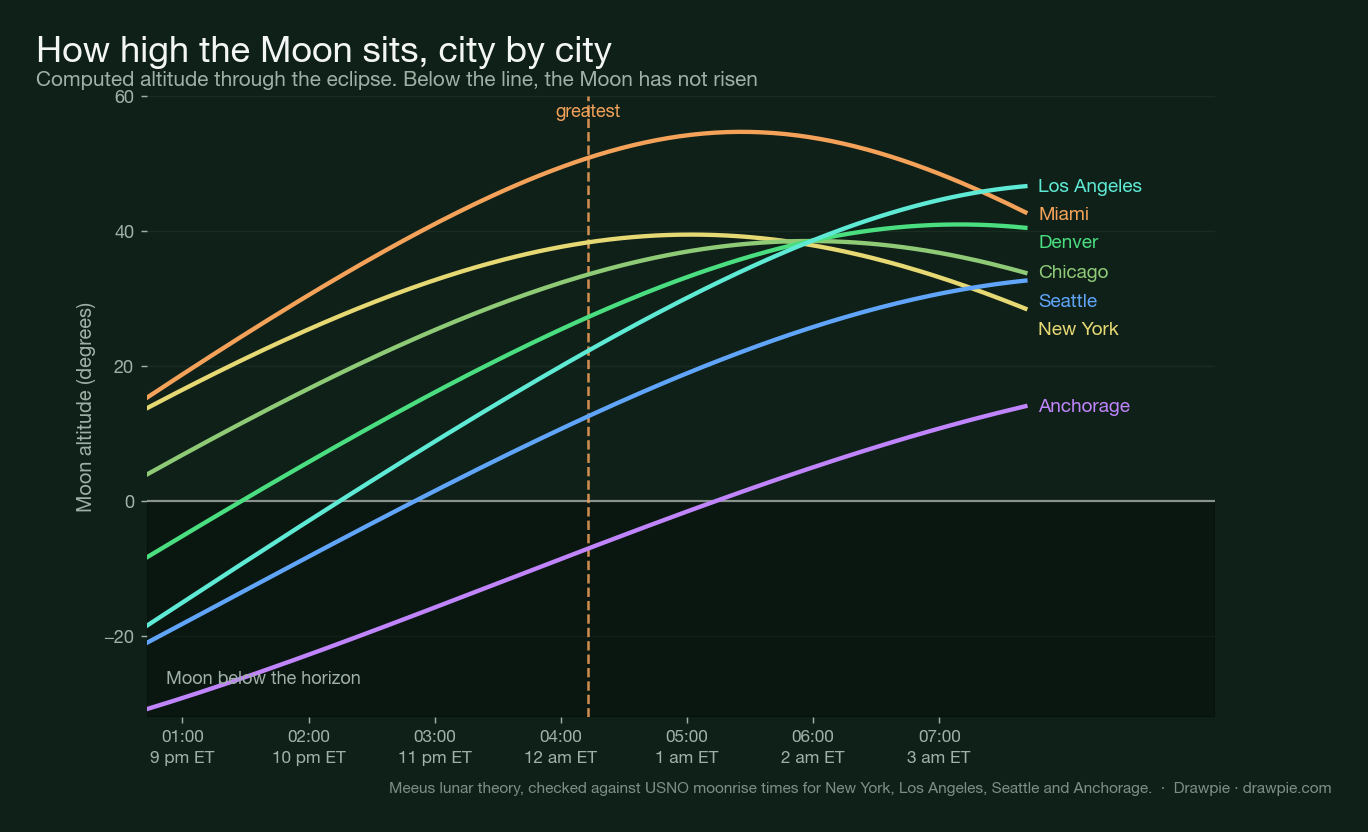
New York gets the tidiest geometry of all. The US Naval Observatory puts the Moon’s highest point of the night there at 12:14 a.m., and greatest eclipse falls at 12:13 a.m. — the eclipse peaks within two minutes of the Moon being as high as it will get.
Seattle is the hardest of the mainland cities, at about 12° at greatest, which is roughly one fist held at arm’s length above a flat horizon. That is workable, but a clear eastern horizon matters there in a way it does not in Denver or Chicago.
What did it actually look like?
Deep, dark and coppery, but not fully eclipsed. At greatest eclipse 96.3% of the Moon’s disk is inside the umbra, the dark central part of the Earth’s shadow — a sliver of the northern edge stays in sunlight all the way through.
That figure is worth pinning down, because two different numbers circulate. NASA defines umbral magnitude as the fraction of the Moon’s diameter inside the shadow, and that is 93%. The share of the visible face in shadow is a different quantity, and it is 96.3%. Both describe the same picture; a circle carries very little of its area out at the rim.
Nowhere on Earth saw totality on this date. But at 96% the effect was close enough that observers reported a crimson, near-total Moon: within an hour of the partial phase beginning the lit part was small enough for the eye to adapt and pick up the coppery colour of the shadowed portion.
You need no equipment and no filter. A lunar eclipse is safe to look at directly, which is the whole difference between this and a solar eclipse.
Where can you watch the lunar eclipse live?
Two free streams cover it, and one of them runs the entire partial phase. If your sky is clouded over, this is the fallback.
| Stream | Eastern time | Notes |
|---|---|---|
| Griffith Observatory | 10:25 p.m. – 3:05 a.m. | Weather permitting; time-lapse posted later |
| Virtual Telescope Project | From 9:30 p.m. | Telescopes in Italy and Chile |
Griffith Observatory in Los Angeles ran its broadcast from 7:25 p.m. to 12:05 a.m. Pacific, bracketing the whole partial phase. Its planned in-person public observing event was cancelled on the day — the observatory’s visitor notice announced the cancellation without giving a reason — but the grounds stayed open and the online feed went ahead, and it said a time-lapse would be posted to its YouTube channel at 8:00 a.m. Pacific on 28 August.
The Virtual Telescope Project started earlier, at 01:30 UTC — 9:30 p.m. Eastern — with commentary from Gianluca Masi and feeds from telescopes in Manciano, Italy and in Chile. It published no end time, and archives its sessions on its own WebTV page.
When is the next lunar eclipse?
Find an unobstructed view in the right direction, and give your eyes twenty minutes. That is most of it.
- Look east and high. The Moon rises in the east around sunset and climbs through the evening, so unlike the UK’s version of this eclipse you are not fighting a low horizon. In New York it is nearly overhead at the peak.
- Get away from direct light, not from the city. A lunar eclipse is bright enough to see from a lit street. What ruins it is a porch light in your eyes while your pupils are trying to adapt.
- Binoculars help more than a telescope. The whole Moon fits in the field, and the colour gradient across the shadow is the thing worth seeing.
- Start before the partial phase. Getting outside well before first contact gives your eyes time to adjust before the interesting part.
Every time on this page was fixed by orbital mechanics and did not move. The one thing no page written two days out could tell you was the cloud — and cloud is what decided it for a lot of people. Storms crossed the US East Coast that night, Griffith Observatory called off its in-person event in Los Angeles, and plenty of the best photographs came from observers who got a single break in the overcast at the right moment.
How we verified this
The contact times are derived, not copied. NASA’s five-millennium catalogue puts greatest eclipse at 04:14:04 Terrestrial Dynamical Time with a delta-T of 75 seconds — that is 04:12:49 UTC — and the partial phase at 198.1 minutes. Everything else on this page comes from those two figures. The derivation reproduces NASA’s Scientific Visualization Studio pages (2:34 and 4:13 UT) and Griffith Observatory’s own published 7:34 p.m., 9:13 p.m. and 10:52 p.m. PDT to the minute. Three publishers, one piece of arithmetic, no disagreement.
⚠️ Some sources print 4:12 rather than 4:13. Both describe 04:12:49 UTC; one rounds and the other truncates. Our own guide to this eclipse for UK readers uses 5.12am BST for the same instant, which is why the two pages appear to differ by a minute. They do not.
The Moon’s position was computed here, then checked against the US Naval Observatory. There is no astronomy library on the machine this was written on, so lunar positions come from an implementation of Meeus’s lunar theory. It is not trusted on its own: the chart script replays USNO’s published moonrise times for New York, Los Angeles, Seattle and Anchorage through it and refuses to draw anything if any of them misses by more than the stated tolerance. New York matches to the minute, Los Angeles and Seattle to one minute, Anchorage to seven.
🔴 That is why no Anchorage moonrise time appears on this page. At 61° north the Moon meets the horizon at a shallow angle, so a small altitude error becomes a large time error. The Alaska statement here is the one the computation supports — the Moon is below the horizon at greatest eclipse — and not a rise time to the minute.
✅ The visibility classes were computed before NASA’s own wording was read, and they agree. A city counts as seeing the whole partial phase when the Moon is above the horizon at both partial contacts. Anchorage and Honolulu fail that test on the computation alone; NASA’s summary independently says the umbral phase is visible in the Americas “except Alaska and northwestern Canada”.
Stream times are each broadcaster’s own. Griffith Observatory’s event page publishes 7:25 p.m.–12:05 a.m. PDT and the words “weather permitting”; the Virtual Telescope Project lists a 01:30 UTC start. Neither was taken from an article about them. The Virtual Telescope Project publishes no end time, which is why the chart shows its coverage fading rather than stopping.
Nothing here predicts cloud cover. Whether you see this eclipse depends on your local sky on the night, and no forecast that far out is worth printing.