Apple Upgrade With Klarna: Pricing, Terms and Fees Explained (2026)

- Apple Upgrade is a consumer lease provided by Klarna, not a loan and not an instalment plan. Apple’s own wording is that you do not own the device at the end. Leasing an iPhone 17 Pro for 24 months costs $767.76 and ends with you handing it back, unless you pay a buy-out fee on top.
- The buy-out fee is list price minus what you have already paid, so any path that ends in ownership costs exactly list price. In cash-flow terms that lands where an interest-free plan with a final balloon payment would, but Apple calls it a lease rather than a loan and publishes no APR for it.
- The early termination fee is every unpaid monthly payment through the end of the initial term. Leaving at month 6 of a 24-month lease therefore costs the same in total as staying to month 24; you just lose the device sooner.
- It is United States only, iPhone leases require an AT&T, T-Mobile or Verizon plan, and the iPhone Upgrade Program and iPhone Payments are being retired in the US.
Apple launched Apple Upgrade on 28 July 2026, and the important word in the announcement is one most coverage skipped: lease. Apple’s own footnote puts it plainly — “this offer is for a consumer lease, not a purchase or loan.”
That single word changes what every number in the programme means. This piece covers what it costs, what you end up owning, every fee Apple discloses, and how the arithmetic compares with simply financing the device at 0%.
What is Apple Upgrade, and is it a loan?
It is a lease, and the leasing company is Klarna rather than Apple.
Apple Upgrade lets you take an iPhone, iPad, Mac or Apple Watch for a fixed monthly payment. Klarna Inc. is the lease provider: it runs the credit decision, collects the payments, and holds the agreement. Apple handles the shopping, the delivery and the support; Klarna provides the lease. Unless you exercise the purchase option at the end, the device does not become yours. You manage payments in the Klarna app.
The terms depend on the product:
| Product | Lease terms offered | Monthly payments from |
|---|---|---|
| iPhone | 12 or 24 months | $17.99 |
| Apple Watch | 12 or 24 months | $11.99 |
| iPad | 24 or 36 months | $11.99 |
| Mac | 24 or 36 months | $24.99 |
Apple notes that the 12- and 36-month terms are not available on every model. The first payment falls due roughly 30 days after the device ships or is ready for collection. There is no security deposit, and — unlike most financing — you cannot put money down to lower the monthly payment.
Approval runs on a soft credit inquiry, which Apple states will not affect your credit score, with final approval at checkout.
How much does Apple Upgrade cost?
Between half and three-quarters of the device’s list price, depending on the term, if you hand it back at the end.
Apple publishes four worked examples. Multiply each monthly payment by its term and you get what the lease actually costs over its life:
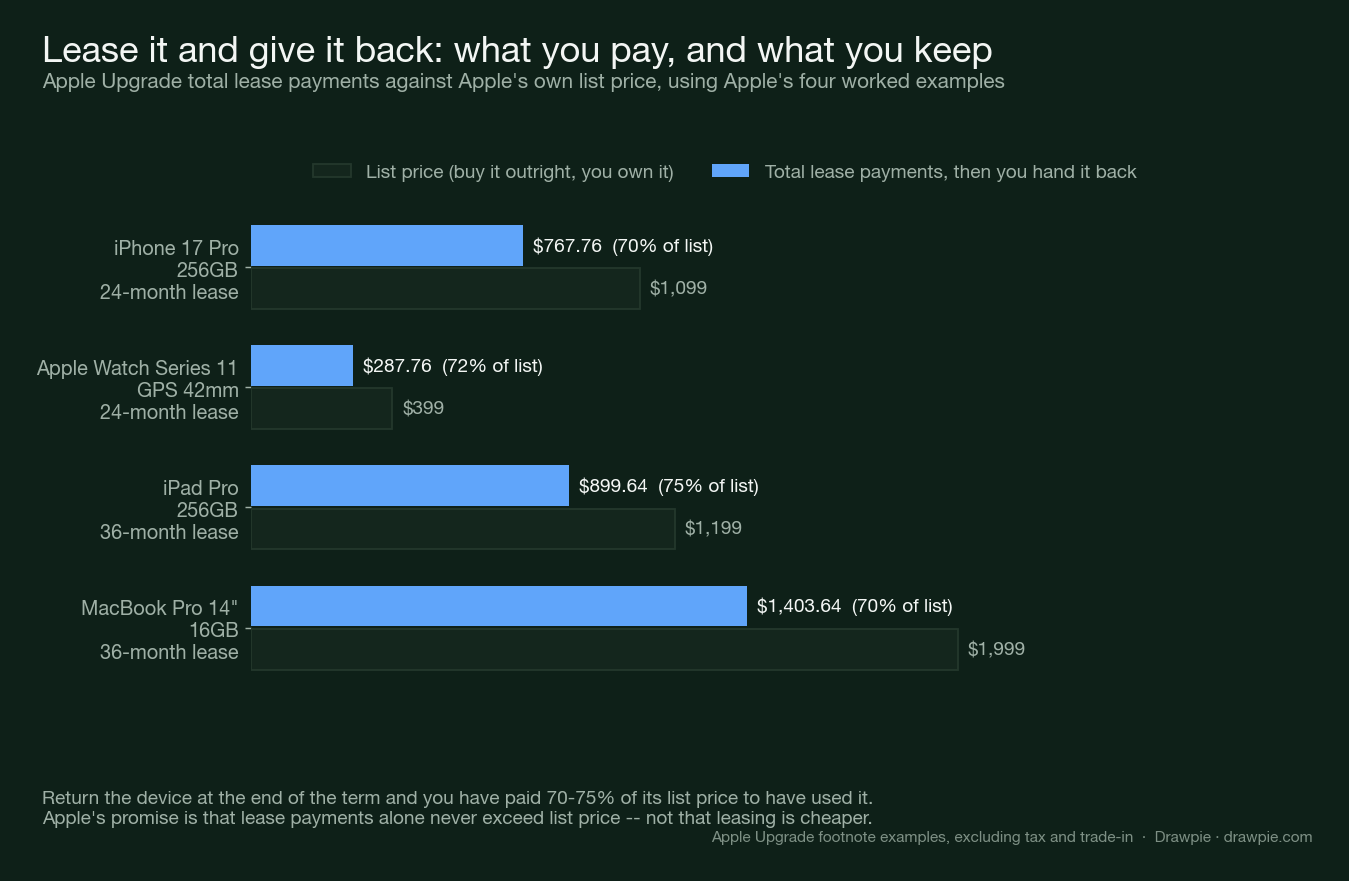
| Device | List price | Term | Monthly | Total paid | Share of list |
|---|---|---|---|---|---|
| iPhone 17 Pro 256GB | $1,099 | 24 months | $31.99 | $767.76 | 70% |
| iPhone 17 Pro 256GB | $1,099 | 12 months | $45.99 | $551.88 | 50% |
| Apple Watch Series 11 42mm | $399 | 24 months | $11.99 | $287.76 | 72% |
| Apple Watch Series 11 42mm | $399 | 12 months | $21.99 | $263.88 | 66% |
| iPad Pro 256GB | $1,199 | 36 months | $24.99 | $899.64 | 75% |
| iPad Pro 256GB | $1,199 | 24 months | $31.99 | $767.76 | 64% |
| MacBook Pro 14-inch 16GB | $1,999 | 36 months | $38.99 | $1,403.64 | 70% |
| MacBook Pro 14-inch 16GB | $1,999 | 24 months | $53.99 | $1,295.76 | 65% |
All figures exclude sales tax and any trade-in credit, as Apple’s do. Note the direction of travel on the shorter terms: a 12-month iPhone lease costs more per month but less in total, because you are paying for less time with the device. The monthly number and the total move in opposite directions, which is the thing a “from $17.99 a month” headline is least equipped to tell you.
One caveat on the iPad row. Apple’s press release calls that example an 11-inch iPad Pro 256GB at $1,199; the programme page footnote calls it an iPad Pro 256GB at $1,099, with the same $24.99 monthly payment. We have used the press release figure, so treat the iPad percentage as the softest number in the table.
What do you actually own at the end?
Nothing, unless you pay again. Apple’s FAQ answers its own question “Do I own my device at the end of my lease term?” with “No, you do not.”
At the end of the initial term you have three choices: upgrade to a new device and return the old one, return it and leave, or buy it. The buy-out has a defined price — Apple calls it the purchase option fee, and defines it as list price minus the lease payments you have made, minus any remaining discounts or trade-in credit.
That definition has a consequence Apple states outright: you will not pay more than the device’s list price. Run it on the iPhone example and the arithmetic is exact.
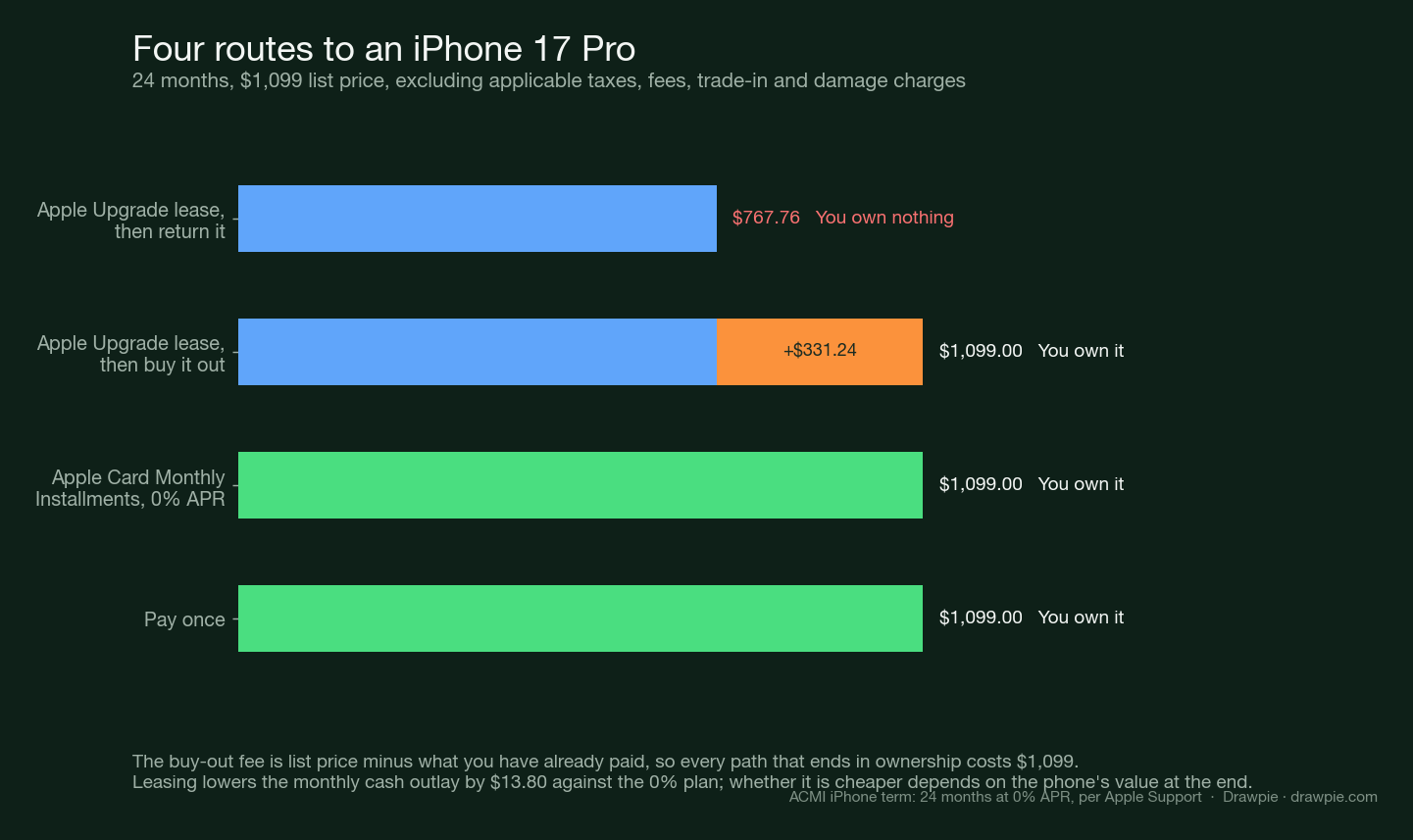
| Route | Monthly | Paid over 24 months | Extra to own it | Total | You end up with |
|---|---|---|---|---|---|
| Apple Upgrade, then return | $31.99 | $767.76 | — | $767.76 | Nothing |
| Apple Upgrade, then buy out | $31.99 | $767.76 | $331.24 | $1,099.00 | The phone |
| Apple Card Monthly Installments | $45.79 | $1,099.00 | — | $1,099.00 | The phone, owned from day one |
| Pay once | — | $1,099.00 | — | $1,099.00 | The phone |
Every route that ends with you owning the phone costs exactly $1,099. Ignoring tax, damage fees and any credits, the cash flows of leasing-then-buying land in the same place as an interest-free instalment plan with a final balloon payment — though that is a description of where the money goes, not a label Apple uses. Apple states this is not a purchase or a loan and publishes no APR for it. Apple Card Monthly Installments, by contrast, is an instalment purchase at an explicit 0% APR over 24 months for an iPhone: you buy the phone on day one and simply pay it off, with no balance and no decision left at the end.
Which makes the lease’s real proposition narrow and specific: it is about $13.80 a month cheaper than the 0% instalment option, and the price of that discount is owning nothing after two years.
(The ACMI monthly figure is list price divided by 24; Apple rounds it to $45.79, so the final instalment adjusts by a few cents to land on $1,099. Apple Card’s 3% Daily Cash applies on both routes but not equally: on the lease you earn it on each payment as you make it, which on $767.76 of payments comes to $23.03, while ACMI pays 3% of the full $1,099 — $32.97 — up front. That is about $10 in ACMI’s favour, before counting the fact that you get it two years earlier.)
What fees does Apple Upgrade charge?
None inside the monthly payment. Three charges sit outside it, across four situations, and one of them is large.
Apple’s FAQ says there are “no fees associated with your monthly lease payment.” The charges arrive when you deviate from the plan, and leaving early and upgrading early are billed the same way:
| Fee | When it applies | How much |
|---|---|---|
| Early termination fee | Leaving before the initial term ends, after the first 14 days | Every unpaid monthly payment through the end of the initial term, plus applicable taxes and fees |
| Early upgrade | Upgrading before you have made every monthly payment on the current lease | The same early termination fee — all unpaid payments, plus taxes and fees — plus any damage fee, paid to close the old lease before the new one starts |
| Damage fee | Device returned lost, stolen, or not in the required condition | Not published; AppleCare coverage can reduce or avoid it, though AppleCare service fees still apply |
| Purchase option fee | Choosing to keep the device | List price minus payments made, minus remaining credits |
Those first two rows are the same fee. Apple’s own upgrade FAQ is explicit: you can upgrade with no fee only “once you’ve completed all your monthly payments” — all 24 of them on a 24-month lease — and upgrading before that means closing the current lease by paying every unpaid payment first. So the programme’s headline flexibility, upgrading whenever you like, is priced at the full remaining term.
That fee deserves its own look, because “early termination fee” normally implies a penalty you can shrink by waiting. Here it does not shrink your total at all.
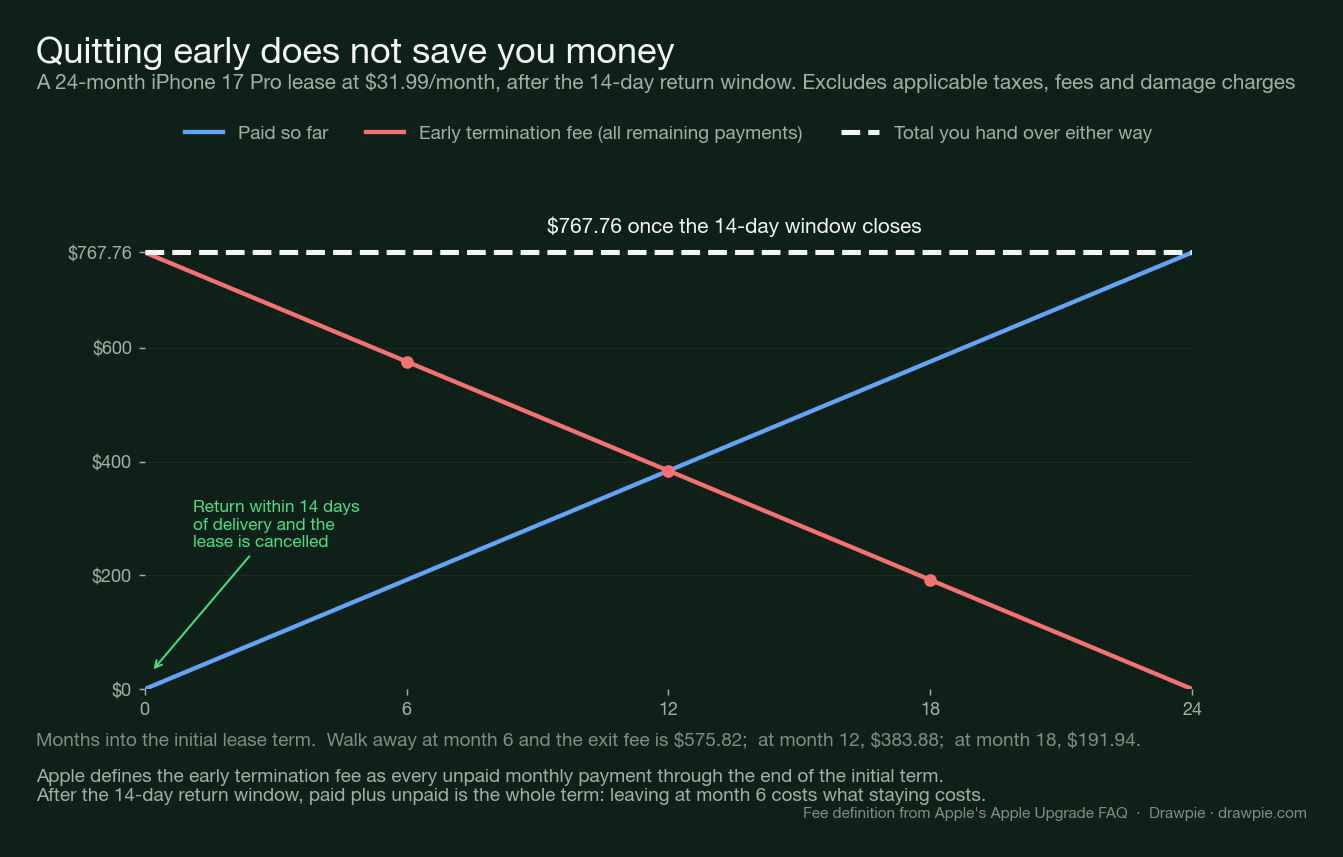
| Month you leave | Paid so far | Early termination fee | Total handed over |
|---|---|---|---|
| Within 14 days of delivery | $0 | None — return it and the lease is cancelled | $0 |
| Month 6 | $191.94 | $575.82 | $767.76 |
| Month 12 | $383.88 | $383.88 | $767.76 |
| Month 18 | $575.82 | $191.94 | $767.76 |
| Month 24 (term ends) | $767.76 | — | $767.76 |
Because the fee is defined as everything you have not yet paid, what you have paid plus what you owe is always the whole term. Walking away early costs exactly what staying costs. You simply stop having the device.
The one genuine exit is the first two weeks: return the device within 14 days of receiving it and the lease is cancelled outright.
Two more things behave like fees without being called one. If you reach the end of your term and do nothing, the lease converts to month-to-month for up to six months and your payment may rise — any trade-in credit stops applying at that point, because it only ever covered the initial term. Take no action by the end of that window and Klarna charges you the purchase option fee and the device becomes yours by default. And if the device is lost or stolen without AppleCare+ with Theft and Loss, you keep paying monthly until you either pay the termination fee or buy it outright.
Who can get Apple Upgrade, and what does it require?
United States residents with a Klarna account, and iPhone leases come with a carrier condition.
- Where: the US only, excluding US territories. Devices ship to US addresses or are collected from US Apple Stores. It has not launched anywhere else, so there is no UK, Canadian or Australian version to compare
- Who: 18 or over (or the legal age in your state), a valid Social Security Number or ITIN, an accepted credit or debit card, an Apple Account in good standing, a Klarna account, and a phone that can receive verification codes
- iPhone only: you must connect to AT&T, T-Mobile or Verizon, and prepaid plans are not allowed. The leased iPhone is unlocked, so you can switch carriers afterwards. iPad, Mac and Apple Watch leases have no carrier requirement
- Payment methods: debit cards and most major credit cards. American Express and UnionPay are not accepted, and neither are cards issued by Chase or Capital One. Apple Pay and PayPal cannot be used either
- Not eligible: refurbished devices, and the Employee Purchase Plan, corporate purchase programmes, Apple at Work, and the Government, Education and Veterans and Military stores
Some products are excluded from the programme entirely: iPhone 16, iPhone 16 Plus, Apple Watch SE, MacBook Neo, Mac mini, iPad (A16) and Studio Display. The pattern is the cheaper end of each line — which fits a lease structure that depends on residual value.
A few practical notes: you can lease several devices but must apply for each separately; AppleCare is not included and is billed by Apple rather than Klarna, with a 60-day window after enrolling to add it; a trade-in lowers your payments across the initial term only, and you cannot trade in again when you upgrade; and if you never collect a store order, the lease cancels after 7 days and charges are refunded.
What happens to the iPhone Upgrade Program?
It is being retired in the United States, along with iPhone Payments.
Apple is closing both as Apple Upgrade launches. Existing iPhone Upgrade Program members are pointed to four options: lease through Apple Upgrade, finance with Apple Card Monthly Installments, buy the device outright, or use carrier financing.
The swap is not like for like. The iPhone Upgrade Program was an instalment loan — written by Citizens Bank rather than by Apple — that bundled AppleCare+ and ended with you owning the phone. Apple Upgrade is a lease from a buy-now-pay-later provider, excludes AppleCare, and ends with you owning nothing by default. The monthly number may look similar; the thing you get for it is not.
Is Apple Upgrade worth it?
It is worth it for one specific customer, and mildly bad value for everyone else.
It may suit you if you already upgrade on a fixed cycle — but only after one calculation the programme does not do for you. Leasing an iPhone 17 Pro for two years costs $767.76 and Apple handles the disposal. Buying it costs $1,099, and after two years you still hold a phone you can sell or trade in. The difference is $331.24, and that is your break-even: if a two-year-old iPhone 17 Pro is worth more than that in resale or trade-in credit, buying it and moving it on beats leasing it, even on the fixed-cycle habit the lease is designed around. Pay with an Apple Card and the Daily Cash difference pulls the break-even down to about $321.
How likely you are to clear that bar depends less on the phone than on how you sell it. Private resale and trade-in credit for the same handset are not close to each other, and trade-in quotes in particular can come in well under a private sale. Check what your specific model actually fetches on the route you would really use, rather than the route that produces the nicer number.
For the same reason, the trade-in credit at enrolment is not a discount the programme gives you. It is your own existing device, converted into someone else’s payments.
It is poor value if you keep hardware. Anyone who runs a phone for four years is being offered a worse version of a deal Apple already sells them: 0% instalments that end in ownership. Paying $13.80 a month less to own nothing is only a discount if the ownership was worthless to you.
The structural change is in what kind of product this is. The iPhone Upgrade Program was an instalment loan written by Citizens Bank; Apple Upgrade is a lease written by a buy-now-pay-later company, and a lease brings return conditions, damage assessments and an exit that is only cheap at the scheduled moments. Between those moments, as the arithmetic above shows, there is no cheap way out. That is a different consumer product wearing a similar monthly number, and the monthly number is the part the marketing leads with.
Our verdict: fine as a subscription to hardware, weak as a way to buy it. Treat the monthly payment as rent rather than as a purchase spread out, and the decision gets much clearer. If you want the phone at the end, the 0% instalment plan costs the same in total and skips the return inspection.
If you are weighing this up against simply paying more later, our piece on why Apple is raising prices over the memory shortage covers the pressure on hardware pricing that sits behind all of this.
How we verified this
Every figure here comes from Apple’s own published material, checked on 29 July 2026: the Apple Upgrade press release of 28 July 2026, the Apple Upgrade programme page and its FAQ, and Apple’s support documentation for Apple Card Monthly Installments. The four device examples — list price and typical monthly payment per term — are Apple’s worked examples, quoted excluding taxes and any trade-in credit exactly as Apple states them. Totals, percentages and buy-out figures in this article are arithmetic applied to those examples using Apple’s own definitions of the purchase option fee and the early termination fee; no rate, residual value or effective APR has been modelled or inferred, and every calculation can be redone from the numbers on the page.
One discrepancy is left standing rather than resolved: Apple’s press release gives the iPad Pro example as an 11-inch iPad Pro 256GB with a purchase price of $1,199, while the programme page footnote gives an iPad Pro 256GB at $1,099 — with an identical $24.99 monthly payment on a 36-month term in both. We use the press release figure and flag the conflict rather than pick silently, so the iPad percentage in this article carries that uncertainty.
One fee is described without a figure because Apple publishes none: the damage fee. Apple states what triggers it and that AppleCare coverage can reduce or avoid it, while noting AppleCare’s own service fee can still apply after assessment. Every other charge in this article is quoted from Apple’s own definition, including upgrading early, which an earlier version of this piece wrongly described as a separate undisclosed fee — Apple’s upgrade FAQ states that leaving early to upgrade means paying the same early termination fee as leaving altogether. Klarna’s lease agreement is issued at application rather than published, so everything here is what Apple discloses publicly; the binding document is the one shown at checkout.
Two claims are deliberately narrow. Describing the lease-then-buy path as landing where interest-free instalments plus a balloon payment would is a statement about cash flow, not a characterisation of the product: Apple calls it a consumer lease rather than a loan and publishes no APR for it. And the comparison with buying is stated as a break-even resale figure rather than a verdict, because whether $331.24 is beaten by a two-year-old handset’s resale value is a forecast, not something Apple documents.