Andy Burnham's First Month as Prime Minister: What He Has Done
Update log (1)
- — Andy Burnham is now prime minister. He won the Makerfield by-election on 19 June 2026, Keir Starmer announced his resignation on 22 June, and Burnham was elected Labour leader unopposed on 17 July before taking office on 20 July. This page previously set out whether he could reach Number 10; it now covers what he has done since arriving, including the cabinet and the first month's policies.
- Andy Burnham has been prime minister since 20 July 2026. He was elected Labour leader unopposed three days earlier, nominated by more than 94% of the party’s MPs after Keir Starmer said on 22 June that he would resign.
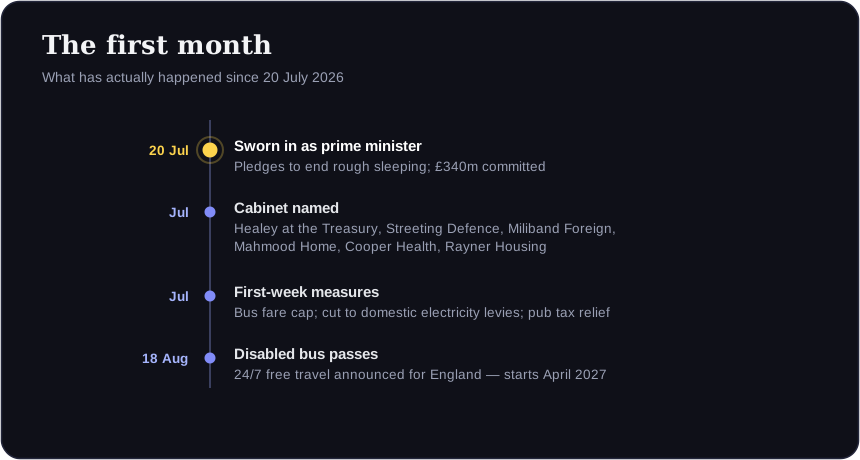
- His first act was on homelessness: a pledge to end rough sleeping, with £340 million committed. The first week brought a bus fare cap, a cut to domestic electricity levies and tax relief for pubs.
- The three colleagues most often named as his rivals — Wes Streeting, Angela Rayner and Shabana Mahmood — all sit in his cabinet, at Defence, Housing and the Home Office. So does Ed Miliband, who beat him to the leadership in 2010, as Foreign Secretary.
- The agenda he brought from Greater Manchester is devolution and public control of essentials. The clearest example is the Bee Network, which took buses back into public control for the first time in an English city region since deregulation.
Andy Burnham has been prime minister since Monday 20 July 2026. He got the job without an election and without a contest — nominated by more than 94% of Labour’s MPs and elected unopposed.
This page used to ask whether he could reach Number 10. That question has been answered, so here is what has actually happened since.
How did Andy Burnham become prime minister?
In four steps over five weeks, none of which involved a general election or a leadership ballot.
| Date | What happened |
|---|---|
| 19 June 2026 | Wins the Makerfield by-election, returning to Parliament |
| 22 June 2026 | Keir Starmer announces he will resign as leader and prime minister |
| 17 July 2026 | Elected Labour leader unopposed, nominated by over 94% of Labour MPs |
| 20 July 2026 | Becomes prime minister |
The by-election mattered because a Labour leader has to be an MP, and Burnham had spent nine years as a mayor instead. Once Starmer went — pushed by a party that had lost confidence in him after a punishing run of polling and local election results — the obstacle that had defined Burnham’s position for years simply was not there any more.
He did not beat anyone. When nominations closed he was the only eligible candidate, with 379 nominations. The contest everyone had expected did not happen.
What has he done in his first month?
Started with homelessness, then moved quickly to visible cost-of-living measures.
| When | What |
|---|---|
| Day one | Pledge to end rough sleeping, with £340 million committed |
| First week | Bus fare cap; cut to levies on domestic electricity bills; tax relief for pubs |
| 18 August | 24/7 free bus travel announced for disabled pass holders in England, starting April 2027 |
The pattern is recognisable to anyone who watched him in Manchester: transport, housing and the price of everyday things, announced fast and in plain language. The disabled bus pass change is the clearest example of the continuity — we covered that announcement in full , including the detail that Greater Manchester had already done it for itself in March.
Who is in his cabinet?
The people most often described as his rivals are all in it.
| Post | Who |
|---|---|
| Chancellor of the Exchequer | John Healey |
| Foreign Secretary | Ed Miliband |
| Home Secretary | Shabana Mahmood |
| Defence Secretary | Wes Streeting |
| Health Secretary | Yvette Cooper |
| Housing Secretary | Angela Rayner |
Two things stand out. Streeting, Rayner and Mahmood were the three names most commonly listed as competitors for the succession; all three took senior posts rather than running against him. And Ed Miliband, who beat Burnham to the Labour leadership in 2010, is his Foreign Secretary.
Who is Andy Burnham?
A Merseyside-born former health secretary who spent nine years as a metro mayor and came back.
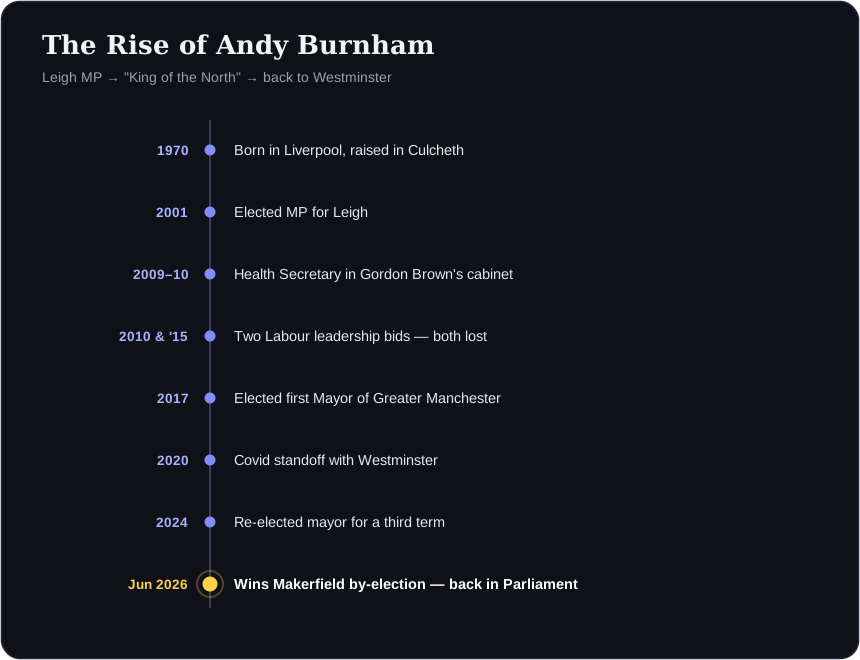
Andrew Murray Burnham was born in Liverpool on 7 January 1970, the son of a telephone engineer and a receptionist, and grew up in Culcheth between Liverpool and Manchester. He studied at Fitzwilliam College, Cambridge, wrote for trade magazines, and worked for the Labour MP Tessa Jowell before winning Leigh in 2001.
Under Blair and Brown he served at the Home Office, the Treasury and as Culture Secretary, becoming Health Secretary in 2009. As Culture Secretary he attended the memorial for the Liverpool fans who died at Hillsborough, and went on to be one of the most persistent parliamentary champions of the Hillsborough families’ campaign — a cause still closely associated with him.
He ran for the Labour leadership twice and lost twice: to Ed Miliband in 2010 and to Jeremy Corbyn in 2015. The detour that followed is what made him. In 2017 he became the first Mayor of Greater Manchester, winning again in 2021 and 2024.
The nickname came in October 2020, when he staged a public standoff with Boris Johnson’s government over the support offered to Greater Manchester under Tier 3 Covid restrictions. Standing outside to demand a better deal for local workers, he became the face of a North that felt short-changed — and “King of the North” stuck.
What is the Bee Network, and why does it keep coming up?
It is the Greater Manchester transport network he built by taking buses back into public control — and it is the template for what he is now doing nationally.
Franchising returned Manchester’s buses to public control for the first time in an English city region since 1980s deregulation, and folded buses, trams and cycling into one branded network. Alongside it he ran “A Bed Every Night” on homelessness, giving up part of his salary to a homelessness fund, and a “Good Landlords Charter” on renters’ rights.
His line as mayor was: “There’s a better way than the Whitehall way.” The awkwardness of that slogan is that he now runs Whitehall.
What is he trying to do?
Push power and money out of London, and put the basics under stronger public control.
That is the thread connecting the mayoralty to the premiership: devolution, reindustrialisation, and public control of things people cannot opt out of buying — transport, energy, housing. His first speech in office framed it as taking power out of Westminster and into every postcode.
Whether it holds is genuinely open. He inherits a party that lost heavily in the 2025 locals, a challenge from Reform UK, and an autumn budget he has not yet delivered. This page does not predict how that goes.
What to take from it
- He is prime minister, not a contender. Since 20 July 2026.
- He was elected unopposed. More than 94% of Labour MPs nominated him; there was no ballot.
- The rivals became the cabinet. Streeting, Rayner and Mahmood all serve under him; so does the man who beat him in 2010.
- The first month was transport, housing and bills — the same territory as the mayoralty.
- The hard part has not happened yet. The budget, and whether the early goodwill survives it, are ahead of him.
Sources
| Source | What it supports here |
|---|---|
| GOV.UK: Andy Burnham’s first speech as Prime Minister, 20 July 2026 | The date he took office and the framing of his agenda in his own words |
| GOV.UK: Free bus travel 24/7 for disabled people | The 18 August announcement, and his own statement that he did the same thing in Greater Manchester |
| Wikipedia: 2026 Labour Party leadership election | The nomination count, that he stood unopposed, and the 17 July result |
| Wikipedia: 2026 Makerfield by-election | The 19 June by-election result that returned him to Parliament |
Checked 18 August 2026. Cabinet posts are those reported at the time of appointment. No affiliate links, and no payment was received for any link on this page.
How we verified this
This page was rewritten because its central question had been answered. The earlier version, published on 20 June 2026, asked whether Burnham could become prime minister and set out the obstacles: that Starmer had vowed to stay, that a contest needed 81 MPs, and that Streeting, Rayner and Mahmood were rivals. All three were overtaken by events within a month. The rewrite keeps the biographical record, which was not affected, and replaces the speculative sections with what happened.
The leadership sequence is stated with its dates because the compressed version misleads. The by-election win was 19 June 2026; Starmer’s resignation announcement was 22 June; Burnham was elected leader on 17 July, unopposed, with nominations from more than 94% of Labour MPs; he took office on 20 July. He did not defeat anyone in a contest, and this page does not describe it as a victory over rivals.
Cabinet posts are reported from coverage of the appointments, not from an official list we retrieved. They are presented as the posts reported at the time of the appointments. Reshuffles happen, and a reader arriving later should check the current holder rather than assume this page is live.
The £340 million homelessness figure and the first-week measures are as reported around the first days in office. Where a measure was announced rather than legislated, this page says announced. Nothing here claims a policy is in force unless the source says so.
The slug still refers to “next prime minister” and that is deliberate. Changing it would need a redirect and would discard the ranking history this page has built. The title and content have been corrected; the URL is left alone, per our practice of not moving URLs for cosmetic reasons.
No prediction is offered about how the premiership goes. Polling movement, the autumn budget and whether the early measures hold are all outside what this page will claim.