A Toxic Love Story on Netflix: The True Story, the Ending Explained, and Whether It Earns Its Twist
Update log (2)
- — Add an entry dated 2026-09-02 recording that Rotten Tomatoes now shows a 100% Tomatometer from 15 critic reviews against a 64% audience score, replacing the 'no score yet' note from launch week; that Netflix availability was re-checked and is unchanged (Netflix-only, no rental or purchase tier); and that the Bureau of Prisons inmate locator still lists Ian Diaz at FMC Fort Worth with a 31 January 2031 projected release.
- — Published two days after release. Rotten Tomatoes had six critic reviews and no Tomatometer score at the time of writing.

- Yes, it is a true story. Michelle Hadley spent 88 days in an Orange County jail in 2016 for a campaign of threats and staged sexual assaults that her ex-boyfriend — a serving deputy US marshal — and his new wife had manufactured against themselves.
- Ian Diaz was convicted in March 2023 of conspiracy to commit cyberstalking, cyberstalking, perjury and obstruction, and sentenced to 10 years. Angela Connell pleaded guilty in 2017 and served five years. Hadley was never convicted of anything.
- The IP addresses behind the threatening emails traced back to the couple’s own condo. A federal judge later found that any reasonably competent investigator would have found no probable cause to arrest Hadley.
- Anaheim settled Hadley’s civil suit in 2021. Her legal team reported the figure at $1.795 million.
A Toxic Love Story arrived on Netflix on 22 July 2026 — an 89-minute documentary directed by Alexandra Lacey about a case that began with anonymous emails in a comfortable Orange County suburb and ended with a federal law enforcement officer in prison.
Yes, it is a true story. All three people are real, all three names are on court records, and the outcome is not in dispute: one of them was convicted after a federal trial, one pleaded guilty, and one spent 88 days in jail for something she did not do.
This is the full account of what happened, what the ending means, and where everyone is now.
⚠️ Everything below is a spoiler. If you have not watched it yet and want the reveal to land, come back afterwards.
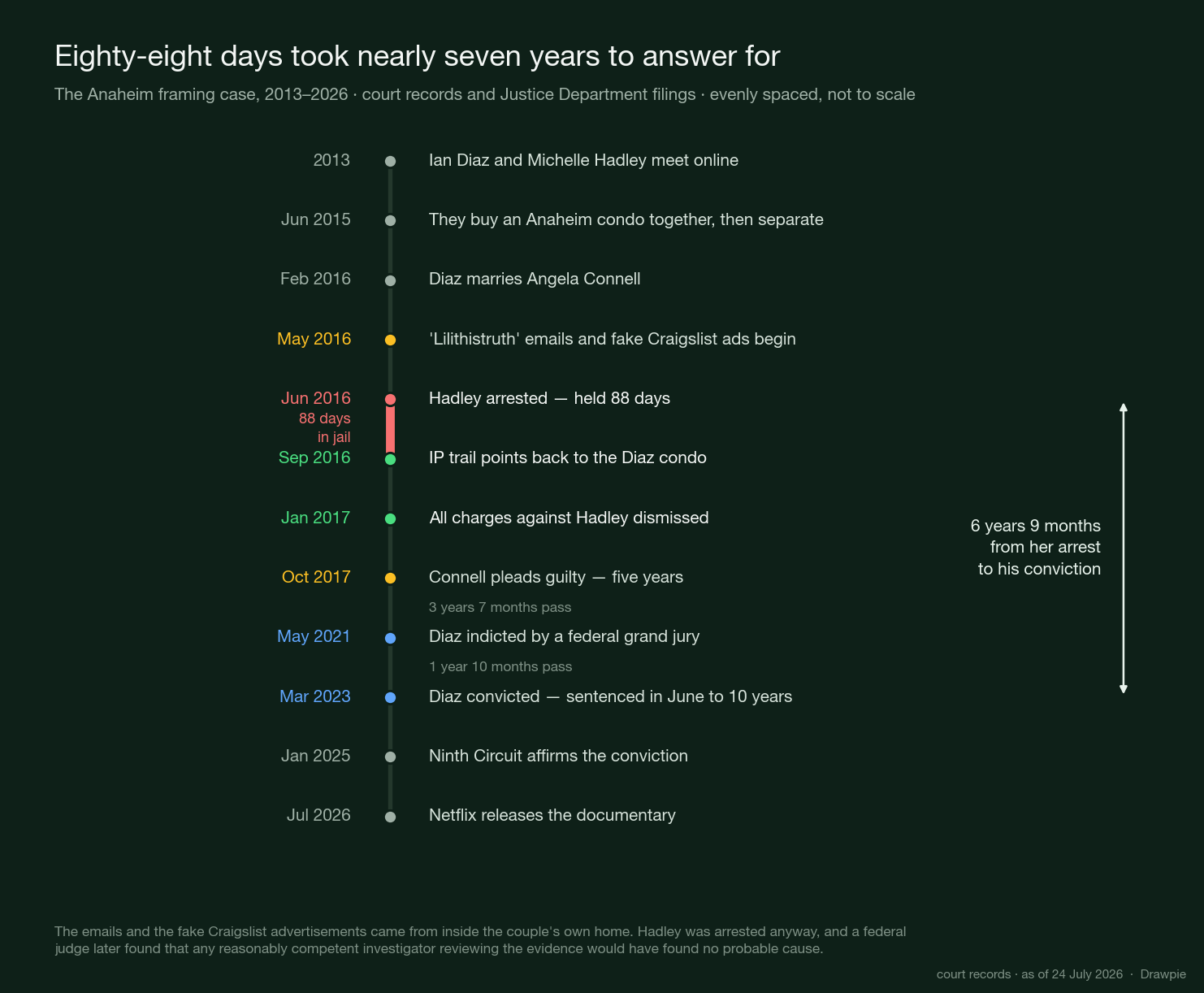
The case in one timeline
| Detail | |
|---|---|
| Released | 22 July 2026, Netflix |
| Runtime | About 89 minutes |
| Director | Alexandra Lacey |
| Format | Feature documentary — not a series |
| Where the case happened | Anaheim and Brea, Orange County, California |
| Took part in the film | Michelle Hadley, and a longtime friend of Ian Diaz |
| Did not take part | Ian Diaz (in federal prison) and Angela Connell (declined) |
Who is who
Ian Diaz — a deputy US marshal from Brea, California. He met Michelle Hadley online in 2013; they bought a condominium in Anaheim together in June 2015 and separated about two months later. He met Angela Connell in January 2016 and married her the following month. He is the person a federal jury convicted of orchestrating the entire campaign, and the reason the case became a federal matter at all: he was a serving federal law enforcement officer, and the credibility that came with the badge is what made the false report stick.
Angela Connell — Diaz’s second wife, and the person who reported to Anaheim police that she was being stalked and threatened. She was, on the face of it, the victim: the threatening emails were addressed to her, the fake Craigslist advertisements used her photograph, her name and her home address, and the staged assault was staged on her. She pleaded guilty in 2017. Some coverage refers to her as Angela Diaz; the couple has since divorced.
Michelle Hadley — Diaz’s ex-girlfriend, and the person the couple framed. She was arrested in June 2016, held for 88 days, and faced the possibility of a life sentence before the case against her collapsed. She is the only one of the three who appears in the documentary.
What actually happened
The condo
The dispute underneath everything is mundane. Diaz and Hadley bought an Anaheim condominium together in June 2015 and split roughly two months later. She moved out; he stayed. When he married Connell in early 2016 and moved her into the same property, there was an unresolved ownership interest in Hadley’s name and a live argument about it.
That is the motive prosecutors put in front of the jury: a property fight, run through a machinery of manufactured terror.
The emails
From around May 2016, Diaz and Connell began receiving daily messages from an account calling itself Lilithistruth. The tone was religious and apocalyptic — the writer positioned herself as a wronged woman whose life had been stolen. The content escalated into images of aborted foetuses and decapitated bodies, and into direct threats against Connell.
Everything about the account pointed at Hadley. That was the design.
The Craigslist advertisements
This is the part that turned a harassment complaint into a felony case. Advertisements went up in Craigslist’s personals section, apparently posted by Hadley, offering Connell up for a staged “rape fantasy” — complete with her photograph, her name and the address of the condo, and instructions that any resistance was part of the act.
At least one man responded and came to the house. The point of the exercise was to produce a real sexual assault, or something close enough to one, that could be attributed to Hadley.
The arrest
Diaz and Connell reported all of it to Anaheim police in June 2016, naming Hadley as the source. She was arrested that month on charges including stalking and attempted rape, and held without release for 88 days. Had the case gone to trial and gone against her, she faced the possibility of spending the rest of her life in prison.
There is one piece of this that gets flattened in the retellings and should not be. Hadley has acknowledged sending two early emails herself — messages using religious imagery and the name Lilith — during what she has described as a dissociative episode, at a point when she had been hospitalised and diagnosed with complex PTSD after the relationship. Those two emails are not the campaign. The campaign — the daily threats, the mutilation imagery, the Craigslist advertisements, the staged assault — was built by the couple, and Diaz and Connell used her two messages as the seed of plausibility that made the rest of it credible.
How it came apart
From September 2016, investigators following the IP addresses behind the emails found that they did not lead to Hadley. They led back to the condo — to Angela Connell and to the house she shared with Diaz.
The rest unravelled from there. Body-camera footage showed Diaz locating the Craigslist respondent’s profile without appearing to search for it, and encouraging him to come to the house. Investigators later established that Diaz had coached Connell through her police interviews. Fragments of the Lilithistruth account were recovered from his government-issued laptop. When he was first questioned in the autumn of 2016, he tried to put the whole thing on his wife, deleted email accounts and changed his phone number.
The Orange County District Attorney’s office dismissed every charge against Hadley in January 2017.
The ending explained
The documentary’s structure is a reversal: it presents the case the way Anaheim police first received it, then turns it over. So “the ending” is really two endings — what the film reveals, and what the courts did about it.
What the film reveals is that the victim and the villain were the same household. The woman being threatened was co-authoring the threats. The decorated federal officer standing beside her, helping the local police understand the danger his ex-girlfriend posed, had written the danger.
What the courts did took considerably longer.
- January 2017 — Connell was arrested. In October 2017 she pleaded guilty to ten felony counts including kidnapping, false imprisonment and falsely reporting a crime, along with more than twenty misdemeanour counts, and was sentenced to five years. She was released in 2020.
- May 2021 — a federal grand jury indicted Diaz, after a Justice Department investigation established his role. He had not been charged at all in the state case.
- March 2023 — a federal jury convicted him of conspiracy to commit cyberstalking, cyberstalking, perjury, and obstruction of a federal matter. He was sentenced on 30 June 2023 to 10 years — the Justice Department’s own announcement put it at ten years and one month — plus three years of supervised release.
- January 2025 — the Ninth Circuit affirmed the conviction.
And there is a fourth outcome that is not in the criminal record at all. Hadley sued the City of Anaheim and its police department over the investigation. In September 2020 a federal judge, David Carter, declined to throw the case out, finding that any reasonably competent investigator who had reviewed the evidence would have found no probable cause to arrest her. Anaheim settled in 2021; her legal team reported the figure at $1.795 million.
That ruling is the sharpest sentence in the whole record. It is a federal judge saying, in effect, that the evidence needed to not arrest Michelle Hadley was already sitting in the file.
Where are they now
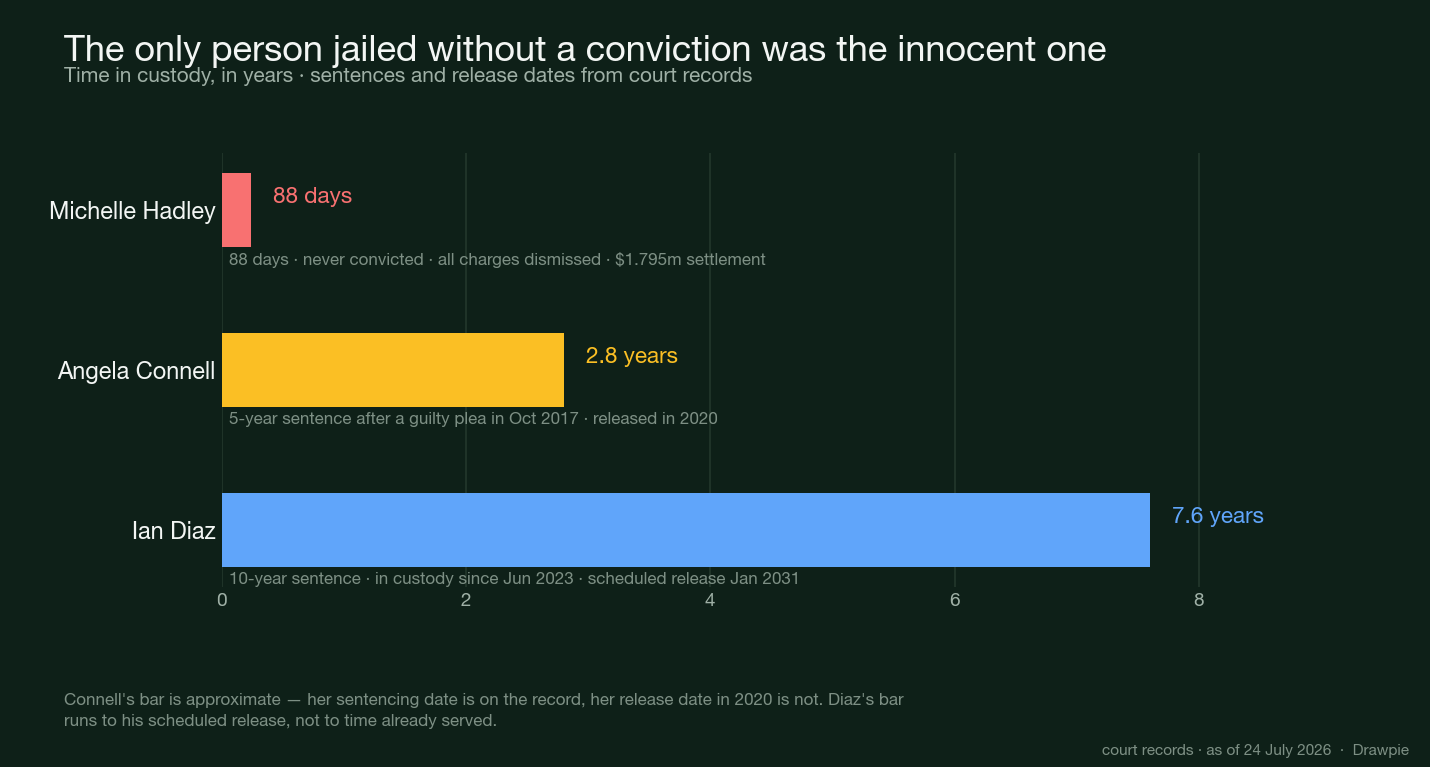
| Outcome | In custody | Now | |
|---|---|---|---|
| Michelle Hadley | Never convicted — all charges dismissed Jan 2017 | 88 days, pre-trial | Free; Anaheim settled her civil suit in 2021 |
| Angela Connell | Pleaded guilty Oct 2017 — five years | Released 2020 | Moved away from California |
| Ian Diaz | Convicted Mar 2023 — 10 years, appeal failed | Since Jun 2023 | Federal custody, FMC Fort Worth; release due 31 Jan 2031 (BOP, checked Sep 2026) |
Michelle Hadley was exonerated in January 2017. She has since completed an MBA at Chapman University and had a daughter — born, as it happens, on the day Ian Diaz was convicted. She took part in the documentary and appears on camera roughly midway through it, which is where the film hands the story over to her.
Ian Diaz is serving his sentence at a federal medical centre in Fort Worth, Texas, with a scheduled release date of 31 January 2031 — still listed there in the Bureau of Prisons inmate locator when we checked on 2 September 2026. He pleaded not guilty at trial, his appeal failed, and he did not participate in the film.
Angela Connell completed her sentence, was released in 2020, and has moved away from California. She declined to take part.
There is one more detail from the record worth knowing, because it reframes the marriage at the centre of this. Before she met Diaz, Connell had a documented history of elaborate deceptions — in 2013 she convinced a partner she was a Justice Department attorney with stage 4 cervical cancer, using wigs and fake medical equipment, and left when it fell apart. Diaz also discovered that a pregnancy she had claimed was fabricated using altered tests. Whatever else this was, it was not one person deceiving another.
Is it worth watching?
It has a score now, and it is a lopsided one. Rotten Tomatoes shows a 100% Tomatometer from 15 critic reviews, against a 64% Popcornmeter from audiences — checked 2 September 2026. Fifteen reviews is still a thin critic sample, and the 36-point gap between the critics and the people watching it at home is the more interesting number, so the assessment below rests on what the film is built from and on the case underneath it.
What the film has going for it is unusually complete evidence. Most true-crime documentaries are built from interviews and re-enactment because that is all that survives. This case generated a state prosecution, a federal prosecution and a civil suit, which means it also generated body-camera footage, recorded interrogations, call recordings and the emails themselves. Lacey builds the film out of that material rather than around it, running chronologically and letting the evidence arrive as the investigators got it. That is the right instinct: the documents are stranger than anything a talking head could say about them.
The structural risk is the twist. Presenting the case as Anaheim police first understood it, then pivoting, is genuinely effective — and it asks the audience to spend the first half suspecting a woman who was, in life, actually suspected, actually arrested, and actually jailed for 88 days. That is not automatically wrong; putting you in the position of the people who got it wrong is a defensible way to show how they got it wrong. But it only pays off if the film then treats the error as the subject rather than as the reveal. A twist and an indictment are different shapes, and this material genuinely supports the second one.
The hole in the middle is motive. Neither Diaz nor Connell participates. Diaz maintained his innocence through trial and appeal, so his absence is not a surprise, but it means the single question the case leaves open — what makes a federal officer do this over a condominium — has nobody in the room to answer it. Hadley’s account and a friend’s recollection are what stand in that gap.
Our read: the case is remarkable and the evidentiary record is exceptional, so the raw material here is far above the true-crime average. The thing to watch for is whether the last twenty minutes are about the criminals or about the institution. The most damning fact in this entire story is not that Ian Diaz built the scheme — a determined liar can build a scheme. It is that the exculpatory evidence surfaced while Michelle Hadley was still in a cell, that she stayed there anyway, and that it then took until 2023 for the man responsible to be convicted. If the film lands that, it is a serious piece of work. If the twist is the point, it is a very good episode of something more disposable.
That tension is not unique to this film. It is the same question that hangs over Sky’s Katie Price documentary , from an entirely different direction: what a documentary owes the real person it is built out of, when the person’s worst experience is also the product.
Where to watch A Toxic Love Story
Netflix, included with any subscription — there is no rental or purchase tier, and no extra charge. It has been streaming since 22 July 2026.
Re-checked on 2 September 2026: still streaming on Netflix in the US, still with no rental or purchase option anywhere. It is a Netflix original documentary, so availability elsewhere follows Netflix’s own regional rollout rather than a separate licensing deal; we have not verified every territory and are not going to guess at ones we have not checked. Streaming rights are the fastest-changing thing on this page.
Frequently asked questions
Is A Toxic Love Story based on a true story?
Yes, entirely. It is a documentary about a real 2016 criminal case in Anaheim, California. All three central figures are real people and the outcomes come from court records.
Who was Lilithistruth?
The email account that appeared to belong to Michelle Hadley and was used to send threats to Ian Diaz and Angela Connell. Investigators traced the IP addresses behind it back to the couple’s own condominium. Fragments of the account were later recovered from Diaz’s government-issued laptop.
Did Michelle Hadley do anything at all?
She has acknowledged sending two early emails using religious imagery and the name Lilith, during a dissociative episode after a period of hospitalisation. She did not create the sustained threat campaign, the fake Craigslist advertisements or the staged assault, and she was never convicted of anything. All charges against her were dismissed in January 2017.
What was Ian Diaz convicted of, and how long is his sentence?
Conspiracy to commit cyberstalking, cyberstalking, perjury, and obstruction of a federal matter, in March 2023. He was sentenced in June 2023 to 10 years, plus three years of supervised release. His scheduled release date is 31 January 2031.
What happened to Angela Connell?
She pleaded guilty in October 2017 to ten felony counts — including kidnapping, false imprisonment and falsely reporting a crime — and more than twenty misdemeanours, and was sentenced to five years. She was released in 2020 and has moved away from California.
Did Michelle Hadley get compensation?
She sued the City of Anaheim and its police department. A federal judge found in 2020 that a reasonably competent investigator would have found no probable cause to arrest her, and the city settled in 2021. Her legal team reported the settlement at $1.795 million.
How long is A Toxic Love Story and is it a series?
It is a single feature documentary of about 89 minutes, not a multi-episode series.
Do Ian Diaz or Angela Connell appear in the documentary?
No. Diaz is in federal prison and maintained his innocence through his trial and appeal; Connell declined to take part. Michelle Hadley participated, and a longtime friend of Diaz also appears.