Who Won the 3M Open 2026? Jackson Koivun, in His Third Pro Start
Update log (2)
- — Published on Thursday with Round 1 under way. No scores from the opening round were used anywhere in this article.
- — Rewritten as a results page now that the tournament is over. Every betting price has been removed — the contender section was organised around a bookmakers' board, and that board is gone, replaced by where each of those players actually finished. Publishing odds is no longer something this site does in any category. The course guide, the scoring history and the strokes-gained analysis are unchanged, because none of them depended on a price. The predictions the original made are set against the results in a new section rather than quietly deleted.

- Jackson Koivun won at 25 under par, a tournament record, three shots clear of world No. 1 Scottie Scheffler. He was 21 and it was his third start as a professional.
- Scheffler, the heavy favourite in this page’s original preview, finished second. Seven editions of this tournament had produced seven different winners; the eighth produced an eighth.
- TPC Twin Cities is not a hard course. It is a dangerous one: water is in play on 15 of 18 holes, and it ranks among the top five on Tour for penalty strokes per round. That section of this page is unchanged and still holds.
- The preview’s thesis was right and its shortlist was wrong. It argued that this is the course where being the best player matters least, and that the winner would probably not be a household name — then named five contenders, none of whom won.
This page was a preview. It was published on 23 July 2026 with the first round under way, and it predicted the winner. This version carries the results — and, in a new section near the end, an honest account of which of its own calls held up.
Who won the 3M Open 2026?
Jackson Koivun. He was 21 years old, it was his third start as a professional, and he won at 25 under par (259), a tournament record, three shots clear of world No. 1 Scottie Scheffler.
| Pos | Player | To par | Total |
|---|---|---|---|
| 1 | Jackson Koivun | −25 | 259 |
| 2 | Scottie Scheffler | −22 | 262 |
| T3 | Hideki Matsuyama · Brian Harman · Chandler Phillips · Denny McCarthy | −20 | 264 |
Koivun closed bogey-free with a 5-under 66 and took $1,584,000 of the $8.8 million purse, along with 500 FedExCup points and 42 world ranking points.
The original preview had Scheffler as the clear favourite and named five contenders. Koivun was not one of them — he appeared once, in a list of names rounding out the field.
The number that explains this tournament
Look at what it has taken to win here.
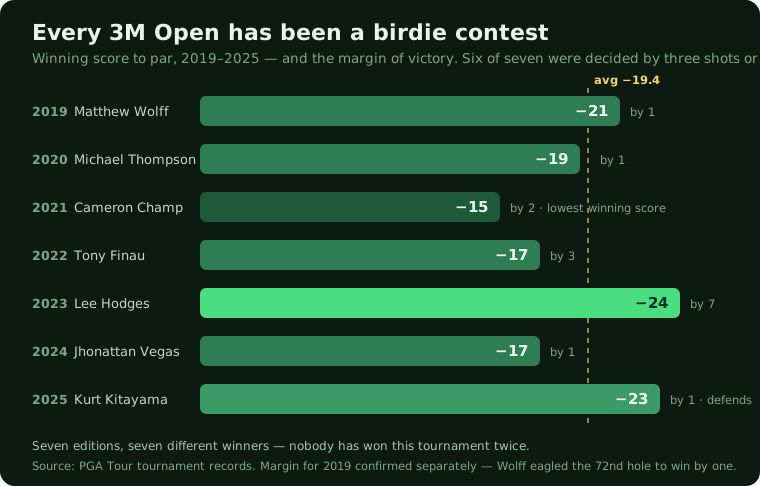
Every winner but one has reached at least 17 under par. The average winning score across the seven editions in the chart is 19.4 under. Lee Hodges won at 24 under. Kurt Kitayama won at 23 under in 2025 — and won by one. The chart covers 2019 to 2025 and so predates this year: Koivun’s 25 under in 2026 is higher than anything on it, and is the tournament record.
Now look at the right-hand column. Six of the seven editions were decided by three shots or fewer, and four by a single shot. The one blowout, Hodges’ seven-shot win in 2023, is the exception that proves the rule.
Put those two facts together and you get the defining feature of the 3M Open: the field all scores, so nobody separates. Everyone makes birdies. Almost nobody makes enough of them to run away. Seven editions had produced seven different winners — no one has ever won this tournament twice. The eighth produced an eighth.
That was the environment Scheffler walked into, and it is close to the least favourable one for a dominant player. His edge is largest when a course punishes the field and he survives it. Here, the field does not get punished. It gets a wedge in its hands and a chance to make four. He shot 22 under and lost by three.
The basics
What TPC Twin Cities actually asks of you
This is the part most previews get backwards. TPC Twin Cities has historically ranked as one of the easier courses on the PGA Tour — in some seasons among the five easiest. It is not a brute.
What it is, is wet. Water is in play on 15 of the 18 holes, and the course has ranked among the top five of 40 venues for penalty strokes per round — as high as second in a recent season. Arnold Palmer routed it through 27 bodies of water, and the closing par 5 has a lake down the entire right side that is live off the tee and again on any approach played at the green in two.
So the danger is not difficulty. The danger is variance. A player can make six birdies and still lose three shots to the field in ten seconds.
Everything else about the course is generous:
| TPC Twin Cities | PGA Tour average | |
|---|---|---|
| Greens in regulation | 72.7% | 65.6% |
| Driving distance | 291 yards | 282 yards |
| Driving accuracy | 63.7% | 62% |
| Fairway width | ~35 yards (14th widest on Tour) | — |
| Greens | Bent, ~6,500 sq ft, stimp 12 | — |
| Rough | 3–4 inches depending on the year | — |
Greens in regulation seven points above Tour average is an enormous gap. The field hits this golf course. Every one of the 18 holes has produced a birdie rate above 10%, and half of them above 20% — but 12 holes also carry bogey rates above 10%. Birdies everywhere, and trouble everywhere, on the same holes.
It is worth contrasting this with the other TPC the Tour visited a month ago. TPC River Highlands, host of the Travelers Championship , defends itself by being short — a par 70 of 6,844 yards that takes the driver out of your hands and asks for precision. TPC Twin Cities is 587 yards longer, hands the driver back, and defends itself with water instead. Same brand, opposite question.
Where the strokes actually come from
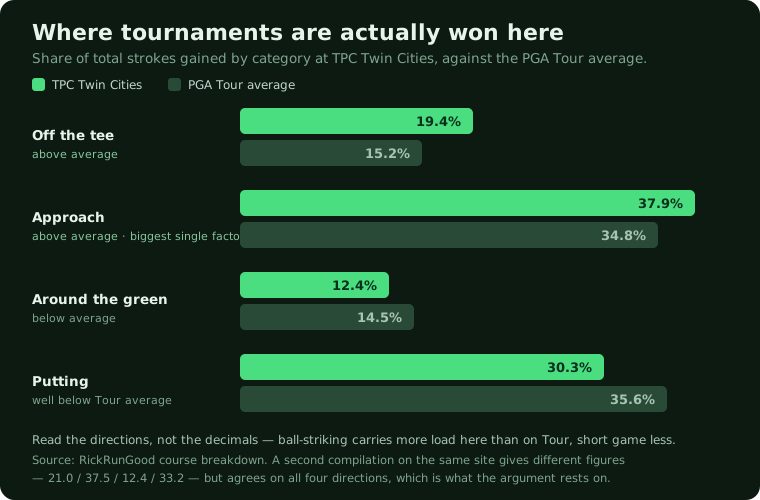
Two things fall out of that chart.
Ball-striking carries more weight here than it does on Tour — both off the tee and, especially, on approach. Nearly two-thirds of approach shots at this course are played from beyond 150 yards, and almost a quarter from 200 or more. That is mid- and long-iron golf, not wedge golf, despite the scoring.
And it is not a putting contest. Putting accounts for a smaller share of strokes gained here than it does almost anywhere, and the greens have ranked among the easiest on Tour to putt four years running. When everyone holes out at a similar rate, the putter stops being a separator.
A note on those numbers: two published compilations of the same statistic disagree slightly — one gives 19.4 / 37.9 / 12.4 / 30.3, the other 21.0 / 37.5 / 12.4 / 33.2. They agree on all four directions, which is what the argument rests on. We have used the internally consistent set and shown the other in the chart caption rather than picking silently.
How the contenders actually finished
The original version of this section was a bookmakers’ board: five contenders, each with a price in its heading, plus a handful of longer names. Here is the same list with the prices replaced by results.
| Player | What the preview said | Finished |
|---|---|---|
| Scottie Scheffler | The clear favourite; best ball-striker in the world, perfect course fit | 2nd, −22 |
| Kurt Kitayama | Defending champion; won at 23 under with a course-record 60 | T24, −13 |
| Maverick McNealy | “The straightest read on the course-fit chart” | T34, −11 |
| Hideki Matsuyama | “The pick that requires the least explaining” | T3, −20 |
| Ryan Fox | Open champion nine days earlier at Royal Birkdale | Missed cut |
| Keith Mitchell | Rounding out the board | T44, −9 |
| Jake Knapp | Rounding out the board | T13, −16 |
| Jackson Koivun | Rounding out the board | Won, −25 |
| Tom Kim | “A genuinely good fit” | T20, −14 |
| Johnny Keefer | “The name worth knowing”; the widest gap on the board between profile and price | Missed cut |
| Jordan Smith | Top-five ball-striker in the field | T39, −10 |
| Jackson Suber | Top-five ball-striker in the field | Missed cut |
Four things stand out.
Scheffler was the right favourite and still lost. He finished second at 22 under — a score that would have won five of the seven previous editions outright. He was beaten because somebody went lower than anyone ever has here, not because he played badly.
Matsuyama was the best of the named picks. The preview called him the contender who required the least explaining, and he finished tied third.
The two long-odds picks both missed the cut. Johnny Keefer, singled out as the name worth knowing, and Jackson Suber, named as a top-five ball-striker in the field, neither made the weekend. So did Ryan Fox, who had won the Open Championship nine days earlier.
And the winner is the line that matters. Koivun appeared in a single sentence, in a list of four names rounding out the board.
Players to watch beyond the favourites
The players below are as the preview named them. Their finishing positions are in the table above.
Johnny Keefer was the name it pushed hardest: second in the field in ball-striking over the last 36 rounds, directly behind Scheffler, with top-ten finishes at comparable ball-strikers’ venues. He missed the cut.
Jordan Smith and Jackson Suber completed the top five ball-strikers in the field. Smith finished T39; Suber missed the cut.
The preview also noted a family of courses whose results tend to travel here — PGA National, TPC Deere Run and TPC Craig Ranch — and that the weather would stay benign, which it did. Neither observation was wrong. Neither identified the winner.
The subplot that makes this field deeper than the purse
This is the 32nd of 34 regular-season events. After the Rocket Classic and the Wyndham Championship, the FedExCup regular season closes and the field for the playoffs locks:
| Cut | Who advances |
|---|---|
| Top 70 | FedEx St. Jude Championship |
| Top 50 (after St. Jude) | BMW Championship |
| Top 30 | Tour Championship |
That is why an $8.8 million tournament in late July had 144 players in it who badly wanted to be there. The cut line ran directly through a group of very recognisable names — Brian Harman, Jason Day, Keegan Bradley, Mac Meissner, Lucas Glover, Michael Thorbjornsen and Jordan Smith were all clustered in the seventies of the standings with two events left to move.
The original deliberately did not name who was exactly 70th, because the number moved with every shot struck. Watch the band, not the rank was the advice, and it is still the right advice for any week of that fortnight. Brian Harman, the first name in that list, then finished tied third here.
What this preview got right and wrong
Set against the result, the original page divides cleanly in two.
Its thesis was right, and it was right for the reason it gave. The argument was that TPC Twin Cities is the course where being the best player in the world matters least — benign, birdie-soaked, decided by whoever avoids the one wet ball — and that Scheffler was therefore “the right favourite and the wrong price”. He finished second. The best player in the field played well and lost anyway, which is exactly what the page said the course does.
It also described the winner before the tournament started. Its own words: the winner “very likely comes from the elite ball-strikers, and very likely is not a household name”, and the precedent it cited was the 2019 champion — Matthew Wolff, a 20-year-old who took his first PGA Tour title here. Jackson Koivun was 21, in his third start as a professional, and unheard of outside college golf. The archetype was called correctly.
And then it named five contenders, none of whom won. That is the part worth being blunt about. Having correctly reasoned that the winner would probably be someone outside the obvious names, the page went on to build its recommendations out of the obvious names — because a bookmakers’ board is a list of the obvious names, and organising a section around one pulls you toward the top of it. Koivun was on that board. He was on it in a throwaway sentence, at the bottom, alongside three other players who were there to round the list out.
The specific misses. Johnny Keefer was the page’s long-odds enthusiasm — “the name worth knowing”, the widest gap between profile and price — and he missed the cut. So did Ryan Fox, nine days after winning the Open Championship. Matsuyama was the best of the named picks at tied third, which is a good call that still did not produce a winner.
The lesson this page is keeping. The reasoning was sound and the shortlist was not, and the shortlist was the part built from prices. Everything on this page that came from the golf course — the water, the strokes-gained mix, the compressed leaderboards, the seven winners in seven editions — held up. Everything that came from a board did not.
When was the 3M Open 2026?
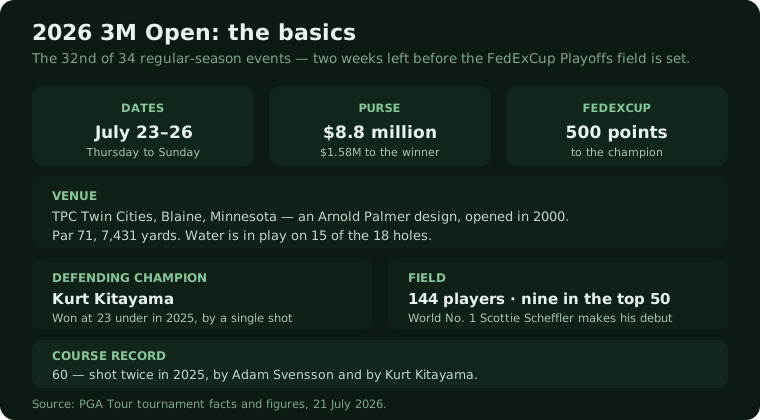
Thursday 23 July to Sunday 26 July 2026, at TPC Twin Cities in Blaine, Minnesota.
Who was the defending champion at the 3M Open 2026?
Kurt Kitayama, who won in 2025 at 23 under par by a single shot and shot a course-record 60 along the way. He finished tied 24th defending it. Jackson Koivun is the defending champion for 2027.
How much is the 3M Open purse in 2026?
$8.8 million, with $1.58 million and 500 FedExCup points to the winner.
Where did Scottie Scheffler finish at the 3M Open 2026?
Second, at 22 under par, three shots behind Jackson Koivun. It was his first appearance in the tournament.
What par is TPC Twin Cities and how long is it?
Par 71 at 7,431 yards. It is an Arnold Palmer design that opened in 2000, and water is in play on 15 of the 18 holes.
What is a typical winning score at the 3M Open?
High. Through 2025 the seven winning scores ranged from 15 under to 24 under, averaging 19.4 under, and six of the seven tournaments were decided by three shots or fewer. Koivun’s 25 under in 2026 is the lowest winning total in the tournament’s history.
Why does the 3M Open matter in the FedExCup race?
It was the 32nd of 34 regular-season events. Only the top 70 in the FedExCup standings advance to the FedEx St. Jude Championship, so players outside that mark have this event, the Rocket Classic and the Wyndham Championship left to move. At the other end of the same season, the field narrows to 50 and then 30: the BMW Championship is where that cut happens .
Sources
| Source | Used for |
|---|---|
| Golf News Net — 2026 3M Open final results and prize money | The full final leaderboard, every finishing position in the scorecard table, the winner’s share and the purse |
| PGA Tour — final-round recap | Koivun’s bogey-free closing 66, his third professional start and the three-shot margin |
| PGA Tour facts-and-figures page for the event, 21 July 2026 | Dates, purse, FedExCup points, course specification, past winners and the course record |
| The 23 July 2026 version of this page | Every “what the preview said” quotation |
How we verified this
This page was organised around a bookmakers’ board and no longer is. The original ran an odds snapshot from three books taken on 22–23 July 2026, with each contender’s price in its own heading. Every one of those prices has been removed and each player is now listed by where he actually finished. Nothing was rebuilt in its place, because a finishing position is the better version of what a price was trying to estimate.
The three charts are unchanged and none of them contained a price. They cover winning scores by year, tournament basics and the strokes-gained mix by category. ⚠️ The winning-scores chart plots 2019 to 2025 and therefore predates the 2026 result; the text beneath it now says so, and gives the 2026 figure separately rather than implying the chart includes it.
The results come from the tournament’s published final leaderboard, cross-checked against the PGA Tour’s own recap. The leaderboard source passed a control test: a real article returned HTTP 200 and an invented path on the same host returned 404, so a successful response distinguishes a real page from a missing one.
The original’s calls are kept and marked rather than deleted. Rewriting a preview into a results page invites quietly dropping the picks that missed. The scorecard section lists each named player against his finish, including the two that look worst — the long-odds pick singled out as “the name worth knowing” missed the cut, and the reigning Open champion missed it too.
Tournament facts — dates, purse, winner’s share, FedExCup points, course specification, past winners and the course record — come from the PGA Tour’s own facts-and-figures page for this event, published 21 July 2026. Course statistics come from published course breakdowns; two compilations on the same source give slightly different strokes-gained percentages, so the chart uses the internally consistent set, states the other in its caption, and the text relies only on the directions both agree on.
One correction carried over from the original. A power-ranking headline described Scheffler as the 2026 Masters champion, which is wrong — Rory McIlroy won it and Scheffler was runner-up. That error is not repeated here.