2027 Dodge Charger Super Bee: Specs, 0-60, Engine & Everything We Know

- The 2027 Dodge Charger Super Bee Launch Edition makes an SAE-certified 600 hp and 531 lb-ft from a 3.0-litre twin-turbo straight six, and Dodge claims 0-60 mph in 3.6 seconds and a quarter mile in 11.8 seconds. It was revealed on 7 August 2026 in both two-door and four-door bodies.
- There is no V8. This is the first Super Bee in the nameplate’s 59-year history without one, and the power comes from bigger 56 mm Garrett turbos, a recalibration and a cooling system with more than 50% extra capacity.
- It is the quickest petrol Charger, but not the quickest Charger. The electric Daytona Scat Pack makes 670 hp and does 0-60 in 3.3 seconds on Dodge’s own numbers.
- Dodge has not announced a price, an on-sale date or ordering details. Its release says only that they are coming ’later this year’. The Scat Pack it is based on starts at $54,995, so that is the floor rather than the answer.
Dodge revealed the 2027 Charger Super Bee Launch Edition on 7 August 2026: 600 horsepower, a claimed 3.6-second 0-60 mph, and a straight six where every previous Super Bee had a V8.
It is a limited-production car, built at Windsor Assembly, offered as a two-door coupe or a four-door sedan. What Dodge did not announce is what most people want to know next — price, ordering and on-sale timing all remain outstanding, and the release commits only to “later this year”.
What is the 2027 Dodge Charger Super Bee?
The most powerful petrol Charger of the current generation, and a track-focused version of the Charger Scat Pack rather than a new model line.
The Super Bee Launch Edition takes the Scat Pack’s SIXPACK High Output engine and pushes it from 550 hp to an SAE-certified 600 hp, alongside brakes, cooling, aerodynamics and suspension changes aimed at repeat hard laps rather than a single quick run. Dodge calls it the “quickest, fastest, most powerful Dodge Super Bee ever”, which is a claim about the nameplate’s own history rather than about the Charger range.
It arrived as part of Dodge’s 60th-anniversary programme for the Charger, which has run through 2026 — the Charger nameplate debuted on 1 January 1966, and Dodge’s anniversary tour took in the Carlisle Chrysler Nationals in July, the Route 66 Centennial Parade and a Petersen Automotive Museum cruise-in. Some coverage has placed the 60th anniversary in 2027; that is the model year of the car, not the birthday of the nameplate.
What engine does the Super Bee have?
A 3.0-litre twin-turbocharged inline-six — the SIXPACK High Output — with larger turbos, more boost and a lot more cooling. There is no V8 and no HEMI option.
The headline changes over the 550 hp Scat Pack version of the same engine:
| Change | Detail |
|---|---|
| Turbos | 56 mm Garrett Motion, 7.5% more airflow |
| Boost | Over 30 psi |
| Output | 600 hp, 531 lb-ft |
| Torque peak | 3,000 rpm, held to 5,900 |
| Cooling | High-temp circuit up over 50% |
Two of those matter more than the horsepower figure. The first is the torque curve: peak torque is unchanged at 531 lb-ft, but it now arrives at 3,000 rpm instead of the Scat Pack’s 3,500 and holds to 5,900 rpm. That is a wider usable band, not just a bigger number.
The second is heat. Dodge increased the high-temperature cooling circuit’s capacity by more than 50%, more than doubled the low-temperature circuit, added auxiliary radiators in the corners of the front fascia and redesigned the fascia to push 30% more air into the main cooling stack. Small-capacity forced-induction engines lose power when they get hot, and that is the failure mode a track day exposes.
At 200 hp per litre, this is a highly strung engine by muscle-car standards. It drives the rear wheels through a TorqueFlite 880RE eight-speed automatic, with all-wheel drive standard and an on-demand mode that sends 100% of torque rearwards, triggered by a dedicated button on the steering wheel.
How fast is the Super Bee, 0-60 and quarter mile?
Dodge claims 0-60 mph in 3.6 seconds and the quarter mile in 11.8 seconds. It has not published a top speed.
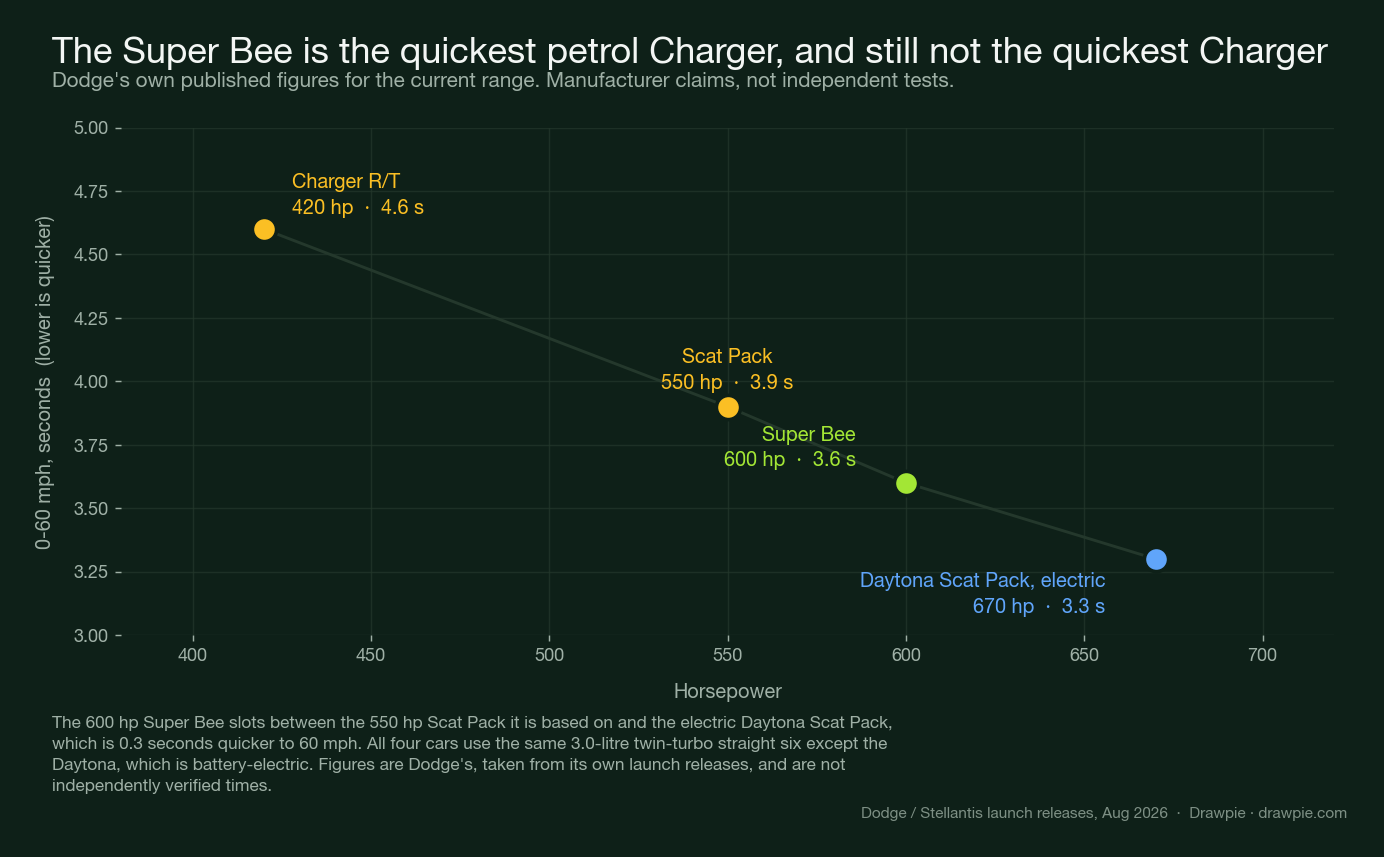
Chart: Dodge’s own published figures for the current Charger range. Manufacturer claims, not independently instrumented tests.
Those numbers put the Super Bee 0.3 seconds ahead of the Scat Pack to 60 mph and 0.4 seconds ahead over the quarter. They also put it behind the electric Charger Daytona Scat Pack, which Dodge rates at 670 hp, 3.3 seconds and 11.5 seconds. So the accurate description is “quickest petrol Charger”, not “quickest Charger” — and Dodge’s own release is careful about this.
The comparison enthusiasts will reach for is the old supercharged V8. A 2019 Challenger Hellcat Redeye made 797 hp and also did 0-60 in 3.6 seconds. The Super Bee matches that with 197 fewer horsepower, which is what standard all-wheel drive, launch control and a torque curve that starts 500 rpm earlier will do for a standing-start number. It is not the same thing as matching a Redeye everywhere else.
One caveat that applies to every figure on this page: these are Dodge’s numbers, taken from its own launch material. Nobody outside the company has instrumented one yet.
What are the full Super Bee specs?
Track hardware throughout: 16-inch Brembos, 305-section Goodyears on 20×11 forged wheels, adaptive dampers and stiffer everything.
| Item | Specification |
|---|---|
| Engine | 3.0L twin-turbo I6, SIXPACK H.O. |
| Output | 600 hp / 531 lb-ft |
| Gearbox | TorqueFlite 880RE 8-speed auto |
| Drive | AWD, on-demand 100% RWD mode |
| 0-60 mph | 3.6 sec (Dodge) |
| Quarter mile | 11.8 sec (Dodge) |
| Brakes | 16-in Brembo, 6-piston front / 4-piston rear |
| Wheels | 20 × 11-in forged |
| Tyres | Goodyear Eagle F1 Supercar 3, 305/35ZR20 |
| Bodies | 2-door coupe, 4-door sedan |
| Built at | Windsor Assembly, Ontario |
The suspension is retuned rather than replaced: Continuous Damping Control dual-valve adaptive dampers, front spring rates up 12% and rear up 6%, a rear stabiliser bar 20% stiffer, front tension-link bushings 25% stiffer and handling-link bushings 50% stiffer.
Dodge’s brake claim is the most striking hardware number in the release. The 16-inch vented rotors with six-piston front and four-piston rear fixed calipers are said to give three times the fade resistance of other SIXPACK Chargers and double that of the previous-generation SRT Charger.
Aerodynamically it gets an extended front splitter a third longer than the Scat Pack’s and a larger spoiler, together worth over 100 lb of additional downforce at 150 mph. Drive modes add Track and Drag alongside Torque Reserve, Race Prep — which keeps the cooling fans running after shutdown — line lock and launch control.
Inside, it is deliberately spare: cloth high-back performance seats with an embroidered Super Bee logo on the headrests, Sour Lemon accent stitching, larger paddle shifters, a Citrus Peel 12 o’clock marker on the wheel and a Super Bee instrument-panel badge. A Cosworth Drive Experience Recorder, a 1080p 60fps camera with an integrated microphone, is available.
The Launch Edition comes in three colours: Sucker Punch, a new yellow-green, plus Shady grey and Diamond Black, with gloss-black or Sucker Punch “Stinger” bodyside graphics, gloss-black 20-inch wheels and Hyper Lime brake calipers.
How does it compare with the Charger Scat Pack?
Same engine, 50 hp more, 0.3 seconds quicker — and every chassis system uprated.
| Model | Power | 0-60 | Quarter |
|---|---|---|---|
| Charger R/T | 420 hp | 4.6 s | 12.9 s |
| Scat Pack | 550 hp | 3.9 s | 12.2 s |
| Super Bee | 600 hp | 3.6 s | 11.8 s |
| Daytona Scat Pack | 670 hp | 3.3 s | 11.5 s |
All four are Dodge’s own claims. The R/T and Scat Pack use the same 3.0-litre straight six in standard-output and high-output tunes; the Daytona Scat Pack is the battery-electric car, with 627 lb-ft and a 94 kWh pack.
The honest read is that the Super Bee is not a step change in straight-line speed over the Scat Pack. What it adds is the ability to keep doing it — the brakes, the cooling and the aero are the real difference, and none of them show up in a 0-60 time.
What do we still not know?
Price, ordering and availability. Dodge’s release says all three are coming “later this year”, and that is the entire statement.
There is no MSRP, no order-bank opening date, no delivery window and no production figure beyond the phrase “limited-production model”. Some coverage has read the timing as later in 2027; the release itself says later this year, which means 2026.
For a floor rather than an answer, the Charger the Super Bee is based on carries these US prices, from Dodge’s own November 2025 announcement:
| Charger Scat Pack | MSRP |
|---|---|
| Two-door | $54,995 |
| Four-door | $56,995 |
Those exclude destination, tax and title, and the Super Bee’s extra hardware sits on top of them. We are not going to put a number on how much on top, because Dodge has not, and any figure you see quoted today is a guess.
The other unknown is what Dodge does with the nameplate after the Launch Edition. “Launch Edition” implies a wider Super Bee range behind it, but nothing has been confirmed.
Where does the Super Bee name come from?
A 1968 budget muscle car, and this is its sixth outing — the first without a V8.
The original Super Bee arrived for 1968 as a stripped-down, cheap-to-buy performance version of the Dodge Coronet, and stayed on that body through 1970 before moving to the Charger for 1971. The name then sat unused for more than three decades.
| Era | Car |
|---|---|
| 1968–1970 | Dodge Coronet Super Bee |
| 1971 | Dodge Charger Super Bee |
| 2007–2009 | Charger Super Bee (LX) |
| 2012–2013 | Charger SRT8 Super Bee |
| 2023 | Charger Super Bee, 1,000 built |
| 2027 | Charger Super Bee Launch Edition |
The 2023 car is the one worth holding next to this one. It was a 1,000-unit Last Call model built to see the V8 Charger out of production, and it is the immediate predecessor to a Super Bee whose whole story is that it does not have a V8. Dodge CEO Matt McAlear framed the name as standing for “maximum Dodge attitude: bold, accessible” — accessible being the original 1968 pitch, and the part that the missing price makes impossible to assess.
The bottom line
The 2027 Charger Super Bee is a 600 hp, 3.6-second, six-cylinder muscle car with genuinely serious track hardware bolted to it, revealed on 7 August 2026 and built in limited numbers at Windsor. On Dodge’s own figures it is the quickest petrol Charger ever and still slower to 60 mph than the electric one in the same showroom.
Whether it is a good buy is unanswerable today, because Dodge has not said what it costs or when you can order one. Both are promised before the end of 2026, and we will update this page when they land.
It is not the only 2026 reveal in that position: the Freelander 8, revealed with full specs and no price , is in the same holding pattern, while the electric BMW iX5 arriving in 2027 went the other way and led with its number.
Every performance figure here is a manufacturer claim from Dodge’s launch material, not an independently measured test result.