2026 Senate Control Predictions: The Four Seats That Decide It
Update log (1)
- — South Carolina Republicans choose a Senate nominee in a special primary on 11 August, with a runoff on 25 August if nobody clears 50%. The seat became vacant when Lindsey Graham died on 11 July and his sister Darline Graham was appointed to finish the term.

- Republicans are favoured to keep the Senate. They hold it 53-47, and because the Vice President breaks a 50-50 tie they can lose three of the 35 seats up on 3 November 2026 and still run the chamber. Democrats need a net gain of four.
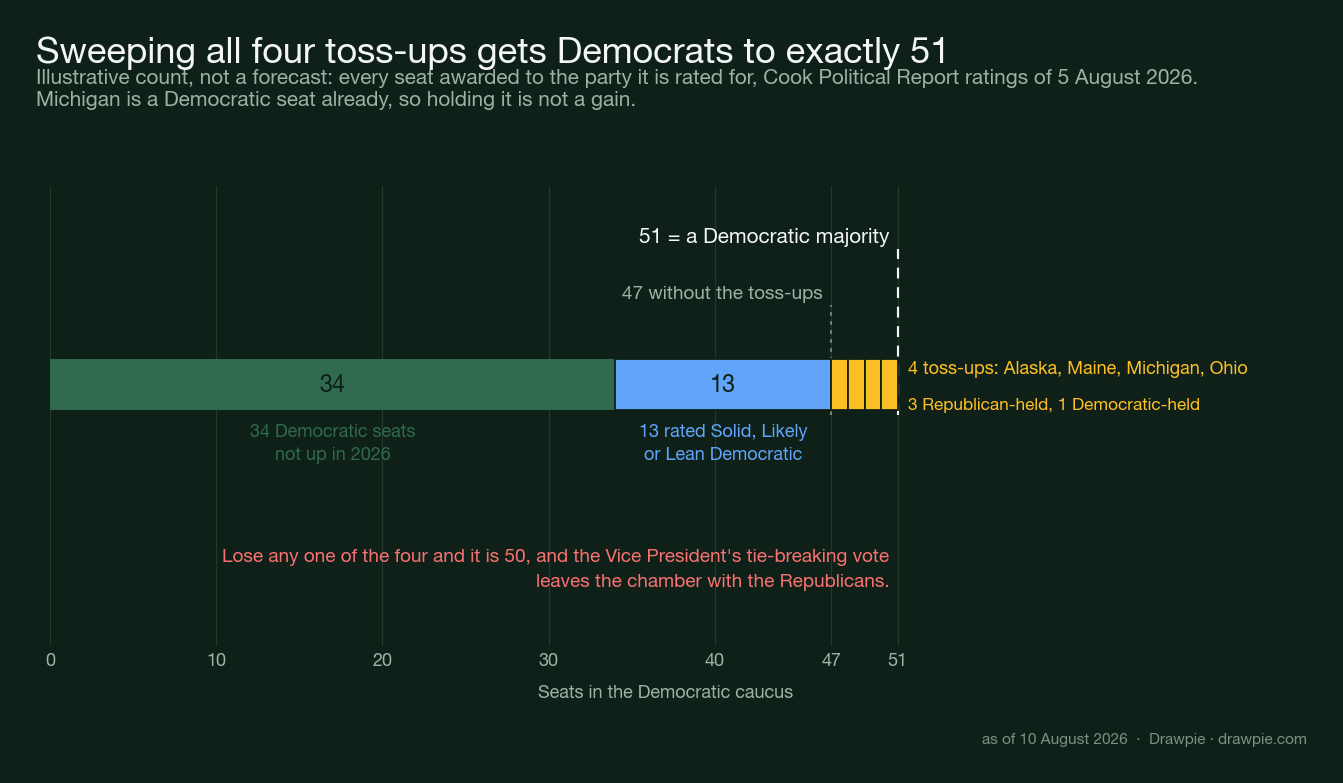
- The arithmetic leaves one route. Award every seat to the party it is rated for and Democrats reach 47 before the toss-ups. There are exactly four toss-ups, so they have to sweep all of them to reach 51 — and one of the four, Michigan, is a seat they already hold.
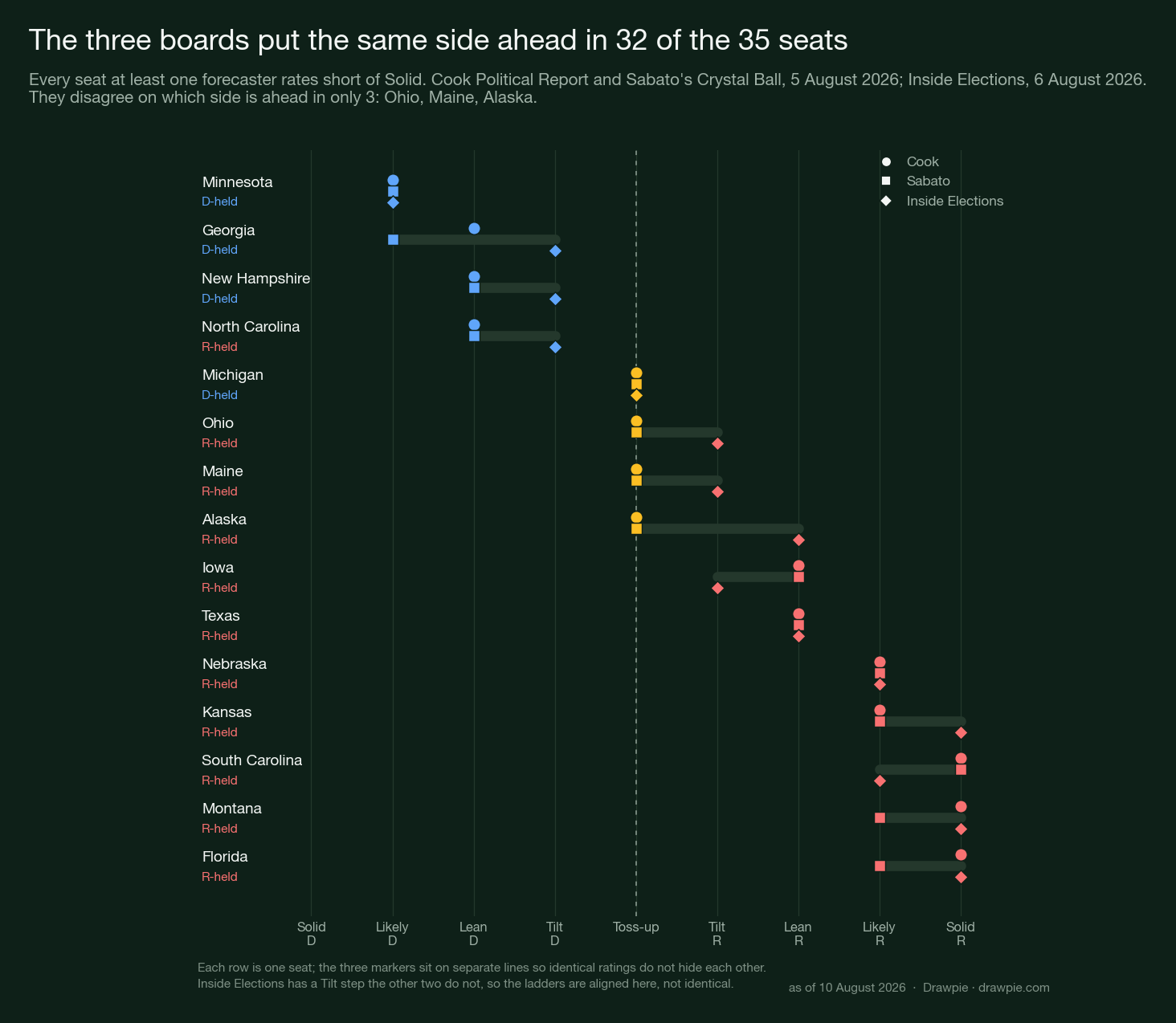
- The three main forecasters barely disagree. Cook Political Report, Sabato’s Crystal Ball and Inside Elections put the same side ahead in 32 of the 35 seats. Their entire disagreement is Alaska, Maine and Ohio.
- North Carolina is the one Republican seat rated Democratic. All three boards lean it to Roy Cooper, and it is the only Republican-held seat any of them puts on the Democratic side of the line.
- Ten of the 35 seats have no nominee yet. South Carolina and Minnesota settle theirs on 11 August, Alaska on 18 August and New Hampshire not until 8 September. Minnesota, Alaska and New Hampshire are all rated short of Solid, and Alaska is one of the four toss-ups.
Republicans are favoured to keep the Senate, and Democrats have one route rather than several. Republicans hold the chamber 53-47. Because Vice President JD Vance breaks a 50-50 tie, they can lose three of the 35 seats on the ballot on 3 November 2026 and still run it. Democrats need a net gain of four.
What makes the 2026 map unusual is not that number. It is how little room the ratings leave around it.
Who is predicted to control the Senate in 2026?
Republicans, on all three of the major race-rating boards — but only just, and none of them will actually call it.
Award every seat to the party it is currently rated for and you get the same answer twice. Cook Political Report and Sabato’s Crystal Ball both leave Democrats on 47 and Republicans on 49, with four seats they will not assign. Inside Elections, which uses an extra step in its scale, leaves 47 and 52 with one seat unassigned.
That is the whole prediction. Nobody is putting a number on the outcome, because the four unassigned seats are exactly the ones that settle it.
| Cook rating | Seats | D total |
|---|---|---|
| Not up in 2026 | 34 | 34 |
| Solid D | 9 | 43 |
| Likely D | 1 | 44 |
| Lean D | 3 | 47 |
| Toss Up | 4 | 51 |
The last row is the article. Democrats reach a majority at exactly 51, with nothing spare, and only if all four toss-ups fall their way. Lose one and it is 50, which the Vice President’s vote hands back to the Republicans.
How many seats do Democrats need to flip in 2026?
Four — but the more useful way to say it is that they need to win 17 of the 35 seats on the ballot, and Republicans need 19.
Sixty-five senators are not up for election this year: 34 who caucus with Democrats and 31 Republicans. Add the seats each side needs from the 35 and the asymmetry falls out.
| Side | Not up | Needs | Total |
|---|---|---|---|
| Democrats | 34 | 17 | 51 |
| Republicans | 31 | 19 | 50 + VP |
Republicans need fewer because they do not need a majority. Fifty is enough. This is why “Democrats need four” and “Republicans can afford to lose three” are the same sentence: a 53-47 chamber losing three Republican seats is a 50-50 chamber, and a 50-50 chamber is a Republican one until the Vice President changes.
Twenty-two of the 35 seats up are Republican-held, against 13 Democratic. On paper that is a Democratic opportunity. In practice 14 of those 22 are rated Solid Republican by Cook, so the exposure is much narrower than the raw count suggests.
Which Senate seats are the toss-ups in 2026?
Alaska, Maine, Michigan and Ohio. Cook Political Report and Sabato’s Crystal Ball name the same four, from separate processes.
Below is every seat that at least one of the three forecasters rates short of Solid — 15 of the 35. What is striking is how little daylight there is between three organisations that reach their ratings separately.
| Seat | Cook | Sabato | Inside |
|---|---|---|---|
| Minnesota | Likely D | Likely D | Likely D |
| Georgia | Lean D | Likely D | Tilt D |
| N. Carolina | Lean D | Leans D | Tilt D |
| N. Hampshire | Lean D | Leans D | Tilt D |
| Michigan | Toss Up | Toss-up | Toss-up |
| Maine | Toss Up | Toss-up | Tilt R |
| Ohio | Toss Up | Toss-up | Tilt R |
| Alaska | Toss Up | Toss-up | Lean R |
| Iowa | Lean R | Leans R | Tilt R |
| Texas | Lean R | Leans R | Lean R |
| Nebraska | Likely R | Likely R | Likely R |
| Kansas | Likely R | Likely R | Solid R |
| S. Carolina | Solid R | Safe R | Likely R |
| Florida | Solid R | Likely R | Solid R |
| Montana | Solid R | Likely R | Solid R |
The three put the same side ahead in 32 of the 35 seats. Their entire disagreement is Alaska, Maine and Ohio, where Cook and Sabato decline to pick a side and Inside Elections puts all three on the Republican side. That single difference is why Inside Elections ends at 52 Republican seats and the other two end at 49.
One caution on reading the table across: Inside Elections uses a five-step ladder with a “Tilt” between Toss-up and Lean, so its labels are not the other two’s labels. All three use the same label in only two of the 35 seats.
What do the polls say in the battleground races?
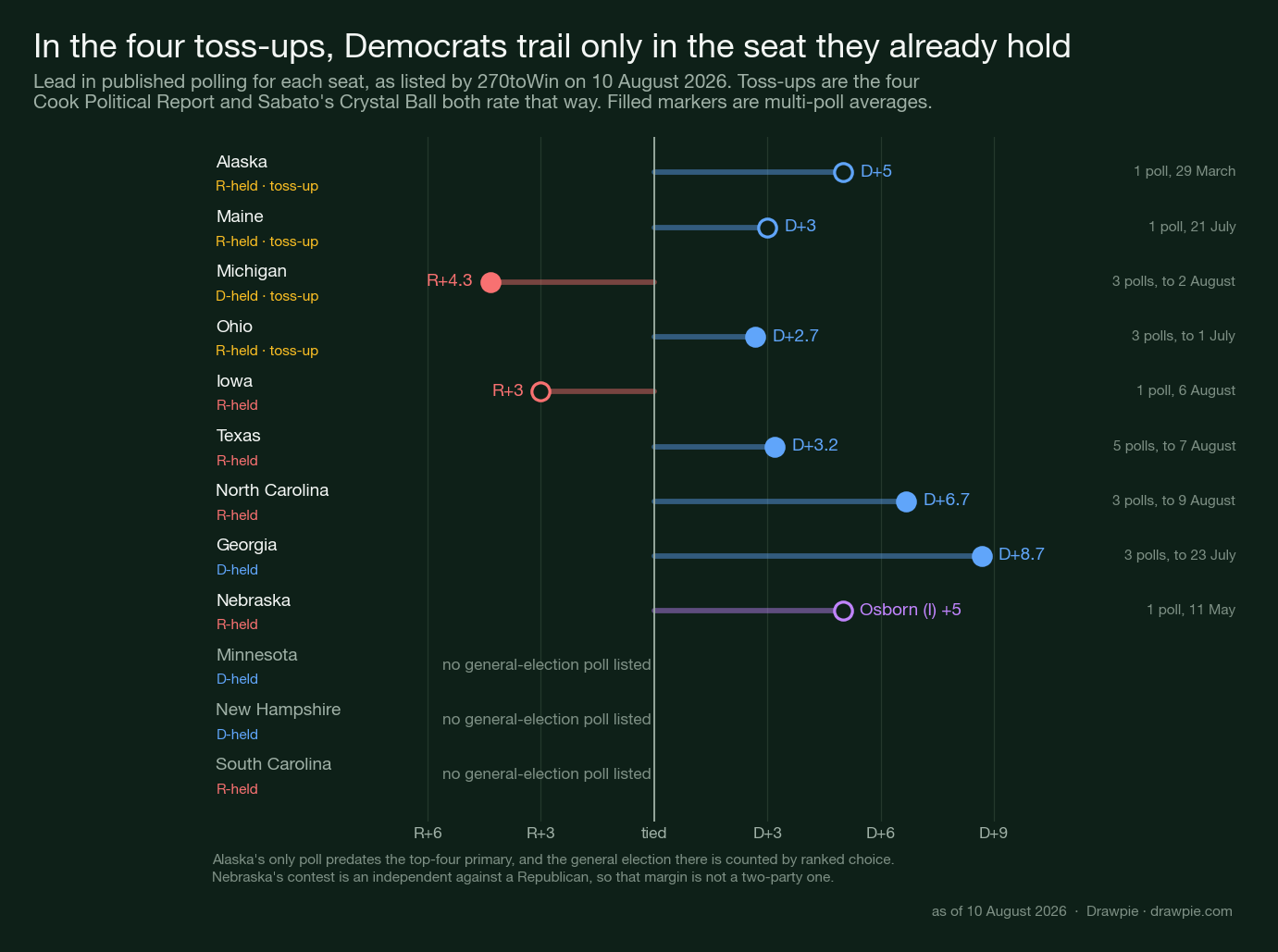
Democrats lead in three of the four toss-ups and trail in the fourth — and the fourth is Michigan, a seat they currently hold.
These are the leads listed by 270toWin on 10 August 2026, on one consistent method: an average of polls within seven days of the most recent one, widened to 30 days or five polls where fewer than five qualify.
| Seat | Lead | Based on |
|---|---|---|
| Georgia | D+8.7 | 3 polls, to 23 Jul |
| N. Carolina | D+6.7 | 3 polls, to 9 Aug |
| Texas | D+3.2 | 5 polls, to 7 Aug |
| Ohio | D+2.7 | 3 polls, to 1 Jul |
| Maine | D+3 | 1 poll, 21 Jul |
| Alaska | D+5 | 1 poll, 29 Mar |
| Nebraska | Osborn +5 | 1 poll, 11 May |
| Iowa | R+3 | 1 poll, 6 Aug |
| Michigan | R+4.3 | 3 polls, to 2 Aug |
| Minnesota | — | none listed |
| N. Hampshire | — | none listed |
| S. Carolina | — | none listed |
Three things in that table are worth more than the numbers themselves.
The Michigan row is the problem the seat arithmetic already implied. It is an open seat — Gary Peters is retiring — and the Democratic primary on 4 August produced Abdul El-Sayed over Haley Stevens, against Republican Mike Rogers, who was unopposed. It is the only toss-up Democrats are defending, and the only one where they are behind.
The Ohio row is the stalest of the multi-poll averages: its most recent component is from 1 July, in a race between former senator Sherrod Brown and Jon Husted, the appointee holding Vance’s old Ohio seat. It is a special election for the final two years of that term.
The Alaska and Nebraska rows are not comparable to the others at all, and the chart marks them as such. Alaska’s only listed poll predates its 18 August top-four primary, and its general election is settled by ranked choice rather than by whoever gets the most votes. Nebraska is an independent, Dan Osborn, against Republican Pete Ricketts — so that margin is not a two-party margin, and Osborn has said he would not caucus with either party if he won, which would leave the arithmetic above with a hole in it.
Why is North Carolina the Democrats’ best chance?
Because it is the only Republican-held seat any forecaster puts on the Democratic side of the line, and all three do.
Thom Tillis announced in June 2025 that he would not run again, leaving the seat open. The contest is former governor Roy Cooper against Michael Whatley, the former Republican National Committee chair. Cooper has near-universal name recognition in the state; a Fox News poll conducted 23–27 July found 51% held a favourable view of him, against a 17% favourable rating for Whatley and 36% who said they were not familiar with him.
Money has run the same way. Cooper raised $8.1 million in the second quarter and entered July with close to $21 million in hand, against $2.9 million raised and $3.5 million banked for Whatley.
North Carolina is not, on its own, enough. It gets Democrats to 48 with three still to find, which is why the four toss-ups do all the work.
What could still change the map before November?
Ten of the 35 seats have not chosen nominees yet, and three of them are among the twelve Cook rates short of Solid.
| Date | Seat | Contest |
|---|---|---|
| 11 Aug | Minnesota | Both primaries |
| 11 Aug | S. Carolina | Special GOP primary |
| 18 Aug | Alaska | Top-four primary |
| 18 Aug | Florida | Both primaries |
| 18 Aug | Wyoming | Both primaries |
| 25 Aug | Oklahoma | Runoff |
| 1 Sep | Massachusetts | Both primaries |
| 8 Sep | N. Hampshire | Both primaries |
| 9 Sep | Rhode Island | Both primaries |
| 15 Sep | Delaware | Both primaries |
South Carolina is the newest hole in the map. Lindsey Graham died on 11 July 2026, after he had already won the June primary. Governor Henry McMaster appointed his sister, Darline Graham, on 13 July; she was sworn in on 14 July, the first woman to represent the state in the Senate, and is running for the full term with Donald Trump’s endorsement. Republicans hold a special primary on 11 August to choose a nominee, with a runoff on 25 August if nobody clears 50%. Ralph Norman, Russell Fry and Mark Sanford are among those running against her. Inside Elections has already moved the seat off Solid Republican; Cook and Sabato have not.
Alaska has two Dan Sullivans on the ballot. A retired teacher from Petersburg named Dan J. Sullivan filed against the incumbent, Dan S. Sullivan. The state Division of Elections tried to remove him; the Alaska Supreme Court ruled on 29 June that he could stay. State and federal prosecutors are investigating whether the campaign was created to confuse voters, which the challenger denies. In a toss-up seat decided by ranked choice against Mary Peltola, that is not a footnote.
Texas has already produced the cycle’s biggest upset. Ken Paxton took 63.8% against John Cornyn in the 26 May runoff — the first primary defeat of a sitting Texas senator since 1970 — and faces Democrat James Talarico. Louisiana produced the other one: Bill Cassidy finished third in the 16 May primary, and Julia Letlow won the 27 June runoff. All three still rate Louisiana safely Republican. Texas is the seat that moved: Inside Elections shifted it from Likely Republican to Lean Republican.
Maine changed nominees after the primary. Graham Platner won the Democratic primary in June, then withdrew in July following a sexual assault allegation he denies. More than 600 Democratic delegates met in Bangor and chose Troy Jackson, a former state senate president, to face Susan Collins. The one poll of that matchup was taken before he was chosen, as a hypothetical, which is worth knowing before reading too much into the three points in the table above.
Set against all that, nine senators are retiring outright and four seats are open for other reasons.
| Seat | Why it is open |
|---|---|
| Illinois | Durbin retiring |
| Michigan | Peters retiring |
| Minnesota | Smith retiring |
| N. Hampshire | Shaheen retiring |
| Kentucky | McConnell retiring |
| Iowa | Ernst retiring |
| N. Carolina | Tillis retiring |
| Montana | Daines retiring |
| Wyoming | Lummis retiring |
| Alabama | Tuberville, running for governor |
| Texas | Cornyn lost the primary |
| Louisiana | Cassidy lost the primary |
| Oklahoma | Mullin resigned; appointee cannot run |
Thirteen of the 35 seats have no incumbent on the ballot. Four of those are Democratic and nine are Republican.
What none of this tells you
How any single seat will actually vote, and how likely any of it is.
Ratings are not probabilities. “Toss Up” does not mean 50-50 in any measured sense; it means the people writing the rating are not willing to name a favourite. Adding four toss-ups together and calling the result a coin flip is doing arithmetic the ratings do not support.
August polling in a midterm is early, and the gap between it and the ratings is real. Democrats lead the published averages in Texas and Ohio, and both remain rated against them — which tells you the raters are weighting things polls do not measure, such as how a state has actually voted.
The national environment favours Democrats but the size of the advantage depends on which poll you read: Morning Consult’s weekly tracking had it 46-42, a lead that moved between three and four points from spring onwards, while an Emerson survey of likely voters put it at 53-42. Those are different elections.
And two of the twelve seats Cook rates short of Solid have no general-election polling at all, because neither has a nominee. Minnesota and New Hampshire are both open Democratic seats, rated Likely and Lean Democratic respectively, and they pick candidates on 11 August and 8 September. Whatever the ratings say about them today is a judgement about the states, not about the races.
The broader backdrop — a labour market where hiring has stalled while layoffs stay low, and a split economy where the aggregate numbers hide the divergence — is the thing every one of these campaigns is arguing about, and it is the part no rating captures.
Sources
Checked on 10 August 2026. Ratings and polling averages move; the seat arithmetic does not.
| Source | What it supports here |
|---|---|
| Cook Political Report ratings | The 5 August rating of all 35 seats, the tier counts behind the running total, and the 34 and 31 seats not up this year |
| 270toWin — Crystal Ball ratings | Sabato’s Crystal Ball ratings as of 5 August, and the 53-47 split with a net gain of four |
| Inside Elections ratings | The 6 August ratings, the extra Tilt step, Texas moving from Likely to Lean Republican, and which 13 seats are open |
| 270toWin — 2026 Senate polls | Every poll and every average in the polling table, taken from the per-state pages |
| 270toWin — 2026 primary calendar | The remaining primary and runoff dates, and the 3 November election date |
| SC Election Commission | The 11 August special Republican primary in South Carolina and the 25 August runoff |
| NPR — Darline Graham | Lindsey Graham’s death on 11 July, the appointment on 13 July and the swearing-in |
| NPR — Maine nominee | Graham Platner’s withdrawal and the delegate vote that chose Troy Jackson |
| Texas Tribune — Texas runoff | Ken Paxton’s 63.8% against John Cornyn on 26 May |
| CNN — Alaska ruling | The Alaska Supreme Court ruling of 29 June on the second Dan Sullivan |
| NBC News — Michigan results | The 4 August primary result that made Abdul El-Sayed the nominee |
Three notes on the list. Cook Political Report and Inside Elections both reject command-line requests, so those two pages were read in a browser rather than checked with a fetch. Sabato’s Crystal Ball is linked through 270toWin because its own site would not load from here at all, and we do not link pages we have not opened. Every other URL above was requested alongside a deliberately wrong path on the same domain, so that a page which answers everything with “200” could not pass as verified.
How we verified this
Ratings were read on each forecaster’s own page, not from aggregators. The Cook Political Report ratings are the set dated 5 August 2026; Sabato’s Crystal Ball ratings are the set carried as “as of August 5, 2026”; the Inside Elections ratings come from that site’s own ratings file, stamped 6 August 2026. Each set was checked to contain exactly 35 seats before anything was counted.
The three boards do not use the same ladder. Inside Elections has a “Tilt” step between Toss-up and Lean that the other two do not. Placing all three on one scale is our alignment, not theirs, and both the chart and the table say so. Where the article counts agreement, it counts which side is ahead — not whether the labels match, which they do in only two of the 35 seats.
The seat arithmetic is ours and can be rechecked. 34 Democratic-held and 31 Republican-held seats are not up this year; 13 Democratic and 22 Republican seats are. Every total in the article was computed from those lists with assertions that they sum to 100 and to 35, so a wrong list would have stopped the piece rather than quietly changing a number.
Polling is quoted from one source with one method. All poll figures and averages come from 270toWin’s per-state 2026 Senate polling pages, read on 10 August 2026. That site averages polls within seven days of the most recent one, one per pollster, widening the window to 30 days or five polls if fewer than five qualify. We recomputed all five published averages from the underlying rows and they match to one decimal place. States with no qualifying average are shown as single polls, and states with no general-election poll at all are shown as having none rather than being left out.
Two polling numbers are not comparable to the rest. Alaska’s only listed poll is from 29 March, before the top-four primary, and the general election there is decided by ranked choice rather than by a plurality. Nebraska’s contest is an independent against a Republican, so its margin is not a two-party margin.
This article does not predict a result. It reports what published ratings and published polls say as of 10 August 2026, and what the seat count would be if every seat went to the party it is currently rated for. That is an arithmetic exercise, labelled as one on the chart, and not a forecast of the election.