2026 MLB Playoff Picture: Wild Card Standings, Playoff Predictions
Standings move every night. Everything here is read from MLB’s own Stats API through 25 August, and the six-team AL cluster in particular can reorder in a weekend. The format, the seeding rules and the season dates are the durable parts; the numbers are a snapshot.
Everything else on the page is unaffected; the figures below still say when they were read.

- Through 25 August, not one of the 30 clubs has clinched a playoff place and not one has been eliminated. The league’s own standings carry no clinch or elimination markers yet.
- The American League wild card race is the tight one: Cleveland hold the third and last spot at 66-66, with Houston half a game back and five more clubs inside 4.5 games.
- The National League is not close in the same way. San Diego hold the third spot at 71-61 and the nearest chaser, Arizona, is two games back — but after Miami at four out the field thins fast.
- Three clubs are 66-66. Texas lead a division, Cleveland hold a wild card, and St. Louis are five games out of one. Same record, three different futures.
- On the current table the Chicago White Sox at 68-63 would take a first-round bye while the Yankees at 74-56 would play a Wild Card Series — because seeds one to three are reserved for division winners.
- There are 29 to 32 games left depending on the club. The regular season ends on 27 September and the postseason starts the next day.
With five weeks of the season left, not one of the 30 clubs has clinched a playoff place and not one has been eliminated. That is unusual this late, and it is the league’s own assessment rather than ours — MLB publishes a clinch flag for every club, and on 25 August every one of them reads false.
Underneath that, the two leagues are having completely different Augusts. The American League has six clubs stacked inside 4.5 games of its last wild card. The National League has a top four that have mostly settled and a field that thins quickly behind them.
What is the 2026 MLB playoff picture right now?
Six division leaders, six wild cards, and a very uneven spread of comfort. These are the division leaders through 25 August:
| Division | Leader | W-L |
|---|---|---|
| AL East | Tampa Bay Rays | 78-53 |
| AL Central | Chicago White Sox | 68-63 |
| AL West | Texas Rangers | 66-66 |
| NL East | Atlanta Braves | 76-55 |
| NL Central | Milwaukee Brewers | 81-50 |
| NL West | Los Angeles Dodgers | 80-51 |
Read the two leagues against each other and the gap is stark. Milwaukee and the Dodgers are both 30 games over .500. The Texas Rangers lead the AL West at exactly .500 — as many losses as wins, in late August, in first place.
Who holds the wild card spots?
Three per league, and one race is far tighter than the other.
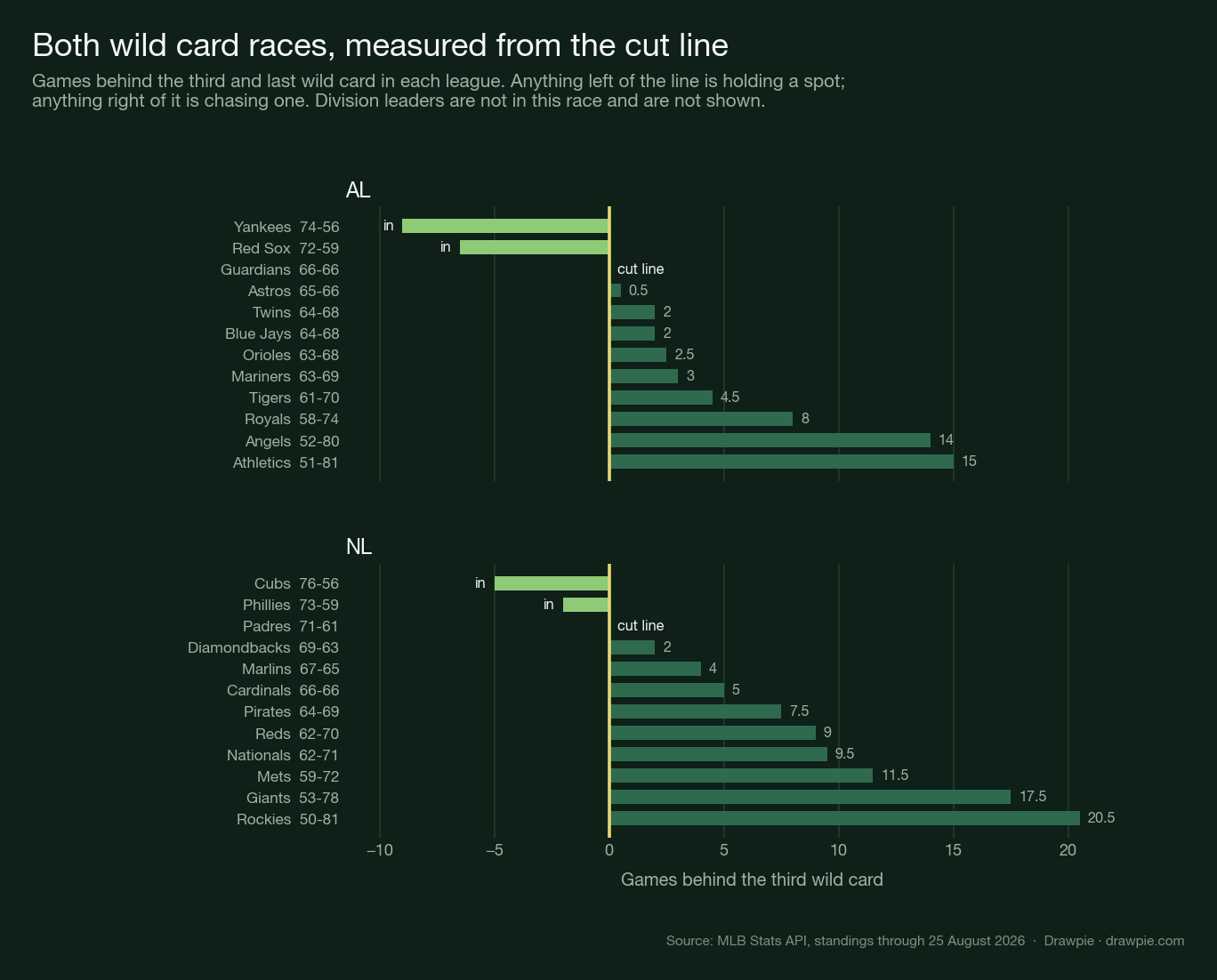
In the American League the Yankees (74-56) and Red Sox (72-59) are comfortable. The third spot belongs to Cleveland at 66-66, and behind them it is a queue: Houston half a game back, Minnesota and Toronto two, Baltimore two and a half, Seattle three, Detroit four and a half. Six clubs, one place.
The National League looks similar at the top — the Cubs (76-56) and Phillies (73-59) are clear, San Diego (71-61) hold the third — but the chase is thinner. Arizona are two games back, Miami four, St. Louis five, and then it falls away.
Why are three teams at 66-66 in completely different positions?
Because in this format your record decides far less than your address.
Three clubs are 66-66 right now. Texas lead the AL West. Cleveland hold the American League’s last wild card. St. Louis are five games out of the National League’s last one. Identical records, and one would host a playoff series tonight while another would be watching.
That is not a quirk of the standings; it is what the format does. Three of the six places in each league are reserved for division winners regardless of record, so a .500 club in a weak division is in and a .500 club in a strong one is not.
What would the bracket be if the season ended today?
This, and only in the sense that the table says so — it is a description of tonight’s standings, not a prediction of October.
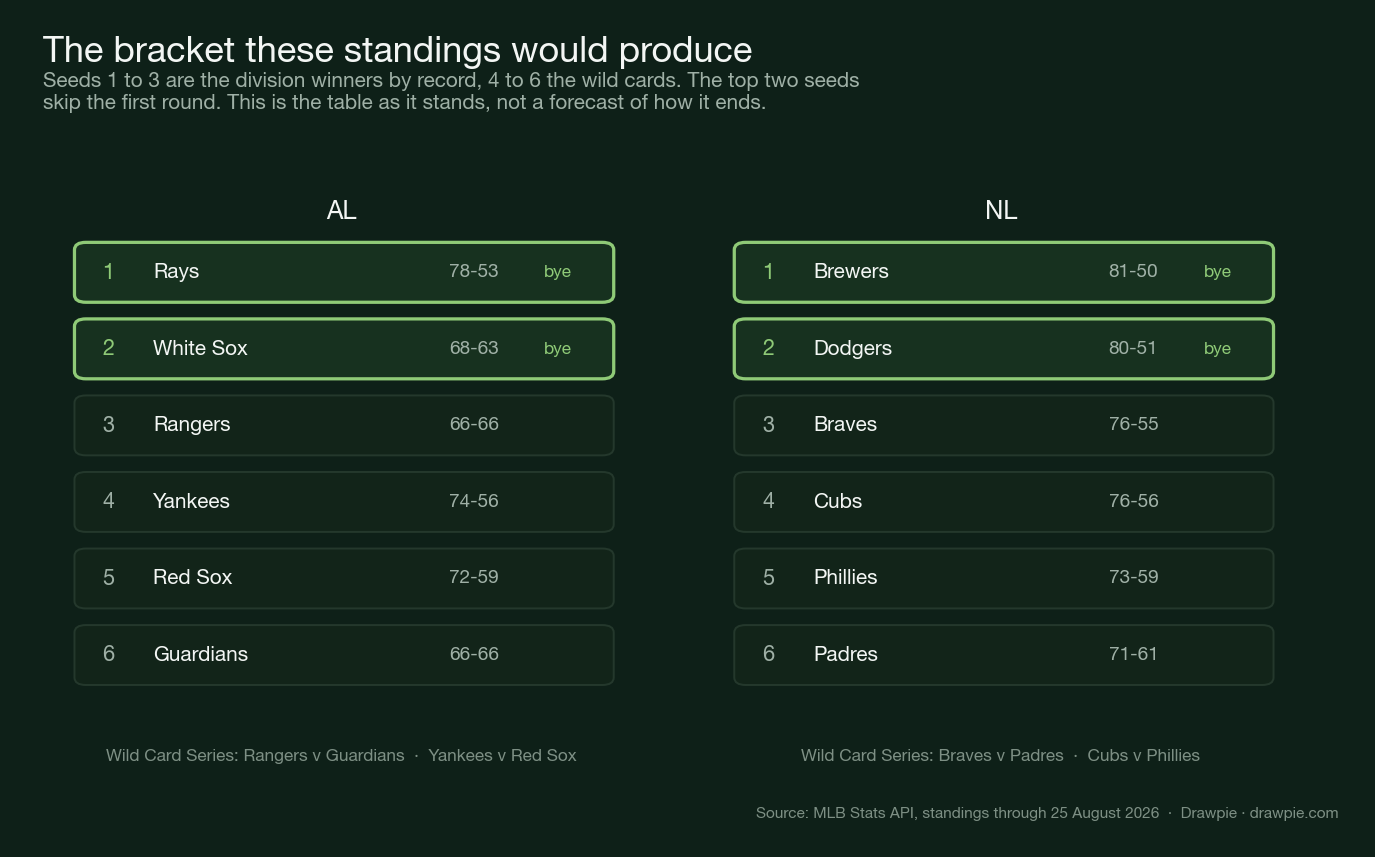
The Wild Card Series pair the third seed against the sixth and the fourth against the fifth. On this table that gives an all-.500 American League tie — Texas at 66-66 hosting Cleveland at 66-66 — alongside Yankees against Red Sox.
Why does a 68-63 team get a bye over a 74-56 team?
Because seeds one to three go to the division winners, ordered among themselves, and only then do the wild cards take four to six.
The Chicago White Sox lead the AL Central at 68-63. The Yankees are 74-56 — six games better — but they are second in the AL East, so they are a wild card. The White Sox therefore take the second seed and a first-round bye; the Yankees take the fourth seed and a best-of-three series.
It is worth being clear that this is the rule working as designed rather than a glitch. Winning your division is the reward, and the bye is the reward for winning it well. But the current table produces an unusually blunt example of it, and if the standings hold, a 68-win club will be resting while a 74-win club plays.
Has anyone clinched or been eliminated?
No, on both counts, and the numbers show how far there is to go.
MLB publishes an elimination number for each club — the combination of its own losses and the leader’s wins that would end it. The lowest in either wild card race belongs to Colorado at 11, with San Francisco at 14. Even the two worst clubs in the National League are not out yet.
At the other end, Milwaukee have the shortest magic number in baseball at 26, with the Dodgers on 22 for the NL West. Neither is close to a formality with 30-odd games left.
How much baseball is left?
Between 29 and 32 games, depending on the club, because they have played different numbers.
The regular season ends on Sunday 27 September and the postseason begins the next day, Monday 28 September. So there are about five weeks in which six American League clubs have to sort out one wild card place between them.
What should you actually watch?
The American League wild card queue, and specifically the games those six clubs play against each other.
Houston at 65-66 are half a game from a playoff place while sitting below .500 — which tells you most of what you need to know about that race. Minnesota and Toronto are level at 64-68. In a group that tight, head-to-head results move the table twice as fast as anything else, and the elimination numbers say every one of them still controls its own case.
There is one club in that queue worth separating out, because the runs say something the record does not. Detroit are 61-70 and have outscored their opponents by 70 runs. Every other club in the cluster has been outscored: Cleveland by 7, Baltimore by 35, Houston by 44, Minnesota by 51, Seattle by 54, Toronto by 55. On run differential Detroit are the best team in the group by a distance of 77 runs, and they are the furthest out of the six.
Some of that is timing rather than mystery — a team that wins blowouts and loses one-run games will look exactly like this — and Detroit are currently on a six-game losing streak while Cleveland run a five-game winning one. But it does mean the club with the strongest underlying numbers in the American League’s middle is the one the table has pushed furthest away.
One more thing worth checking before you read any gap as settled: clubs have not played the same number of games. The Yankees have played 130, Washington and Pittsburgh 133. In a race decided by half-games, three unplayed games is not a rounding error.
In the National League the question is narrower: whether Arizona, two games back, can catch San Diego. And whether the Dodgers, 80-51 and still 22 away from clinching, can run down Milwaukee for the bye that would let them skip a round.
The same runs-versus-record test is worth applying there too, and it flags a different club. Miami are 67-65 and four games out of the last wild card, but they have outscored opponents by 19 — a better figure than San Diego’s +15 from four games higher up. Arizona, the club everyone is watching, are at +2. And the Cubs at +122 are not really in this conversation: on runs they belong with the division leaders rather than the wild cards.
How we verified this
scripts/build_mlb_playoff_picture.py rebuilds it from the standings and asserts each league produces exactly three division winners and three wild cards.
⚠️ A projected bracket is a description of the present, not a forecast. It is what the table would produce if the season stopped tonight. With five weeks left, it will not survive intact.
⚠️ MLB’s wild card standings exclude division leaders — they carry 24 clubs, not 30 — which is why Texas appear in the division table below and not in the wild card one. The script asserts that the six absent clubs are exactly the six division leaders.
⚠️ Games remaining is derived as 162 minus games played, and clubs have played different numbers of games, which is exactly why the figure is worth printing.